
- Spyne Overview: Spyne Watermark Remover is an AI-powered online tool for efficient watermark removal from images.
- Core Features: It offers AI detection, batch processing, and an intuitive interface for quick edits.
- Ideal Use: Best for removing simple, consistent logos from product photos, saving significant time.
- Limitations: Struggles with intricate watermarks on sensitive documents, potentially causing quality degradation.
- Comparison: Spyne excels in ease of use and AI accuracy for simple tasks; UniConverter offers broader functionality and speed.
- Risks: Cloud-based processing raises data privacy concerns; quality degradation and hidden costs are potential pitfalls.
- Legal Note: Removing watermarks from copyrighted material without permission carries significant legal and ethical risks.
- UniConverter Alternative: UniConverter provides a robust, versatile, and ad-free solution for efficient, high-quality watermark removal.
In this article
- Part 1: What is Spyne Watermark Remover?
- Part 2: Spyne Watermark Remover: Core Features, Pros, and Cons
- Part 3: Spyne Watermark Remover: Ideal Users and Use Cases
- Part 4: Spyne Watermark Remover and Alternatives Comparison
- Part 5: Risks and Pitfalls to Consider
- Part 6: How to Use UniConverter for Efficient Watermark Removal
- Part 7: Conclusion
- Part 8: FAQs
Spyne Watermark Remover Review: A Comprehensive Review and Comparison
In today's digital age, visual content is paramount, and the need to present clean, professional images is more critical than ever. Watermarks, while serving their purpose of protecting intellectual property, often detract from the aesthetic appeal and usability of an image. This Spyne Watermark Remover review delves into a popular solution designed to tackle this common challenge. We will explore its features, evaluate its performance against competitors, and provide a detailed analysis to help users make informed decisions about their watermark removal needs. This review aims to provide a clear understanding of Spyne Watermark Remover's capabilities and limitations within the broader landscape of image editing tools.
Part 1: What is Spyne Watermark Remover?
Spyne Watermark Remover is an AI-powered online tool designed to efficiently remove unwanted watermarks from images. Developed to streamline the post-processing workflow for photographers and businesses, it aims to provide a quick and effective solution for cleaning up visual content. The tool leverages advanced artificial intelligence algorithms to detect and erase watermarks, seeking to preserve the original image quality as much as possible. This review will address the core question of whether Spyne Watermark Remover truly delivers on its promise of accurate and seamless watermark removal, especially when compared to other solutions available in the market.
The Growing Need for Efficient Watermark Removal
* Professional Presentation: Businesses and individuals require clean images for marketing, e-commerce, and portfolios.
* Time-Saving Solutions: Manual watermark removal is often time-consuming and requires specialized skills.
* Content Repurposing: The ability to easily remove watermarks facilitates the repurposing of visual assets across different platforms.
* Enhanced User Experience: Unobstructed images provide a better viewing experience for audiences.
Part 2: Spyne Watermark Remover: Core Features, Pros, and Cons
Spyne Watermark Remover positions itself as a user-friendly and efficient solution for image clean-up. Its core capabilities revolve around leveraging AI for automated watermark detection and removal. The tool aims to simplify a task that traditionally required complex photo editing software and significant manual effort.
Core Features:
1. AI-Powered Detection: Utilizes machine learning to automatically identify and isolate watermarks.
2. Batch Processing: Allows users to remove watermarks from multiple images simultaneously.
3. Intuitive Interface: Designed for ease of use, even for those without extensive photo editing experience.
4. Quality Preservation: Aims to remove watermarks without significantly degrading the underlying image quality.
5. Cloud-Based Operation: Accessible from any device with an internet connection, requiring no software installation.
Pros:
* Intuitive User Interface for Quick Edits
* Batch Processing Capability for Multiple Files
* AI-Powered Detection for Accurate Watermark Removal
Cons:
* Limited Customization Options for Complex Watermarks
* Subscription-Based Model Can Be Costly for Infrequent Users
Part 3: Spyne Watermark Remover: Ideal Users and Use Cases
Spyne Watermark Remover is particularly well-suited for users who frequently deal with a high volume of images requiring simple watermark removal. Its AI-driven automation and batch processing capabilities make it a strong contender for specific use cases where efficiency and consistency are key. However, its limitations become apparent when faced with more intricate or sensitive visual content.
Best Use Case: Removing Simple Logos from Product Photography
Imagine an e-commerce business that regularly photographs hundreds of products. Each image might have a small, consistent logo or text watermark applied for branding or copyright protection. Manually removing these from each photo would be incredibly time-consuming. Spyne Watermark Remover excels here, quickly identifying and removing these uniform watermarks across an entire batch of images, significantly speeding up the workflow and ensuring a clean, professional look for product listings.
Limitation Scenario: Dealing with Intricate Watermarks on Sensitive Documents
Consider a scenario where a legal professional needs to remove a highly intricate, semi-transparent watermark that spans across critical text on a confidential document. The watermark might have varying opacity, complex patterns, or be deeply embedded within the document's texture. In such cases, Spyne Watermark Remover's automated AI might struggle to differentiate between the watermark and the underlying content, potentially leading to blurred text, artifacts, or incomplete removal. The lack of fine-grained control and customization options would make it unsuitable for preserving the integrity and readability of such sensitive documents.
Part 4: Spyne Watermark Remover and Alternatives Comparison
When evaluating watermark removal tools, it's crucial to look beyond a single product and consider how it stacks up against its competitors. This comparison highlights Spyne Watermark Remover's position in the market alongside other notable solutions, focusing on key performance indicators.
| Feature/Product | Spyne Watermark Remover | UniConverter | PhotoDirector | Inpaint |
| Ease of Use | High | High | Medium | Medium |
| AI Accuracy | High | High | Medium | Medium |
| Batch Processing | Yes | Yes | Some | No |
| Pricing Model | Subscription | One-time purchase/Subscription | Subscription | One-time purchase |
| Output Quality | Excellent | Excellent | Good | Good |
| Processing Speed | Fast | Very Fast (GPU) | Fast | Medium |
| Customer Support | Email/Live Chat | Email/Forum | ||
| Security | Cloud-based | Local/Cloud | Local/Cloud | Local |
Key Differentiators: Spyne's AI-driven precision and user-friendliness stand out for straightforward tasks. UniConverter offers a more versatile, comprehensive media toolkit with robust watermark removal, often leveraging GPU acceleration for speed. PhotoDirector provides a broader suite of photo editing features, while Inpaint is a dedicated, effective tool for object removal, including watermarks, but lacks batch processing. For users prioritizing quick, simple, and high-volume watermark removal, Spyne is a strong choice. However, for those needing a more all-encompassing media solution with superior speed and broader functionality, UniConverter presents a compelling alternative.
Part 5: Risks and Pitfalls to Consider
While watermark removal tools offer convenience, their use, especially with cloud-based services or less reputable software, comes with inherent risks. Users must be aware of these potential pitfalls to protect their data, maintain image quality, and adhere to ethical and legal standards.
Data Privacy Concerns with Cloud-Based Processing
When uploading images to cloud-based watermark removers like Spyne, users are entrusting their visual data to a third-party server. This raises concerns about data security, potential unauthorized access, and how long the images are stored. Sensitive or confidential images should be handled with extreme caution, as the privacy policies of these services may not always align with individual or corporate security requirements.
Potential for Quality Degradation on Heavily Watermarked Images
Automated watermark removal, particularly on images with complex, large, or heavily embedded watermarks, can lead to noticeable quality degradation. This might manifest as blurring, pixelation, color shifts, or the introduction of artifacts in the areas where the watermark was removed. While Spyne's AI aims to minimize this, aggressive removal settings or challenging watermarks can still result in an output that is less sharp or natural than the original.
Hidden Costs or Upsells in Subscription Tiers
Many online tools, including subscription-based models like Spyne, might offer seemingly attractive entry-level pricing but then introduce hidden costs or upsells for advanced features, higher processing limits, or faster speeds. Users might find themselves needing to upgrade to a more expensive tier to access functionalities they initially assumed were included, leading to unexpected expenses.
Ethical Implications of Removing Copyrighted Watermarks
Removing watermarks from images, especially those not owned by the user, carries significant ethical and legal implications. Watermarks are often used to assert copyright and ownership. Removing them without permission can constitute copyright infringement, leading to legal repercussions. Users must always ensure they have the necessary rights or permissions to modify any watermarked content.
Inconsistent Performance Across Different File Formats
While most tools claim broad compatibility, the effectiveness of watermark removal can vary significantly across different image file formats (e.g., JPEG, PNG, TIFF). Some formats might retain more information, allowing for better removal, while others might be more prone to artifacts. Users might experience inconsistent results depending on the original file type, requiring additional manual adjustments or alternative tools.
Part 6: How to Use UniConverter for Efficient Watermark Removal
When other tools fall short, struggling with batch processing, inconsistent results, or leaving behind noticeable artifacts, UniConverter emerges as a robust and versatile solution. It's designed to handle a wide array of media editing tasks, including efficient and high-quality watermark removal, making it an ideal choice for users seeking a comprehensive and reliable tool. UniConverter stands out with its ad-free experience, extensive format support, GPU acceleration for speed, stable and lossless processing, and powerful batch watermark removal capabilities. It truly is an all-in-one ultimate solution for your media needs.
Step 1: Open UniConverter and Choose Watermark Remover
Launch UniConverter and navigate to the 'Toolbox' section. Select the 'Watermark Remover' option to begin.

Step 2: Upload the Videos
Click 'Add Files' or drag and drop your watermarked image(s) into the UniConverter interface.

Step 3: Choose Selected Area
Use the selection tool to precisely highlight the watermark area you wish to remove. UniConverter's intelligent algorithms will then process the selected region.
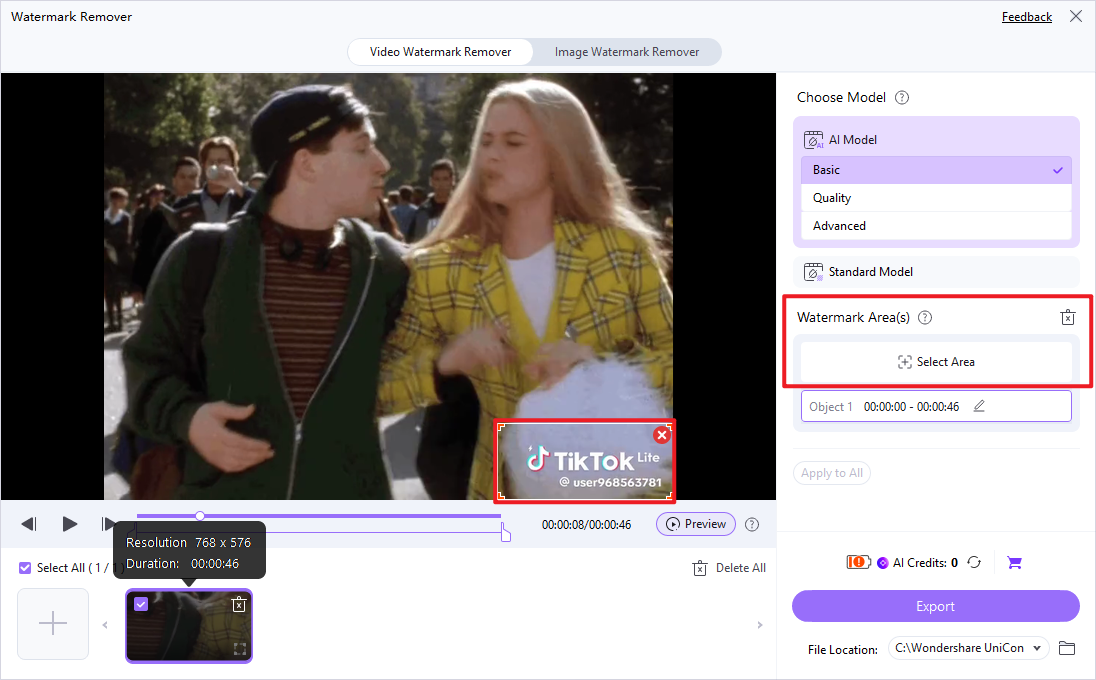
Step 4: Preview and Save the Video
Preview the result to ensure the watermark has been removed cleanly. Once satisfied, click 'Start' to save your cleaned image to your desired output folder.
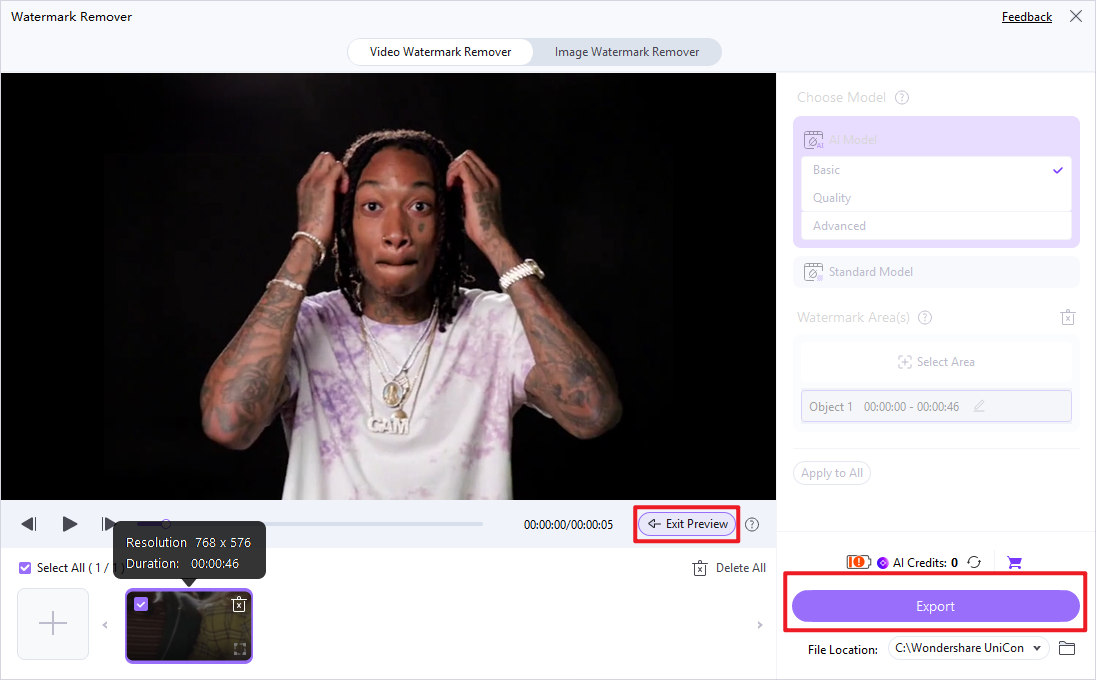

Efficiently Remove Watermarks from Your Videos
Part 7: Conclusion
This Spyne Watermark Remover review has highlighted its strengths as an accessible and efficient tool for basic watermark removal, particularly for batch processing simple logos on product photography. Its AI-driven approach and user-friendly interface make it a convenient option for those seeking quick solutions. However, for complex watermarks, intricate images, or situations demanding precise control and minimal quality degradation, its limitations become apparent. Users dealing with sensitive documents or requiring advanced editing capabilities might find Spyne's subscription model costly for infrequent use and its customization options insufficient. For such scenarios, more comprehensive tools like UniConverter offer greater versatility, robust features, and often better control over the removal process, alongside broader media editing functionalities. Ultimately, the choice depends on the specific use case, the complexity of the watermarks, and the user's budget and frequency of use. Always prioritize ethical considerations and copyright laws when removing watermarks from any content.
Part 8: FAQs
-
1. Is Spyne Watermark Remover completely free to use?
Spyne Watermark Remover typically operates on a subscription model, offering limited free trials or basic features.
-
2. Can Spyne Watermark Remover remove watermarks from videos?
Spyne Watermark Remover primarily focuses on image watermarks. For video, dedicated video editing software is usually required.
-
3. How accurate is Spyne's AI in detecting watermarks?
Spyne's AI is generally highly accurate for common and well-defined watermarks, but complex or embedded watermarks may require manual adjustments.
-
4. Does Spyne Watermark Remover compromise image quality after removal?
While Spyne aims to preserve quality, some minor degradation can occur, especially with intricate watermarks or aggressive removal settings.
-
5. Are there any legal implications of using watermark removers?
Removing watermarks from copyrighted material without permission can have legal consequences. Always ensure you have the right to modify the content.
