
- AI Enhancement: Filmora Video Enhancer uses AI for upscaling, noise reduction, and color correction, making complex improvements accessible.
- Target Audience: Ideal for content creators and prosumers needing user-friendly video quality improvement without deep technical expertise.
- Feature Comparison: Filmora balances AI enhancement with accessibility; UniConverter offers similar ease and robust conversion.
- Professional Alternatives: Topaz Video AI excels in specialized AI upscaling; DaVinci Resolve offers comprehensive professional editing.
- Considerations: Be aware of potential over-processing, hardware demands, and subscription costs when using enhancement tools.
- UniConverter's Value: UniConverter provides stable, efficient, and batch-friendly video enhancement, often surpassing Filmora's capabilities.
In this article
- Part 1: What is Wondershare Filmora Video Enhancer?
- Part 2: Wondershare Filmora Video Enhancer: Core Features, Pros, and Cons
- Part 3: Target Audience and Use Cases for Filmora Video Enhancer
- Part 4: Wondershare Filmora Video Enhancer and Alternatives Comparison
- Part 5: Risks and Pitfalls to Consider
- Part 6: How to Use UniConverter to Efficiently Enhance Videos
- Part 7: Conclusion
- Part 8: FAQs
Wondershare Filmora Video Enhancer: Elevating Your Visual Storytelling
In an era dominated by visual content, the demand for high-quality video is paramount. From aspiring YouTubers to seasoned filmmakers, everyone seeks tools that can transform ordinary footage into captivating narratives. This Wondershare Filmora Video Enhancer review delves into a powerful solution designed to meet this need. We will explore its AI-driven capabilities, assess its performance against key competitors, and provide a comprehensive guide to its optimal use, helping you make an informed decision in your video editing journey.
Part 1: What is Wondershare Filmora Video Enhancer?
Wondershare Filmora Video Enhancer is an AI-powered software designed to improve the quality of video footage. It leverages advanced algorithms to upscale resolution, reduce noise, and correct colors, breathing new life into old or low-quality videos. Positioned as an accessible yet robust tool, it aims to democratize professional-grade video enhancement, making it available to a broader audience beyond expert editors. This review will address the core question: Can Filmora Video Enhancer truly deliver on its promise of significantly improving video quality, and how does it stack up against specialized enhancement tools and comprehensive editing suites?
The Evolving Landscape of Video Editing Tools
* Increasing demand for high-quality content: Social media and streaming platforms have raised audience expectations for visual fidelity.
* Proliferation of user-generated content: More people are creating videos, often with varying equipment and recording conditions.
* Advancements in AI technology: AI is increasingly being integrated into editing software to automate complex tasks like enhancement.
* Need for user-friendly solutions: Many creators seek powerful tools that don't require extensive technical expertise.
Part 2: Wondershare Filmora Video Enhancer: Core Features, Pros, and Cons
Wondershare Filmora Video Enhancer stands out with its AI-driven capabilities, making complex video improvements accessible. Its core strength lies in its ability to intelligently analyze and refine video footage, addressing common issues like blurriness, grain, and poor color balance. Beyond simple upscaling, it integrates seamlessly with Filmora's broader editing ecosystem, offering a holistic solution for video creators. This section details its key features and evaluates its strengths and weaknesses based on practical application.
* AI-Powered Upscaling: Intelligently increases video resolution without significant loss of detail.
* Noise Reduction: Effectively removes visual noise and grain from footage.
* Color Correction & Grading: Enhances color vibrancy, contrast, and overall visual appeal.
* Stabilization: Reduces camera shake for smoother playback.
* Integrated with Filmora Editor: Allows for seamless workflow between enhancement and further editing.
Pros:
* AI-Powered Upscaling for Stunning Clarity in Low-Resolution Footage
* Intuitive Interface for Beginners and Intermediate Editors
* Comprehensive Suite of Editing Tools Beyond Enhancement (e.g., color correction, audio editing)
Cons:
* Resource-Intensive for High-Resolution Processing
* Subscription Model Can Be Costly for Occasional Users
Part 3: Target Audience and Use Cases for Filmora Video Enhancer
Wondershare Filmora Video Enhancer is primarily designed for content creators, casual videographers, and prosumers who want to elevate their video quality without delving into highly technical software. Its user-friendly interface and AI-driven features make it ideal for those who prioritize ease of use and efficient workflows. It caters to individuals looking to improve existing footage, whether for personal projects, social media, or small business marketing.
* Best Use Case: Revitalizing Old Family Videos for Modern Displays
* Scenario: A user wants to digitize and enhance decades-old VHS recordings to watch on a 4K TV, improving clarity and color without extensive manual editing. Filmora's AI upscaling and noise reduction can dramatically improve the visual quality, making cherished memories enjoyable on contemporary screens.
* Limiting Use Case: Professional-Grade Forensic Video Analysis
* Scenario: A law enforcement agency needs to extract minute details from highly compressed surveillance footage for investigative purposes, requiring specialized algorithms beyond general enhancement. While Filmora can improve general clarity, it lacks the highly specialized, pixel-level analysis and reconstruction capabilities required for forensic applications, which often demand dedicated, industry-specific software.
Part 4: Wondershare Filmora Video Enhancer and Alternatives Comparison
| Feature/Aspect | Wondershare Filmora Video Enhancer | UniConverter | Topaz Video AI | DaVinci Resolve Studio |
| Ease of Use | High | High | Medium | Low |
| AI Upscaling Quality | Excellent | Excellent | Superior | Good (with advanced plugins) |
| Price Model | Subscription | One-time purchase/Subscription | One-time purchase | Free (paid studio version) |
| Integrated Editing Suite | Extensive | Extensive (conversion focus) | Limited | Comprehensive |
| Target User | Casual to Prosumer | Casual to Prosumer | Professional | Professional |
Key Differentiators: Balancing Accessibility with Advanced AI
Wondershare Filmora Video Enhancer strikes a balance between advanced AI enhancement and user accessibility, making it a strong contender for prosumers. UniConverter offers a similar ease of use with a robust set of conversion and basic enhancement tools, often at a more flexible pricing model. Topaz Video AI excels in pure AI upscaling quality, often preferred by professionals for its highly specialized algorithms, but it lacks a comprehensive editing suite. DaVinci Resolve Studio, while offering unparalleled professional-grade editing and color grading, has a steep learning curve and its enhancement capabilities often rely on advanced plugins and user expertise rather than automated AI. For users prioritizing an all-in-one, easy-to-use solution with good enhancement, Filmora or UniConverter are excellent choices. For specialized, top-tier AI enhancement, Topaz Video AI is superior, while DaVinci Resolve remains the industry standard for professional post-production.
Part 5: Risks and Pitfalls to Consider
While video enhancement tools like Wondershare Filmora Video Enhancer offer significant advantages, users should be aware of potential risks and pitfalls. These can range from technical limitations to financial considerations, impacting the overall user experience and the quality of the final output. Understanding these aspects is crucial for making an informed decision and managing expectations.
Data Privacy Concerns with Cloud-Based Processing
If any part of the enhancement process involves cloud-based servers, users should be mindful of their data's privacy and security. Uploading sensitive or personal video content to external servers can pose risks if data encryption and privacy policies are not robust. Always review the software's privacy policy regarding data handling.
Potential for Over-Processing and Unnatural Artifacts
AI enhancement, while powerful, isn't foolproof. Aggressive settings or poor source material can lead to "over-processing," where the video looks artificial, plastic-like, or introduces new, unnatural artifacts (e.g., ghosting, shimmering, or AI-generated details that don't exist in the original). Finding the right balance is key to achieving natural-looking results.
Hidden Costs and Upsells in the Subscription Model
While a subscription model offers continuous updates, it can also come with hidden costs or frequent upsells for additional features, effects packs, or cloud storage. Occasional users might find the recurring cost disproportionate to their usage, and unexpected charges can arise if not carefully monitored.
Hardware Requirements for Optimal Performance
Video enhancement, especially AI-driven upscaling, is computationally intensive. Without adequate hardware (particularly a powerful GPU and sufficient RAM), the process can be extremely slow, rendering the software frustrating to use. Users with older or less powerful machines may experience crashes or excessively long render times, negating the efficiency benefits.
Compatibility Issues with Niche Video Formats
While most popular video formats are supported, users working with niche or legacy video formats might encounter compatibility issues. This could require additional conversion steps before enhancement, adding complexity and potentially degrading quality further before the main process even begins.
Part 6: How to Use UniConverter to Efficiently Enhance Videos
When other tools fall short with unstable enhancements, weak effects, or lack of batch processing, UniConverter emerges as a robust alternative. It offers a comprehensive, ad-free solution for video enhancement, supporting a wide range of formats, leveraging GPU acceleration for speed, ensuring stable and lossless processing, and facilitating batch enhancements. UniConverter stands as an all-in-one ultimate solution for your video needs.
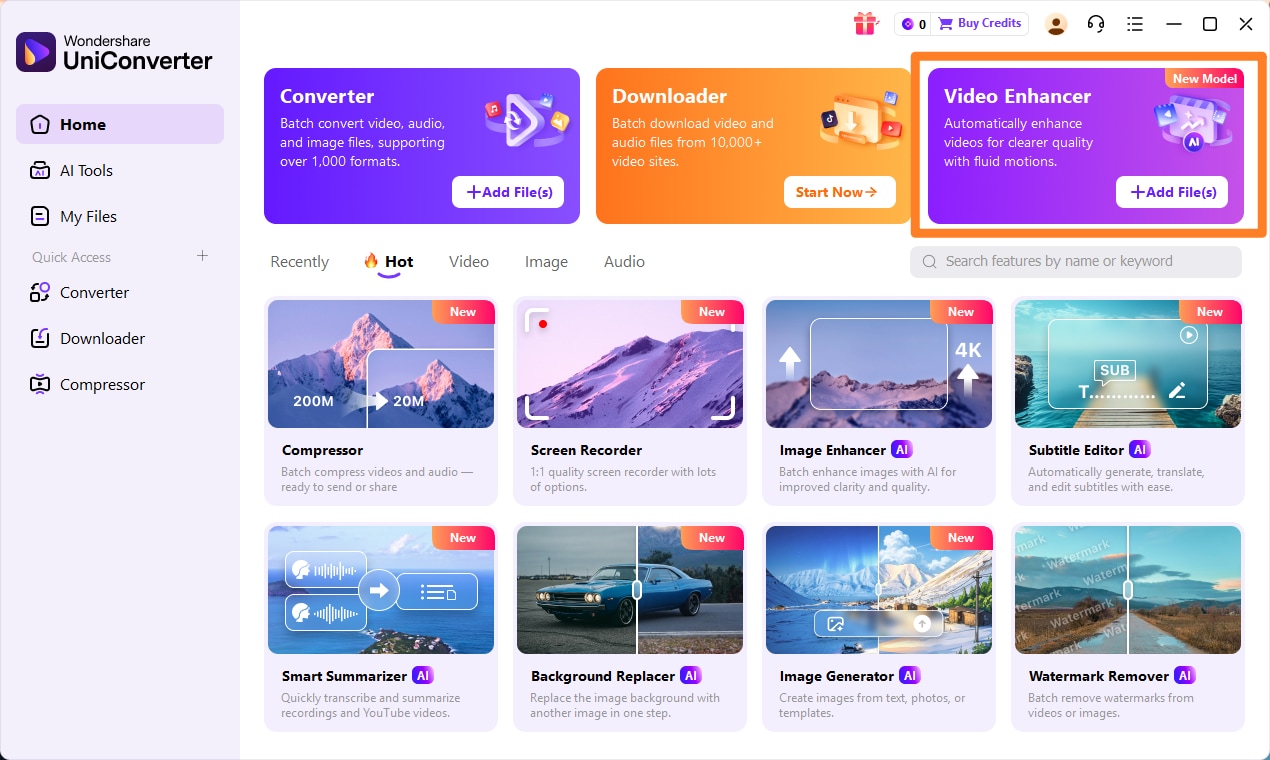
Step 1: Open UniConverter and Choose Video Enhancer
Launch UniConverter on your computer. From the main interface, navigate to the "Toolbox" section and select "Video Enhancer."
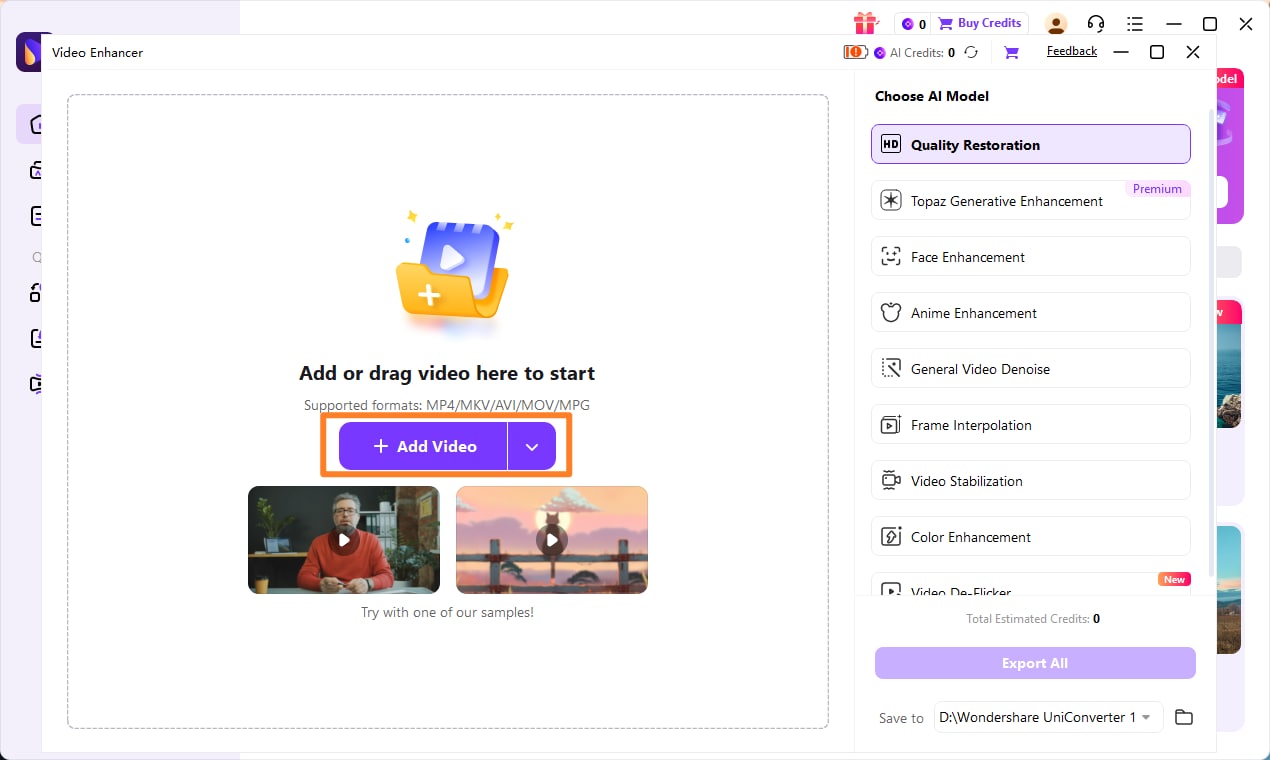
Step 2: Upload the Videos
Click on the "Add Files" button or drag and drop your video files directly into the UniConverter window. You can add multiple videos for batch processing.
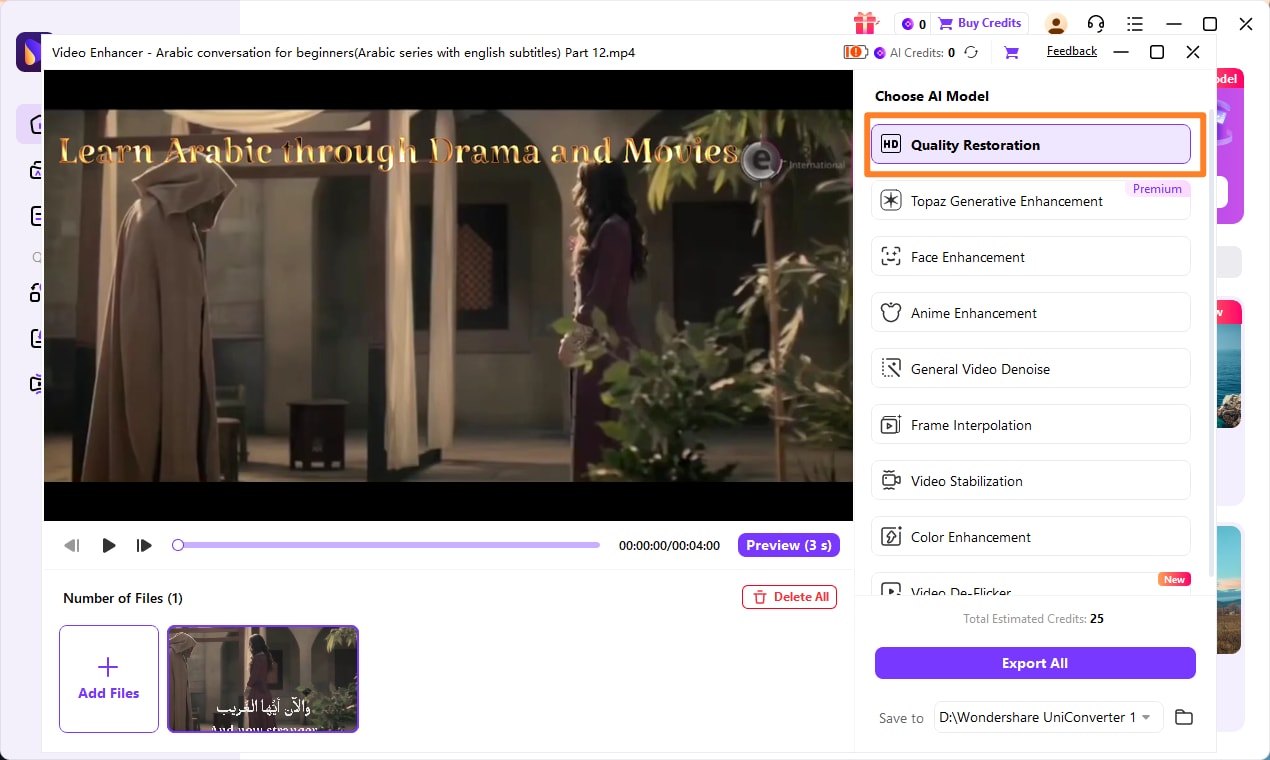
Step 3: Choose Enhancement Model
Select the desired enhancement options, such as AI Upscaling, Denoise, Brightness/Contrast, or Stabilization. Adjust the parameters as needed to fix pixelated videos.
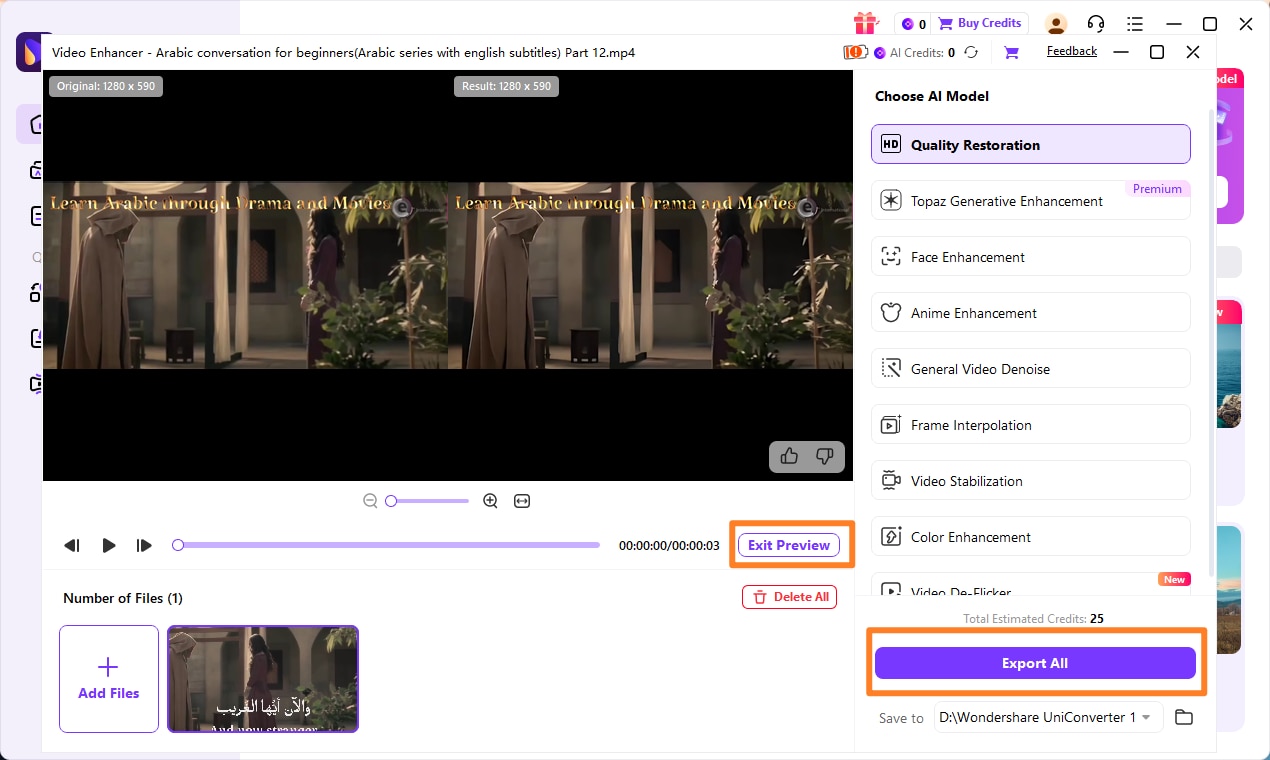
Step 4: Preview and Save the Enhanced Video
Preview the enhanced video to ensure satisfaction. Once ready, choose your output format and destination folder, then click "Export" to save your high-quality video.

Enhance Videos Beyond Filmora's Capabilities?
Part 7: Conclusion
The Wondershare Filmora Video Enhancer review reveals a powerful and accessible tool for improving video quality, particularly for casual users and prosumers. Its AI-driven features deliver impressive results in upscaling, noise reduction, and color correction, making it an excellent choice for revitalizing old footage or enhancing new content for social media. However, its resource intensity and subscription model might be drawbacks for occasional users or those with less powerful hardware. While it excels in user-friendliness and integrated editing, professionals requiring forensic-level detail or highly specialized algorithms might find dedicated tools like Topaz Video AI or DaVinci Resolve Studio more suitable. Ultimately, the best choice hinges on balancing budget, technical expertise, and the specific demands of your video projects. For a versatile, user-friendly, and effective enhancement solution, Filmora stands strong, but understanding its limitations and exploring alternatives like UniConverter for specific needs is always recommended.
Part 8: FAQs
-
1. Can Filmora Video Enhancer improve the quality of highly compressed videos?
While it can improve some aspects like noise and color, heavily compressed videos have lost too much data for significant quality recovery, and Filmora cannot magically recreate lost information.
-
2. Is a powerful graphics card necessary to use Filmora Video Enhancer effectively?
Yes, a dedicated GPU (Graphics Processing Unit) significantly speeds up the enhancement process, especially for higher resolutions and complex AI tasks. Without one, processing times can be very long.
-
3. Does Filmora Video Enhancer offer a free trial?
Yes, a free trial is typically available, allowing users to test its features. However, enhanced video exports during the trial period may be watermarked or have other limitations.
-
4. Can I use Filmora Video Enhancer for commercial projects?
Yes, with a valid paid license (subscription or perpetual), you are generally permitted to use Filmora Video Enhancer for commercial projects. Always check the specific terms of your license agreement.
-
5. How does Filmora's AI upscaling compare to traditional upscaling methods?
AI upscaling uses machine learning to intelligently analyze and add detail, often resulting in a more natural and higher-quality output by "guessing" missing pixels based on learned patterns, unlike traditional methods that simply duplicate or interpolate existing pixels, which can lead to blurriness.
