
- Video2X Overview: An open-source, command-line tool for AI-driven video upscaling and enhancement.
- Pros & Cons: Offers advanced AI upscaling and customization, but has a steep learning curve and high resource demands.
- Ideal Users: Best for tech-savvy users, developers, and archivists needing granular control for restoration.
- Comparison: Free and highly customizable, but less user-friendly than UniConverter; Topaz offers professional quality.
- Risks: Potential for artificial-looking results, high hardware requirements, and compatibility issues.
- UniConverter Alternative: Provides a user-friendly, stable, and efficient solution for seamless video enhancement.
In this article
Video2X Video Enhancer: A Comprehensive Scenario-Based Review
The digital age has ushered in an unprecedented demand for high-quality visual content. From social media influencers to professional filmmakers, the pursuit of crisp, clear, and visually appealing videos is relentless. However, a vast archive of valuable footage exists in lower resolutions, often suffering from noise, blur, or compression artifacts. This is where video enhancement tools, such as Video2X Video Enhancer, step in. This review will delve into Video2X's capabilities, comparing it against leading competitors to provide a nuanced understanding of its strengths and weaknesses. We aim to equip users with the knowledge to make informed decisions for their specific video enhancement needs, whether for restoring cherished memories or professional post-production.
Part 1: What is Video2X
Video2X is an open-source, command-line tool designed for video upscaling and enhancement, primarily leveraging AI models like Waifu2x, Anime4K, and Real-ESRGAN. Its core purpose is to take low-resolution, often noisy, or artifact-ridden video footage and transform it into higher-resolution, clearer, and more visually appealing content. This tool has gained significant traction within communities focused on anime upscaling, archival footage restoration, and general video quality improvement. This review aims to address the critical question of whether Video2X, with its open-source nature and powerful AI backend, can stand up to commercial alternatives in terms of quality, usability, and overall value.
The Growing Demand for High-Quality Video Content
* Legacy Content Revival: A vast amount of historical and personal video content exists in resolutions unsuited for modern displays.
* Professional Production Standards: Content creators and filmmakers increasingly require pristine visuals, even from older source material.
* Accessibility of AI Technologies: The proliferation of advanced AI models has made sophisticated enhancement techniques more accessible to a broader audience.
Part 2: Video2X Core Features: Pros & Cons
Video2X Video Enhancer is a powerful tool primarily focused on AI-driven video upscaling and restoration. Its core capabilities revolve around processing video frames using advanced neural networks to improve resolution, reduce noise, and sharpen details. It supports a variety of AI models, allowing users to choose the best fit for their specific content, whether it's anime, live-action, or general footage. The tool excels in its ability to handle various input formats and output high-quality enhanced videos, making it a versatile option for different enhancement tasks.
* AI-Powered Upscaling: Utilizes advanced AI models (Waifu2x, Real-ESRGAN, Anime4K) for intelligent resolution enhancement.
* Noise Reduction: Effectively minimizes grain and artifacts present in source videos.
* Detail Sharpening: Enhances fine details, making footage appear crisper and more defined.
* Batch Processing: Capable of processing multiple video files sequentially, improving workflow efficiency.
* Customizable Parameters: Offers extensive options for fine-tuning enhancement settings to achieve desired results.
Pros
* Advanced AI Upscaling for Legacy Footage: Exceptional at breathing new life into old, low-resolution videos, making them suitable for modern viewing.
* Open-Source Flexibility and Community Support: Being open-source allows for community contributions, continuous improvement, and transparent operation.
* Customizable Enhancement Parameters for Specific Needs: Users have granular control over the enhancement process, allowing for tailored results.
Cons
* Steep Learning Curve for Novice Users: Its command-line interface and numerous configuration options can be intimidating for beginners.
* Resource-Intensive Processing Requirements: Requires significant computational power, especially a robust GPU, for efficient processing.
Part 3: Video2X: Ideal Users and Use Cases
Video2X is best suited for users who possess a certain level of technical proficiency and are looking for highly customizable and powerful video enhancement solutions. Its open-source nature and command-line interface appeal to developers, tech enthusiasts, and professionals who prefer granular control over their tools. It's not a plug-and-play solution but rather a robust framework for those willing to invest time in learning its intricacies.
Best Use Case: Restoring Archival Footage for Documentary Production
For documentary filmmakers or archivists dealing with historical footage often recorded in low resolution or on deteriorating media, Video2X is an invaluable asset. Its advanced AI models can intelligently upscale and denoise these videos, preserving their historical value while making them presentable for modern audiences and high-definition broadcasts. The ability to fine-tune parameters ensures that the enhancement respects the original aesthetic while improving clarity.
Limited Use Case: Real-time Gaming Stream Enhancement
Video2X is fundamentally designed for offline, batch processing. It is not engineered for real-time applications. Therefore, attempting to use it for live gaming stream enhancement would be impractical and result in significant latency and performance issues. Streamers requiring real-time enhancement would need to look for dedicated hardware or software solutions built for live video processing.
Part 4: Video2X and Alternatives Comparison
| Feature/Scenario | Video2X | UniConverter | Topaz Video AI | DaVinci Resolve Studio |
| Upscaling Quality (Low-Res to 4K) | Excellent | Very Good | Excellent | Good |
| Ease of Use | Moderate | High | Moderate | Low |
| Processing Speed | Moderate | Fast | Fast | Moderate |
| Customization Options | High | Moderate | High | Very High |
| Cost | Free (Open Source) | Subscription/One-time | One-time Purchase | One-time Purchase |
| Offline Processing | Yes | Yes | Yes | Yes |
| Batch Processing | Yes | Yes | Yes | Yes |
| AI Models | Waifu2x, Real-ESRGAN, Anime4K | Proprietary AI | Proprietary AI | Neural Engine |
| Customer Support | Community Forums | Dedicated Support | Dedicated Support | Dedicated Support |
| Security | Local Processing | Local Processing | Local Processing | Local Processing |
Video2X stands out for its open-source nature and high degree of customization, making it a favorite for tech-savvy users who want to tinker with settings and leverage community-driven enhancements. UniConverter offers a more user-friendly experience with a good balance of quality and speed, ideal for everyday users. Topaz Video AI is a strong contender for professional upscaling, often delivering industry-leading quality but at a premium price and with a steeper learning curve than UniConverter. DaVinci Resolve Studio, while primarily a full-fledged editing suite, includes some decent upscaling capabilities, but its complexity makes it less suitable for users whose sole need is video enhancement.
Part 5: Risks and Pitfalls When Using Video Enhancers
When venturing into the world of video enhancement, especially with tools like Video2X or other commercial offerings, users must be aware of several potential risks and pitfalls. These can range from technical challenges to ethical considerations, impacting the final output and user experience.
Potential for "Artificial" Look in Enhanced Footage
One of the most common pitfalls is the risk of creating an "artificial" or "plastic" look in the enhanced video. Aggressive upscaling or noise reduction algorithms can sometimes smooth out natural textures and details, resulting in footage that looks overly processed or unnatural. This is particularly true when dealing with highly compressed or very low-resolution source material, where the AI has to "invent" details, which can lead to visual inconsistencies.
Hardware Requirements and Performance Bottlenecks
Video enhancement, especially AI-driven upscaling, is incredibly resource-intensive. Tools like Video2X and Topaz Video AI heavily rely on powerful GPUs (preferably NVIDIA with CUDA support) and ample RAM. Users with older or less powerful hardware may experience extremely slow processing times, making the enhancement process impractical for longer videos or batch jobs. This can lead to frustration and significant delays in workflow.
Subscription Costs and Hidden Fees
While Video2X is free, many commercial alternatives operate on a subscription model or one-time purchase that can be quite expensive. Users need to carefully evaluate the total cost of ownership, including potential hidden fees for additional features, updates, or cloud processing. It's crucial to understand the licensing terms to avoid unexpected expenses, especially for professional use cases.
Compatibility Issues with Various Video Formats
Not all video enhancers support every conceivable video format or codec. Users might encounter compatibility issues with obscure or legacy formats, requiring additional steps like format conversion before enhancement. This can add complexity to the workflow and potentially introduce further quality degradation if not handled correctly. Ensuring the chosen tool supports your specific input and desired output formats is essential.
Part 6: How to Use UniConverter for Seamless Video Enhancement
When other tools fall short with unstable enhancements, weak effects, or lack of batch processing, UniConverter emerges as a robust and user-friendly alternative. It provides a stable, high-quality solution for enhancing videos, free from ads, and supporting a wide array of formats. Leveraging GPU acceleration, UniConverter ensures lossless quality and efficient batch processing, positioning itself as an all-in-one ultimate solution for video enhancement.
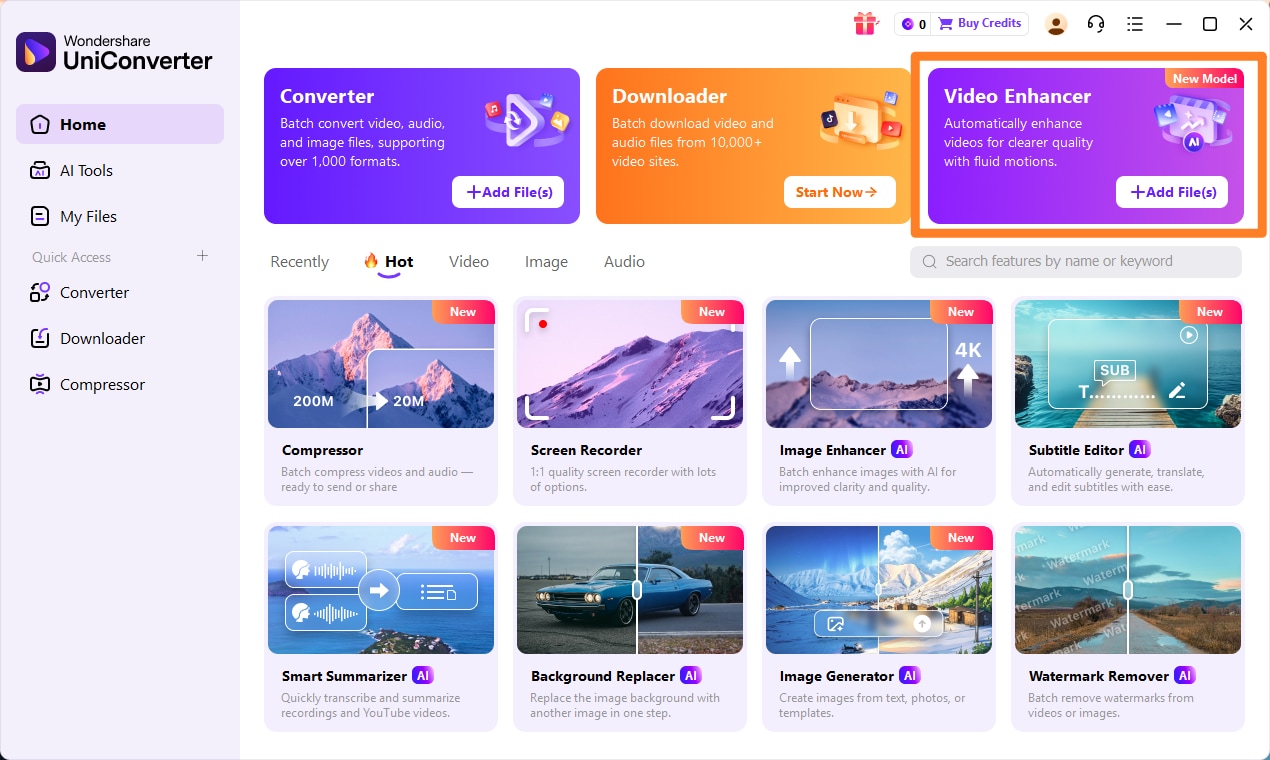
Step 1: Open UniConverter and Choose Video Enhancer
Launch UniConverter on your computer. From the main interface, navigate to the "Toolbox" section and select the "Video Enhancer" feature. This will open the dedicated enhancement module.
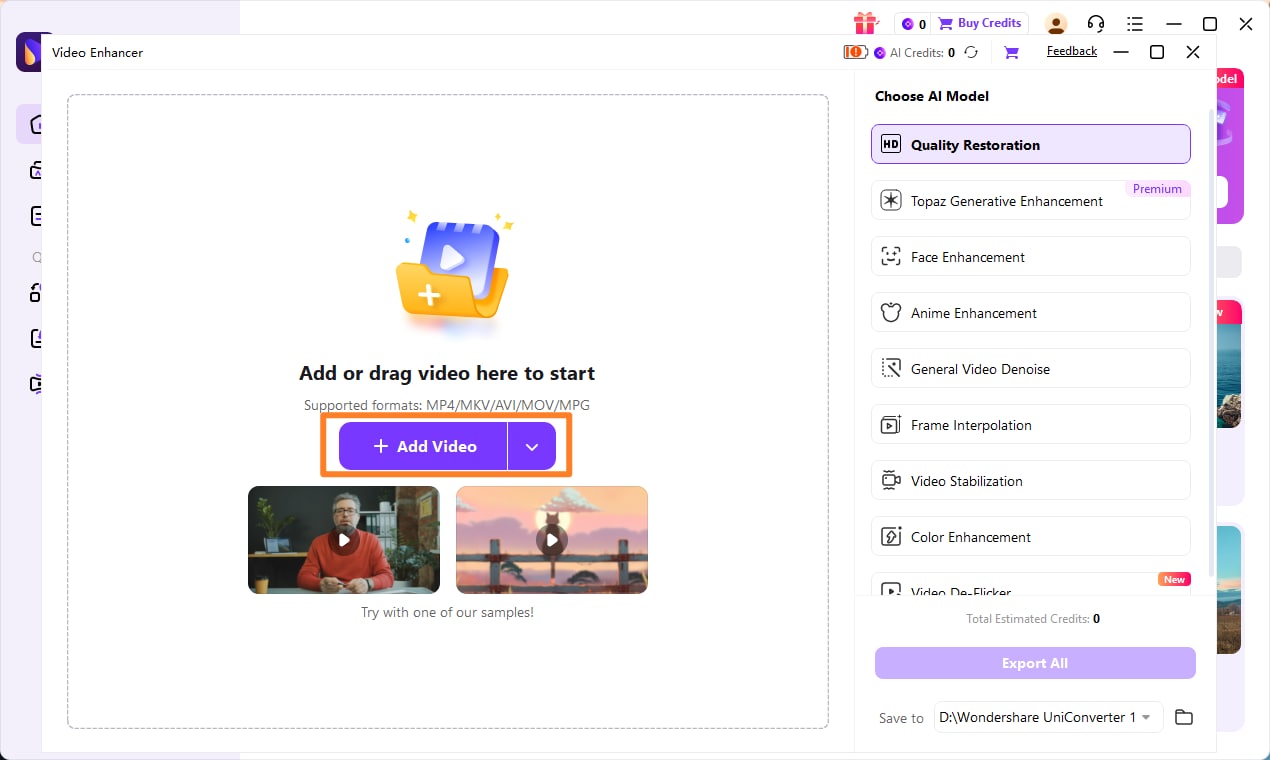
Step 2: Upload the Videos
Click on the "Add Files" button or drag and drop your video files directly into the UniConverter interface. You can add multiple videos for batch processing.
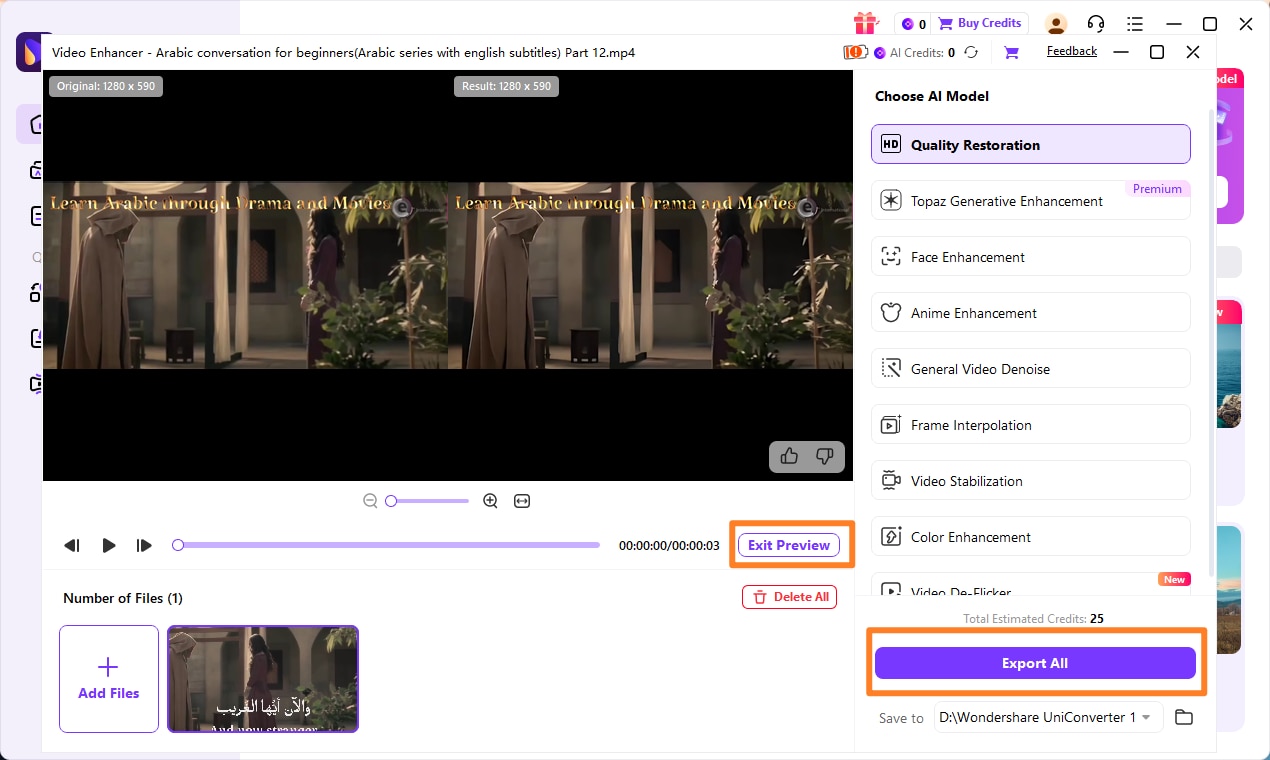
Step 3: Choose Enhancement Model
Once your videos are loaded, UniConverter will present various enhancement options. Select the desired AI enhancement model (e.g., AI Upscale, Denoise, Deblur) and adjust parameters like resolution, brightness, and contrast as needed. For instance, you might want to remove background without losing quality or utilize a high-definition background remover to refine your footage. UniConverter also offers features to change video background or even use an online background remover for quick edits.

Step 4: Preview and Save the Enhanced Video
Before finalizing, utilize the preview function to see the enhanced result. Once satisfied, choose your output format and destination folder, then click "Enhance" or "Start All" to process and save your high-quality video.

Enhance Your Videos with a Powerful Alternative
Part 7: Conclusion
The Video2X Video Enhancer offers a compelling solution for advanced video upscaling, particularly for those comfortable with a command-line interface and seeking deep customization. Its open-source nature and powerful AI models make it an excellent choice for restoring archival footage and for tech-savvy users who appreciate granular control. However, its steep learning curve and significant hardware demands may deter casual users. For individuals prioritizing ease of use, faster processing, and comprehensive features without the technical overhead, commercial alternatives like UniConverter provide a more accessible and efficient experience. Professionals focused on peak quality might lean towards Topaz Video AI, despite its cost. Ultimately, the best choice hinges on the user's technical expertise, specific project requirements, budget, and desired balance between control and convenience.
Part 8: FAQs
-
1. Is Video2X truly free to use?
Yes, Video2X is an open-source project, making it free to download and use.
-
2. What kind of hardware do I need to run Video2X effectively?
Video2X is resource-intensive and benefits greatly from a powerful GPU (NVIDIA preferred) and ample RAM for optimal performance.
-
3. Can Video2X enhance videos in real-time?
No, Video2X is designed for offline processing and is not suitable for real-time video enhancement.
-
4. How does Video2X compare to commercial video enhancement software in terms of quality?
Video2X can achieve comparable or even superior quality to some commercial software, especially with proper configuration, but often requires more technical expertise.
-
5. Are there any privacy concerns with using Video2X?
As an open-source, local-processing tool, Video2X generally poses fewer privacy concerns than cloud-based solutions, as your data remains on your machine.
