
- VapourSynth Overview: A powerful, open-source video processing framework for advanced users seeking granular control via Python scripting.
- Core Features & Benefits: Script-based processing, extensive filter library, high bit depth support, and modular design for unparalleled customization.
- Target Audience: Ideal for video professionals, archivists, and enthusiasts with technical expertise, not for casual users or quick edits.
- Comparison & Alternatives: VapourSynth offers unmatched control but has a steep learning curve; UniConverter provides user-friendly AI-driven enhancement.
- Risks & Considerations: Requires significant time investment, technical skills, and powerful hardware; relies on community support.
- UniConverter Solution: A user-friendly alternative for efficient, stable, and GPU-accelerated video enhancement without scripting complexity.
In this article
- Part 1: What is VapourSynth Video Enhancer?
- Part 2: VapourSynth Video Enhancer: Core Features, Pros & Cons
- Part 3: Target Users and Usage Scenarios
- Part 4: VapourSynth and Alternatives Comparison
- Part 5: Risks and Considerations
- Part 6: How to Use UniConverter for Efficient Video Enhancement
- Part 7: Conclusion
- Part 8: FAQs
VapourSynth Video Enhancer: In-Depth Review and Comparison
Welcome to an in-depth VapourSynth Video Enhancer review. This article delves into VapourSynth, a powerful, open-source video processing framework, examining its core functionalities, strengths, and weaknesses. We will explore its market position, ideal user base, and compare it against prominent competitors to help you understand where VapourSynth excels and where alternatives might be more suitable. By the end of this comprehensive analysis, you'll have a clear understanding of VapourSynth's capabilities and limitations, enabling you to make an informed decision for your video enhancement needs.
Part 1: What is VapourSynth Video Enhancer?
VapourSynth is a robust, open-source video processing framework that allows for highly customizable and advanced video manipulation through Python scripting. Unlike many commercial video enhancement tools that offer pre-set filters and user-friendly interfaces, VapourSynth provides granular control over every aspect of video processing, from deinterlacing and denoising to upscaling and color correction. This level of control makes it a favorite among video enthusiasts, archivists, and professionals who require precise adjustments beyond what off-the-shelf software can offer. This review aims to dissect VapourSynth's technical prowess, its demanding learning curve, and its unique position in the video enhancement landscape, ultimately guiding users toward the most appropriate tool for their specific projects.
Market Context and User Pain Points:
* Demand for High-Quality Video Restoration: The increasing availability of older footage and the desire for pristine digital archives drive the need for powerful enhancement tools.
* Limitations of Automated Solutions: Many automated video enhancers often fall short in complex scenarios, leading to artifacts or unnatural results.
* The Need for Granular Control: Professionals and enthusiasts often require fine-tuned control over every processing step to achieve specific aesthetic or technical outcomes.
Part 2: VapourSynth Video Enhancer: Core Features, Pros & Cons
VapourSynth's core strength lies in its script-based approach, offering unparalleled flexibility. Users write Python scripts to define a precise chain of filters and operations, allowing for highly specific and complex enhancements. It supports a vast array of filters for tasks such as deinterlacing, denoising, sharpening, color correction, and upscaling. Its modular design means new filters and functionalities can be easily added by the community, constantly expanding its capabilities.
Core Features:
* Script-based Processing: Utilizes Python for defining complex video processing workflows.
* Extensive Filter Library: Supports a wide range of filters for various enhancement tasks.
* High Bit Depth Support: Handles video with high bit depths for professional-grade quality.
* Frame-accurate Control: Allows for precise manipulation of individual frames or segments.
* Modular and Extensible: Open-source nature encourages community development of new plugins and filters.
Pros:
* Highly customizable scripting for advanced users
* Unparalleled control over video processing parameters
* Open-source and community-driven development
Cons:
* Steep learning curve for beginners
* Requires technical expertise and scripting knowledge
Part 3: Target Users and Usage Scenarios
VapourSynth is not a tool for the faint of heart or those seeking quick, one-click solutions. Its target audience consists primarily of advanced users, video professionals, archivists, and enthusiasts who possess a strong understanding of video codecs, processing techniques, and Python scripting. These users are willing to invest significant time and effort to achieve highly specific and often superior results that are simply not possible with more user-friendly software.
Best Use Case: Professional Post-Production and Archival Restoration
VapourSynth shines in scenarios demanding meticulous control over video quality. This includes professional post-production workflows where specific visual effects or corrections are needed, and in archival restoration projects where historical footage requires careful de-noising, stabilization, and upscaling without introducing unwanted artifacts. Its ability to precisely target and correct specific issues makes it invaluable for preserving and enhancing valuable video assets.
Limited Use Case: Quick Edits and Casual Users
For casual users looking to quickly enhance a home video or apply a simple filter, VapourSynth is overkill. Its complex scripting interface and the time investment required to learn it make it impractical for everyday, straightforward video editing tasks. Users who prioritize ease of use and speed over granular control will find VapourSynth frustrating and inefficient.
Part 4: VapourSynth and Alternatives Comparison
| Feature / Product | VapourSynth Video Enhancer | UniConverter | Topaz Video AI | DaVinci Resolve |
| Processing Speed | Varies (script-dependent, can be very fast with optimized scripts) | Fast (GPU acceleration) | Moderate to Fast (GPU intensive) | Moderate to Fast (GPU intensive) |
| Output Quality | Excellent (highly customizable) | Good to Excellent (AI-driven) | Excellent (AI-driven, specialized) | Excellent (professional-grade) |
| Ease of Use | Very Low (requires scripting) | Very High (intuitive GUI) | Moderate (GUI-based, some learning) | Moderate to Low (professional suite) |
| Customer Support | Community Forums | Dedicated Support | Dedicated Support | Dedicated Support |
| Security | Open-source (community audited) | High (reputable software) | High (reputable software) | High (professional software) |
VapourSynth stands out for its unparalleled scripting flexibility, allowing users to craft highly customized enhancement pipelines. However, this comes at the cost of a steep learning curve. UniConverter offers a user-friendly experience with AI-driven enhancement and broad format support, making it ideal for general users. Topaz Video AI specializes in AI-powered upscaling and denoising, delivering impressive results with a more accessible interface than VapourSynth. DaVinci Resolve, while a full-fledged professional editing suite, includes powerful video enhancement tools, but its complexity extends beyond simple enhancement tasks.
Part 5: Risks and Considerations
While VapourSynth offers immense power, its advanced nature comes with several risks and considerations that users must be aware of before committing to it. These potential pitfalls can lead to frustration, suboptimal results, or significant time investment if not properly understood.
Complexity and Time Investment
The most significant hurdle with VapourSynth is its steep learning curve. Users must be comfortable with Python scripting and understand various video processing concepts. This requires a substantial time investment to learn the syntax, available filters, and how to combine them effectively. Without this dedication, users will struggle to achieve desired outcomes.
Hardware Requirements for Real-time Processing
While VapourSynth itself is not inherently hardware-intensive, the complexity of the scripts and the filters used can demand significant computational resources. Real-time processing, especially for high-resolution or heavily filtered video, often requires a powerful CPU and a capable GPU. Underpowered hardware can lead to extremely long processing times, making the workflow inefficient.
Community Support Dependency
As an open-source project, VapourSynth relies heavily on its community for support, documentation, and filter development. While the community is active and helpful, it's not a commercial support channel. Solutions to complex problems might take time to find, and direct, personalized assistance is not guaranteed, unlike with commercial software.
Potential for Suboptimal Results Without Expertise
The freedom VapourSynth offers can be a double-edged sword. Without a deep understanding of video processing principles, users can easily create scripts that introduce artifacts, degrade video quality, or produce unnatural-looking results. The lack of an intuitive visual feedback loop means that errors might only become apparent after a lengthy rendering process.
Part 6: How to Use UniConverter for Efficient Video Enhancement
When other tools fall short with unstable enhancements, poor quality, or lack of batch processing, UniConverter emerges as a robust and user-friendly alternative. It bypasses the complexities of scripting, offering a streamlined experience for enhancing videos without ads, watermarks, or inconsistent results. UniConverter provides a stable, lossless, and GPU-accelerated solution for batch enhancement across a wide range of formats, making it an ideal all-in-one solution. For those looking to enhance video quality, this tool offers a comprehensive approach. You can also upscale video resolution with ease. If you need to fix pixelated videos, UniConverter is an excellent choice. Additionally, it can help you to unblur a video effectively.
Step 1: Open UniConverter and Choose Video Enhancer
Launch UniConverter and navigate to the "Toolbox" section. Select the "Video Enhancer" feature to begin.

Step 2: Upload the Videos
Click on the "Add Files" button or drag and drop your video files into the interface. You can upload multiple videos for batch processing.
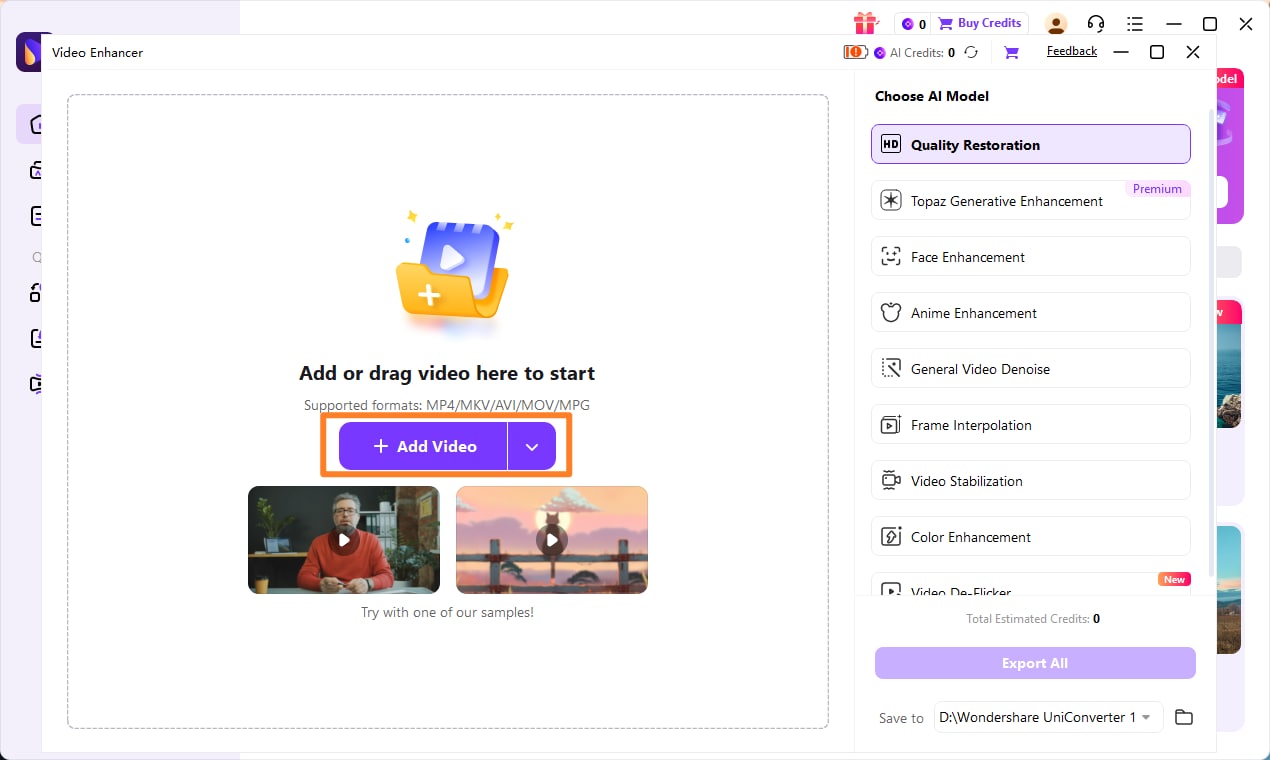
Step 3: Choose Enhancement Model
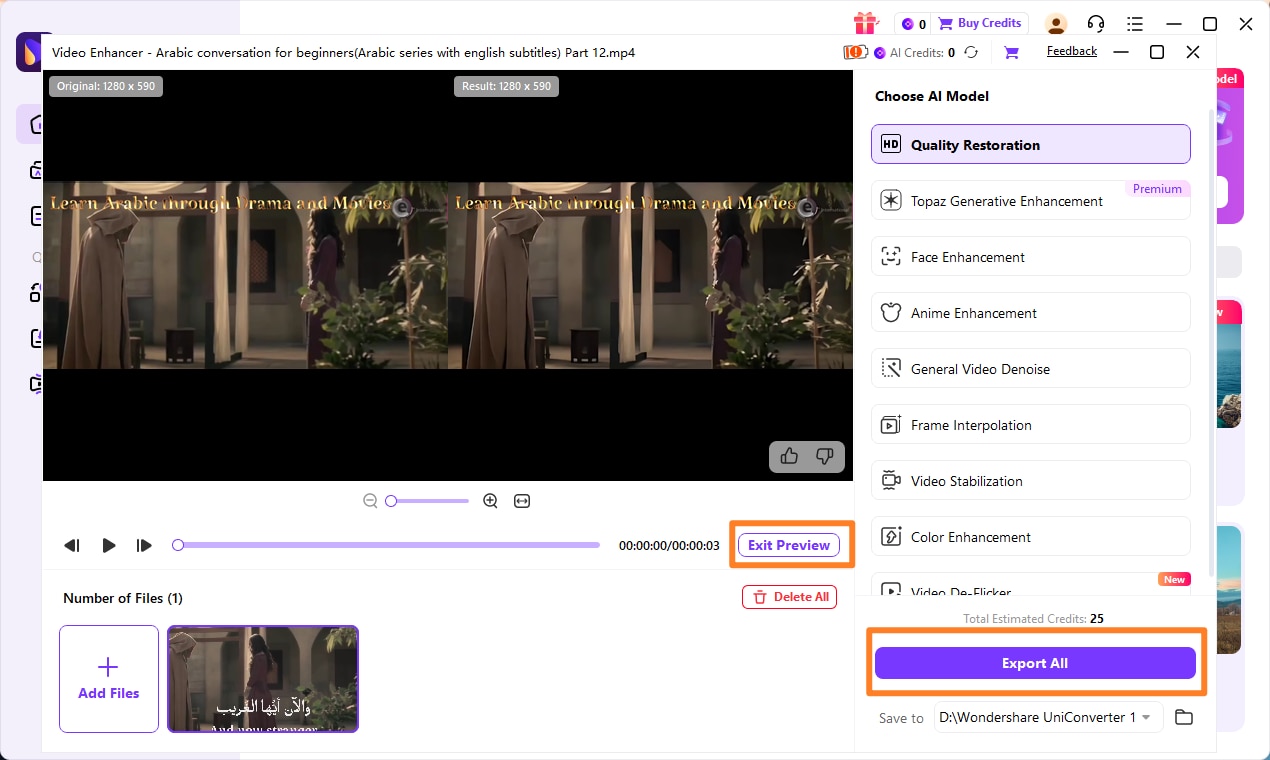
Select the desired enhancement model (e.g., AI Upscaler, Denoise, Deblur) and adjust parameters like resolution, quality, and output format.

Step 4: Preview and Save the Enhanced Video
Preview the enhanced video to ensure satisfaction. Once ready, click "Export" to save your high-quality, enhanced video.

Seeking a VapourSynth Video Enhancer Alternative?
Part 7: Conclusion
The VapourSynth Video Enhancer review reveals a powerful, open-source tool best suited for advanced users and professionals who demand granular control over every aspect of video processing. Its script-based nature offers unmatched customization and the potential for superior results, particularly in professional post-production and archival restoration. However, this power comes with a significant learning curve and requires technical expertise, making it unsuitable for beginners or those seeking quick, easy enhancements. For casual users or those prioritizing ease of use and efficiency, user-friendly alternatives like UniConverter provide a more accessible and streamlined experience with robust AI-driven enhancement capabilities. Ultimately, the choice between VapourSynth and its competitors hinges on the user's technical proficiency, the specific demands of their project, and their willingness to balance control with convenience.
Part 8: FAQs
-
1. Is VapourSynth free to use?
Yes, VapourSynth is open-source and free.
-
2. What kind of videos can VapourSynth enhance?
VapourSynth can enhance various video types, from old archives to modern footage.
-
3. Is VapourSynth suitable for real-time video processing?
Real-time processing depends heavily on your hardware and script complexity.
-
4. How does VapourSynth compare to commercial video enhancers?
VapourSynth offers more granular control but requires more technical skill than most commercial tools.
-
5. Where can I find VapourSynth scripts and tutorials?
The VapourSynth community forums and GitHub repositories are excellent resources.
