
- Format Overview: Opus is a high-efficiency audio format designed for streaming and modern audio applications.
- Playback Options: Popular media players like VLC, Winamp, and Foobar2000 support Opus files across different platforms.
- Compatibility Solution: Converting Opus files ensures playback on devices or apps that do not support this format natively.
- Best Solution: Wondershare UniConverter enables fast, high-quality Opus file conversion to widely supported formats.
In this article
- Part 1: What is Upscayl?
- Part 2: Upscayl: Core Features, Pros, and Cons
- Part 3: Who is Upscayl For? Ideal Scenarios and Limitations
- Part 4: Upscayl and Alternatives Comparison
- Part 5: Risks and Pitfalls to Consider
- Part 6: How to Use UniConverter for Efficient Image Enhancement
- Part 7: Conclusion
- Part 8: FAQs
When I first stumbled upon Upscayl image enhancer review, I was intrigued by the promise of free, open-source AI upscaling. As someone who frequently deals with older, lower-resolution images, the idea of breathing new life into them without a hefty subscription fee was incredibly appealing. This review aims to provide a comprehensive, scenario-based analysis of Upscayl, comparing it to its paid counterparts and exploring its strengths and weaknesses in various real-world applications. I'll share my personal experiences and insights to help you decide if Upscayl is the right tool for your image enhancement needs.
Part 1: What is Upscayl?
Upscayl is a free and open-source AI image upscaler that leverages various artificial intelligence models to enlarge and enhance images without significant loss of quality. It's designed to take low-resolution images and intelligently add detail, making them suitable for larger displays or prints. For me, the appeal was immediate – no subscriptions, no hidden costs, just a straightforward tool for a common problem.
The Rise of AI Image Enhancement
The digital age has brought an explosion of images, but not all are created equal. We often find ourselves with:
* Legacy photos: Old family photos scanned at low resolutions.
* Web-sourced images: Downloaded images that are too small for high-quality use.
* Cropped images: Photos that, after cropping, lose too much detail to be useful.
This is where AI image enhancement steps in, promising to solve these common pain points by intelligently reconstructing missing pixels and details.
Part 2: Upscayl: Core Features, Pros, and Cons
Upscayl, in my experience, is a no-frills tool that focuses on its core competency: image upscaling. It's not an all-in-one photo editor, and that's perfectly fine. Its main ability is to take a small image and make it bigger and sharper using AI.
* AI Model Selection: It offers a choice of AI models, which I found useful for experimenting with different enhancement styles.
* Offline Processing: This was a huge plus for me, as I'm always wary of uploading sensitive images to online services.
* Batch Processing: Being able to process multiple images at once is a real time-saver, especially when dealing with a collection of old photos.
* Simple Interface: The user interface is incredibly straightforward, making it easy to pick up and use without a steep learning curve.
* Output Format Options: It allows saving in various formats, which is convenient for different uses.
Pros:
* Open-source and free to use: You can't beat the price, and the transparency of open-source is reassuring.
* Offline processing for privacy: My images stay on my computer, which is a big win for privacy.
* Multiple AI models for diverse enhancement needs: I appreciate having options to fine-tune the enhancement for different types of images.
Cons:
* Limited advanced editing features: If you need to do more than just upscale, you'll need another tool.
* Can be resource-intensive for large images: My older laptop sometimes struggled with very large images, leading to longer processing times.
Part 3: Who is Upscayl For? Ideal Scenarios and Limitations
From my perspective, Upscayl shines in specific situations, particularly for those who prioritize cost and privacy. It's not a one-size-fits-all solution, but it excels where it's designed to.
Best Use Case: Enhancing Old Photos for Personal Archives
This is where Upscayl truly impressed me. I had a collection of scanned family photos from the 80s and 90s, all quite low resolution. Using Upscayl, I was able to enlarge them significantly, making them look much better on modern displays and even suitable for small prints. The AI did a surprisingly good job of adding detail to faces and textures, making these cherished memories much clearer. If you're just looking to improve your personal photo collection without spending a dime, this is your go-to.
Limited Scenario: Professional Print Production Requiring Fine-Grained Control
However, if you're a professional photographer or graphic designer needing pixel-perfect control for large-format prints or commercial projects, Upscayl might fall short. It lacks the advanced sharpening, noise reduction, and color correction tools found in more specialized, paid software. I found that while it enhances, it doesn't offer the granular control needed for truly high-end, professional output where every detail matters and specific color profiles are crucial.
Part 4: Upscayl and Alternatives Comparison
When I started using Upscayl, I naturally wondered how it stacked up against the competition. Here's a breakdown of my findings, comparing it to some popular alternatives.
| Feature/Scenario | Upscayl | Topaz Gigapixel AI | VanceAI Image Enlarger | UniConverter |
| Cost | Free | Paid ($99.99) | Freemium (from $9.99/month) | Paid (from $49.99/year) |
| Offline Processing | Yes | No | No | Yes |
| AI Models | Multiple | Proprietary | Multiple | Multiple |
| Ease of Use | High | Medium | High | High |
| Advanced Editing | Low | High | Medium | Medium |
| Batch Processing | Yes | Yes | Yes | Yes |
| Output Quality | Good | Excellent | Very Good | Excellent |
| Processing Speed | Moderate | Fast | Moderate | Fast |
| Customer Support | Community | Dedicated | Dedicated | Dedicated |
| Security | High (offline) | Standard | Standard | High (offline) |
Key Differentiators:
Upscayl's open-source nature and offline capability are its biggest selling points for me, especially for privacy-conscious users. You just can't get that with most online or subscription-based tools. Topaz Gigapixel AI, while expensive, delivers exceptional quality and advanced features, making it a favorite for professionals. VanceAI offers a good balance of features and ease of use, but its online nature is a drawback for privacy. UniConverter stands out for its comprehensive toolkit and offline processing, offering a strong alternative for those who need more than just upscaling.
Part 5: Risks and Pitfalls to Consider
While Upscayl is fantastic for what it offers, and I've had great experiences, it's important to be aware of potential downsides, especially when considering other tools or pushing the limits of what free software can do.
Privacy Concerns with Online Enhancers
This is a big one for me. Many online image enhancers require you to upload your images to their servers. While they often promise data deletion, the thought of my personal or sensitive images residing on a third-party server, even temporarily, is a significant privacy risk. I've heard stories of data breaches, and that's why Upscayl's offline processing is such a relief. With online tools, you're essentially trusting a company with your visual data, and that trust isn't always warranted.
Potential for Over-Processing and Artifacts
I've noticed that sometimes, especially with very low-quality source images, Upscayl (and other AI enhancers) can "hallucinate" details that weren't there, leading to an artificial, almost painterly look. This "over-processing" can introduce artifacts like strange textures or distorted lines, making the image look worse than before. It's a fine line between enhancement and artificiality, and you need to be careful not to push it too far.
Performance Issues on Older Hardware
While Upscayl is free, it's not magic. AI image enhancement is computationally intensive. If you're running it on an older computer without a dedicated GPU, you might find the processing times incredibly long, especially for larger images. I've experienced my laptop's fans spinning up like a jet engine, and sometimes the application would even crash if the image was too big or my system was under heavy load. This can be a significant barrier if you don't have robust hardware.
Limited Support and Community Resources
Being open-source, Upscayl relies on its community for support. While there's a community, it's not as extensive or as responsive as the dedicated customer support teams you'd find with paid software. If you run into a niche bug or need specific guidance, you might be left to figure things out on your own, which can be frustrating.
Lack of Advanced Color Correction
Upscayl focuses purely on resolution and detail enhancement. It doesn't offer any tools for color correction, white balance adjustments, or exposure fixes. This means if your original image has color cast issues or is underexposed, you'll need to use another photo editor before or after using Upscayl, adding an extra step to your workflow.
Part 6: How to Use UniConverter for Efficient Image Enhancement
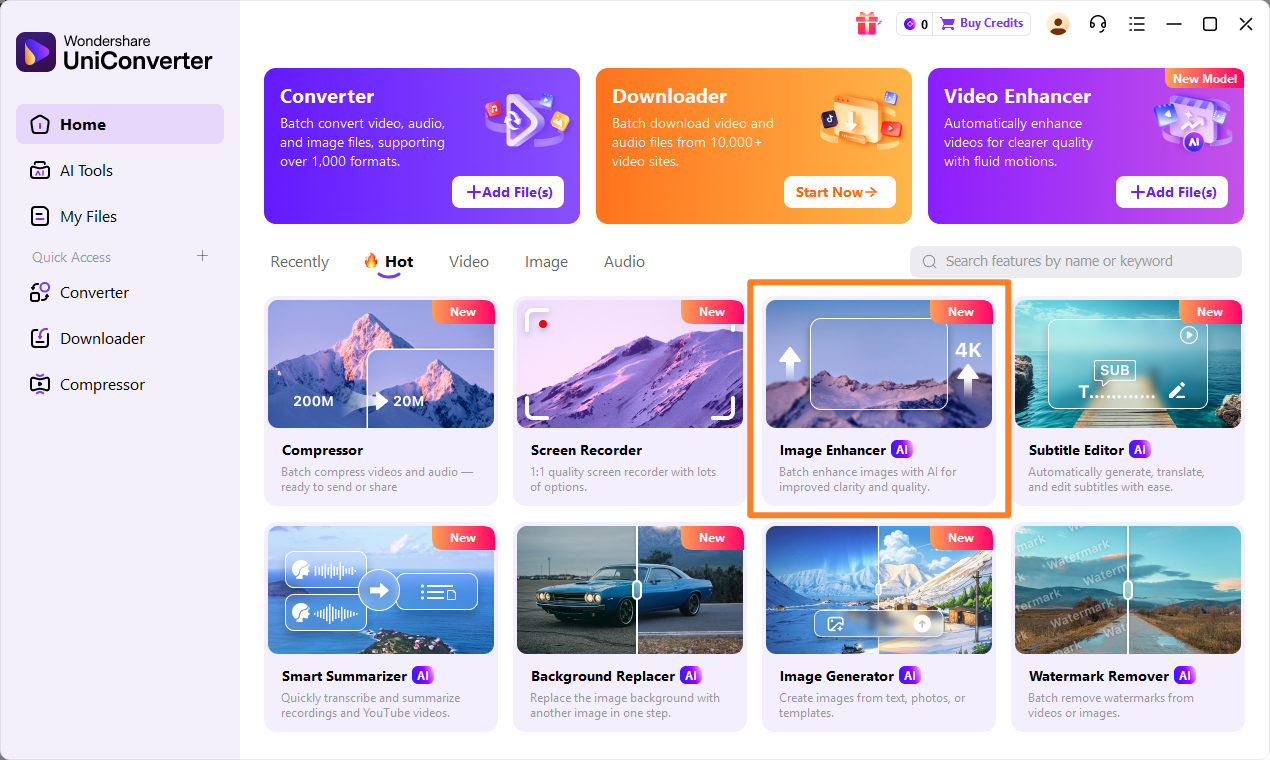
Upscayl's limitations, like the occasional over-processing or the lack of broader editing tools, can be a bit of a hurdle. If you're looking for a more robust, all-in-one solution that handles image enhancement with greater stability and additional features, I've found UniConverter to be an excellent alternative. It's particularly useful when you need batch processing, consistent quality, and a wider range of media tools without the privacy concerns of online services. UniConverter offers a powerful AI image enhancer that's integrated into a comprehensive media toolkit, ensuring no ads, rich format support, GPU acceleration for speed, stable and lossless enhancement, and efficient batch processing. For those needing to upscale images to 4K, this tool provides a reliable solution. It truly acts as a one-stop solution for all your media conversion and enhancement needs. If you're also interested in improving video quality, UniConverter also offers an AI video enhancer to help you achieve clearer footage.
Step 1: Open UniConverter and Choose Image Enhancer
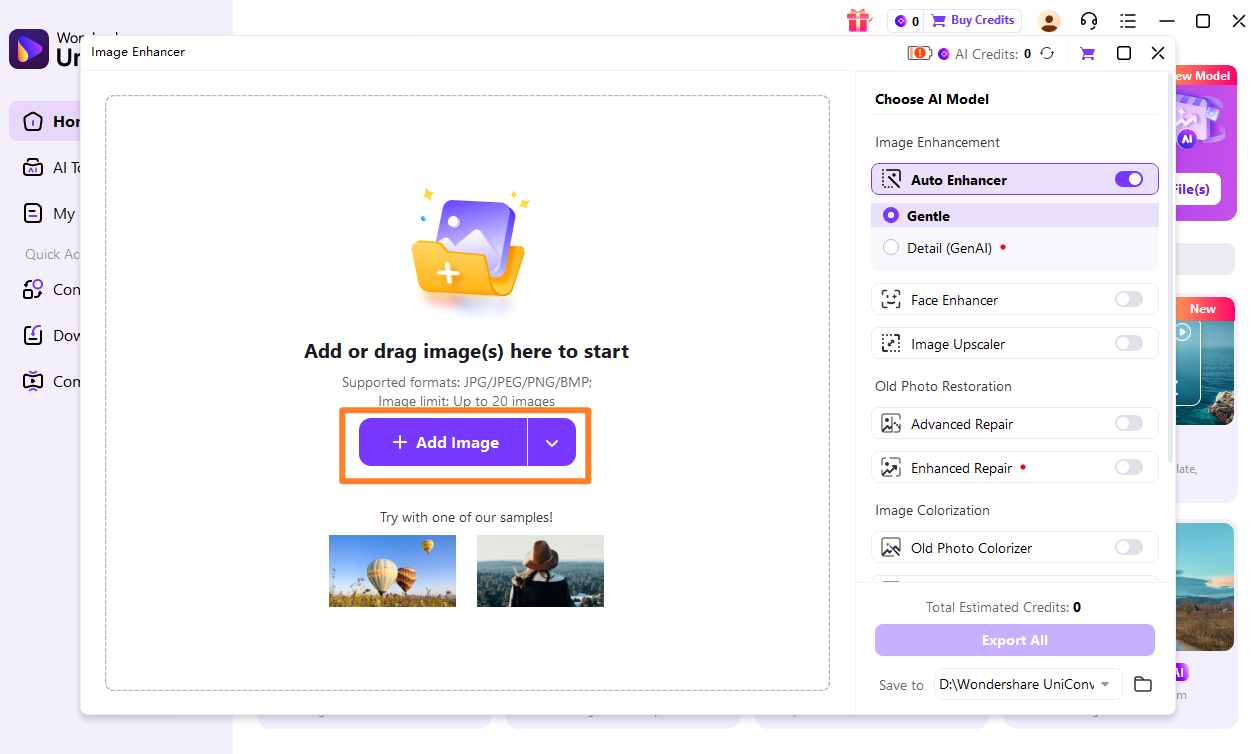
Step 2: Upload the Images
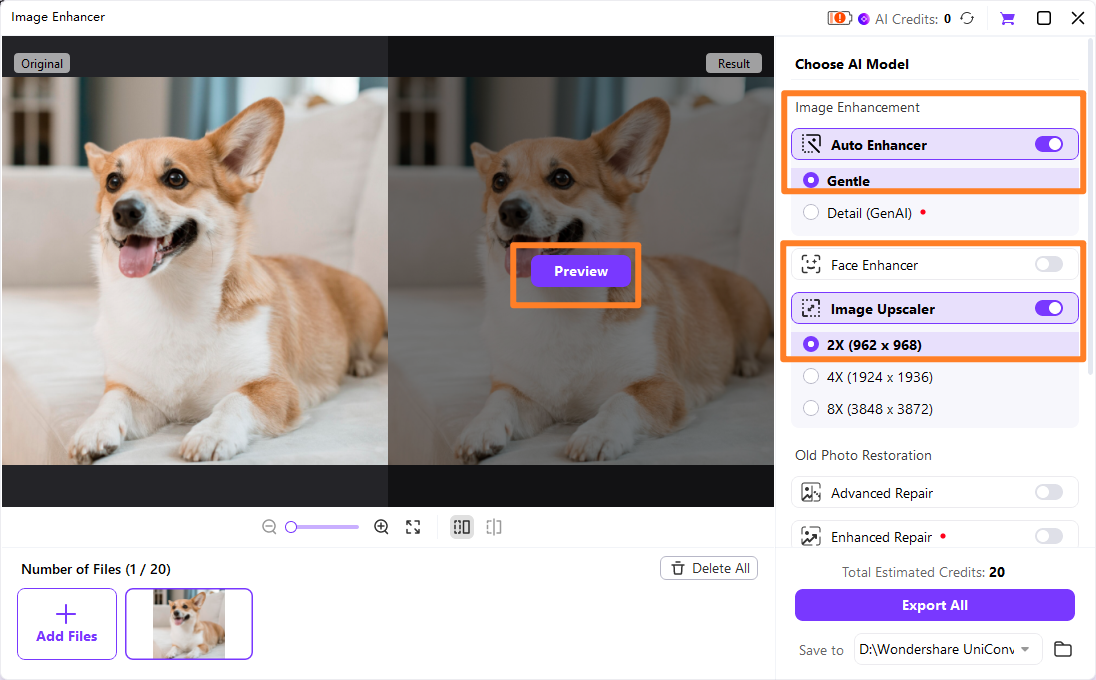
Step 3: Choose Enhancement Model
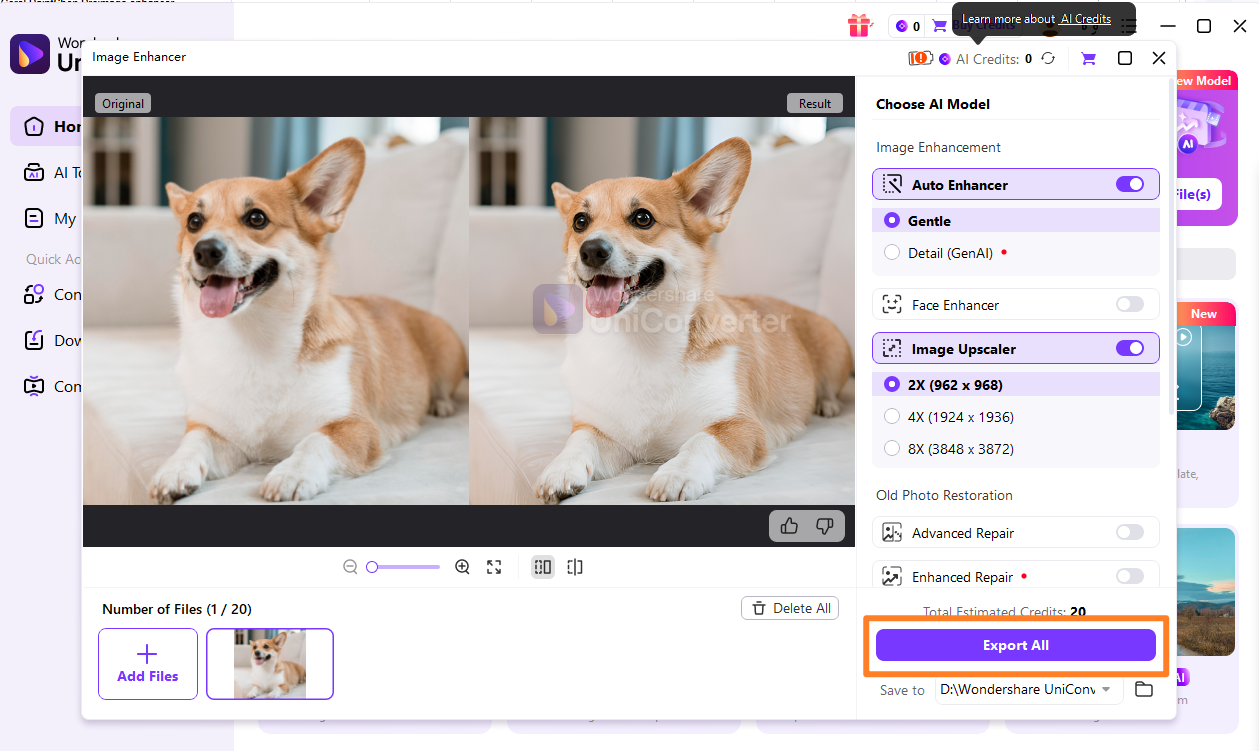
Step 4: Preview and Save the Enhanced Images

Enhance Images Beyond Upscayl's Limits?
Part 7: Conclusion
After extensively using and comparing Upscayl image enhancer review with its alternatives, my conclusion is clear: Upscayl is an outstanding tool for specific users and scenarios. For budget-conscious individuals and privacy advocates who primarily need to upscale personal photos or web images, its free, open-source, and offline nature makes it an unbeatable choice. However, professional photographers and graphic designers requiring pixel-perfect control, advanced editing features, and dedicated support will likely find more comprehensive solutions like Topaz Gigapixel AI or UniConverter to be better investments. Casual users seeking quick enhancements will appreciate Upscayl's ease of use, but those needing a comprehensive media toolkit will benefit from UniConverter's broader capabilities. Ultimately, the best tool depends on your specific needs, budget, and desired level of control.
Part 8: FAQs
-
1. Is Upscayl truly free?
Yes, Upscayl is completely free and open-source, meaning you can use it without any cost or subscription.
-
2. Can Upscayl improve blurry images significantly?
While Upscayl can enhance details and make images appear sharper, it struggles with severely blurry images. It can't magically create detail that isn't there, so extremely blurry photos might only see marginal improvement.
-
3. What are the system requirements for Upscayl?
Upscayl benefits greatly from a dedicated GPU (graphics processing unit) for optimal performance, especially when processing larger images or multiple files. While it can run on systems without a dedicated GPU, processing will be significantly slower.
-
4. Does Upscayl offer batch processing?
Yes, Upscayl supports batch processing, allowing you to enhance multiple images in a single operation, which is a huge time-saver for large collections.
-
5. How does Upscayl compare to online image enhancers?
Upscayl's primary advantage over most online image enhancers is its offline processing capability. This means your images are never uploaded to a server, offering superior privacy and security compared to web-based tools.
