
- Upscaler.cc Value: Free, user-friendly, and effective for basic image upscaling and quick social media enhancements.
- Limitations: Lacks advanced customization, can produce artifacts on complex images, and is unsuitable for professional print.
- Comparison: Simpler than Topaz Gigapixel AI or UniConverter, which offer superior control and quality for professional tasks.
- Risks: Online tools pose data privacy concerns, inconsistent output, ads, and reliance on internet connectivity.
- Decision: Choose Upscaler.cc for casual use; opt for robust desktop software like UniConverter for professional, secure, and high-quality results.
In this article
- Part 1: What is Upscaler.cc?
- Part 2: Upscaler.cc: Core Features, Pros, and Cons
- Part 3: Who Should Use Upscaler.cc? Ideal Scenarios and Limitations
- Part 4: Upscaler.cc vs. Competitors: A Head-to-Head Battle
- Part 5: Risks and Pitfalls When Using Online Image Enhancers
- Part 6: How to Use UniConverter to Efficiently Enhance Images
- Part 7: Final Verdict and Recommendations
- Part 8: Frequently Asked Questions (FAQs)
When I first started dabbling in digital photography and content creation, I quickly realized the importance of high-quality visuals. But let's be honest, not every photo we take is perfect straight out of the camera. That's where AI image enhancement tools come into play, promising to magically transform our mediocre shots into stunning masterpieces. I've spent countless hours exploring various options, and today, I'm excited to share my Upscaler.cc image enhancer review and a comprehensive comparison with other tools I've tried. My goal is to help you navigate this crowded market and find the best solution for your specific needs, whether you're a casual social media user or a professional looking for robust editing capabilities.
Part 1: What is Upscaler.cc?
Upscaler.cc is an online AI-powered image enhancement tool designed to enlarge and improve the quality of your images. It leverages artificial intelligence algorithms to upscale photos without pixelation, aiming to recover details and make them look sharper. When I first stumbled upon it, I was intrigued by its promise of simplicity and effectiveness. It positions itself as a quick and easy solution for anyone looking to give their images a boost without needing complex software or advanced editing skills. My initial thought was, "Could this really be as good as it sounds for a free online tool?"
The Rise of AI Image Enhancement Tools
The demand for AI image enhancement tools has surged, driven by several factors:
* The ubiquity of smartphones: Everyone's a photographer now, and we all want our phone snaps to look professional.
* Social media's visual dominance: High-quality images are crucial for engagement and standing out online.
* The need for quick fixes: Not everyone has the time or expertise for manual photo editing.
Part 2: Upscaler.cc: Core Features, Pros, and Cons
Upscaler.cc's core ability lies in its AI-driven upscaling. It takes a lower-resolution image and intelligently adds pixels, attempting to fill in missing details and smooth out jagged edges. What I found most appealing was its straightforward approach – upload, select, download. It supports common image formats like JPG, PNG, and WebP, which covers most of my needs. The tool also offers a basic level of detail recovery, which can be quite noticeable on simpler images. For me, the most useful aspect was its ability to quickly prepare images for web use without much fuss.
Pros:
* User-Friendly Interface for Quick Enhancements: Seriously, it's incredibly intuitive. You can get started in seconds.
* Effective for Basic Image Upscaling and Detail Recovery: For everyday photos, it does a decent job.
* Free Tier for Casual Users: This is a huge plus if you only need occasional enhancements.
Cons:
* Limited Advanced Customization Options: Don't expect to tweak specific parameters like noise reduction or sharpness levels.
* Potential for Artifacts on Highly Complex Images: On intricate photos, I sometimes noticed unnatural textures or blurring.
Part 3: Who Should Use Upscaler.cc? Ideal Scenarios and Limitations
From my experience, Upscaler.cc is best suited for individuals who need a quick and easy way to improve their images without diving deep into photo editing. If you're a social media enthusiast, a blogger, or someone who just wants to make their personal photos look a bit better for sharing, this tool is definitely worth considering.
Best Use Case: Quickly Enhancing Social Media Photos
I often use Upscaler.cc to upscale photos I want to post on Instagram or Facebook. It helps make my phone pictures look sharper and more professional, especially when I'm trying to crop them into different aspect ratios. It's perfect for those moments when you just need a quick visual boost without spending a lot of time.
Limited Scenario: Professional Print Production Requiring Flawless Detail
However, if you're a professional photographer or graphic designer working on projects that demand absolute precision and flawless detail, like large-format prints or high-resolution marketing materials, Upscaler.cc might fall short. I've found that for such critical applications, its limitations in customization and potential for artifacts on complex images become a significant drawback. You'll likely need more robust software for those tasks.
Part 4: Upscaler.cc vs. Competitors: A Head-to-Head Battle
When I compare Upscaler.cc to other tools I've used, its simplicity really stands out. But that simplicity often comes with trade-offs. For instance, while Upscaler.cc is great for quick fixes, tools like Topaz Gigapixel AI or Adobe Photoshop offer far more control and produce superior results for professional work. Even some online alternatives like VanceAI or Let's Enhance provide more advanced features.
| Feature/Tool | Upscaler.cc | Topaz Gigapixel AI | VanceAI | Let's Enhance |
| AI Model Sophistication | Basic | Advanced | Advanced | Advanced |
| Output Resolution Limit | Moderate | Very High | High | High |
| Customization Options | Limited | Extensive | Moderate | Moderate |
| Pricing Model | Freemium | One-time Purchase | Freemium | Freemium |
| Artifact Handling | Moderate | Excellent | Good | Good |
| Processing Speed | Fast | Moderate (GPU dependent) | Fast | Fast |
| Ease of Use | Excellent | Moderate | Good | Good |
| Customer Support | Basic | Excellent | Good | Good |
| Security | Standard | Offline Software | Standard | Standard |
Upscaler.cc shines in its ease of use and speed for basic tasks. If you're just looking to quickly upscale an image for a blog post or social media, it's incredibly efficient. However, for tasks requiring high fidelity and intricate detail, Topaz Gigapixel AI, with its advanced AI models and extensive customization, consistently delivers superior results, albeit with a steeper learning curve and a higher price tag. VanceAI and Let's Enhance strike a good balance, offering more advanced features than Upscaler.cc without the complexity of desktop software like Gigapixel AI.
Part 5: Risks and Pitfalls When Using Online Image Enhancers
Using online image enhancers, especially the free ones, isn't without its risks. I've learned this the hard way. One of my biggest concerns has always been data privacy. When you upload your images to a third-party server, you're essentially trusting them with your personal data.
Data Privacy Concerns with Uploaded Images
I always worry about what happens to my photos after I upload them. Are they stored? For how long? Could they be used for training AI models without my consent? It's a valid concern, especially with personal or sensitive images. Always read the privacy policy!
Inconsistent Output Quality Across Different Image Types
I've noticed that the quality of enhancement can vary wildly depending on the original image. A simple, well-lit portrait might look great, but a complex landscape with fine details or a low-light photo often struggles, leading to unnatural textures or a "painted" look.
Annoying Ads and Upsells on Free Tiers
Many free online tools, including some I've tried, bombard you with ads or constantly push you to upgrade to a paid version. It can be quite disruptive to the workflow and detract from the user experience.
Potential for Over-Processed, Unnatural-Looking Results
Sometimes, the AI tries too hard, resulting in images that look artificial or overly smoothed. It loses the natural texture and can make people look like plastic dolls. This is particularly noticeable when the original image quality is very low.
Dependence on Internet Connectivity
Since these are online tools, you're completely reliant on a stable internet connection. If your Wi-Fi drops, so does your ability to enhance images. This can be a real pain when you're on the go or dealing with unreliable networks.
Part 6: How to Use UniConverter to Efficiently Enhance Images
When I've encountered online tools that don't support batch processing, produce unstable enhancements, or offer very weak results, I've often turned to UniConverter. It's a desktop solution that avoids many of the pitfalls of online enhancers, offering a more robust and reliable experience. UniConverter provides a comprehensive suite of tools, including a powerful AI Image Enhancer that ensures stable, lossless quality, supports a wide range of formats, and leverages GPU acceleration for fast batch processing, making it an all-in-one solution for your image enhancement needs without ads or privacy concerns. For those looking to upscale images to 4K, this tool is particularly effective.
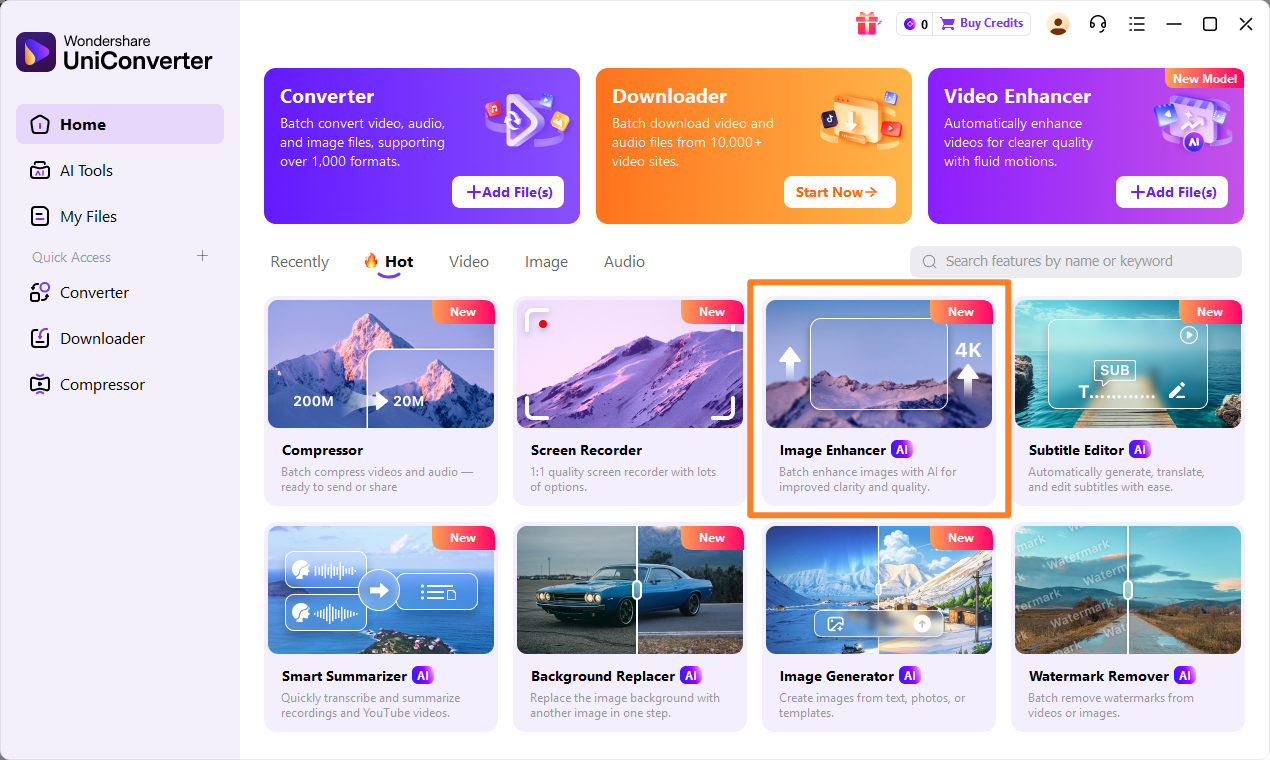
Step 1: Open UniConverter and Choose Image Enhancer
First, launch UniConverter on your computer. Navigate to the "AI Lab" section from the left sidebar and select the "Image Enhancer" tool.
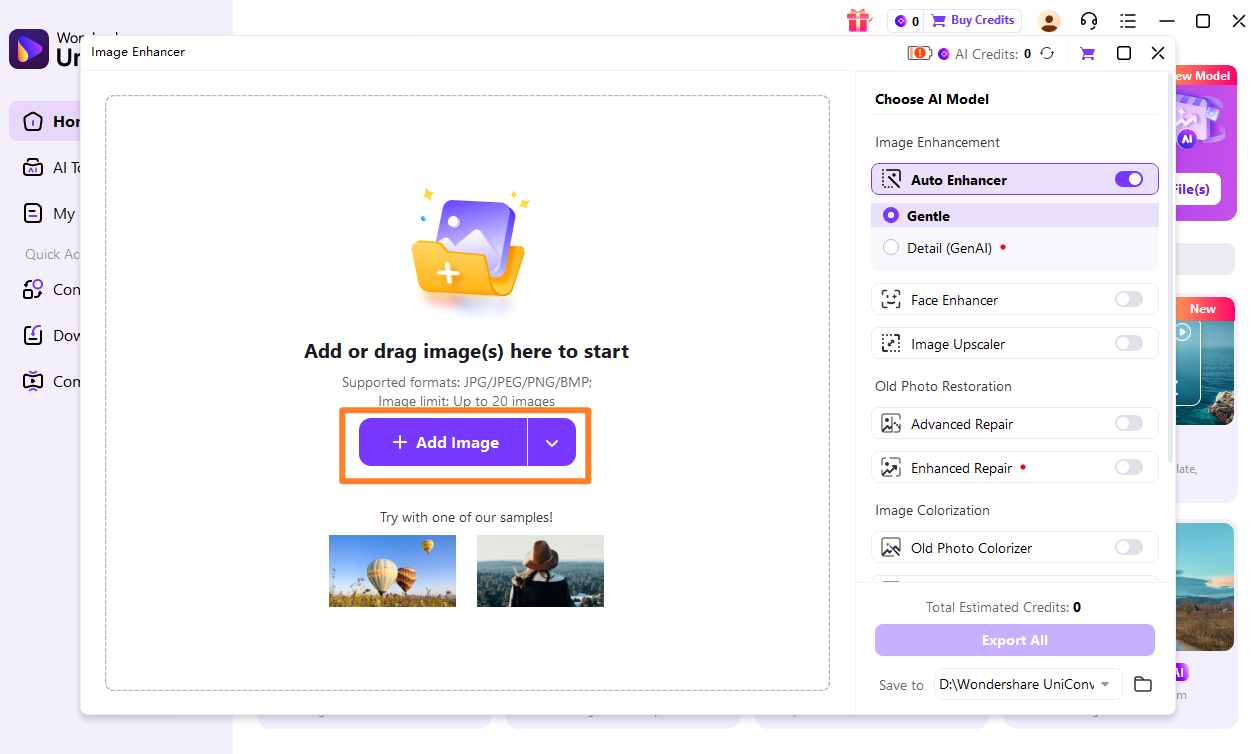
Step 2: Upload the Images
Click on the "Add Files" button or simply drag and drop the images you want to enhance into the UniConverter interface. You can add multiple images for batch processing.
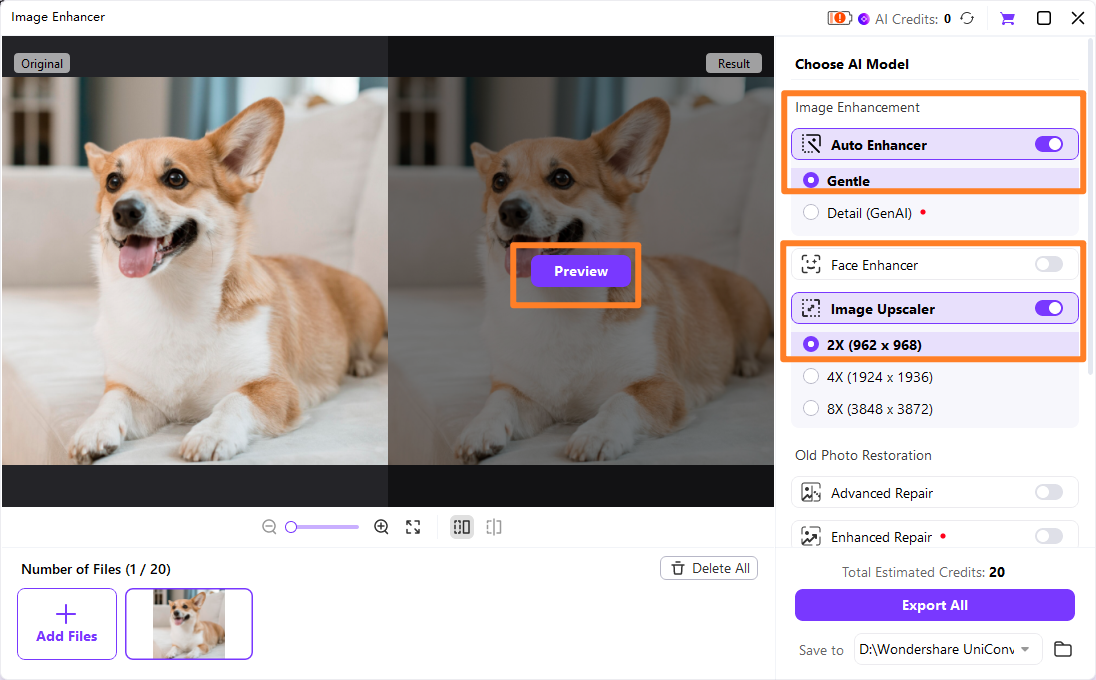
Step 3: Choose Enhancement Model
Select the desired enhancement model based on your image type (e.g., general enhancement, portrait, landscape). You can also adjust upscaling factors if needed.
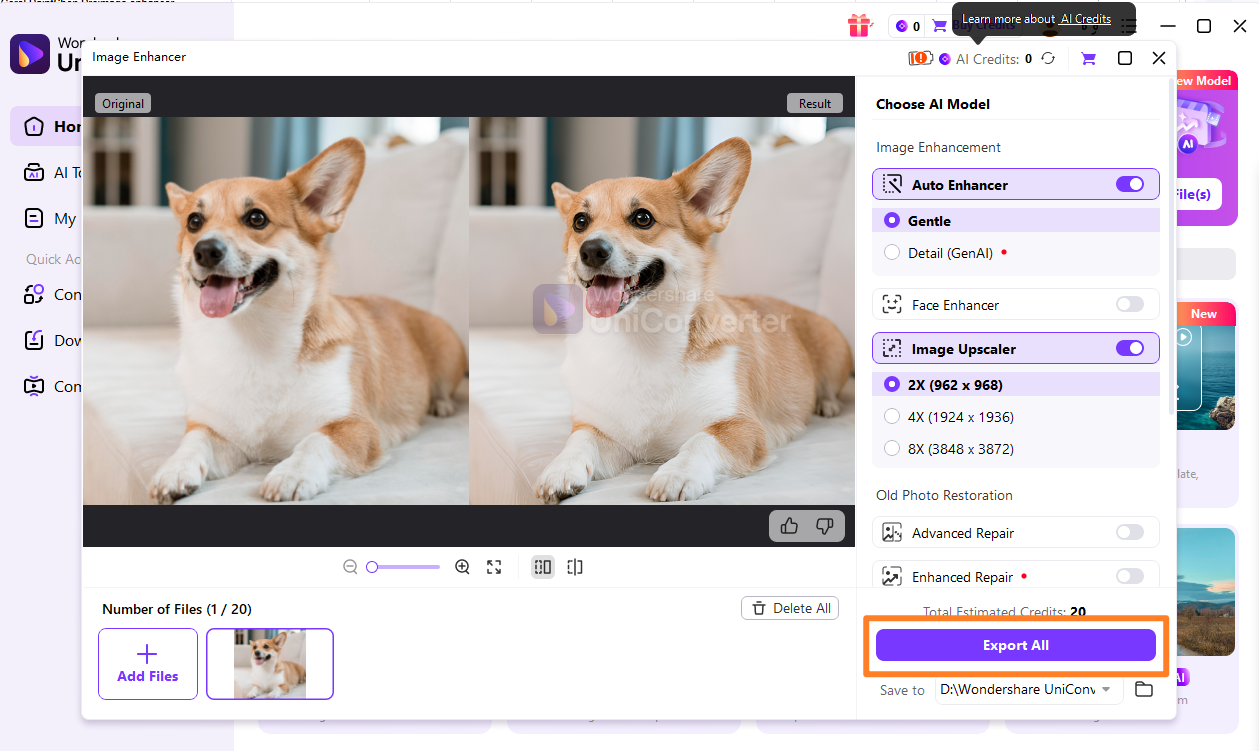
Step 4: Preview and Save the Enhanced Images
After processing, preview the enhanced images to ensure they meet your expectations. Once satisfied, click the "Export" button to save them to your desired location.

Enhance Images Beyond Upscaler.cc
Part 7: Final Verdict and Recommendations
After extensively using and comparing various image enhancement tools, my Upscaler.cc image enhancer review concludes that it serves a specific niche very well. For casual users who need a quick, free, and straightforward way to upscale and slightly improve their social media photos or blog images, Upscaler.cc offers undeniable convenience. Its user-friendly interface means you can get results without any technical know-how. However, for professionals or anyone requiring high-quality, artifact-free results for print, large-scale projects, or intricate detail recovery, investing in more robust solutions like desktop software or advanced online alternatives is a must. These tools offer the customization, control, and consistent output quality that Upscaler.cc simply cannot match. When balancing cost and quality, carefully consider freemium models; while they offer a taste, the limitations often push you towards paid tiers for serious work. Ultimately, prioritizing privacy by choosing reputable offline software like UniConverter for sensitive images is a wise decision.
Part 8: Frequently Asked Questions (FAQs)
-
1. Is Upscaler.cc completely free to use?
Upscaler.cc offers a free tier with certain limitations, typically regarding the number of images you can process or the maximum output resolution. For unlimited usage or higher quality, they usually offer paid subscription plans.
-
2. Can Upscaler.cc improve blurry images significantly?
While Upscaler.cc can enhance details and sharpness, it has limitations with severely blurry images. It can make minor improvements, but it's not a magic bullet for completely out-of-focus or motion-blurred photos. For significant blur reduction, specialized deblurring tools are usually more effective.
-
3. What are the best alternatives to Upscaler.cc for professional use?
For professional use, I highly recommend desktop software like Topaz Gigapixel AI, Adobe Photoshop (with its Super Resolution feature), or Luminar Neo. Online alternatives that offer more advanced features include VanceAI and Let's Enhance, which provide greater control and often better results for complex images.
-
4. How does AI image enhancement work?
AI image enhancement tools use deep learning models, often trained on vast datasets of images. These models learn to recognize patterns, textures, and details, allowing them to intelligently add pixels when upscaling, reduce noise, sharpen edges, and even reconstruct missing information, aiming to make the image look more natural and higher quality.
-
5. Is it safe to upload personal photos to online image enhancers?
It depends on the service. While many reputable services claim to delete uploaded images after processing, there's always a risk when uploading personal or sensitive data to third-party servers. Always review the privacy policy of any online tool you use. For maximum safety, consider using offline desktop software like UniConverter, where your images remain on your computer.
