
- Topaz Video AI Review: Discover Topaz Video AI's strengths for professional-grade video enhancement and restoration.
- Feature Comparison: Compare Topaz Video AI with alternatives like UniConverter, HitPaw, and CapCut for diverse needs.
- Ideal Use Cases: Understand when Topaz Video AI excels (archival restoration) versus when simpler tools are better (social media).
- Risks & Pitfalls: Learn about data privacy, AI artifacts, over-enhancement, and hardware limitations in video enhancement.
- UniConverter Value: See how UniConverter offers a balanced, user-friendly, and efficient alternative for video enhancement.
In this article
- Part 1: What is Topaz Video AI
- Part 2: Topaz Video AI: Core Features, Pros, and Cons
- Part 3: Topaz Video AI: Ideal Users and Use Cases
- Part 4: Topaz Video AI and Alternatives Comparison
- Part 5: Risks and Pitfalls in Video Enhancement
- Part 6: How to Use UniConverter for Efficient Video Enhancement
- Part 7: Conclusion
- Part 8: FAQs
Topaz Video AI vs. Web Video Enhancers: A Scenario-Based Comparison
The digital age has ushered in an unprecedented demand for high-quality visual content. From professional filmmakers to casual social media users, everyone seeks to present their videos in the best possible light. This drive has fueled the rapid development of video enhancement technologies, with tools like Topaz Video AI leading the charge in desktop solutions, while a plethora of web-based enhancers offer convenience and accessibility. This Topaz Video AI review and comparative analysis will delve into the strengths and weaknesses of these different approaches, providing a scenario-based evaluation to help users make informed decisions about their video enhancement needs. We will explore core features, ideal use cases, potential pitfalls, and ultimately, guide you toward the optimal solution for your specific requirements.
Part 1: What is Topaz Video AI
Topaz Video AI is a powerful desktop application designed for professional-grade video enhancement. It leverages advanced artificial intelligence models to upscale footage, remove noise, deinterlace, and stabilize shaky videos, delivering significantly improved visual quality. This Topaz Video AI review aims to provide a comprehensive understanding of its capabilities and positioning within the broader video enhancement market.
The Growing Need for High-Quality Video Enhancement
The proliferation of high-resolution displays and the increasing consumption of video content across various platforms have amplified the demand for pristine video quality. Users are no longer satisfied with blurry or pixelated footage. This trend is driven by several key factors:
* Archival Restoration: The need to breathe new life into old, low-resolution footage for documentaries, historical projects, and personal memories.
* Content Creation Standards: The rising bar for visual fidelity in online content, from YouTube to TikTok, where crisp, clear video is crucial for audience engagement.
* Technological Advancements: The continuous evolution of AI and machine learning, making sophisticated video enhancement accessible to a wider audience.
* Professional Production Demands: Filmmakers and videographers constantly seek tools to refine their raw footage, correct imperfections, and achieve a polished, cinematic look.
Part 2: Topaz Video AI: Core Features, Pros, and Cons
Topaz Video AI stands out in the video enhancement landscape due to its sophisticated AI algorithms and dedicated desktop architecture. Its core capabilities revolve around intelligent upscaling, noise reduction, and stabilization, all powered by deep learning models.
Core Features:
1. AI-Powered Upscaling: Utilizes advanced neural networks to intelligently increase video resolution without introducing pixelation or blur.
2. Intelligent De-noising: Effectively removes various types of video noise (e.g., grain, compression artifacts) while preserving fine details.
3. Motion Deinterlacing: Converts interlaced footage into progressive scan, eliminating combing artifacts and improving motion clarity.
4. Video Stabilization: Smooths out shaky footage, making handheld shots more watchable and professional.
5. Frame Interpolation: Generates new frames to increase frame rate, resulting in smoother motion and slow-motion effects.
Pros:
* Advanced AI-driven upscaling and de-noising for professional results
* Batch processing capabilities for efficient workflow
* Dedicated desktop application for robust performance and offline use
Cons:
* High computational demands requiring powerful hardware
* Steep learning curve for new users
Part 3: Topaz Video AI: Ideal Users and Use Cases
Topaz Video AI is a specialized tool that caters to specific user groups and scenarios where uncompromising quality is paramount. Its robust features and demanding hardware requirements position it firmly in the professional and enthusiast segments.
Best Use Case: Restoring and Enhancing Archival Footage for Documentary Production
For documentary filmmakers, archivists, and historical researchers, Topaz Video AI is an invaluable asset. Imagine a project requiring the integration of decades-old, low-resolution archival footage with modern high-definition content. Topaz Video AI can meticulously upscale this vintage material, remove inherent noise and artifacts, and even stabilize shaky historical recordings, bringing them closer to contemporary visual standards. This allows for seamless integration and a more immersive viewing experience, making it an indispensable tool for preserving and presenting historical narratives with enhanced clarity.
Limited Use Case: Quick, On-the-Fly Enhancements for Social Media Posts
While Topaz Video AI can technically enhance videos for social media, it is significantly overkill and inefficient for this purpose. The software's high computational demands mean that even short clips can take considerable time to process, especially on less powerful machines. For a quick social media post, where speed and immediate sharing are crucial, the time investment in setting up and rendering a video through Topaz Video AI far outweighs the marginal quality improvement. Simpler, faster web-based tools or basic mobile editing apps are far more suitable for these "on-the-fly" enhancement needs.
Part 4: Topaz Video AI and Alternatives Comparison
The video enhancement market offers a spectrum of solutions, from powerful desktop applications to convenient web-based tools. Understanding their differences is key to choosing the right one.
| Feature/Scenario | Topaz Video AI | UniConverter | HitPaw Video Enhancer | CapCut Online |
| Video Quality (Upscaling) | Excellent, AI-driven | Very Good, AI-powered | Excellent, diverse AI models | Good, basic AI |
| Processing Speed | Hardware-dependent, generally fast | Fast, GPU acceleration | Fast, GPU acceleration | Slower, cloud-based |
| Ease of Use | Moderate to Complex | Easy | Moderate | Very Easy |
| Cost Model | One-time purchase | One-time/Subscription | Subscription | Free/Subscription |
| Offline Capability | Yes | Yes | Yes | No |
| Batch Processing | Yes | Yes | Yes | Limited/No |
| Customization | High | Moderate | High | Low |
Topaz Video AI excels in delivering the highest quality AI-driven enhancements, making it ideal for professional use where detail and fidelity are paramount. UniConverter offers a balanced approach, providing robust enhancement capabilities alongside a comprehensive suite of video tools, making it a versatile choice for a wider audience. HitPaw Video Enhancer is a strong contender for dedicated enhancement, often providing comparable quality to Topaz but with a subscription model. CapCut Online, while incredibly user-friendly and convenient for quick edits, offers more basic enhancement features and is limited by internet speed and cloud processing.
Part 5: Risks and Pitfalls in Video Enhancement
Navigating the world of video enhancement, especially with the proliferation of AI-powered tools, comes with its own set of risks and potential pitfalls. Users must be aware of these challenges to avoid undesirable outcomes and protect their data.
Data Privacy Concerns with Cloud-Based Enhancers
Many web-based video enhancers require users to upload their video files to remote servers for processing. This raises significant data privacy concerns, especially for sensitive or personal footage. Users often have little control over how their data is stored, processed, or potentially accessed by third parties. It's crucial to review the privacy policies of such services and consider the implications of entrusting your content to an external server.
Potential for "AI Artifacts" and Unnatural Results
While AI enhancement is powerful, it's not foolproof. Aggressive enhancement settings or poorly trained AI models can introduce "AI artifacts" – unnatural textures, distorted facial features, or a "plastic" look that detracts from the original footage. Over-processing can lead to a loss of organic detail, making the video appear artificial rather than genuinely improved.
Over-Enhancement Leading to Loss of Original Detail
There's a fine line between enhancement and over-enhancement. Pushing parameters like sharpness, noise reduction, or contrast too far can obliterate subtle details, flatten dynamic range, and create a harsh, unnatural aesthetic. The goal should always be to improve, not to fundamentally alter or destroy the original artistic intent and texture of the video.
Subscription Traps and Hidden Costs
Many web-based and even some desktop enhancement tools operate on a subscription model, often with enticing "free trials" that automatically convert to paid subscriptions. Users might also encounter hidden costs for premium features, faster processing, or higher output resolutions. It's essential to thoroughly understand the pricing structure and cancellation policies before committing to any service.
Hardware Limitations for Desktop Solutions
Powerful desktop enhancers like Topaz Video AI demand significant computational resources. Users with older or less powerful computers may experience extremely slow processing times, frequent crashes, or be unable to utilize the software effectively. This hardware barrier can be a significant pitfall for those expecting professional-grade results without the necessary investment in their computing setup.
Part 6: How to Use UniConverter for Efficient Video Enhancement
When other tools fall short with unstable enhancements, weak effects, or lack of batch processing, UniConverter offers a reliable and comprehensive solution. It's an all-in-one video toolkit that can efficiently enhance your videos without ads, supporting a wide range of formats, leveraging GPU acceleration for speed, and ensuring stable, lossless quality with batch processing capabilities.
UniConverter: Your All-in-One Video Toolkit
UniConverter provides a robust platform for all your video needs, including powerful AI-driven enhancement. It's designed to be user-friendly while delivering professional results, making it an excellent alternative for those seeking a balanced approach to video quality improvement. With its advanced features, you can easily upscale video or stabilize shaky footage, ensuring your content always looks its best. For those looking to refine their visuals even further, the AI image enhancer can also be a valuable tool.
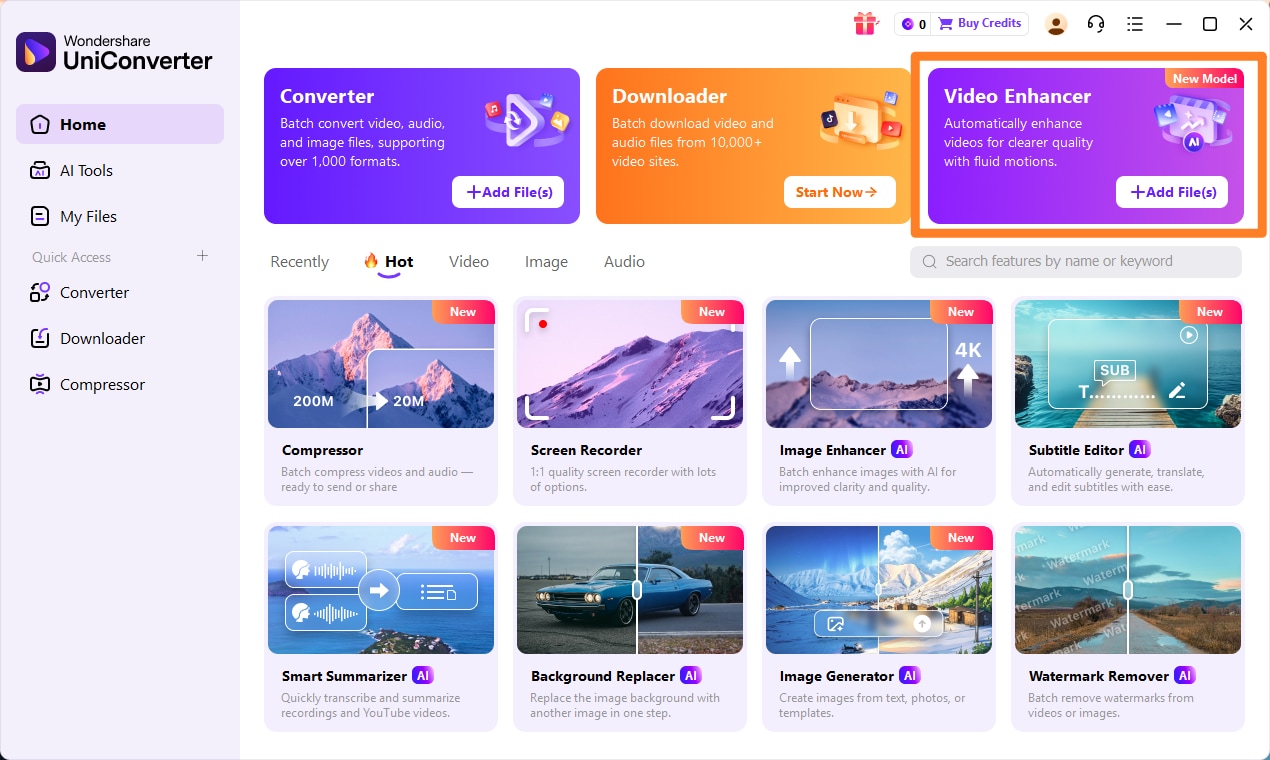
Step 1: Open UniConverter and Choose Video Enhancer
Launch UniConverter on your computer. From the main interface, navigate to the "AI Lab" section and select the "Video Enhancer" tool.
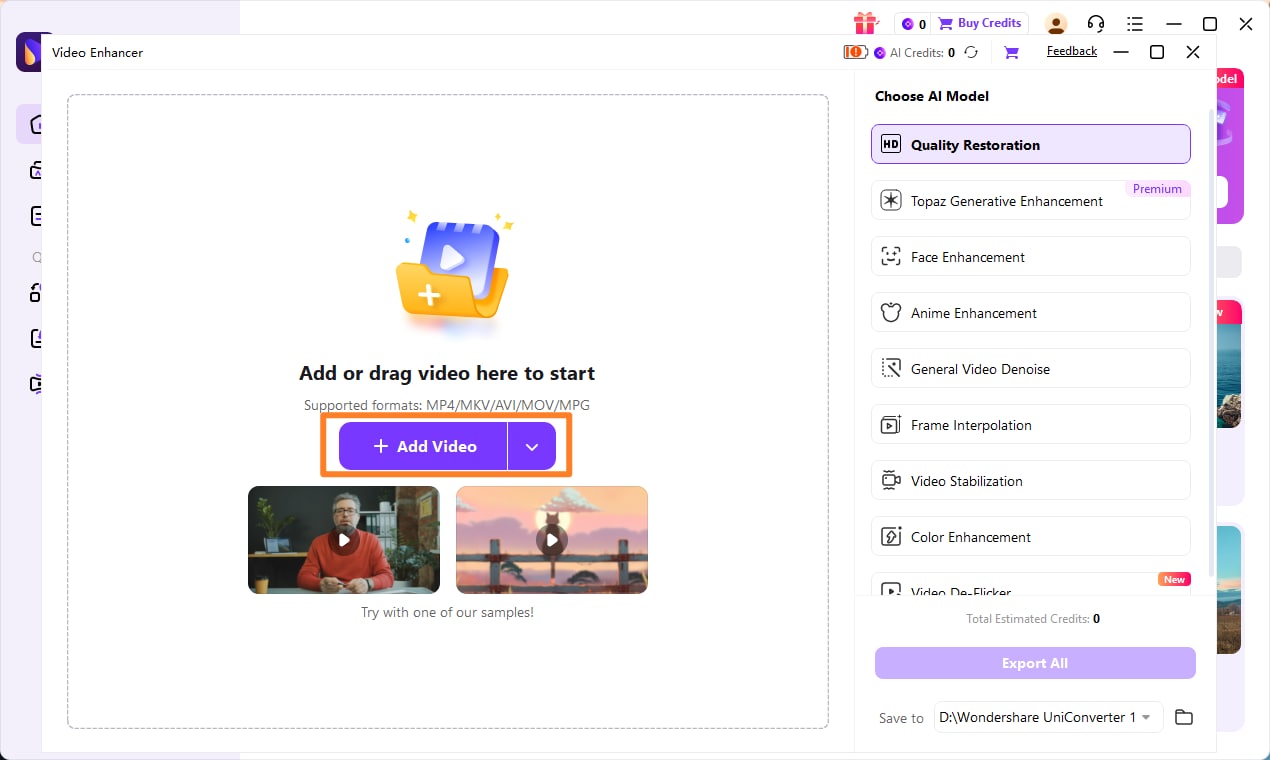
Step 2: Upload the Videos
Click on the "Add Files" button or drag and drop the video files you wish to enhance into the designated area. You can add multiple videos for batch processing.
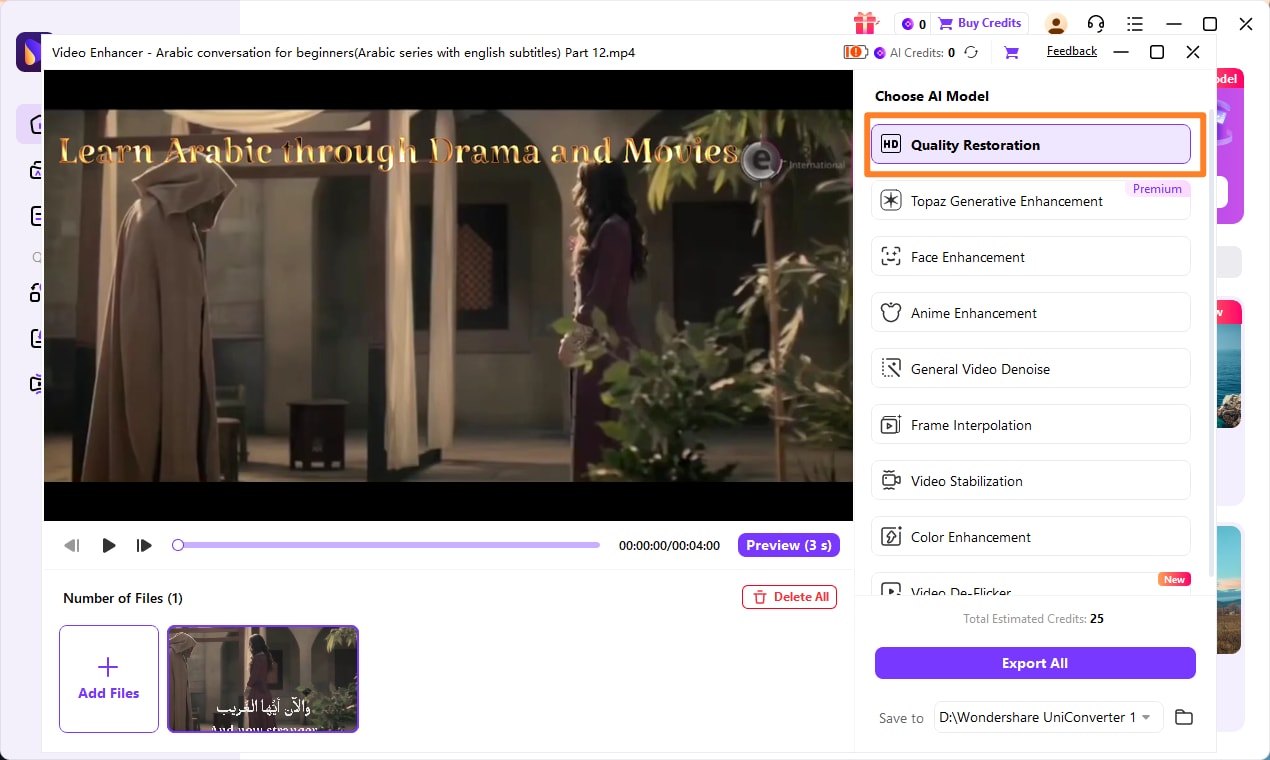
Step 3: Choose Enhancement Model
Select the desired AI enhancement model (e.g., AI Upscaling, AI Denoise, AI Stabilization) and adjust specific parameters as needed. UniConverter offers various options to fine-tune the enhancement process.
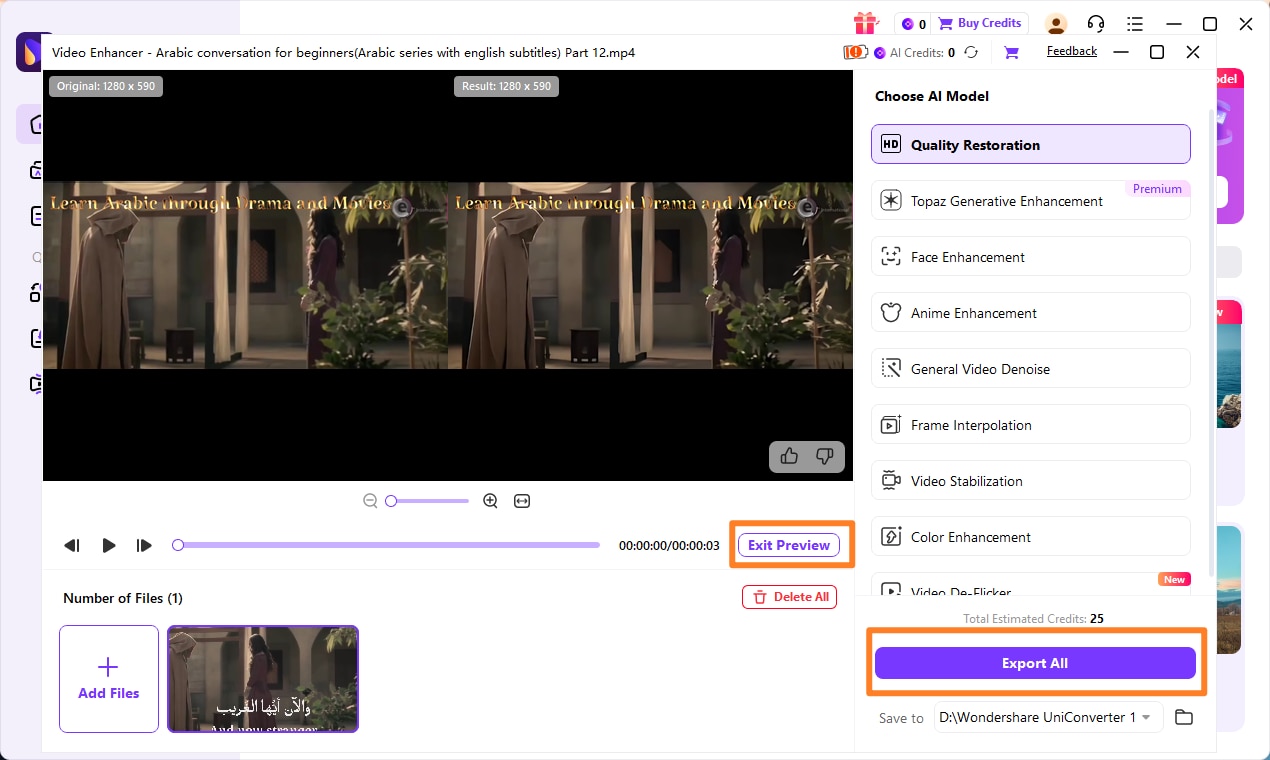
Step 4: Preview and Save the Enhanced Video
After selecting your enhancement options, you can often preview a segment of the enhanced video to ensure it meets your expectations. Once satisfied, click the "Export" or "Save" button to process and save your enhanced video.

Seeking a Topaz Video AI Alternative?
Part 7: Conclusion
Choosing the right video enhancement tool hinges entirely on your specific needs, technical expertise, and available resources. This Topaz Video AI review has highlighted its unparalleled capabilities for professional-grade restoration and upscaling, making it the go-to choice for archivists, filmmakers, and serious enthusiasts who prioritize ultimate quality and have the hardware to support it. For casual users or those needing quick, minor adjustments for social media, web-based enhancers offer undeniable convenience and ease of use, albeit with potential compromises in quality and privacy. However, for a balanced solution that combines powerful AI enhancement with a comprehensive suite of video tools, offline capability, and a user-friendly interface, UniConverter emerges as a highly recommended option. Before making a decision, carefully consider your project's demands, your comfort level with complex software, and your budget, ensuring the chosen tool aligns perfectly with your video enhancement journey.
Part 8: FAQs
-
1. Is Topaz Video AI worth the price?
Topaz Video AI is a premium product with a one-time purchase cost. It is worth the price for professionals, videographers, and serious enthusiasts who require the highest quality AI-driven upscaling, de-noising, and stabilization for critical projects like archival restoration or film production, where the superior results justify the investment.
-
2. Can web video enhancers truly achieve professional-grade results?
Generally, web video enhancers struggle to achieve professional-grade results comparable to dedicated desktop applications like Topaz Video AI. While they offer convenience and basic improvements, they are often limited by cloud processing power, compression, and less sophisticated AI models, leading to lower output quality and fewer customization options.
-
3. What are the minimum system requirements for Topaz Video AI?
Topaz Video AI requires a powerful system, typically an Intel i7 or AMD Ryzen 7 processor (or newer), 16GB RAM (32GB recommended), and a dedicated GPU (NVIDIA RTX 2060 or AMD Radeon RX 5600 XT or newer with at least 6GB VRAM is highly recommended) for efficient processing.
-
4. How do I choose between a desktop and a web-based video enhancer?
Choose a desktop enhancer if you prioritize maximum quality, offline processing, extensive control, and have powerful hardware. Opt for a web-based enhancer if you need quick, simple enhancements, prefer not to install software, and are comfortable with cloud processing, often for less critical projects or social media.
-
5. Does video enhancement always improve video quality?
No, video enhancement does not always guarantee an improvement. Over-enhancement can introduce "AI artifacts," unnatural textures, or loss of original detail. The effectiveness depends on the quality of the original footage, the specific enhancement tool used, and the user's ability to apply settings judiciously.
