
- Topaz Video AI excels at AI-powered upscaling and detail recovery for challenging footage.
- Consider UniConverter for faster processing, broader features, and user-friendly video enhancement.
- Topaz requires significant hardware and time; UniConverter offers efficient, GPU-accelerated alternatives.
- Evaluate your needs: Topaz for professional archival restoration, UniConverter for balanced everyday enhancement.
- Beware of AI artifacts and high costs with Topaz; UniConverter provides consistent, lossless enhancement.
- Make an informed decision by comparing features, speed, and ease of use against your specific project requirements.
In this article
- Part 1: What is Topaz Video AI
- Part 2: Topaz Video AI: Core Features, Pros, and Cons
- Part 3: Topaz Video AI: Ideal Users and Use Cases
- Part 4: Topaz Video AI and Alternatives: A Comparative Analysis
- Part 5: Risks and Pitfalls to Consider
- Part 6: How to Use UniConverter for Efficient Video Enhancement
- Part 7: Conclusion
- Part 8: FAQs
Topaz Video AI Review: A Deep Dive into AI-Powered Video Enhancement
The digital age has ushered in an unprecedented demand for high-quality video content. As creators and consumers alike seek sharper, clearer, and more immersive visual experiences, the challenge of enhancing older, lower-resolution footage has become paramount. This is where AI-powered video upscaling tools step in, promising to breathe new life into pixelated memories and archival treasures. Among these, Topaz Video AI has emerged as a prominent player, leveraging sophisticated artificial intelligence to transform video quality. This Topaz Video AI review will delve into its capabilities, compare it with key competitors, and provide a comprehensive guide to its strengths, weaknesses, and ideal applications, helping you make an informed decision in your video enhancement journey.
Part 1: What is Topaz Video AI
Topaz Video AI is a standalone desktop application developed by Topaz Labs, renowned for its AI-powered image and video enhancement software. It specializes in intelligent video upscaling, deinterlacing, motion interpolation, and noise reduction, aiming to improve the visual fidelity of footage that is often compromised by lower resolutions, compression artifacts, or aged recording formats. This review seeks to address the core question: Can Topaz Video AI truly deliver broadcast-quality enhancements, or are its promises overshadowed by practical limitations?
The Evolving Landscape of Video Enhancement Needs
* The Proliferation of Legacy Footage: A vast amount of valuable content exists in formats that no longer meet modern display standards.
* Demand for Higher Quality Across Platforms: From streaming services to social media, viewers expect crisp, high-definition visuals.
* Limitations of Traditional Upscaling Methods: Simple interpolation often leads to blurry or artificial-looking results.
* The Promise of AI in Visual Processing: AI offers the potential for intelligent, context-aware enhancement that goes beyond simple pixel stretching.
Part 2: Topaz Video AI: Core Features, Pros, and Cons
Topaz Video AI stands out for its dedicated focus on leveraging AI models to reconstruct and enhance video frames. Its core capabilities revolve around intelligently increasing resolution, stabilizing shaky footage, removing noise, and improving overall clarity. The software's strength lies in its ability to analyze individual frames and apply sophisticated algorithms to generate missing detail, rather than simply stretching pixels.
Pros of Topaz Video AI
* Unparalleled Upscaling and Detail Recovery: Utilizes advanced AI models to genuinely "create" detail, not just interpolate, resulting in remarkably sharp and natural-looking upscales.
* Advanced Deinterlacing and Noise Reduction: Effectively removes interlacing artifacts and significantly reduces various types of video noise without sacrificing too much detail.
* Intuitive Interface for Professional and Enthusiast Users: Despite its complex underlying technology, the user interface is relatively straightforward, allowing users to quickly apply presets or fine-tune settings.
Cons of Topaz Video AI
* High System Requirements and Processing Times: Demands significant GPU power and RAM, leading to extremely long processing times, especially for longer or higher-resolution videos.
* Steep Learning Curve for Optimal Results: Achieving the best possible outcome often requires experimentation with different AI models and settings, which can be time-consuming for new users.
Part 3: Topaz Video AI: Ideal Users and Use Cases
Topaz Video AI caters to a specific niche within the video production and archiving landscape. Its strengths are most evident when dealing with footage that genuinely benefits from AI-driven reconstruction, rather than simple scaling. Understanding its ideal applications is crucial for prospective users.
Best Use Case: Restoring Archival Footage for Documentary Filmmaking
Imagine a documentary filmmaker unearthing decades-old 480p footage crucial to their narrative. This footage, often riddled with interlacing, noise, and low resolution, is a perfect candidate for Topaz Video AI. The software can meticulously deinterlace, reduce grain, and upscale the video to 1080p or even 4K, making it seamlessly integrate with modern high-definition content. The time investment in processing is justified by the historical and artistic value of the restored material, allowing for a professional, consistent look across diverse source materials.
Limited Use Case: Quick Edits for Social Media Content Creation
For a social media content creator needing to quickly enhance a short clip for an Instagram Reel or TikTok, Topaz Video AI is often overkill. The lengthy processing times and the need for powerful hardware make it impractical for rapid turnaround projects. Simpler, faster tools or even built-in platform enhancements would be more suitable, as the marginal quality gain from Topaz Video AI might not justify the significant time and resource expenditure for ephemeral content.
Part 4: Topaz Video AI and Alternatives: A Comparative Analysis
When considering video enhancement, Topaz Video AI isn't the only player. A comparative look at its alternatives reveals distinct philosophies and feature sets, each catering to different user needs and technical requirements.
| Feature / Product | Topaz Video AI | UniConverter | DaVinci Resolve Studio | Adobe Premiere Pro (with plugins) |
| Processing Speed | Slow (GPU-intensive, AI models) | Fast (GPU acceleration, optimized algorithms) | Moderate (GPU-accelerated, complex workflows) | Moderate (GPU-accelerated, plugin dependent) |
| Output Quality | Excellent (AI-driven detail reconstruction) | Very Good (Lossless conversion, smart enhancement) | Excellent (Professional grading, extensive tools) | Excellent (Industry standard, vast plugin ecosystem) |
| Ease of Use | Moderate (Requires model selection/tuning) | High (Intuitive UI, one-click options) | Low (Steep learning curve for full features) | Moderate (Industry standard, but feature-rich) |
| Customer Support | Responsive (Dedicated support, community forum) | Responsive (Email, live chat, knowledge base) | Extensive (Blackmagic Design, community forums) | Extensive (Adobe, vast online resources) |
| Security | Local processing (Data stays on device) | Local processing (Data stays on device) | Local processing (Data stays on device) | Local processing (Data stays on device) |
| Primary Focus | AI Video Upscaling/Enhancement | All-in-one Video Toolbox (Conversion, Editing, etc.) | Professional Video Editing, Color Grading, VFX | Professional Video Editing, Post-Production |
| Cost | One-time purchase (with optional upgrades) | Subscription/One-time purchase | One-time purchase (for Studio version) | Subscription |
Topaz Video AI excels in its dedicated AI upscaling capabilities, often producing results that general-purpose editors struggle to match in terms of detail recovery. However, UniConverter offers a more balanced approach for everyday users, combining fast processing with a wide array of features. DaVinci Resolve Studio and Adobe Premiere Pro, while offering some enhancement tools (often via third-party plugins), are primarily full-fledged editing suites where enhancement is one component of a larger workflow. For pure, AI-driven enhancement, Topaz Video AI is a specialist, whereas the others are generalists with varying degrees of enhancement capabilities.
Part 5: Risks and Pitfalls to Consider
While Topaz Video AI offers impressive capabilities, users should be aware of several potential risks and pitfalls that can impact the final output and overall user experience. These considerations are crucial for managing expectations and making informed decisions.
Potential for "AI Artifacts" and Unnatural Results
Despite its sophistication, AI upscaling is not perfect. Depending on the source material's quality and the chosen AI model, Topaz Video AI can sometimes introduce "AI artifacts." These might manifest as waxy skin textures, overly smoothed details, or strange geometric patterns that weren't present in the original footage, making the enhanced video look unnatural or artificial.
Significant Investment in Hardware and Software
Topaz Video AI is a demanding application. It requires a powerful GPU (NVIDIA RTX series or AMD equivalents are highly recommended) and ample RAM. This means a significant upfront investment in hardware for users who don't already possess a high-end system. Furthermore, the software itself is a premium product, adding to the overall cost.
Output Quality Consistency Across Different Source Materials
The performance of Topaz Video AI can vary wildly depending on the input video. Highly compressed, heavily artifacted, or extremely low-resolution footage might not see the dramatic improvements expected, and in some cases, the AI might struggle to interpret the data, leading to less-than-ideal results. Consistency is not guaranteed across all types of source material.
Limited Creative Control Compared to Traditional Editing Tools
While Topaz Video AI excels at enhancement, it is not a creative editing suite. Users have limited control over aspects like color grading, precise cuts, or special effects. It's a tool designed for a specific task – improving video quality – and should be integrated into a broader post-production workflow rather than used as a standalone solution for all video needs.
Part 6: How to Use UniConverter for Efficient Video Enhancement
When other tools fall short in batch processing, stable enhancement, or delivering noticeable improvements, UniConverter emerges as a robust alternative. It offers a comprehensive, ad-free solution for video enhancement, leveraging GPU acceleration for speed, supporting a vast array of formats, and ensuring stable, lossless quality. UniConverter is an all-in-one ultimate solution for your video needs.
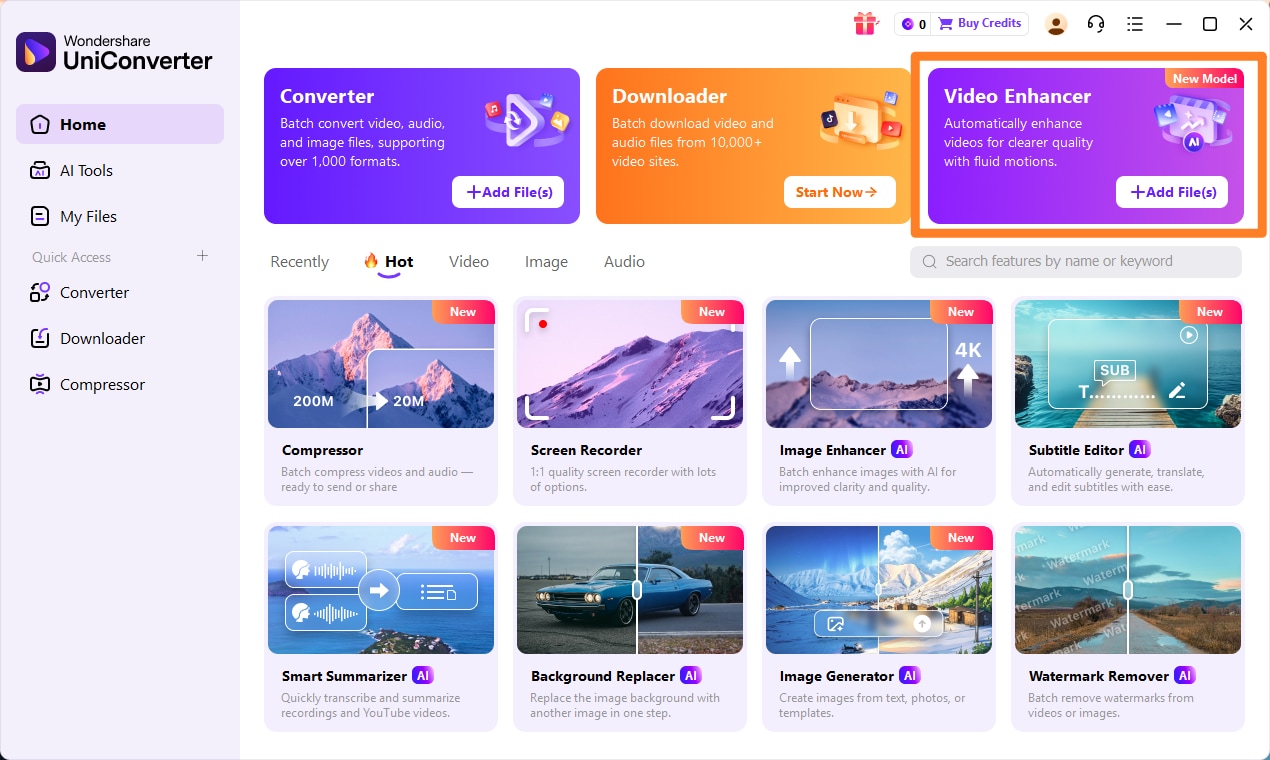
Step 1: Open UniConverter and Choose Video Enhancer
Launch UniConverter on your computer. From the main interface, navigate to the "Toolbox" section and select the "Video Enhancer" feature.
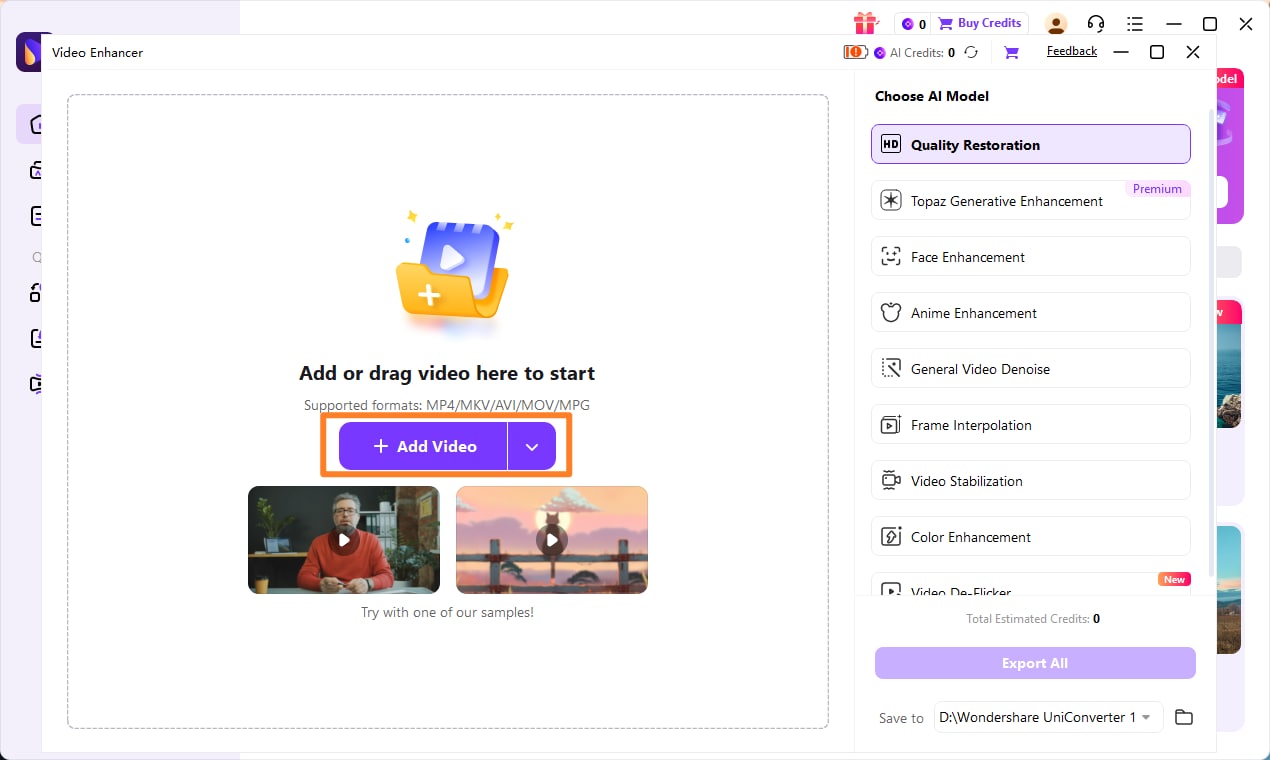
Step 2: Upload the Videos
Click on the "Add Files" button or drag and drop your video files directly into the UniConverter interface. You can add multiple videos for batch processing.
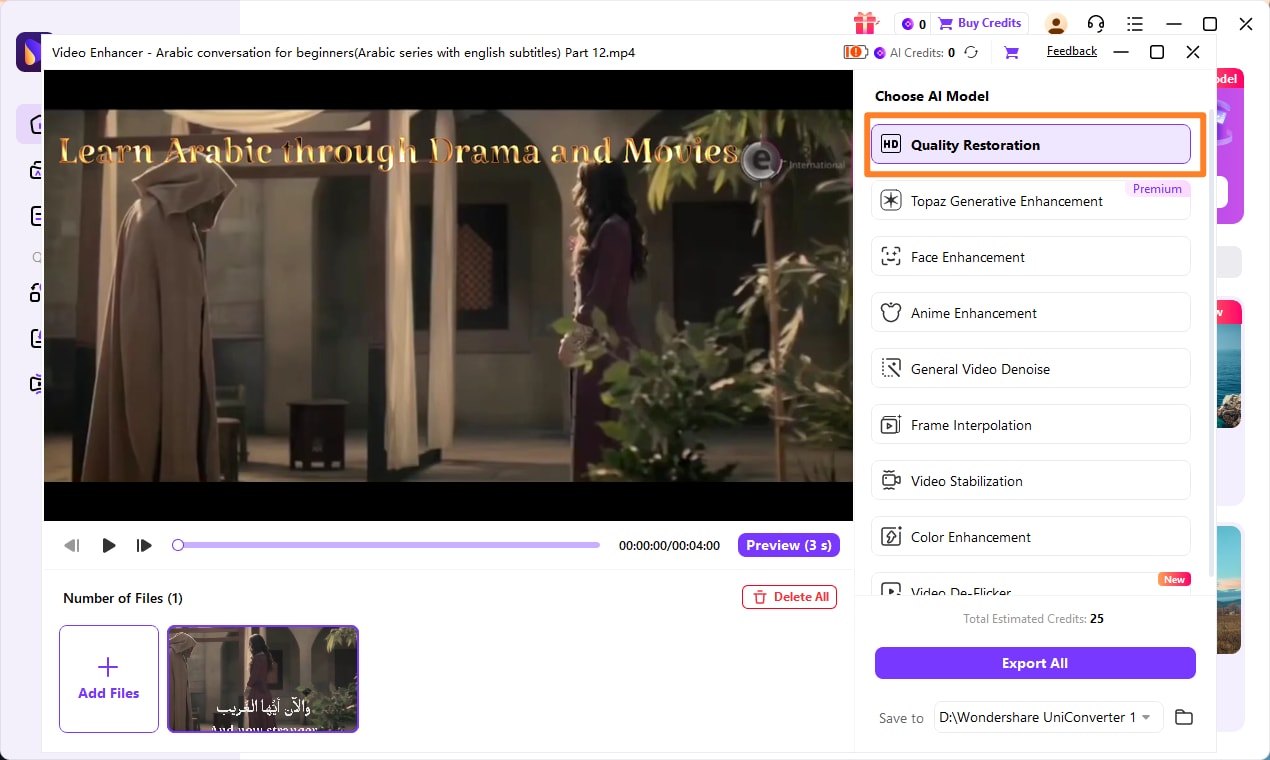
Step 3: Choose Enhancement Model
UniConverter offers various enhancement options such as "Upscale Resolution," "Optimize Brightness and Contrast," "Remove Video Noise," and "Stabilize Video." Select the desired features based on your video's needs. For instance, you might want to change the background of your video or remove the background without losing quality to achieve a specific visual effect. You can also use the background replacer to easily modify your video's setting.
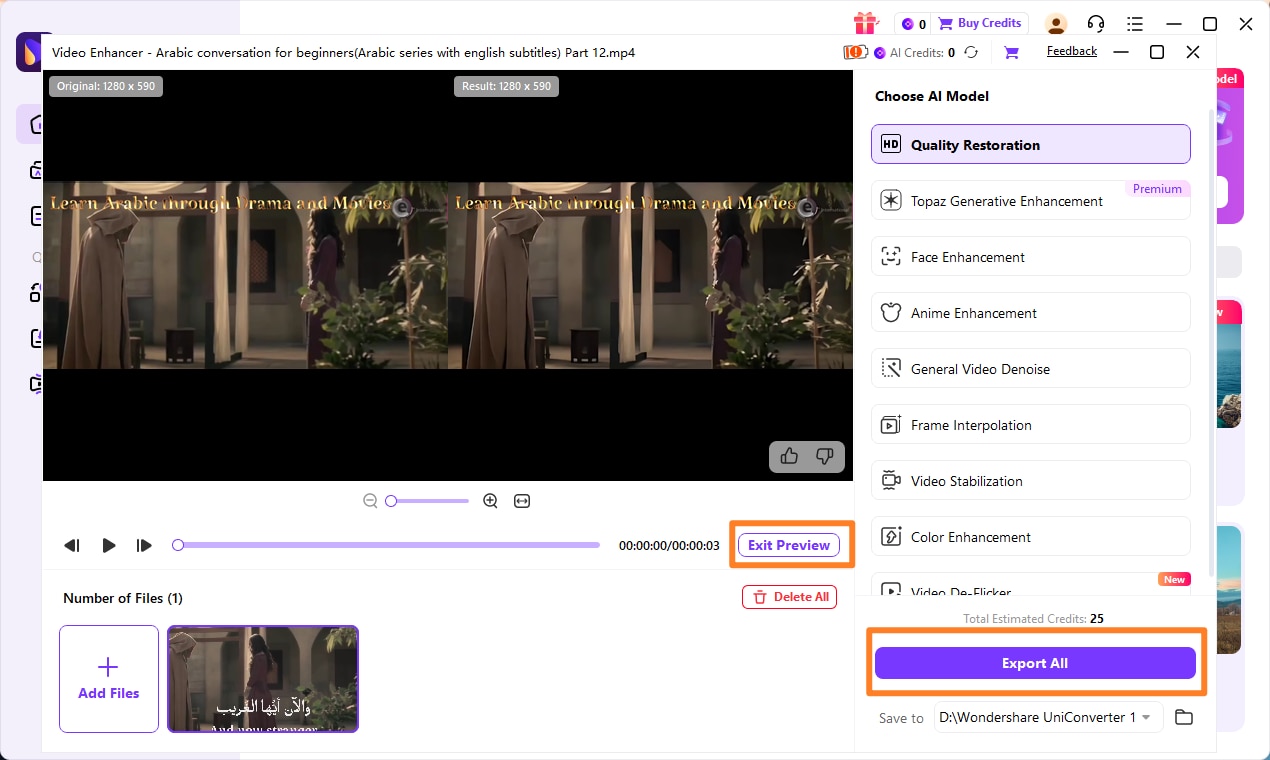
Step 4: Preview and Save the Enhanced Video
After selecting your enhancement options, you can preview the changes to ensure satisfaction. Once ready, choose your desired output format and destination folder, then click "Enhance" to start the conversion and saving process. This powerful tool can even help you achieve high-definition background removal for professional results.

Seeking a Topaz Video AI Alternative?
Part 7: Conclusion
This Topaz Video AI review has explored the capabilities, advantages, and limitations of this powerful AI-driven video enhancement tool. Topaz Video AI stands out for its exceptional ability to upscale and restore detail in challenging footage, making it an invaluable asset for professionals working with archival material or those demanding the highest possible quality from lower-resolution sources. However, its high system requirements, lengthy processing times, and potential for AI artifacts mean it's not a one-size-fits-all solution. For professional archivists and filmmakers, the investment in Topaz Video AI is often justified by the unparalleled quality it can achieve. Enthusiasts seeking high-quality upscaling for personal projects will also find it beneficial, provided they have the necessary hardware and patience. For casual users needing quick and easy solutions, or those requiring a broader set of video tools, alternatives like UniConverter offer a more balanced and efficient approach. Ultimately, the best choice depends on your specific needs, budget, and technical infrastructure.
Part 8: FAQs
-
1. Is Topaz Video AI worth the price?
Topaz Video AI is a premium product. Its worth depends heavily on your use case. For professional work involving critical archival footage or high-end video production where quality is paramount, the investment is often justified. For casual users, it might be an expensive overkill.
-
2. What are the minimum system requirements for Topaz Video AI?
While Topaz Labs provides minimum specifications, for a smooth and efficient experience, a dedicated GPU (NVIDIA RTX 2060 or AMD Radeon RX 5600 XT or newer is recommended), at least 16GB of RAM, and a modern multi-core processor are highly advisable.
-
3. Can Topaz Video AI improve the quality of highly compressed videos?
Topaz Video AI can significantly improve highly compressed videos by reducing artifacts and noise. However, it cannot magically restore detail that was completely lost during extreme compression. It can make the video look much better, but it won't create information that was never there.
-
4. How does Topaz Video AI compare to free upscaling tools?
Topaz Video AI generally outperforms free upscaling tools in terms of detail recovery, artifact reduction, and overall naturalness of the enhanced image. Free tools often rely on simpler algorithms that can lead to blurrier or more artificial-looking results.
-
5. Does Topaz Video AI offer a free trial?
Yes, Topaz Video AI typically offers a free trial period, allowing users to test its capabilities with their own footage before committing to a purchase. This is highly recommended to assess its performance on your specific source material and hardware.
