
- TensorPix Overview: AI-powered video enhancer for upscaling, denoising, and restoring footage to modern standards.
- Pros & Cons: Advanced AI and user-friendly interface vs. subscription cost and potentially long processing times.
- Ideal Users: Best for professional videographers and content creators needing high-quality, regular enhancements.
- Comparison: TensorPix excels in dedicated AI restoration; UniConverter offers broader features and speed; Topaz AI for specific enhancements; DaVinci Resolve for comprehensive editing.
- Risks: Cloud-based service raises data privacy concerns, potential for over-processing artifacts, and internet dependency.
- UniConverter Alternative: Offers efficient, stable, and lossless video/image enhancement, bypassing common issues like watermarks and ads.
- Decision Factor: Choose TensorPix for premium AI enhancement if budget allows; consider UniConverter for versatile, efficient, and cost-effective solutions.
In this article
- Part 1: What is TensorPix?
- Part 2: TensorPix: Core Features, Pros, and Cons
- Part 3: TensorPix: Ideal Users and Use Cases
- Part 4: TensorPix and Alternatives Comparison
- Part 5: Risks and Pitfalls to Consider
- Part 6: How to Use UniConverter to Efficiently Enhance Videos and Images
- Part 7: Conclusion
- Part 8: FAQs
TensorPix Review: Is It the Best AI Video Enhancer for You?
The demand for high-quality video content has never been greater, yet many creators and enthusiasts still grapple with footage that falls short of modern visual standards. Whether it's old home videos, archival footage, or even recently shot content under less-than-ideal conditions, the need to enhance and restore video quality is a pervasive challenge. This TensorPix review delves into one of the prominent AI-powered solutions aiming to bridge this gap, offering a detailed analysis of its capabilities, comparing it against key competitors, and ultimately helping you determine if it's the right tool for your specific video enhancement needs. We'll explore its core features, ideal use cases, potential pitfalls, and provide a comprehensive verdict to guide your decision-making process.
Part 1: What is TensorPix?
TensorPix is an advanced AI-powered video enhancement platform designed to upscale, denoise, deblur, and restore video footage, transforming low-quality or old videos into crisp, high-resolution masterpieces. Leveraging sophisticated machine learning algorithms, it aims to breathe new life into digital content, making it suitable for modern viewing standards. This review will critically examine TensorPix's effectiveness, ease of use, and value proposition in a competitive market.
The Rise of AI Video Enhancement Tools
The proliferation of digital video has led to a significant demand for tools that can improve visual quality. This trend is driven by several factors:
* Legacy Content Preservation: A vast archive of historical and personal videos exists in lower resolutions, requiring enhancement for contemporary displays.
* User-Generated Content: The rise of social media and amateur videography often results in footage captured with varying quality, necessitating post-production improvements.
* Technological Advancements: AI and machine learning have matured to a point where they can intelligently analyze and reconstruct video frames, offering capabilities previously impossible.
Part 2: TensorPix: Core Features, Pros, and Cons
TensorPix stands out with its robust set of features aimed at comprehensive video improvement. Its core capabilities include AI upscaling, which intelligently increases video resolution without significant loss of detail, and advanced restoration tools that tackle issues like noise, blur, and compression artifacts. The platform also boasts color correction and stabilization features, providing a holistic approach to video enhancement. It supports a wide array of input and output formats, making it versatile for various workflows.
Pros
* Advanced AI Algorithms for Upscaling and Restoration: Delivers impressive results in enhancing resolution and repairing damaged footage.
* User-Friendly Interface for Quick Enhancements: Designed for intuitive navigation, allowing users to achieve professional results without a steep learning curve.
* Wide Range of Supported Formats: Accommodates diverse video files, ensuring compatibility with most projects.
Cons
* Subscription-Based Model Can Be Pricey for Casual Users: The cost might be a barrier for those with infrequent enhancement needs.
* Processing Time Can Be Lengthy for High-Resolution Videos: Complex enhancements, especially for 4K or 8K footage, can require significant time.
Part 3: TensorPix: Ideal Users and Use Cases
TensorPix is primarily geared towards users who require high-quality video enhancement on a regular basis and are willing to invest in a premium solution. Its advanced AI capabilities make it suitable for demanding projects where visual fidelity is paramount.
Best Use Case: Professional Videographers and Content Creators
For professionals working with archival footage, documentary filmmaking, or creating high-end marketing content, TensorPix offers the tools to elevate video quality to broadcast standards. Its ability to upscale and restore old footage can be invaluable for projects requiring historical accuracy and visual excellence.
Limited Use Case: Quick Social Media Edits on the Go
While TensorPix can certainly enhance videos for social media, its processing times and subscription model might be overkill for users who only need quick, minor adjustments for casual posts. Simpler, faster, and often free mobile editing apps might be more appropriate for such scenarios.
Part 4: TensorPix and Alternatives Comparison
Understanding how TensorPix stacks up against its rivals is crucial for making an informed decision. Here's a comparison with some notable alternatives.
| Feature/Product | TensorPix | UniConverter | Topaz Video AI | DaVinci Resolve |
| AI Upscaling Quality | Excellent | Good | Excellent | Good |
| Ease of Use | High | High | Medium | Low |
| Pricing Model | Subscription | One-time Purchase | One-time Purchase | Freemium |
| Processing Speed | Moderate | Fast | Moderate | Fast |
| Supported Formats | Extensive | Extensive | Extensive | Extensive |
TensorPix excels in its dedicated AI-powered restoration, often providing superior results for complex enhancement tasks. UniConverter offers a more comprehensive toolkit beyond just enhancement, with a strong focus on speed and ease of use for a broader range of video tasks. Topaz Video AI is a strong contender for pure AI upscaling and frame interpolation, often matching or exceeding TensorPix in specific enhancement qualities but with a steeper learning curve. DaVinci Resolve, while offering powerful editing and color grading, has a less intuitive AI enhancement workflow for beginners.
Key Differentiators: TensorPix's Edge in AI-Powered Restoration
TensorPix's primary advantage lies in its specialized AI models, which are finely tuned for various restoration tasks. This focused approach often yields more natural and artifact-free results compared to more general-purpose video software. Its cloud-based processing can also offload intensive tasks from local hardware, though this comes with its own set of considerations.
Part 5: Risks and Pitfalls to Consider
While TensorPix offers compelling benefits, users should be aware of potential risks and drawbacks, especially concerning cloud-based AI services.
Data Privacy and Security Concerns
As a cloud-based service, uploading sensitive or proprietary video content to TensorPix raises questions about data privacy and security. Users must trust the platform's security protocols to protect their intellectual property and personal data from unauthorized access or breaches.
Potential for Over-Processing and Artifacts
Aggressive AI enhancement can sometimes lead to an "over-processed" look, where videos lose their natural texture and appear artificial. Ghosting, shimmering, or other visual artifacts can also emerge, especially with highly compressed or severely damaged source footage, requiring careful parameter adjustment.
Subscription Cost vs. Value Proposition
The subscription model, while offering continuous updates and cloud access, can become a significant recurring expense. For users with infrequent enhancement needs, the cumulative cost might outweigh the benefits compared to a one-time purchase solution or even free alternatives for simpler tasks.
Dependence on Internet Connection for Cloud Processing
Since TensorPix heavily relies on cloud processing, a stable and fast internet connection is essential. Slow or intermittent internet can severely impact upload times, processing speed, and overall workflow efficiency, making it less ideal for users in areas with poor connectivity.
Part 6: How to Use UniConverter to Efficiently Enhance Videos and Images
When other tools fall short in batch processing, stable enhancement, or delivering noticeable improvements, UniConverter emerges as a robust alternative. It bypasses common issues like watermarks, ads, and inconsistent quality, offering a seamless and powerful solution for all your video and image enhancement needs. With its comprehensive suite of features, including extensive format support, GPU acceleration for faster processing, and stable, lossless output, UniConverter stands as an all-in-one ultimate solution for enhancing your media.
Step 1: Open UniConverter and Choose Video Enhancer
Launch UniConverter on your computer. Navigate to the "Toolbox" section and select the "Video Enhancer" feature. This will open the dedicated enhancement module.

Step 2: Upload the Videos
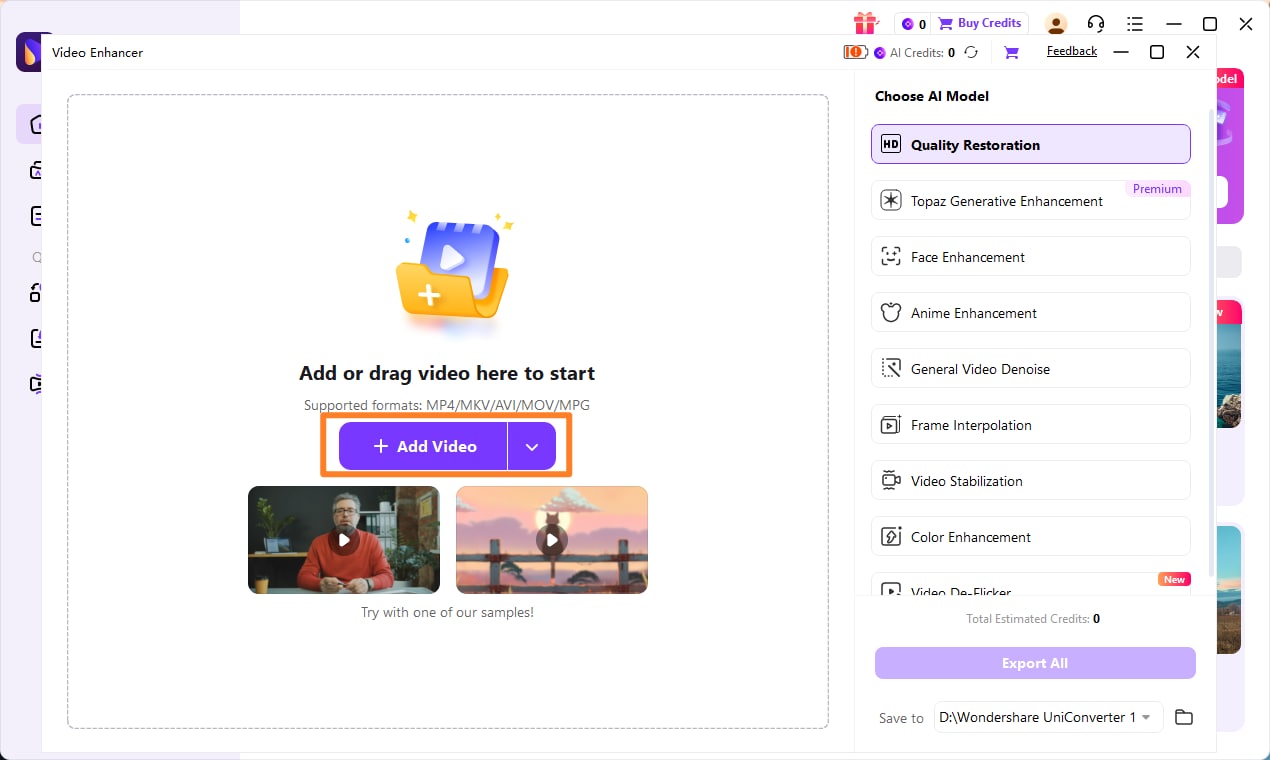
Click on the "Add Files" button or drag and drop your video files directly into the UniConverter interface. You can add multiple videos for batch processing.
Step 3: Choose Enhancement Options
Once your videos are loaded, you'll see various enhancement options such as "Upscale," "Denoise," "Stabilize," and "Adjust Brightness." Select the desired enhancements for your videos. UniConverter also offers advanced features like a background replacer to further refine your visuals. You can easily change video background to create professional-looking content. For images, you can use the online background remover to achieve precise edits.

Step 4: Preview and Save the Enhanced Video
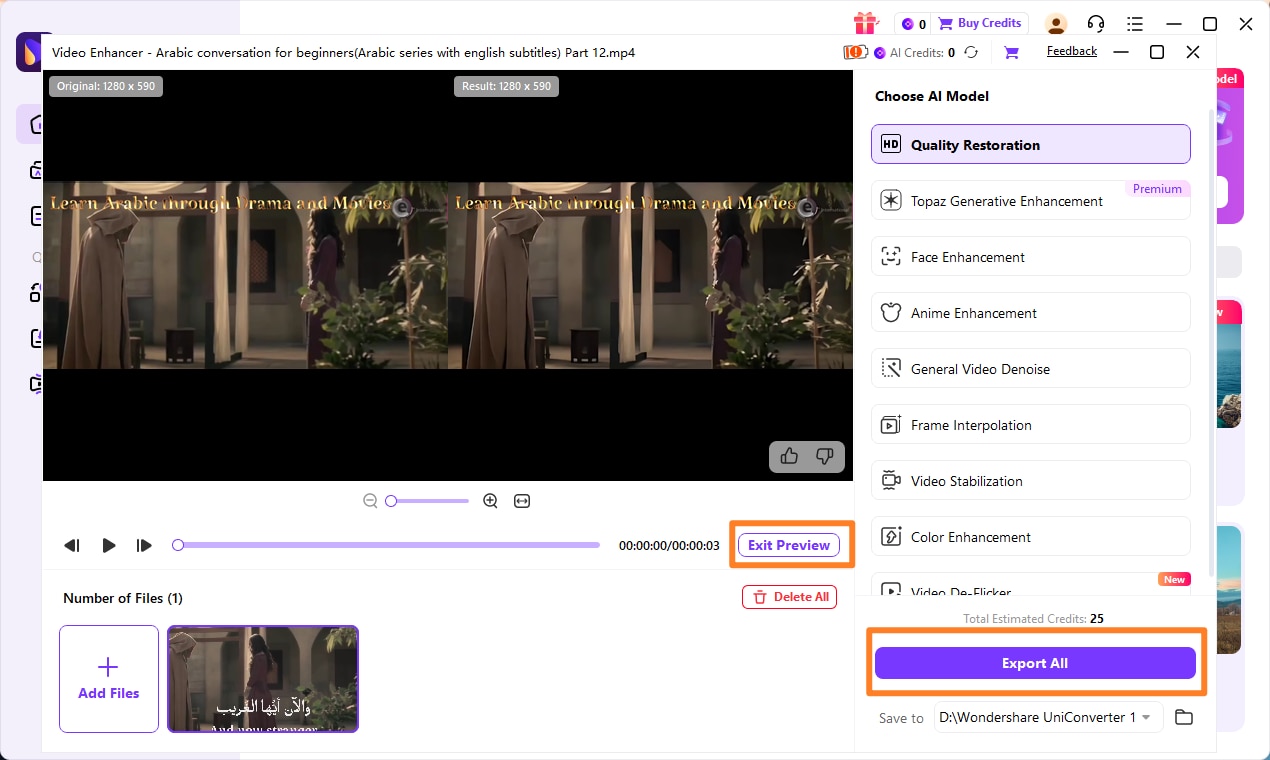
After selecting your enhancement options, click "Preview" to see the changes. If satisfied, choose your desired output format and destination folder, then click "Enhance" to save your improved video. This ensures you can remove background without losing quality for both videos and images.

Seeking a TensorPix Alternative?
Part 7: Conclusion
This TensorPix review has delved into the capabilities, advantages, and potential drawbacks of this AI video enhancement tool. TensorPix stands out for its advanced AI algorithms, delivering impressive upscaling and restoration quality, making it a strong contender for professionals and content creators who prioritize visual fidelity. However, its subscription model and potentially lengthy processing times for high-resolution content might not suit casual users or those with budget constraints. For users seeking top-tier AI enhancement for critical projects, TensorPix offers significant value. For budget-conscious users or those needing quick, simple edits, exploring alternatives with one-time purchase options or faster processing might be more suitable. Ultimately, the best choice depends on individual needs, frequency of use, and specific project requirements, balancing cost, performance, and ease of use.
Part 8: FAQs
-
1. What is TensorPix and how does it work?
TensorPix is an AI-powered video enhancement platform that uses machine learning algorithms to upscale, denoise, deblur, and restore video footage. It analyzes video frames to intelligently reconstruct missing details and improve overall visual quality.
-
2. Is TensorPix free to use?
No, TensorPix operates on a subscription-based model. While it may offer free trials or limited free usage, full access to its advanced features typically requires a paid subscription.
-
3. Can TensorPix improve old, low-quality videos significantly?
Yes, TensorPix is designed to significantly improve old, low-quality videos by upscaling their resolution, removing noise, correcting colors, and stabilizing shaky footage, often transforming them into modern, viewable content.
-
4. How does TensorPix compare to traditional video editing software?
TensorPix specializes in AI-driven enhancement, offering automated solutions for tasks like upscaling and restoration that are often manual or less effective in traditional video editing software. While traditional software provides broader editing capabilities, TensorPix focuses on deep visual improvement.
-
5. What are the system requirements for running TensorPix?
As a cloud-based service, TensorPix primarily requires a stable and fast internet connection for uploading and downloading videos. While it doesn't demand high-end local hardware for processing, a capable computer is still beneficial for managing and previewing files.
