
- Stable Diffusion Apps: Powerful AI image enhancement tools, but navigating various frontends can be complex.
- Core Features: Offer advanced upscaling, noise reduction, and customization, but have a steep learning curve and are resource-intensive.
- Target Users: Ideal for professional artists seeking creative control; less suitable for casual users needing quick, simple enhancements.
- Comparison: Stable Diffusion excels in customization, while UniConverter and Topaz Photo AI offer user-friendliness and efficiency.
- Risks: Cloud-based versions pose data privacy concerns; local versions demand powerful hardware; output quality varies.
- UniConverter Solution: Provides a streamlined, user-friendly alternative for reliable, high-quality image enhancement, especially for batch processing.
In this article
- Part 1: What is Stable Diffusion Web Apps (Various Frontends) Image Enhancer?
- Part 2: Stable Diffusion Web Apps: Core Features and Trade-offs
- Part 3: Target Users and Usage Scenarios
- Part 4: Stable Diffusion Web Apps and Alternatives Comparison
- Part 5: Risks and Pitfalls Analysis
- Part 6: How to Use UniConverter for Streamlined Image Enhancement
- Part 7: Conclusion
- Part 8: FAQs
When I first delved into the world of AI image enhancement, I was immediately drawn to the promise of Stable Diffusion. It's not just another tool; it's a paradigm shift, offering unparalleled control and creative freedom. However, navigating the myriad of Stable Diffusion Web Apps (various frontends) image enhancer review options can be daunting. This comprehensive review aims to cut through the noise, offering my personal insights and experiences to help you understand where these powerful tools shine, and where you might need to look for alternatives. We'll explore their strengths, weaknesses, and how they stack up against other popular solutions, ensuring you make an informed decision for your specific needs.
Part 1: What is Stable Diffusion Web Apps (Various Frontends) Image Enhancer?
Stable Diffusion Web Apps are essentially user-friendly interfaces built on top of the powerful Stable Diffusion AI model. Think of them as the control panels that allow you to harness the raw power of this generative AI for various tasks, including image enhancement. While the core AI model remains the same, each "frontend" offers a unique set of features, workflows, and user experiences. My journey with these apps started with a desire to push the boundaries of image quality beyond traditional editing software, and Stable Diffusion quickly became a go-to. It's not just about upscaling; it's about intelligently reconstructing details, removing noise, and even adding stylistic elements that were previously impossible without extensive manual work.
The Evolving Landscape of AI Image Enhancement Tools
The field of AI image enhancement is booming, and Stable Diffusion Web Apps are at the forefront, offering a unique blend of power and flexibility.
* Democratization of Advanced AI: These apps make cutting-edge AI accessible to a wider audience, moving beyond specialized research labs.
* Community-Driven Innovation: The open-source nature fosters rapid development and a constant influx of new features and models.
* Addressing Creative Bottlenecks: For artists and designers, these tools offer solutions to common challenges like low-resolution source material or the need for intricate detail restoration.
* The Need for Guidance: With so many options, understanding which frontend suits your specific needs is crucial.
Part 2: Stable Diffusion Web Apps: Core Features and Trade-offs
From my experience, the core strength of Stable Diffusion Web Apps lies in their ability to offer a highly customizable approach to image enhancement. I've found myself tweaking parameters for hours, sometimes just to achieve a specific artistic effect that no other tool could replicate. They're not just about making an image "look better"; they're about giving you the reins to define what "better" means for your project. However, this power comes with its own set of challenges, particularly for newcomers.
* Advanced Upscaling Algorithms: They leverage sophisticated AI to intelligently increase image resolution without significant loss of quality, often adding detail rather than just stretching pixels.
* Noise Reduction and Sharpening: These apps excel at cleaning up noisy images and bringing out fine details that might be lost in lower-quality originals.
* Inpainting and Outpainting Capabilities: Beyond simple enhancement, some frontends allow for intelligent content aware filling and extending images.
* Model Versatility: You can often switch between different Stable Diffusion models, each trained for specific styles or enhancement types, offering immense flexibility.
* Batch Processing: For those with large libraries, many frontends support batch processing, saving valuable time.
Pros:
* Unparalleled Customization: I've never encountered another tool that gives me this level of granular control over the enhancement process.
* Community-Driven Innovation: The sheer pace of development and the constant influx of new features from the open-source community is truly impressive.
* Cost-Effective Access: For many, it's a way to access powerful AI models without hefty subscription fees, especially if you have local hardware.
Cons:
* Steep Learning Curve: I remember feeling overwhelmed initially; it definitely takes time to master the various settings and parameters.
* Resource-Intensive: Running these locally can be quite demanding on your hardware, especially for higher resolutions or complex enhancements.
Part 3: Target Users and Usage Scenarios
Based on my time with these tools, I've come to realize that Stable Diffusion Web Apps aren't a one-size-fits-all solution. They truly shine for a specific type of user, while others might find them more frustrating than helpful. If you're someone who enjoys tinkering and has a clear vision for your output, you'll likely fall in love. But if you just need a quick fix, there are simpler options out there.
Best Use Case: Professional Artists and Designers Seeking Creative Control
For me, as someone who values artistic control above all else, these apps are indispensable. If you're a professional artist, graphic designer, or even a hobbyist who wants to push the boundaries of your creations, Stable Diffusion Web Apps offer an unmatched level of customization. I've used them to upscale old artwork for print, restore details in vintage photographs, and even experiment with entirely new artistic styles by blending different models and parameters. The ability to fine-tune every aspect of the enhancement process means you're not just getting an "improved" image; you're getting an image that aligns perfectly with your creative vision. It's about having the freedom to experiment and achieve truly unique results that off-the-shelf solutions simply can't deliver.
Limited Use Case: Casual Users Needing Quick, One-Click Enhancements
On the flip side, if you're a casual user who just wants to quickly upscale a photo for social media or fix a blurry snapshot without diving deep into technical settings, Stable Diffusion Web Apps might feel like overkill. I've seen friends try to use them for simple tasks and quickly get frustrated by the complex interfaces and numerous options. For these scenarios, the learning curve is simply too steep, and the time investment doesn't justify the outcome. You're better off with a tool designed for simplicity and instant results, even if it means sacrificing some of the advanced customization.
Part 4: Stable Diffusion Web Apps and Alternatives Comparison
When I started exploring image enhancement, I quickly realized that Stable Diffusion Web Apps, while powerful, aren't the only players. It's crucial to understand how they stack up against other tools I've used.
| Feature/Product | Stable Diffusion Web Apps (Various Frontends) | Topaz Photo AI | Upscale.media | UniConverter |
| Customization | High | Medium | Low | Medium |
| Ease of Use | Low | High | High | High |
| Cost | Free/Open Source | Paid Subscription | Free/Freemium | Paid/Free Trial |
| Local Processing | Yes (often) | Yes | No (cloud-based) | Yes |
| Output Quality | Excellent (with expertise) | Excellent | Good | Excellent |
| Processing Speed | Varies (hardware dependent) | Fast | Moderate | Fast |
| Batch Processing | Yes | Yes | Yes | Yes |
Key Differentiators: Customization vs. Simplicity
From my perspective, the biggest differentiator is the trade-off between customization and simplicity. Stable Diffusion Web Apps offer unparalleled control, allowing me to tweak every parameter imaginable. This is fantastic for achieving very specific artistic effects, but it demands a significant time investment and a willingness to learn. Topaz Photo AI, on the other hand, strikes a great balance. It's incredibly user-friendly, offering powerful AI enhancements with minimal input, making it ideal when I need high-quality results quickly without deep diving into settings. Upscale.media is perfect for those quick, on-the-go upscales where I don't need much control, as it's entirely cloud-based and super simple. UniConverter, while not solely an image enhancer, offers a surprisingly robust and user-friendly enhancement feature that I've found to be a great middle ground, especially for batch processing and its integration with other multimedia tools. If you're looking for a "set it and forget it" solution with excellent results, Topaz Photo AI or UniConverter might be your best bet. But if you crave ultimate creative freedom and don't mind the learning curve, Stable Diffusion is hard to beat.
Part 5: Risks and Pitfalls Analysis
While the power of Stable Diffusion Web Apps is undeniable, my journey with them has also highlighted several potential pitfalls that I think everyone should be aware of. It’s not all sunshine and perfect upscales; there are real considerations, especially when dealing with open-source tools and cloud-based solutions.
Data Privacy and Security Concerns with Cloud-Based Frontends
I've always been cautious about uploading sensitive images to cloud-based services, and with some Stable Diffusion frontends, this concern is amplified. While many are open-source, the underlying infrastructure for cloud-hosted versions means your data is being processed on someone else's servers. I've often wondered about the security protocols in place and how long my images are stored. For personal or confidential projects, this is a significant red flag for me, and I always opt for local processing whenever possible.
Inconsistent Output Quality Across Different Frontends
One thing I quickly learned is that not all Stable Diffusion frontends are created equal. I've used several, and the output quality can vary wildly, even when using the same underlying Stable Diffusion model. This inconsistency can be frustrating, especially when you're trying to achieve a specific look. Some frontends might have better default settings, offer more refined control over parameters, or simply integrate different post-processing steps that lead to superior results. It often requires trial and error to find the frontend that consistently delivers the quality you expect.
Resource Demands and Hardware Compatibility
My initial excitement about running Stable Diffusion locally quickly turned into a reality check about hardware requirements. These models are incredibly resource-intensive. If you don't have a powerful GPU with ample VRAM, you'll either be waiting a very long time for your enhancements or be limited to lower resolutions and simpler models. I've definitely hit performance bottlenecks on older machines, making the experience less enjoyable and more of a test of patience. It's something I wish I had understood more clearly before diving in.
Potential for Misinformation or Unintended Content Generation
While primarily used for enhancement, the generative nature of Stable Diffusion means there's always a slight risk of unintended content generation, especially if you're experimenting with more advanced features or less-curated models. I've seen instances where the AI "hallucinates" details that weren't there or interprets prompts in unexpected ways. For image enhancement, this usually manifests as odd artifacts or textures, but it's a reminder of the powerful, sometimes unpredictable, nature of these AI tools. It requires a critical eye and careful review of the output.
Part 6: How to Use UniConverter for Streamlined Image Enhancement
Sometimes, the deep customization of Stable Diffusion Web Apps isn't what I need. When I'm facing a pile of images that need a quick, reliable, and high-quality enhancement without the fuss, or when other tools are giving me inconsistent results, I turn to UniConverter. It's become my go-to for situations where I need a streamlined solution that just works, especially for batch processing and when I want to avoid ads or watermarks. UniConverter offers a stable, lossless, and GPU-accelerated enhancement experience, making it an excellent all-in-one solution for my multimedia needs. For those looking to enhance images quickly and efficiently, this tool is invaluable.
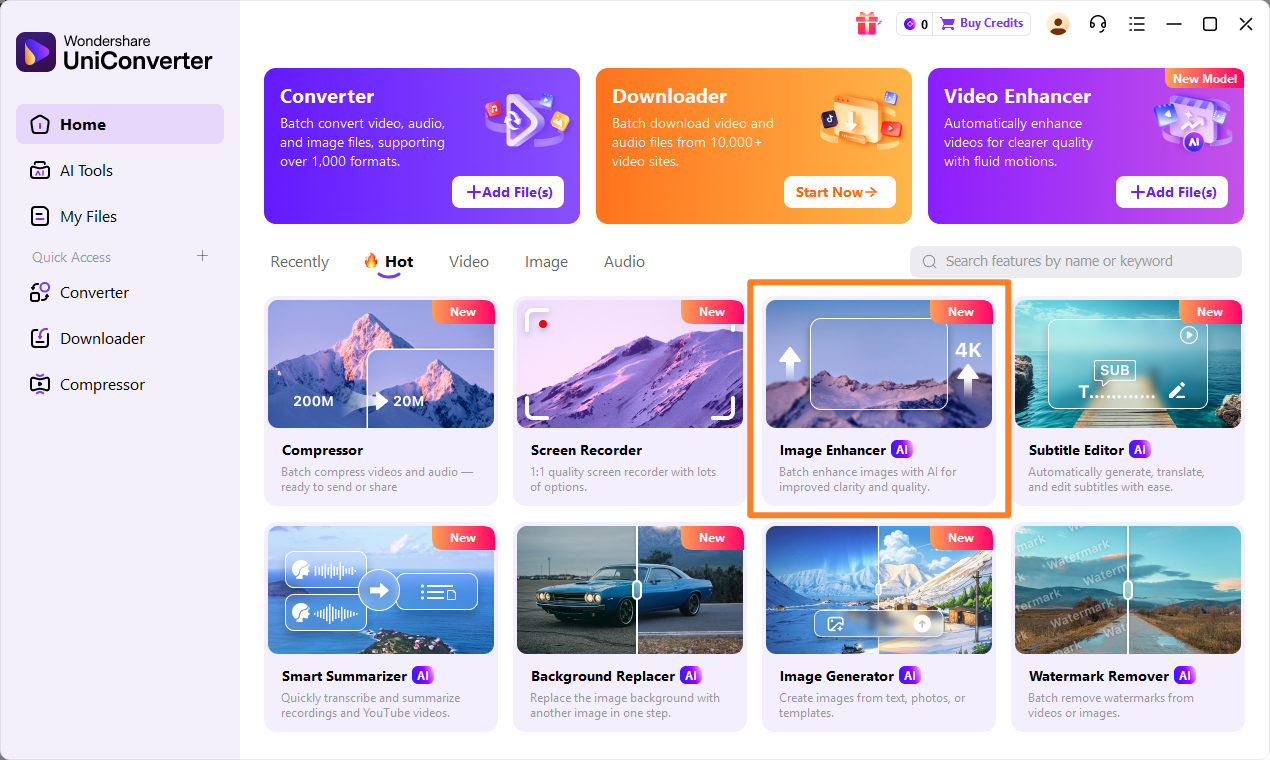
Step 1: Open UniConverter and Choose Image Enhancer
Launch UniConverter on your computer. From the main interface, navigate to the "Toolbox" section and select "AI Lab." Within the AI Lab, you'll find the "Image Enhancer" option. Click on it to open the dedicated enhancement module.
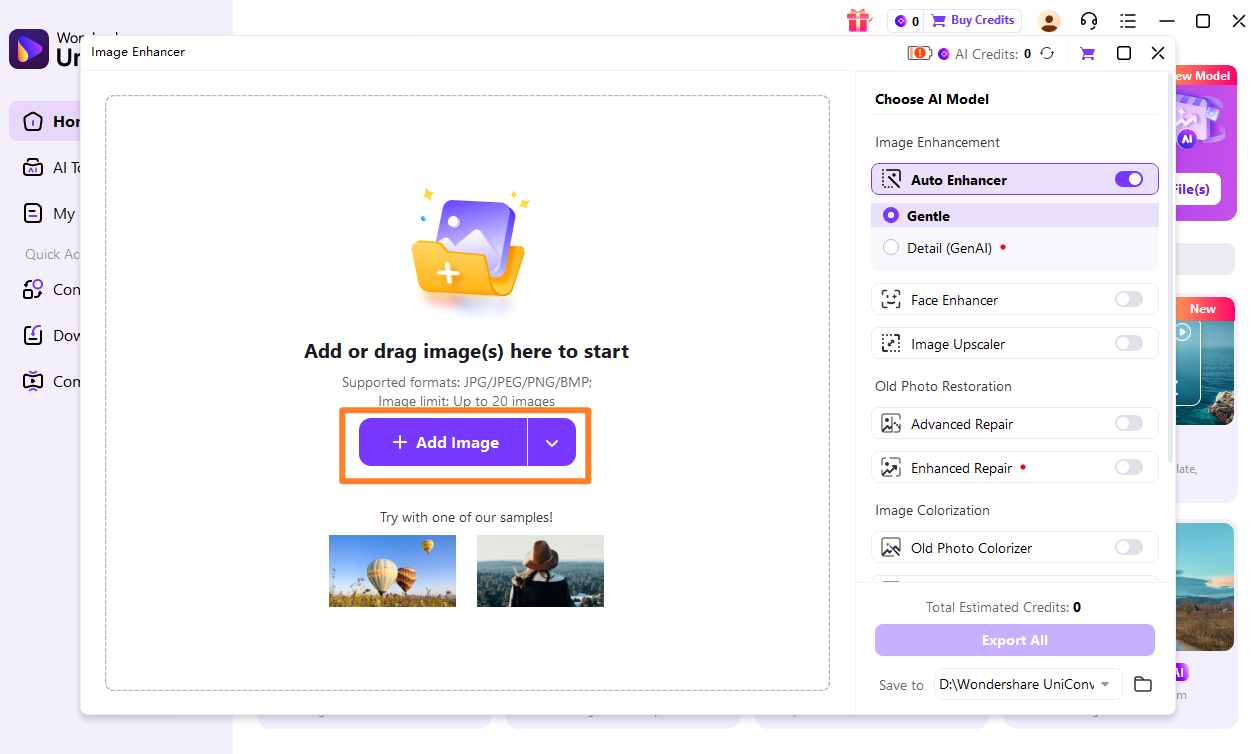
Step 2: Upload the Images
Once the Image Enhancer window is open, you can easily add the images you wish to enhance. Click on the "Add Files" button or simply drag and drop your images directly into the designated area. UniConverter supports various image formats, making it versatile for different source files. This is particularly useful when you need to upscale images to 4K.
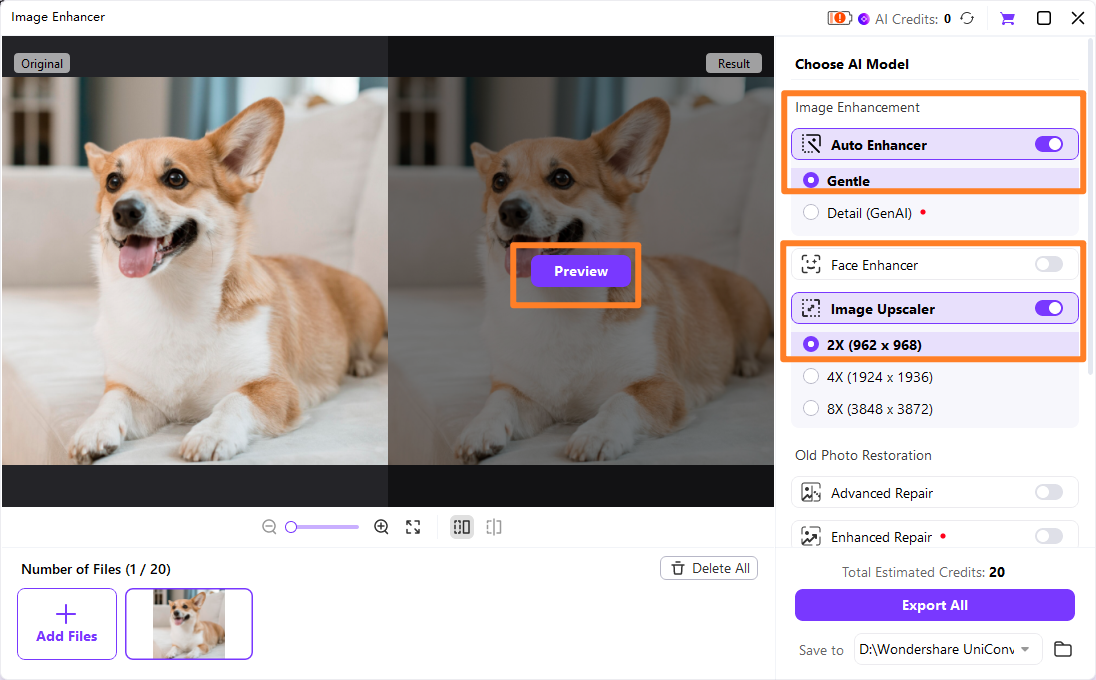
Step 3: Choose Enhancement Model
After uploading your images, UniConverter will present you with different enhancement models or options. You can select the desired level of enhancement, such as "AI Upscale" for resolution improvement, "Denoise" for noise reduction, or "Sharpen" for detail clarity. Adjust any other available settings like output resolution or format as needed. This allows for precise control over the image enhancement process.
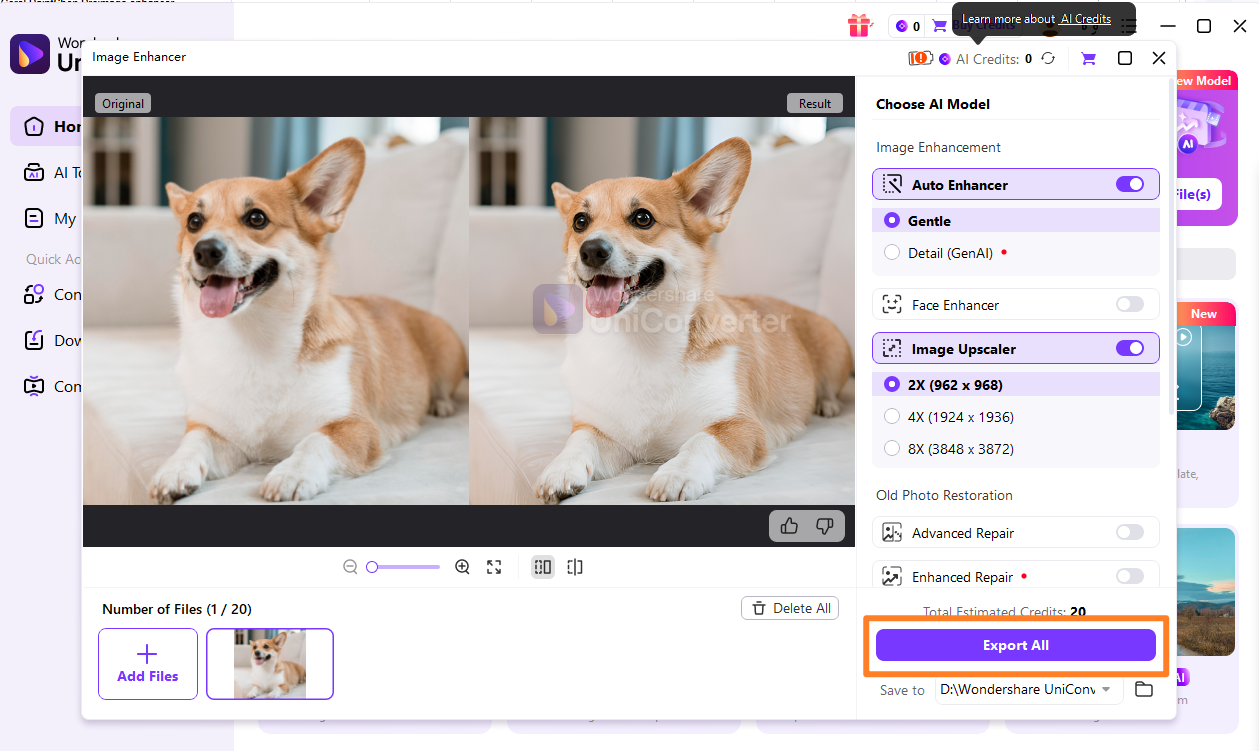
Step 4: Preview and Save the Enhanced Images
Before finalizing, UniConverter allows you to preview the enhanced images. This is a crucial step to ensure the results meet your expectations. Once satisfied, click the "Start" or "Export" button to save your high-quality, enhanced images to your desired location on your computer.

Enhance Stable Diffusion Images with Ease
Part 7: Conclusion
My journey through the world of Stable Diffusion Web Apps (various frontends) image enhancer review has been an enlightening one, revealing both the incredible power and the inherent complexities of these tools. For advanced users, particularly professional artists and designers who crave ultimate creative control and are willing to invest time in mastering intricate settings, Stable Diffusion Web Apps offer an unparalleled playground for image enhancement. Their open-source nature fosters rapid innovation, and the ability to fine-tune every aspect of the output is truly liberating. However, for beginners or casual users who simply need quick, high-quality results without a steep learning curve, the complexity and resource demands can be a significant barrier. In such cases, user-friendly alternatives like Topaz Photo AI or UniConverter provide a more accessible and efficient solution. Ultimately, the best tool depends entirely on your specific needs, technical comfort level, and the desired balance between customization and simplicity. For those seeking a balanced approach, perhaps a hybrid solution where Stable Diffusion is used for highly specialized tasks and more streamlined tools handle everyday enhancements, might be the most effective strategy.
Part 8: FAQs
-
1. What are Stable Diffusion Web Apps?
Stable Diffusion Web Apps are user interfaces built on top of the Stable Diffusion AI model, allowing you to generate and enhance images through a web browser or a local application. They provide a way to interact with the powerful AI without needing to write code.
-
2. Are Stable Diffusion Web Apps free to use?
Many Stable Diffusion Web Apps are open-source and free to use, especially if you run them locally on your own hardware. However, some cloud-based frontends may offer premium features or require subscriptions for faster processing or access to more powerful models.
-
3. How do Stable Diffusion Web Apps enhance images?
They use advanced AI algorithms to intelligently upscale resolution, reduce noise, sharpen details, and even reconstruct missing information in images. This goes beyond simple pixel stretching, aiming to create more realistic and detailed outputs.
-
4. What are the main differences between various Stable Diffusion frontends?
Frontends differ significantly in their user interface design, feature sets (e.g., specific enhancement models, inpainting capabilities), ease of use, and the level of customization they offer. Some are designed for simplicity, while others provide deep control for advanced users.
-
5. Is UniConverter a good alternative to Stable Diffusion Web Apps for image enhancement?
Yes, UniConverter offers a more user-friendly and integrated solution for image enhancement, especially for those who prioritize simplicity, batch processing, and a wider range of multimedia tools. It's an excellent choice if you want reliable, high-quality enhancements without the steep learning curve of some Stable Diffusion frontends.
