
- <b>Remini's Strength:</b> Excels at quick, AI-powered portrait fixes and restoring old, blurry family photos with minimal effort.
- <b>Professional Needs:</b> For professional-grade control, granular adjustments, or offline processing, consider alternatives like Topaz Labs or Photoshop.
- <b>Ease vs. Control:</b> Remini prioritizes ease for casual users; professionals need tools offering more precise control.
- <b>Value Proposition:</b> Assess Remini's subscription cost against your usage frequency for personal photo restoration versus professional work.
- <b>UniConverter Advantage:</b> Offers a robust, ad-free solution for batch processing, stable enhancements, and rich format support, ideal for diverse needs.
In this article
- Part 1: What is Remini Image Enhancer?
- Part 2: Remini Image Enhancer: Core Features, Pros, and Cons
- Part 3: Remini Image Enhancer: Target Audience and Use Cases
- Part 4: Remini Image Enhancer & Alternatives Comparison
- Part 5: Risks and Pitfalls to Consider
- Part 6: How to Use UniConverter to Efficiently Enhance Images
- Part 7: Conclusion
- Part 8: FAQs
When I first stumbled upon Remini Image Enhancer review, I was intrigued by the promise of effortlessly transforming old, blurry photos into crisp, vibrant memories. In a world saturated with digital images, the ability to breathe new life into cherished but low-quality pictures is a game-changer. This review aims to cut through the marketing hype and provide a practical, scenario-based comparison of Remini against its competitors, helping you decide if it's the right tool for your specific needs. I'll share my personal experiences and insights, highlighting where Remini shines and where you might need to look elsewhere for a truly professional touch.
Part 1: What is Remini Image Enhancer?
Remini Image Enhancer positions itself as a revolutionary AI-powered tool designed to restore and enhance photos, particularly those that are old, blurry, or low-resolution. My initial impression was that it was just another photo filter app, but after diving in, I realized its core strength lies in its ability to intelligently reconstruct facial details and sharpen overall image clarity. It leverages sophisticated artificial intelligence algorithms to fill in missing information, effectively making blurry images look like they were taken with a much better camera. This review will explore how well it lives up to this promise and whether it truly offers a significant advantage over other enhancement methods.
The Rise of AI Photo Enhancement
The demand for AI photo enhancement has surged, driven by several key factors:
* Nostalgia for Physical Memories: Many of us have boxes of old printed photos that have faded or deteriorated over time, and we want to preserve them digitally in their best possible form.
* Ubiquity of Smartphone Photography: While modern smartphones take excellent pictures, older devices or challenging lighting conditions often result in less-than-perfect shots that could benefit from a quick fix.
* Ease of Sharing on Social Media: High-quality images are crucial for engaging content online, and AI enhancers provide an accessible way to improve visual appeal without needing advanced editing skills.
Part 2: Remini Image Enhancer: Core Features, Pros, and Cons
Remini's primary capability, from my experience, is its uncanny ability to bring faces into sharp focus. I've used it on numerous old family photos where faces were almost indistinguishable, and it consistently delivered impressive results. It's not just about sharpening; it intelligently reconstructs features, making eyes clearer and skin tones more natural. The app is incredibly straightforward to use, requiring just a few taps to initiate the enhancement process.
* AI-Powered Facial Enhancement: Its standout feature, perfect for portraits.
* Old Photo Restoration: Excellent for bringing faded, scratched, or blurry vintage photos back to life.
* Video Enhancement: A lesser-known but equally powerful feature for improving video quality.
* Color Correction: Subtle but effective adjustments to color balance.
* Scratch and Noise Reduction: Helps clean up imperfections in older images.
- Pros:
- Exceptional Face Detail Restoration for Portraits: This is where Remini truly shines; I've seen it work wonders on blurry faces.
- User-Friendly Interface for Quick Enhancements: You don't need to be a tech wizard to get great results.
- Effective for Old/Low-Resolution Photo Revitalization: It’s my go-to for digitizing and improving old family albums.
- Cons:
- Limited Control Over Enhancement Parameters: Sometimes I wish I could fine-tune the intensity of the enhancement.
- Subscription-Based Model for Full Functionality: The free tier is quite restrictive, pushing you towards a paid plan.
Part 3: Remini Image Enhancer: Target Audience and Use Cases
From my perspective, Remini is tailor-made for anyone who wants to quickly and easily improve the quality of their photos without getting bogged down in complex editing software. It's not for professional retouchers, but for the everyday user, it's incredibly powerful.
- Best Use Case: Reviving Cherished Family Photos
- Scenario: I had a box of old, faded, and blurry family photographs from decades ago. I wanted to digitize them and share them with relatives, but their poor quality made them hard to appreciate. Remini was a lifesaver here. I scanned the photos, ran them through Remini, and the faces, which were once smudged, became remarkably clear. The overall quality improved dramatically, making these memories shareable and enjoyable again. It felt like magic seeing my grandparents' faces come to life.
- Limited Use Case: Professional-Grade Image Editing for Commercial Use
- Scenario: As someone who occasionally dabbles in photography for small commercial projects, I need precise control over every aspect of image enhancement, including color grading, noise reduction, and selective sharpening, especially for high-resolution prints or web campaigns. Remini, while impressive for quick fixes, simply doesn't offer the granular control required for professional work. I found myself needing to switch to more robust software like Photoshop for those tasks, as Remini's automated approach can sometimes over-process or apply effects uniformly when selective adjustments are needed.
Part 4: Remini Image Enhancer & Alternatives Comparison
When I started looking into image enhancers, I quickly realized Remini wasn't the only player. Here's how it stacks up against some of the others I've tried:
| Feature/Competitor | Remini Image Enhancer | Topaz Labs Gigapixel AI | Adobe Photoshop (Neural Filters) | VanceAI Image Enhancer |
| Primary Focus | Face/Portrait Enhancement, Old Photo Restoration | Upscaling, Detail Recovery | Comprehensive Editing, AI-Powered Filters | General Image Enhancement, Upscaling |
| Ease of Use | Very High | Moderate | Low (Steep Learning Curve) | High |
| Control Level | Low | High | Very High | Moderate |
| Subscription Model | Yes | One-time Purchase/Subscription | Yes | Yes |
| Offline Processing | No | Yes | Yes | No |
Key Differentiators: Ease of Use vs. Granular Control
From my experience, Remini is king when it comes to ease of use, especially for quick facial enhancements. If you just want to fix a blurry face on an old photo, it’s incredibly fast and effective. However, if you need to upscale an image for a large print and require precise control over every detail, Topaz Labs Gigapixel AI is far superior, offering much more granular control over the enhancement process. For comprehensive professional editing, Photoshop with its Neural Filters provides unparalleled flexibility, though it comes with a steep learning curve. VanceAI sits somewhere in the middle, offering a good balance of ease and control for general enhancements.
Part 5: Risks and Pitfalls to Consider
While Remini has been a fantastic tool for me, it's not without its drawbacks, and I've learned to be mindful of certain risks, especially if you're using the free version or are concerned about data.
Data Privacy Concerns with Cloud Processing
Since Remini processes all images on its cloud servers, I've always had a slight concern about data privacy. While their policy states photos are deleted after a certain period, it's still something to consider if you're uploading highly sensitive or personal images. For me, it's a trade-off for the convenience, but it's worth being aware of where your data is going.
Potential for Over-Smoothing or "Plastic" Look
I've noticed that Remini, in its zeal to enhance faces, can sometimes lead to an "over-smoothed" or artificial "plastic" look, especially on younger faces or when the original image quality is extremely poor. It's like the AI tries too hard to make it perfect, losing some natural texture. This is where the lack of granular control becomes a real limitation for me.
In-App Advertisements and Upselling
The free version of Remini is riddled with ads. After almost every enhancement, you're hit with a full-screen advertisement, which can be quite disruptive. There's also constant upselling to the subscription model, which, while understandable for a free service, can become annoying if you're just trying to do a few quick edits.
Subscription Cost vs. Value Proposition
For full functionality, Remini requires a subscription. I've had to weigh whether the cost justifies my usage. If you're only enhancing a few photos occasionally, the subscription might feel expensive. However, if you're regularly restoring old photos or improving many portraits, the value proposition increases significantly. It's a personal calculation based on your usage frequency.
Limitations on Output Resolution for Free Users
Another significant pitfall for free users is the limitation on output resolution. While Remini enhances the image, the free version often restricts you from downloading the highest possible resolution, pushing you towards a paid subscription. This can be frustrating if you've achieved a great enhancement but can't get it in the quality you truly desire for printing or high-res sharing.
Part 6: How to Use UniConverter to Efficiently Enhance Images
Sometimes, I find that other tools don't quite hit the mark for batch processing, stable enhancements, or simply delivering the quality I expect. That's when I turn to UniConverter. It's a fantastic alternative that avoids many of the issues I've encountered elsewhere, offering a robust solution for enhancing images without ads, with rich format support, GPU acceleration, stable lossless processing, and efficient batch enhancement. It truly feels like an all-in-one ultimate solution for my image and video needs. For those looking to enhance images with advanced AI capabilities, this tool provides a comprehensive approach.
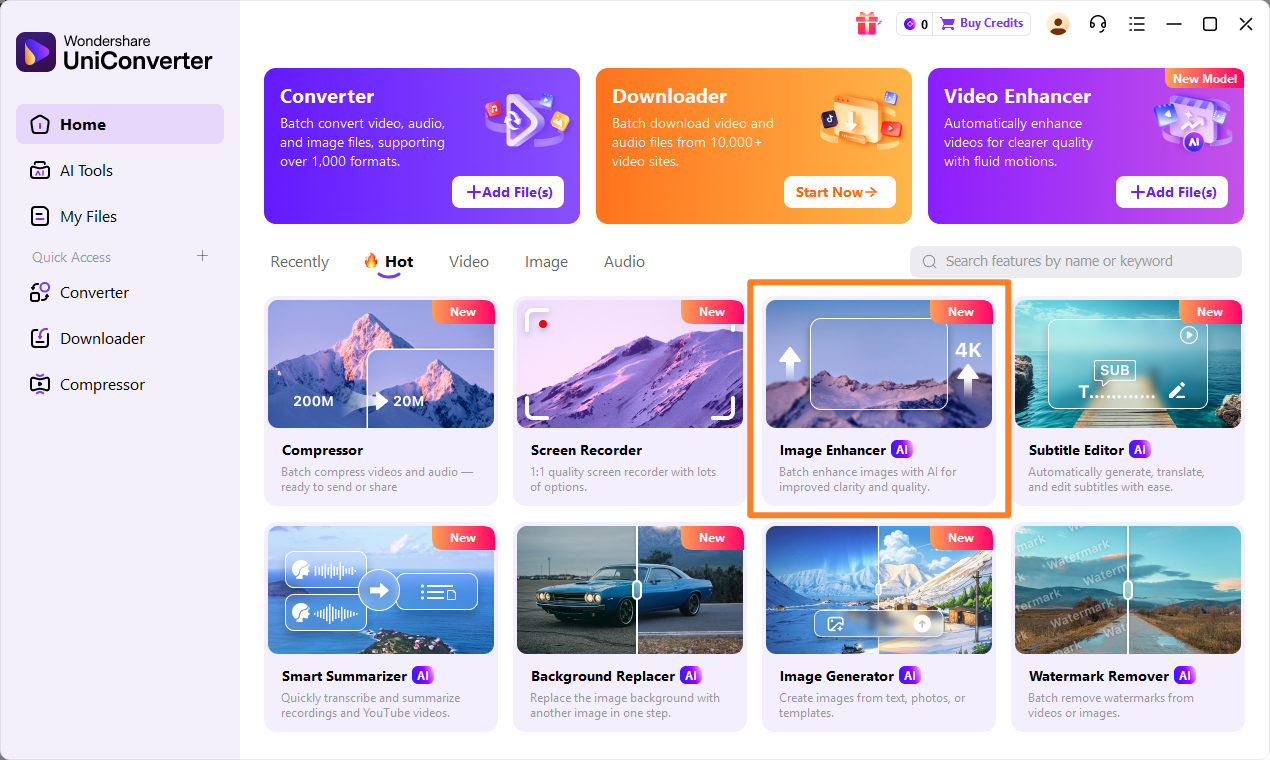
Step 1: Open UniConverter and Choose Image Enhancer
Launch UniConverter on your computer. On the left sidebar, navigate to the "AI Lab" section and select the "Image Enhancer" tool. This feature is designed to improve image quality with ease.
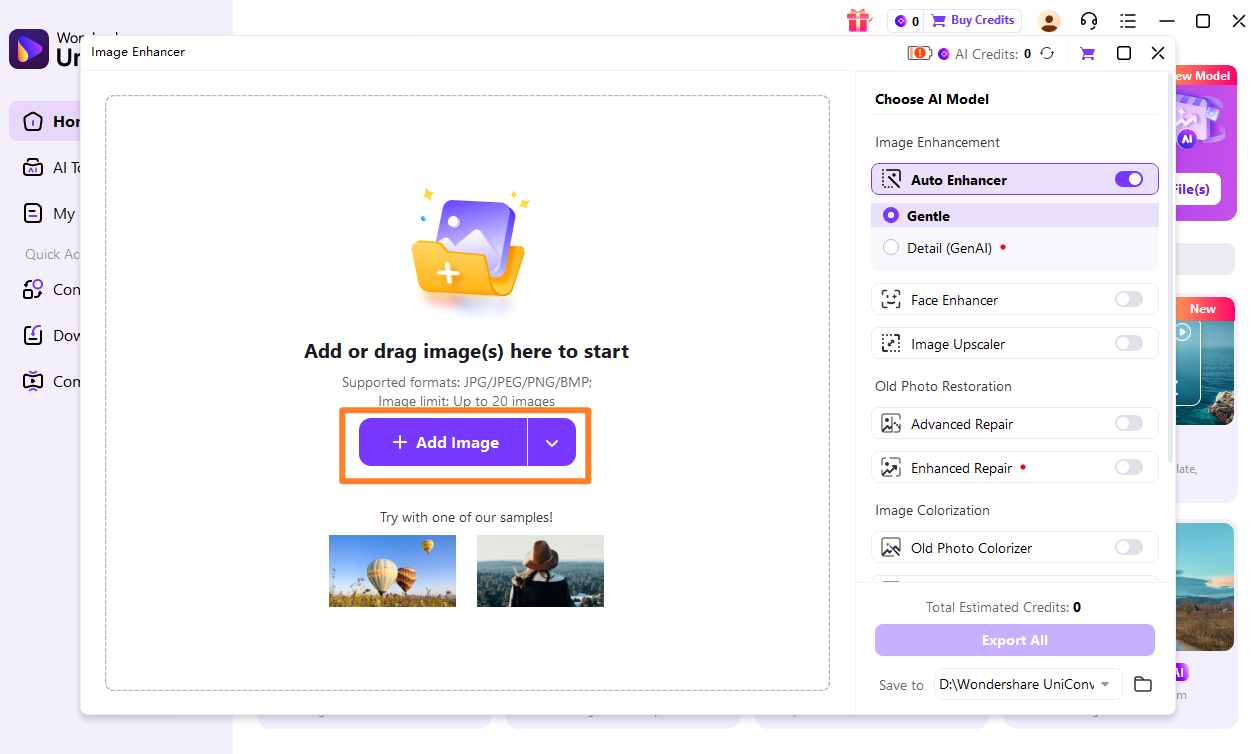
Step 2: Upload the Images
Click the "Add Files" button or simply drag and drop the images you wish to enhance into the UniConverter interface. You can add multiple images for batch processing. If you're looking to upscale images to 4K, this step is crucial for loading your source files.
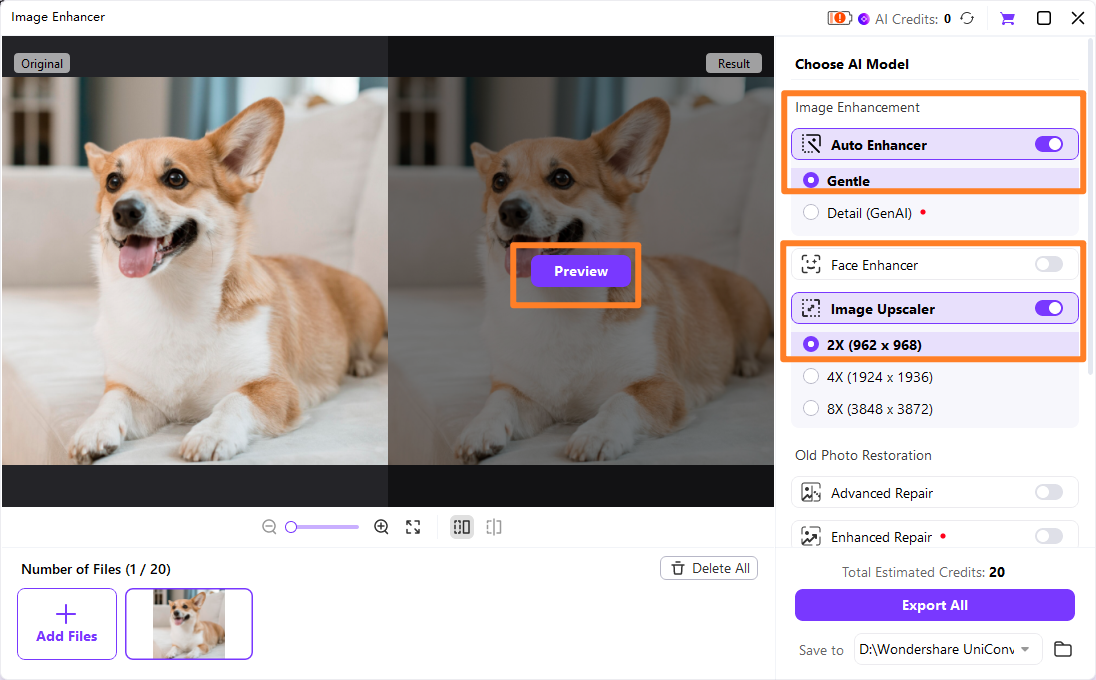
Step 3: Choose Enhancement Model
Once your images are loaded, you'll see options for different enhancement models. Select the one that best suits your needs, such as "Denoise," "Sharpen," or "Upscale." You can also preview the effect before applying. This allows you to enhance your photos precisely as desired.
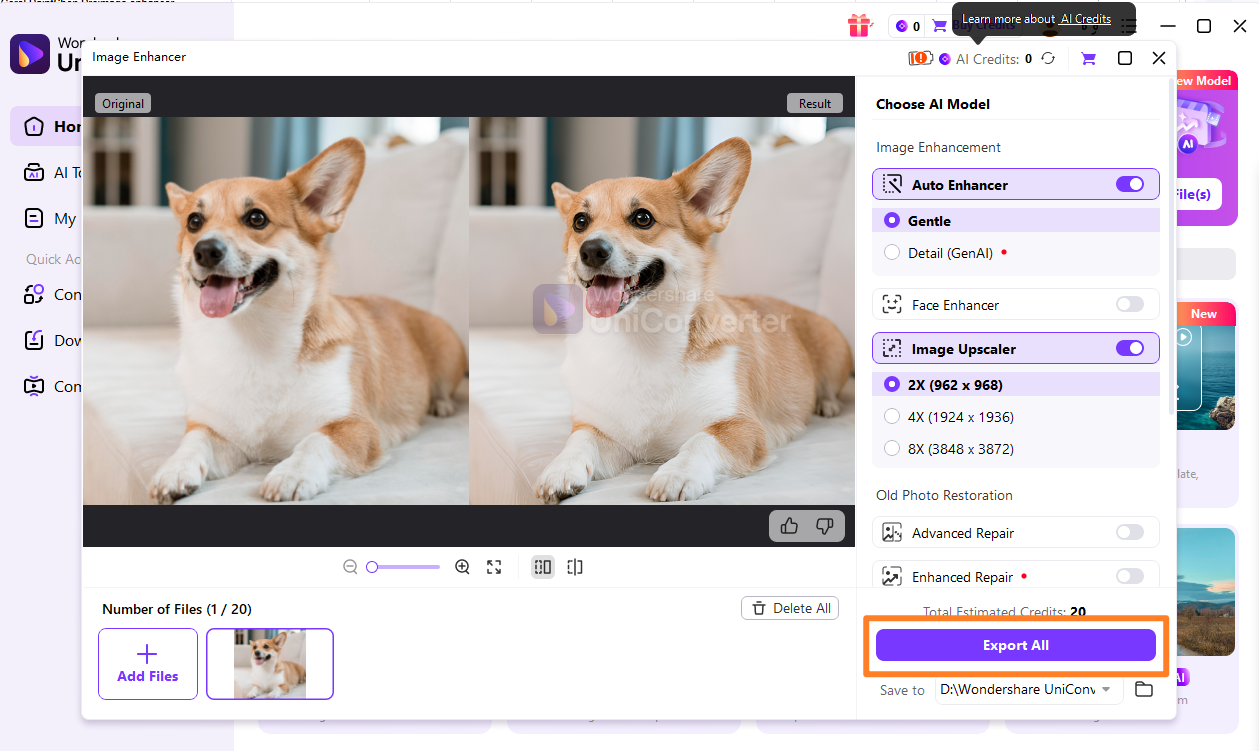
Step 4: Preview and Save the Enhanced Images
After selecting your desired enhancement, click "Start" to begin processing. Once completed, you can preview the enhanced images and then click "Export" to save them to your desired location. This streamlined process ensures you can improve video quality and image quality efficiently.

Enhance Photos Beyond Remini with UniConverter
Part 7: Conclusion
After spending considerable time with Remini Image Enhancer review and its competitors, my conclusion is that Remini is an exceptional tool for a very specific niche: quick, AI-powered portrait fixes and the restoration of old, blurry family photos. It excels at making faces clearer and breathing new life into cherished memories with minimal effort. However, for those seeking professional-grade control, granular adjustments, or offline processing capabilities, alternatives like Topaz Labs Gigapixel AI or Adobe Photoshop are undoubtedly more suitable. The decision often boils down to your specific use case, desired level of control, and willingness to engage with a subscription model versus a one-time purchase. For casual users who prioritize ease and speed for personal photos, Remini offers significant value, but professionals or those with strict privacy concerns might find its cloud-based, automated approach limiting.
Part 8: FAQs
-
1. Is Remini Image Enhancer free to use?
Remini offers a limited free trial with daily credits. Full functionality and unlimited enhancements require a subscription.
-
2. Can Remini enhance images without an internet connection?
No, Remini requires an active internet connection as all processing is done on their cloud servers.
-
3. Does Remini store my photos after enhancement?
Remini's privacy policy states that processed photos are typically deleted after a certain period, but users should review the latest policy for specifics.
-
4. How does Remini compare to professional photo editing software like Photoshop?
Remini excels at quick, AI-driven enhancements, especially for faces, while Photoshop offers far more granular control and a broader range of editing tools for professionals.
-
5. What types of images does Remini work best on?
Remini performs exceptionally well on old, blurry, or low-resolution photos, particularly those containing faces, to improve clarity and detail.
