
- RealScaler Overview: AI-driven video enhancer upscales low-resolution footage to 4K, ideal for older content.
- Pros: AI upscaling, intuitive interface, and batch processing make it user-friendly and efficient.
- Cons: Resource-intensive, requiring powerful hardware; limited customization options for advanced users.
- Best Use: Perfect for revitalizing archival footage for modern displays, making old videos watchable.
- Limitations: Not suitable for real-time enhancement due to high processing demands and lack of live capabilities.
- Comparison: Offers excellent upscaling with high ease of use, but UniConverter balances quality, speed, and features better.
- Considerations: Be aware of potential data privacy, unexpected artifacts, subscription costs, and high hardware needs.
- UniConverter Alternative: Offers stable, fast, and high-quality video enhancement with GPU acceleration and broad format support.
- Decision: Choose based on needs: RealScaler for simplicity, UniConverter for balanced performance, or advanced tools for granular control.
In this article
- Part 1: What is RealScaler Video Enhancer?
- Part 2: RealScaler Video Enhancer: Core Features, Pros, and Cons
- Part 3: RealScaler Video Enhancer: Ideal Use Cases and Limitations
- Part 4: RealScaler Video Enhancer vs. Alternatives
- Part 5: Potential Pitfalls and Considerations
- Part 6: How to Use UniConverter to Efficiently Enhance Videos
- Part 7: Conclusion
- Part 8: FAQs
RealScaler Video Enhancer: A Deep Dive into Upscaling Solutions
The digital landscape is awash with video content, much of it predating high-definition standards. As display technologies advance, the demand for higher resolution content grows, creating a significant need for effective video enhancement solutions. This RealScaler Video Enhancer review delves into a prominent tool designed to bridge this gap, offering an in-depth analysis of its features, performance, and suitability for various users. We will explore its core functionalities, compare it against key competitors, and highlight potential pitfalls, ultimately guiding users toward an informed decision in their quest for superior video quality.
Part 1: What is RealScaler Video Enhancer?
RealScaler Video Enhancer emerges as a dedicated software solution engineered to elevate the quality of video content, primarily through AI-driven upscaling. Its core promise lies in transforming lower-resolution footage into crisp, high-definition, or even 4K visuals, breathing new life into older videos, home movies, and archival material. In an era where 4K and 8K displays are becoming commonplace, the disparity between legacy content and modern viewing experiences is stark. RealScaler aims to bridge this gap by leveraging advanced algorithms to intelligently fill in missing pixels, reduce noise, and sharpen details, without the manual complexities typically associated with video editing. This review will meticulously examine how well RealScaler delivers on this promise, evaluating its effectiveness across diverse video types and user needs.
The Growing Need for Video Enhancement
* Bridging the Resolution Gap: Modern displays demand higher resolution content, making older videos appear pixelated and blurry.
* Preserving Legacy Content: Enhancing archival footage ensures its relevance and watchability for future generations.
* Improving User Experience: Higher quality video provides a more immersive and enjoyable viewing experience.
* Professional Applications: From documentary filmmaking to marketing, enhanced video can elevate production value.
Part 2: RealScaler Video Enhancer: Core Features, Pros, and Cons
RealScaler Video Enhancer is built around a set of functionalities designed to simplify the video upscaling process. Its primary capability is AI-powered resolution enhancement, allowing users to convert standard definition (SD) or high definition (HD) videos to 4K or even higher resolutions. Beyond simple upscaling, it often incorporates features for noise reduction, deinterlacing, and color correction, all automated through its AI engine. The software typically supports a wide array of input and output formats, aiming for broad compatibility. Its user interface is generally designed for ease of use, catering to individuals without extensive video editing experience.
Pros:
* AI-Powered Upscaling for Legacy Content: Effectively transforms old, low-resolution videos into modern, high-definition formats with impressive detail.
* Intuitive User Interface for Quick Enhancements: Designed for ease of use, allowing even beginners to achieve significant video quality improvements without a steep learning curve.
* Batch Processing for Efficiency: Enables users to process multiple video files simultaneously, saving considerable time for large projects or extensive archives.
Cons:
* Resource-Intensive Processing: Requires substantial CPU and GPU power, leading to long processing times on less powerful hardware.
* Limited Customization Options for Advanced Users: While user-friendly, it lacks granular controls for specific parameters, which might frustrate professional editors seeking precise adjustments.
Part 3: RealScaler Video Enhancer: Ideal Use Cases and Limitations
RealScaler Video Enhancer excels in specific scenarios where its AI-driven simplicity and upscaling capabilities are paramount. However, its limitations become apparent in more demanding or real-time applications. Understanding these boundaries is crucial for potential users to determine if it aligns with their specific needs.
Best Use Case: Revitalizing Archival Footage for Modern Displays
RealScaler is an excellent tool for individuals or institutions looking to update old home videos, historical archives, or classic film footage to be viewable on contemporary high-resolution screens. Its AI intelligently reconstructs details and reduces artifacts, making previously unwatchable content enjoyable again. For example, a family wanting to digitize and enhance decades-old VHS tapes for their 4K TV would find RealScaler highly effective, as it automates much of the complex restoration work.
Limited Use Case: Real-time Live Stream Enhancement
RealScaler is not designed for real-time video processing. Its resource-intensive nature means that enhancing a live stream on the fly is beyond its current capabilities. The software requires significant processing time to analyze and render enhanced frames, making it unsuitable for applications like live broadcasting, video conferencing, or gaming where instantaneous output is critical. Users seeking live enhancement solutions would need to explore dedicated hardware or cloud-based real-time processing services.
Part 4: RealScaler Video Enhancer vs. Alternatives
Choosing the right video enhancer often comes down to balancing quality, speed, ease of use, and cost. Here's how RealScaler Video Enhancer stacks up against some prominent competitors: UniConverter, Topaz Video AI, and DaVinci Resolve.
| Feature/Scenario | RealScaler Video Enhancer | UniConverter | Topaz Video AI | DaVinci Resolve |
| Upscaling Quality (SD to 4K) | Excellent | Very Good | Exceptional | Good |
| Processing Speed (1-hour 1080p to 4K) | Moderate | Fast | Moderate | Slow |
| Ease of Use (Beginner) | High | High | Moderate | Low |
| Advanced Customization | Low | Moderate | High | Very High |
| Pricing Model | Subscription | Subscription/One-time | One-time Purchase | Free/Studio License |
RealScaler excels in delivering excellent upscaling quality with high ease of use, making it ideal for beginners. UniConverter offers a balanced approach with very good quality and fast processing, coupled with high ease of use, making it a strong all-rounder. Topaz Video AI leads in upscaling quality and advanced customization but comes with a steeper learning curve and a one-time purchase model. DaVinci Resolve, while offering extensive customization, is primarily a professional editing suite, making its upscaling features less accessible for casual users and slower in processing.
Key Differentiators: AI-Driven Simplicity vs. Feature-Rich Control
RealScaler's main differentiator is its AI-driven simplicity, offering impressive results with minimal user input. This contrasts with tools like Topaz Video AI, which provide extensive controls for fine-tuning the AI models, catering to users who demand granular control over every aspect of enhancement. UniConverter strikes a balance, offering robust enhancement features within a user-friendly interface, making it versatile for various users.
Part 5: Potential Pitfalls and Considerations
While RealScaler Video Enhancer offers compelling benefits, users should be aware of several potential pitfalls and considerations that could impact their experience and the final output.
Data Privacy Concerns with Cloud-Based Processing
If RealScaler utilizes cloud-based processing for its AI algorithms, users must be mindful of data privacy. Uploading sensitive or proprietary video content to external servers raises questions about data security, storage, and who has access to the uploaded files. Users should thoroughly review the software's privacy policy to understand how their data is handled and protected.
Unexpected Artifacts in Specific Video Types
Despite advanced AI, no upscaling solution is perfect. RealScaler may introduce unexpected artifacts, such as shimmering, ghosting, or unnatural textures, especially in videos with complex patterns, fast motion, or highly compressed source material. These artifacts can sometimes be more distracting than the original low resolution, requiring users to experiment with different settings or even revert to the original footage.
Subscription Model Value Proposition
RealScaler's subscription model might not be ideal for all users. For those who only need to enhance a few videos occasionally, a recurring subscription fee could be less cost-effective than a one-time purchase model offered by some competitors. Users should assess their long-term usage needs against the ongoing cost to determine the true value proposition.
Hardware Requirements for Optimal Performance
As an AI-driven tool, RealScaler is inherently resource-intensive. Users with older or less powerful computers, especially those lacking a dedicated GPU, may experience extremely slow processing times or even software crashes. The promise of quick enhancements can be misleading if the user's hardware doesn't meet the optimal performance requirements, leading to frustration and wasted time.
Advertising and Upsell Tactics
Some software, particularly those with free trials or lower-tier subscriptions, might incorporate aggressive advertising or frequent upsell prompts for additional features or higher-tier plans. This can disrupt the user experience and create an impression of a less professional product. Users should be prepared for potential marketing efforts within the application.
Part 6: How to Use UniConverter to Efficiently Enhance Videos
When other tools fall short in batch processing, stable enhancement, or delivering noticeable improvements, UniConverter stands out as a robust alternative. It offers a comprehensive suite of video tools, including a powerful video enhancer that leverages GPU acceleration for faster processing, ensuring stable and lossless quality. UniConverter supports a vast array of formats, operates without intrusive ads, and provides consistent, high-quality results for both individual and batch enhancement tasks. It's the ultimate all-in-one solution for all your video needs.
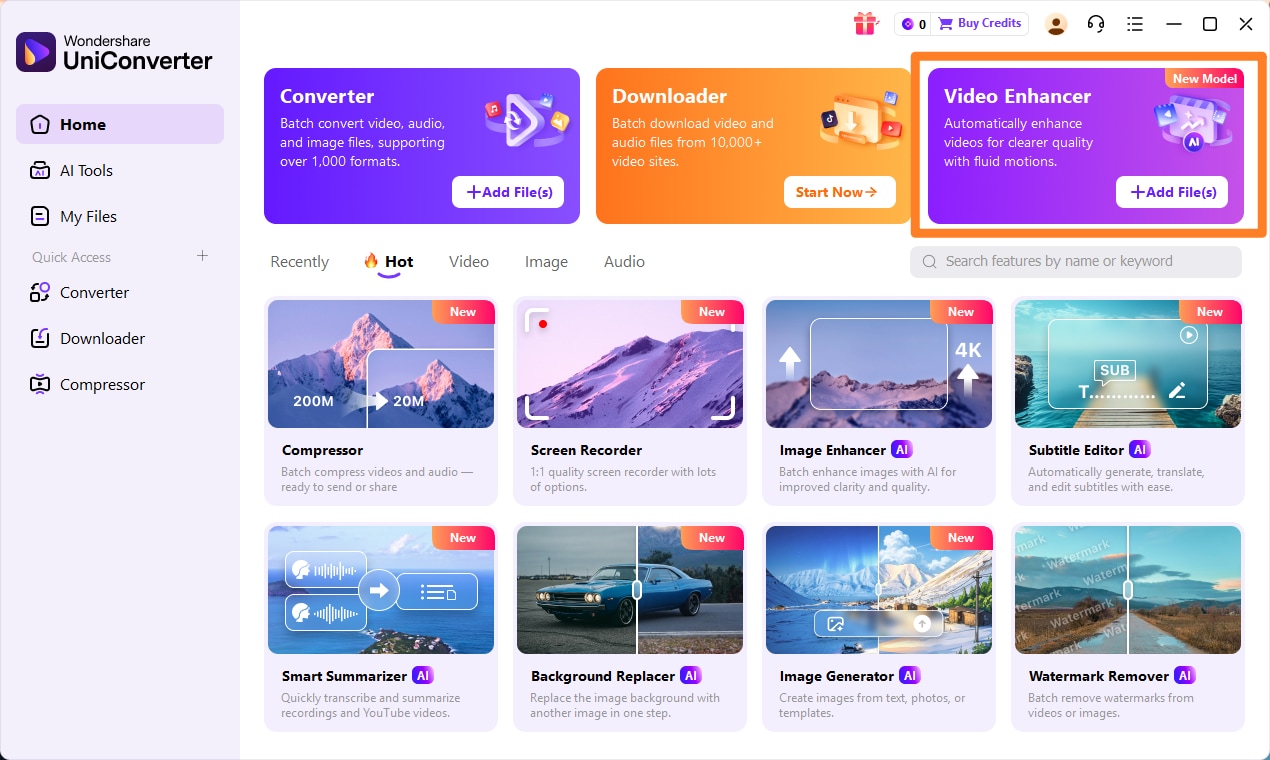
Step 1: Open UniConverter and Choose Video Enhancer
Launch UniConverter on your computer. From the main interface, navigate to the "Toolbox" section and select the "Video Enhancer" option. This will open the dedicated enhancement module.
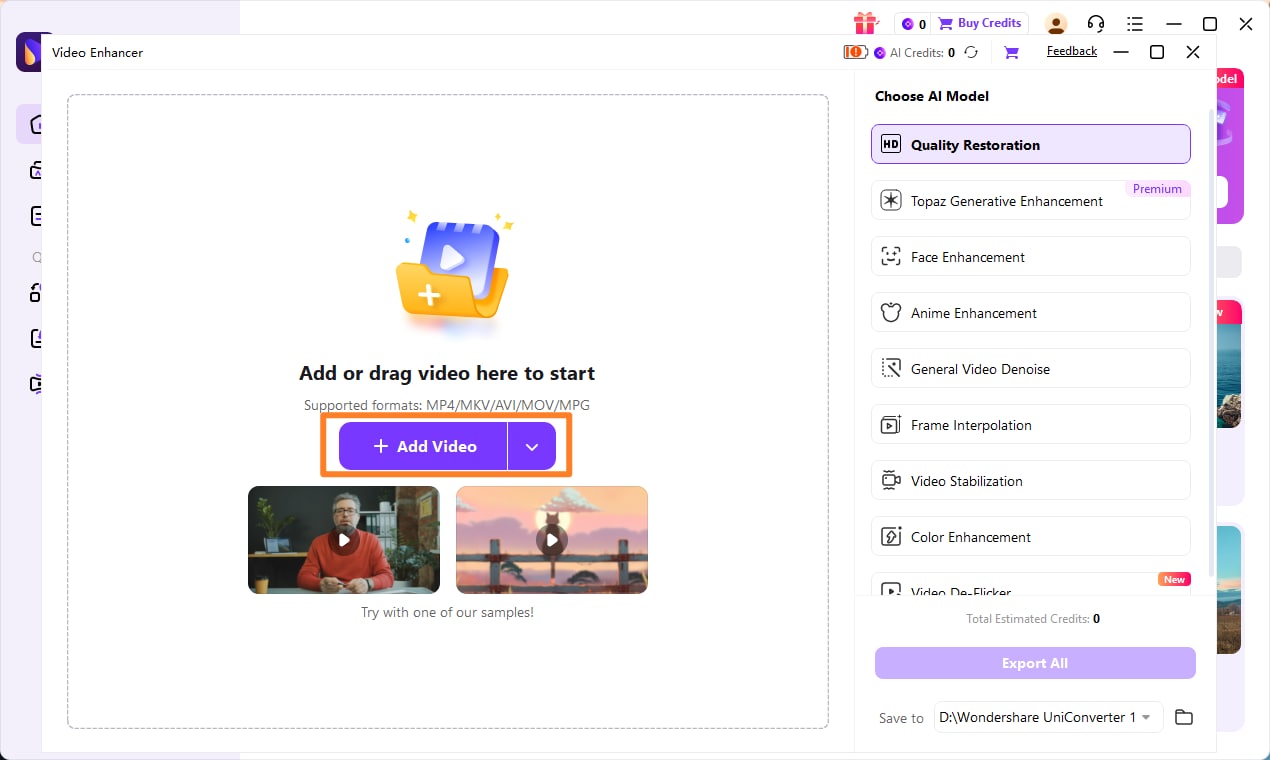
Step 2: Upload the Videos
Click on the "Add Files" button or drag and drop your video files directly into the UniConverter interface. You can add multiple videos for batch processing.
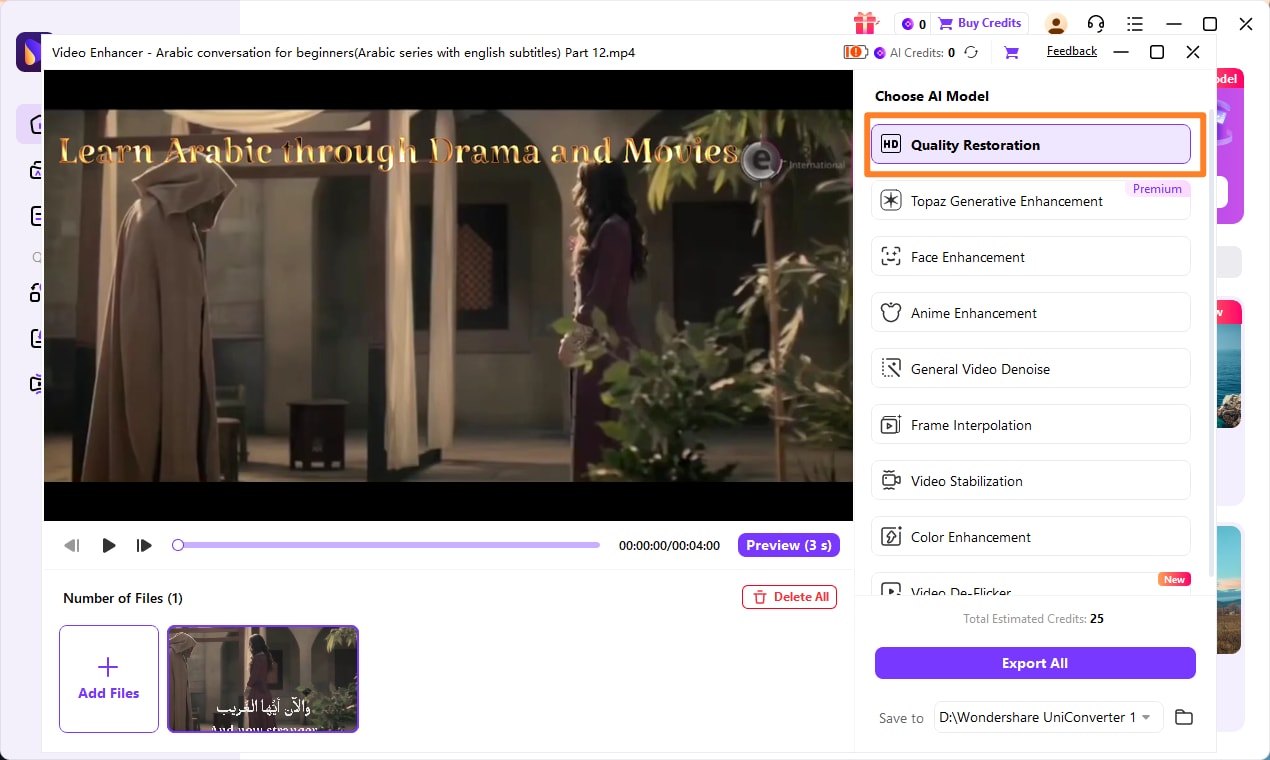
Step 3: Choose Enhancement Model
Once your video is loaded, UniConverter will present various enhancement options. Select the desired AI model for upscaling (e.g., AI Upscale, AI Denoise) and adjust parameters like resolution, brightness, contrast, and saturation as needed. For instance, you might want to remove background without losing quality or utilize a high-definition background remover to refine your footage. You can also explore options to change video background or use an online background remover for quick edits.
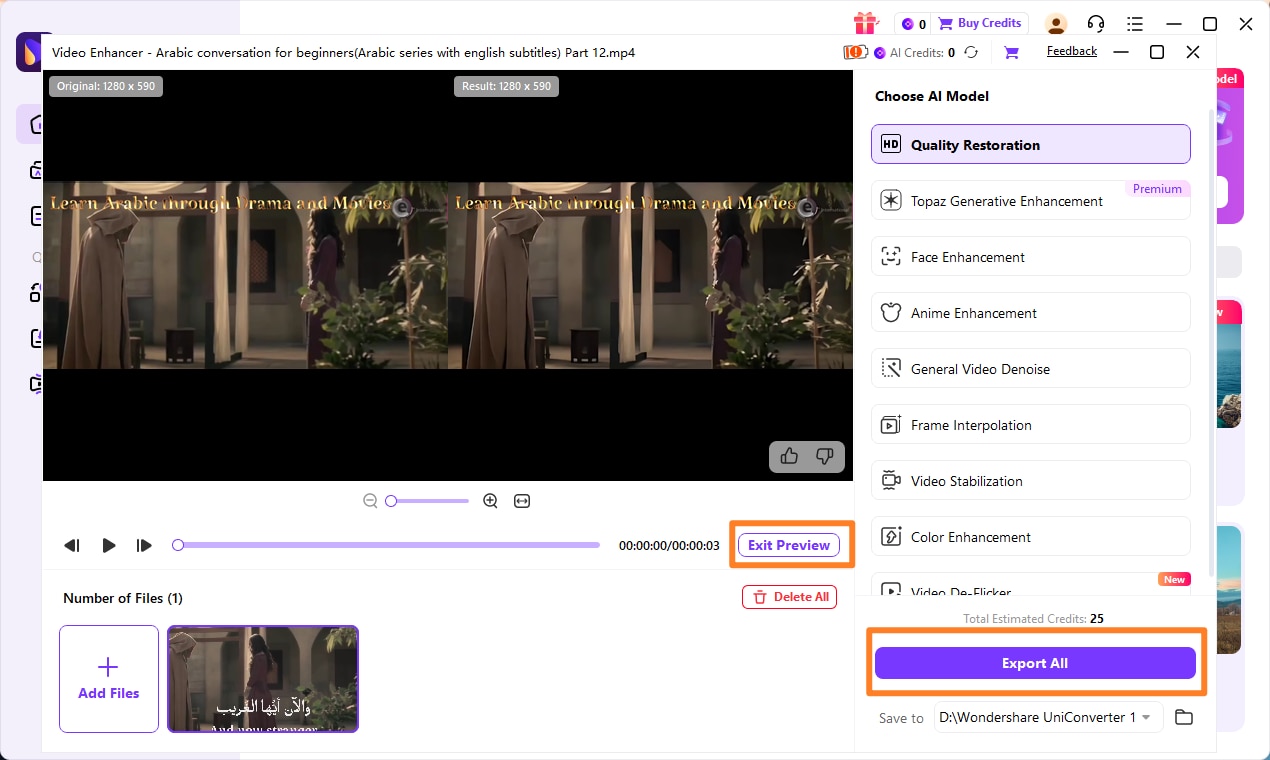
Step 4: Preview and Save the Enhanced Video
Before finalizing, use the "Preview" function to see the enhanced video side-by-side with the original. Once satisfied, choose your output format and destination folder, then click "Export" to save your high-quality video.

Seeking a RealScaler Video Enhancer Alternative?
Part 7: Conclusion
The RealScaler Video Enhancer review reveals a powerful tool for breathing new life into older video content, particularly for users seeking an easy-to-use solution for upscaling and basic enhancement. Its AI-driven approach simplifies complex processes, making it accessible to a broad audience. However, its resource intensity and limited advanced customization might deter professional users or those with less powerful hardware. When considering alternatives, UniConverter emerges as a strong contender, offering a balanced blend of quality, speed, and ease of use, coupled with comprehensive features and a stable performance. For casual users prioritizing quick enhancements, RealScaler is a viable option. Professionals requiring granular control might find more satisfaction with tools like Topaz Video AI or DaVinci Resolve. Budget-conscious consumers should carefully weigh the subscription model against their usage frequency. Ultimately, the best choice depends on individual needs, technical proficiency, and the specific demands of the video enhancement project.
Part 8: FAQs
-
1. Can RealScaler Video Enhancer improve highly compressed videos?
While it can help, heavily compressed videos may still show artifacts due to missing data. The AI can only reconstruct so much information that was lost during the initial compression.
-
2. Is RealScaler Video Enhancer suitable for professional film restoration?
For basic upscaling and noise reduction, yes. However, for advanced restoration tasks like scratch removal, color grading, or frame interpolation for severely damaged footage, specialized professional tools might be needed in conjunction with or instead of RealScaler.
-
3. What are the minimum system requirements for RealScaler Video Enhancer?
A dedicated GPU (NVIDIA, AMD, or Intel Arc) with at least 4GB of VRAM and a modern multi-core CPU (Intel i5/Ryzen 5 or higher) are highly recommended for optimal performance and reasonable processing times. More powerful hardware will significantly reduce rendering duration.
-
4. Does RealScaler Video Enhancer offer a free trial?
Most video enhancers, including RealScaler, typically offer a limited free trial. This usually involves watermarked output, restricted features, or a time limit, allowing users to test the software before committing to a purchase.
-
5. How does RealScaler Video Enhancer handle different video codecs?
It generally supports a wide range of popular video codecs (e.g., H.264, H.265, MPEG-4) and container formats (e.g., MP4, MOV, AVI). However, performance and the quality of enhancement can vary depending on the specific codec, its compression level, and the original video's integrity.
