
- Real-ESRGAN Overview: Open-source, command-line AI tool for advanced video super-resolution, enhancing low-quality footage with deep learning.
- Pros & Cons: Offers exceptional detail restoration and upscaling but demands significant computational resources and can introduce artifacts.
- User Suitability: Ideal for technical users, hobbyists, and professionals comfortable with CLI for customized, high-quality video restoration.
- Competitor Comparison: Outperforms many in raw AI power but lacks the user-friendliness and comprehensive features of GUI alternatives like UniConverter.
- Risks & Pitfalls: Steep learning curve, potential for visual artifacts, and high hardware demands limit accessibility for casual users.
- UniConverter Alternative: Provides a user-friendly GUI, efficient batch processing, and stable enhancement for broader accessibility and convenience.
In this article
- Part 1: What is Real-ESRGAN Video Enhancer?
- Part 2: Real-ESRGAN Video Enhancer: Core Features, Pros, and Cons
- Part 3: Real-ESRGAN Video Enhancer: Ideal Users and Use Cases
- Part 4: Real-ESRGAN Video Enhancer vs. Competitors
- Part 5: Risks and Pitfalls of Using Real-ESRGAN Video Enhancer
- Part 6: How to Use UniConverter to Efficiently Enhance Videos
- Part 7: Conclusion
- Part 8: FAQs
In the rapidly evolving landscape of digital media, the demand for high-quality video content has never been greater. However, a vast archive of valuable footage remains trapped in lower resolutions, often suffering from blurriness, noise, and compression artifacts. This is where AI-powered video enhancement tools step in, promising to breathe new life into old videos. Among these, Real-ESRGAN Video Enhancer review stands out as a powerful, open-source solution leveraging advanced super-resolution techniques. This comprehensive review will delve into its capabilities, compare it with leading competitors, and guide users through its optimal application, helping them make informed decisions about their video enhancement needs.
Part 1: What is Real-ESRGAN Video Enhancer?
Real-ESRGAN Video Enhancer is an open-source, command-line tool designed for state-of-the-art image and video super-resolution. It is based on the ESRGAN (Enhanced Super-Resolution Generative Adversarial Networks) architecture, specifically optimized for real-world images and videos. Unlike traditional upscaling methods that simply interpolate pixels, Real-ESRGAN utilizes deep learning to intelligently reconstruct details, effectively transforming low-resolution input into high-resolution output with remarkable clarity. This review aims to provide a detailed analysis of its performance, user experience, and suitability for various enhancement tasks.
The Rise of AI in Video Enhancement
The advent of AI has revolutionized video processing, addressing long-standing challenges in quality improvement.
* Overcoming Traditional Limitations: AI models can infer missing details and remove noise more effectively than conventional algorithms.
* Accessibility to Advanced Techniques: Complex super-resolution methods are now available to a broader audience.
* Demand for High-Quality Content: The proliferation of high-resolution displays drives the need for enhanced video.
* Revitalization of Archival Footage: AI offers a powerful solution for preserving and improving historical video assets.
Part 2: Real-ESRGAN Video Enhancer: Core Features, Pros, and Cons
Real-ESRGAN Video Enhancer excels in its ability to significantly improve video quality through advanced AI models. Its core capability lies in super-resolution, where it can upscale videos by factors of 2x, 4x, or even 8x, generating missing pixels with impressive detail. It also incorporates noise reduction and artifact removal, making it effective for restoring damaged or low-quality footage. The tool is highly configurable, allowing users to fine-tune parameters for specific enhancement needs, though this requires a deeper understanding of its underlying mechanisms.
Pros:
* Exceptional Detail Restoration for Vintage Footage: Real-ESRGAN can remarkably recover fine textures and details often lost in older, lower-resolution videos.
* Significant Resolution Upscaling for Low-Quality Videos: It effectively transforms blurry, pixelated videos into sharper, higher-definition versions.
* Open-Source and Community-Driven Development: Being open-source, it benefits from continuous improvements and contributions from a global community.
Cons:
* Can Introduce Artifacts on Certain Video Types: Over-enhancement or specific video characteristics can sometimes lead to unnatural textures or ghosting.
* Requires Significant Computational Resources: Processing high-resolution videos demands a powerful GPU and substantial VRAM, limiting accessibility for some users.
Part 3: Real-ESRGAN Video Enhancer: Ideal Users and Use Cases
Real-ESRGAN Video Enhancer is particularly well-suited for users with a technical inclination who are comfortable with command-line interfaces and possess robust hardware. Its power lies in its ability to deliver high-quality, customized enhancements. Hobbyists, researchers, and video restoration professionals who prioritize control and advanced results over ease of use will find it invaluable. However, casual users seeking a quick and simple solution might find its technical demands daunting.
Best Use Case: Revitalizing Archival Family Videos
Imagine old VHS tapes or early digital recordings of cherished family moments. These videos often suffer from low resolution, color degradation, and significant noise. Real-ESRGAN can dramatically upscale these videos, restoring vibrancy, sharpening faces, and making them enjoyable to watch on modern high-definition screens. The ability to bring these memories back to life with such clarity is a compelling use case for the tool.
Limited Use Case: Real-time Gaming Stream Enhancement
While Real-ESRGAN offers impressive upscaling, its computational intensity makes it unsuitable for real-time applications like live gaming stream enhancement. The processing latency would be too high, leading to significant delays and a poor viewer experience. For such scenarios, dedicated hardware encoders or less computationally demanding, real-time-optimized solutions are necessary.
Part 4: Real-ESRGAN Video Enhancer vs. Competitors
When evaluating video enhancement tools, it's crucial to consider various factors beyond just the AI model. Here's a comparison of Real-ESRGAN Video Enhancer with some prominent alternatives: UniConverter, Topaz Video AI, and DaVinci Resolve.
| Feature/Product | Real-ESRGAN Video Enhancer | UniConverter | Topaz Video AI | DaVinci Resolve |
| AI Model | ESRGAN | Proprietary (AI Lab) | Proprietary (Artemis, Dione, Gaia) | Proprietary (Neural Engine) |
| Output Quality | High | High | Very High | Medium-High |
| Ease of Use | Moderate (CLI) | High (GUI) | High (GUI) | Moderate (Pro-grade NLE) |
| Cost | Free | Subscription/One-time Purchase | One-time Purchase | Free (Studio version paid) |
| System Requirements | High (GPU) | Moderate | High (GPU) | High (GPU) |
| Processing Speed | Moderate (GPU dependent) | Fast (GPU acceleration) | Fast (GPU acceleration) | Moderate (GPU dependent) |
| Customer Support | Community | Dedicated Support | Dedicated Support | Community/Paid Support |
| Security | Local processing | Local processing | Local processing | Local processing |
Key Differentiators: Open-Source Flexibility vs. User-Friendly Interfaces
Real-ESRGAN's strength lies in its open-source nature, offering unparalleled flexibility and customization for those with technical expertise. However, its command-line interface presents a steeper learning curve. UniConverter and Topaz Video AI, conversely, prioritize user-friendliness with intuitive GUIs, making advanced enhancement accessible to a broader audience. Topaz Video AI often leads in raw output quality for specific scenarios, while UniConverter provides a comprehensive suite of video tools alongside its enhancement capabilities. DaVinci Resolve, while offering some AI enhancement, is primarily a professional video editing suite where enhancement is one of many features.
Part 5: Risks and Pitfalls of Using Real-ESRGAN Video Enhancer
While Real-ESRGAN offers powerful video enhancement capabilities, users should be aware of several potential risks and pitfalls, especially for those new to AI-powered video processing. Understanding these can help manage expectations and avoid undesirable outcomes.
Potential for Unintended Visual Artifacts
Despite its sophistication, Real-ESRGAN can sometimes introduce visual artifacts. These might include "AI hallucinations" where the model generates non-existent details, unnatural textures, or a "plastic" look, especially on faces or smooth surfaces. Over-enhancement can also lead to a hyper-real or cartoonish appearance, detracting from the original video's authenticity. This is particularly noticeable on videos with complex patterns or significant initial compression.
Steep Learning Curve for Non-Technical Users
Real-ESRGAN is primarily a command-line interface (CLI) tool. This means users need to be comfortable with typing commands, understanding parameters, and potentially compiling code. For those accustomed to graphical user interfaces (GUIs), the initial setup and operation can be daunting and time-consuming, requiring a significant investment in learning the syntax and various options.
Hardware Demands and Processing Time
Effective use of Real-ESRGAN requires substantial computational power, particularly a high-end GPU with ample VRAM. Without adequate hardware, processing even short videos can take an extremely long time, making it impractical for larger projects. Users with older or less powerful machines may find the performance unsatisfactory or even impossible to run effectively.
Data Privacy Concerns with Cloud-Based Implementations
While Real-ESRGAN itself is a local, open-source tool, its popularity has led to various cloud-based services integrating it. If you opt for a cloud-based solution that utilizes Real-ESRGAN, you must carefully review their data privacy policies. Uploading sensitive or personal video content to third-party servers always carries a risk of data breaches or unauthorized access, even if the underlying AI model is open-source.
Part 6: How to Use UniConverter to Efficiently Enhance Videos
When other tools fall short in batch processing, stable enhancement, or delivering noticeable improvements, UniConverter emerges as a robust alternative. It offers a user-friendly, all-in-one solution for video enhancement, ensuring high-quality, stable, and lossless results with GPU acceleration. UniConverter is free from ads and supports a vast array of formats, making it an ideal choice for both individual and batch video enhancement tasks.
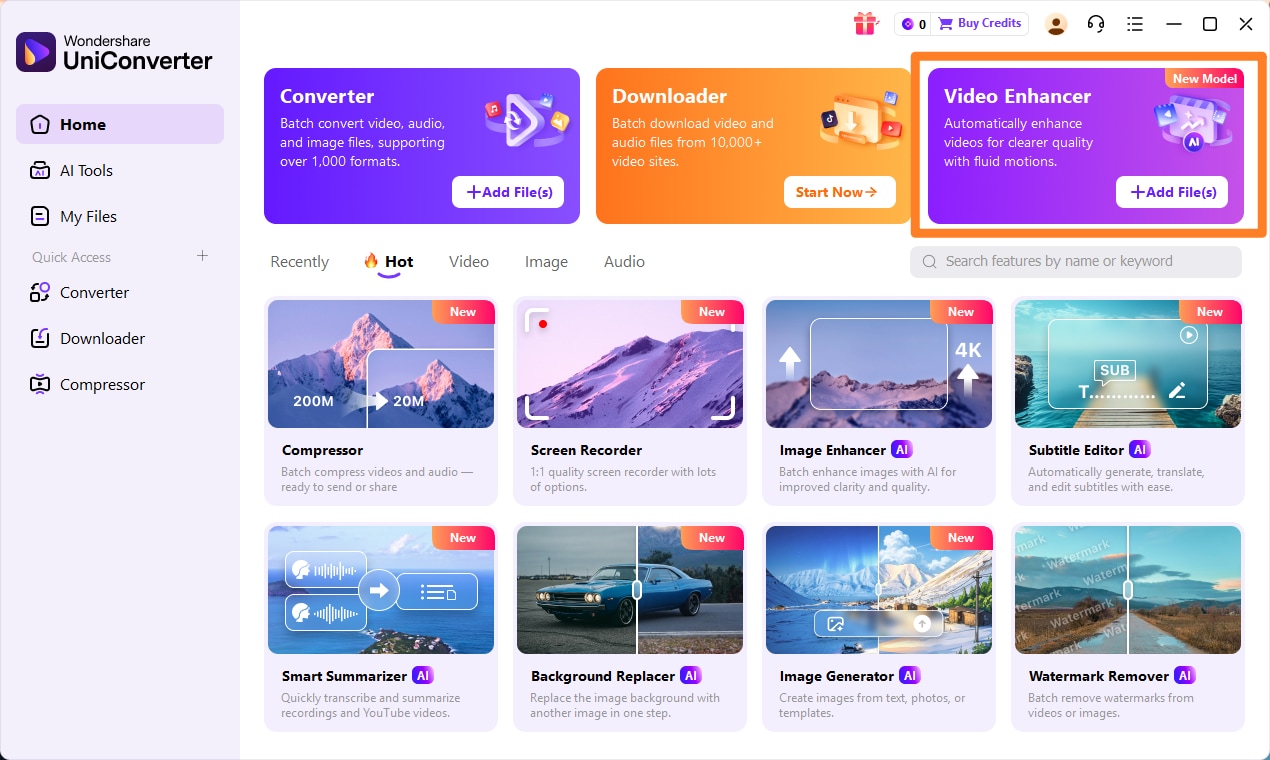
Step 1: Open UniConverter and Choose Video Enhancer
Launch UniConverter on your computer. Navigate to the "Toolbox" section from the main interface. Within the Toolbox, locate and select the "Video Enhancer" option to begin the enhancement process.
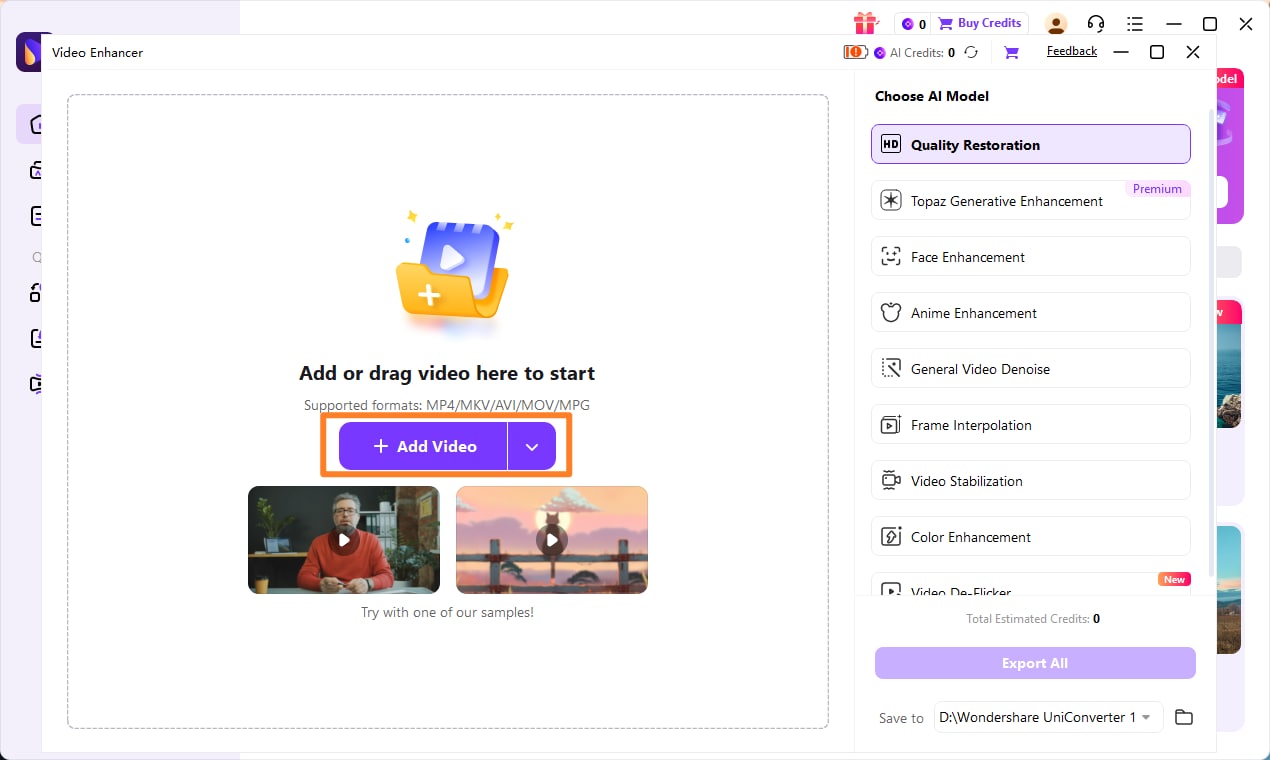
Step 2: Upload the Videos
Click the "Add Files" button or simply drag and drop your video files into the UniConverter interface. You can upload multiple videos for batch processing, saving valuable time.
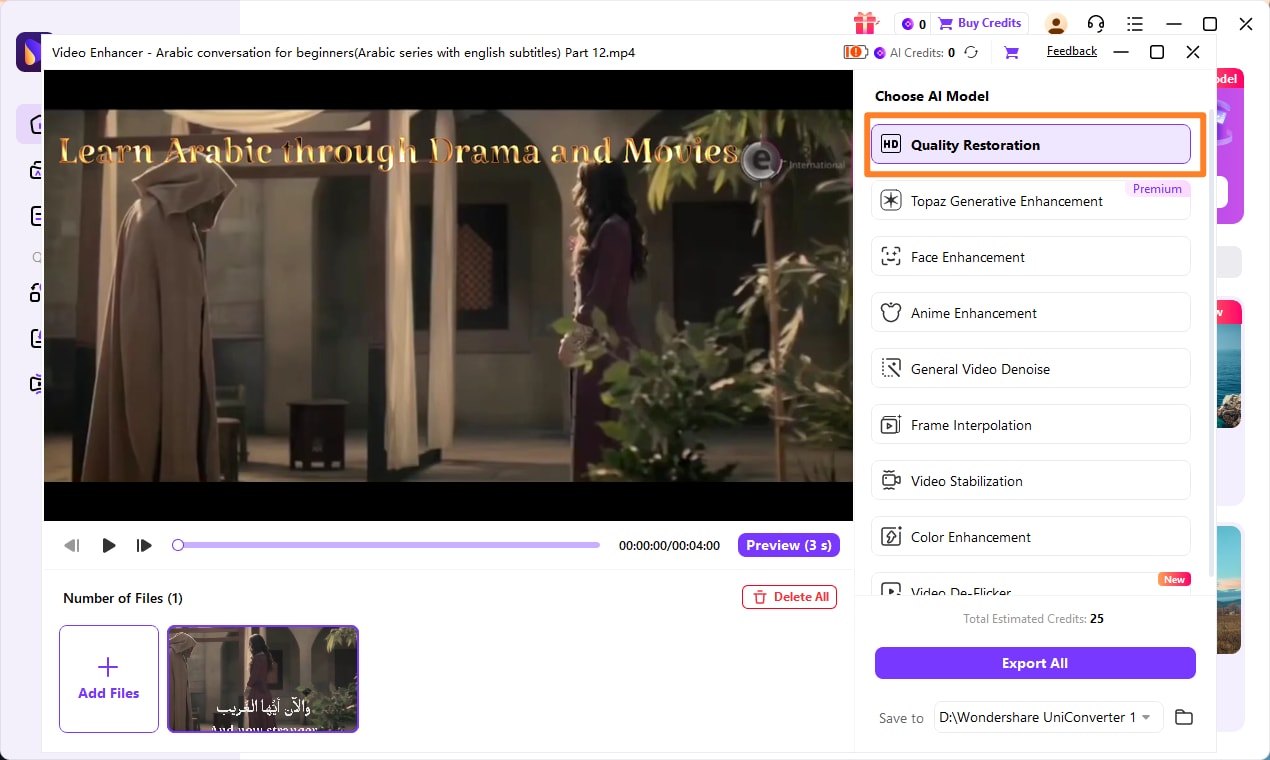
Step 3: Choose Enhancement Model
UniConverter offers various enhancement models, including AI upscaling, brightness/contrast adjustment, de-shaking, and noise reduction. Select the desired enhancement options based on your video's needs. You can preview the changes before applying them.
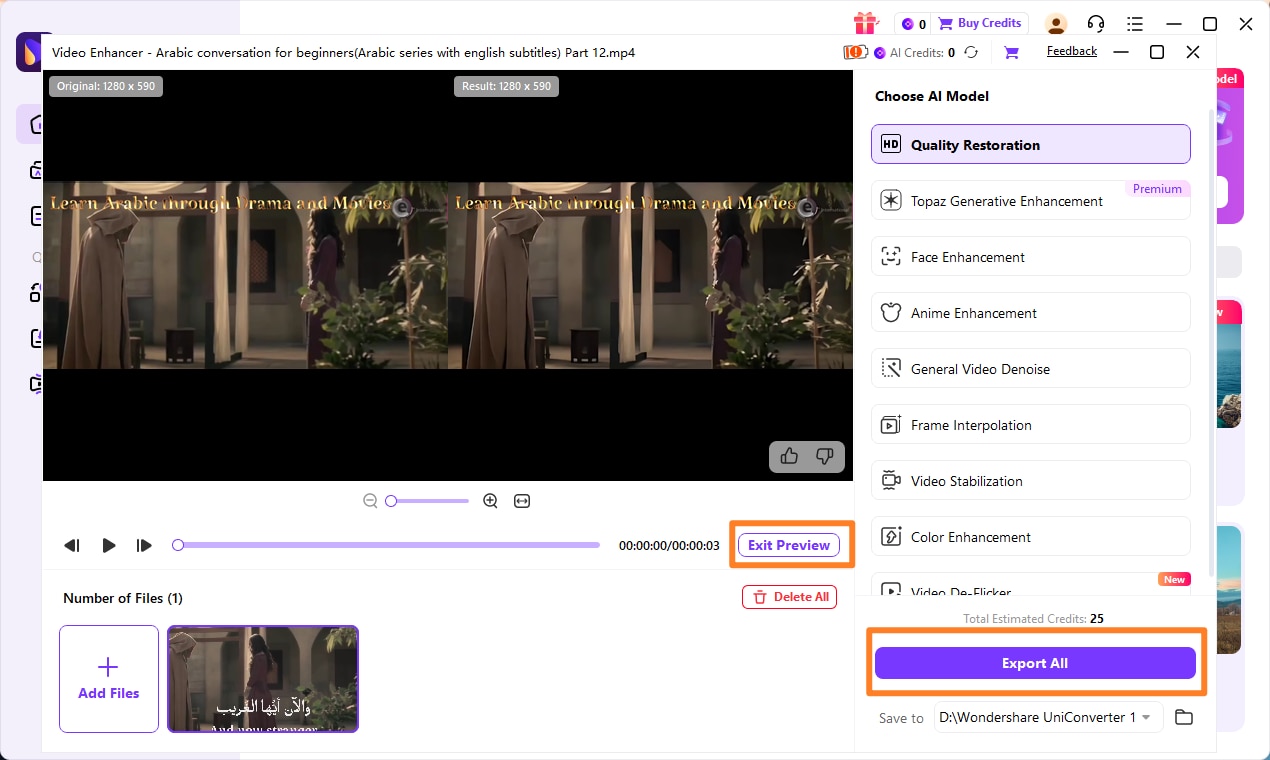
Step 4: Preview and Save the Enhanced Video
After selecting your enhancement settings, click the "Preview" button to see the results. Once satisfied, choose your desired output format and destination folder. Finally, click "Enhance" to process and save your high-quality video.

Enhance Videos Beyond Real-ESRGAN
Part 7: Conclusion
The Real-ESRGAN Video Enhancer review reveals a powerful, open-source tool that excels in super-resolution and detail restoration, particularly for vintage or low-quality footage. Its strength lies in its advanced AI model and the flexibility offered by its command-line interface, making it a favorite among technical users, researchers, and enthusiasts who demand granular control over the enhancement process. However, its significant hardware requirements, potential for artifacts, and steep learning curve present barriers for casual users. For those prioritizing ease of use, a streamlined workflow, and comprehensive features without the technical overhead, alternatives like UniConverter offer a compelling solution. UniConverter provides a user-friendly graphical interface, robust enhancement capabilities, and a broader suite of video tools, making it an excellent choice for general users seeking reliable and efficient video improvement. Ultimately, the best tool depends on the user's technical proficiency, hardware availability, and specific enhancement goals, balancing the raw power of Real-ESRGAN with the accessibility and convenience of commercial alternatives.
Part 8: FAQs
-
1. What is the main difference between Real-ESRGAN and other video enhancers?
Real-ESRGAN is primarily an open-source, command-line tool focused on super-resolution using a specific AI model, while many commercial alternatives offer more user-friendly interfaces and broader feature sets, often with proprietary AI models.
-
2. Can Real-ESRGAN enhance videos in real-time?
Generally no. Real-ESRGAN is computationally intensive and designed for offline processing, not real-time enhancement, due to the significant latency involved in its deep learning computations.
-
3. Is Real-ESRGAN suitable for professional video production?
While it can produce impressive results, its technical nature and potential for artifacts might make it less ideal for direct integration into professional workflows without significant expertise and careful post-processing to mitigate any imperfections.
-
4. What kind of hardware do I need to run Real-ESRGAN effectively?
A powerful GPU with ample VRAM (e.g., NVIDIA RTX series with 8GB+ VRAM) is highly recommended for efficient processing, especially for higher resolution videos and faster rendering times.
-
5. Are there any privacy concerns when using Real-ESRGAN?
As an open-source, locally run tool, Real-ESRGAN itself doesn't inherently pose privacy risks as your data remains on your machine. However, if you use a cloud-based service that integrates Real-ESRGAN, you should review their privacy policy regarding data handling.
