
- OBS Studio: Excellent for real-time streaming and recording, but limited for post-production video enhancement.
- Enhancement Tools: Diverse market from dedicated AI enhancers to all-in-one solutions like UniConverter.
- OBS Pros: Real-time processing, highly customizable, free. Cons: Steep learning curve, limited dedicated enhancement.
- Ideal OBS Users: Live streamers needing real-time adjustments; not ideal for non-technical post-production.
- Comparison: OBS excels in real-time; UniConverter, Topaz, DaVinci offer superior post-production quality.
- OBS Pitfalls: Performance issues on lower-end hardware, complex to achieve desired results, relies on plugins, lacks AI.
- UniConverter Value: Offers efficient, stable, and batch video enhancement with an intuitive interface.
- Decision: Choose OBS for live, UniConverter for comprehensive post-production enhancement and ease of use.
In this article
- Part 1: What is OBS Studio
- Part 2: OBS Studio: Core Features, Pros, and Cons
- Part 3: OBS Studio: Ideal Users and Scenarios
- Part 4: OBS Studio and Alternatives Comparison
- Part 5: Risks and Pitfalls When Using OBS Studio for Enhancement
- Part 6: How to Use UniConverter for Efficient Video Enhancement
- Part 7: Final Verdict and Recommendations
- Part 8: FAQs
OBS Studio Video Enhancer Review
This OBS Studio video enhancer review delves into the capabilities of OBS Studio beyond its primary function as a streaming and recording tool, specifically examining its utility for video enhancement. While OBS Studio is renowned for its robust live broadcasting features, its role in improving video quality, particularly in post-production, often requires a deeper understanding of its filters and settings. This review aims to provide a comprehensive comparison against dedicated video enhancement software, helping users determine if OBS Studio meets their enhancement needs or if alternative solutions are more suitable for achieving professional-grade video quality.
Part 1: What is OBS Studio
OBS Studio, or Open Broadcaster Software, is a free and open-source software suite for video recording and live streaming. Developed and maintained by the OBS Project, it has become a cornerstone for content creators, gamers, and educators worldwide due to its powerful features and extensive customization options. While primarily known for its ability to capture and broadcast video content in real-time, OBS Studio also offers a range of filters and settings that can be leveraged for basic video enhancement during live streams or recordings. This review will critically assess its effectiveness in this secondary role, comparing it with dedicated video enhancement tools.
The Landscape of Video Enhancement Tools
The market for video enhancement tools is diverse, catering to various needs from simple color correction to advanced AI-driven upscaling.
* Dedicated Enhancers: Software like Topaz Video AI or DaVinci Resolve offers sophisticated algorithms for noise reduction, sharpening, and color grading.
* All-in-One Solutions: Tools such as UniConverter integrate enhancement features alongside conversion, editing, and compression functionalities.
* Simple Editors: Many basic video editors include rudimentary enhancement options, often limited to brightness, contrast, and saturation adjustments.
* AI-Powered Tools: A growing segment utilizes artificial intelligence to automatically improve video quality, often with impressive results for upscaling and de-noising.
Part 2: OBS Studio: Core Features, Pros, and Cons
OBS Studio, at its core, is a versatile platform for capturing and broadcasting video. Its primary strength lies in its ability to manage multiple video and audio sources, apply real-time transitions, and stream to various platforms simultaneously. For video enhancement, it relies on a system of filters that can be applied to individual sources or the entire output. These filters include color correction, sharpening, noise suppression, and LUTs (Look-Up Tables) for color grading.
Pros:
* Real-time Processing for Live Streams: Seamless integration for live content creators, allowing on-the-fly adjustments.
* Highly Customizable Settings: Fine-grained control over video and audio parameters, enabling precise adjustments.
* Open-Source and Free: Accessible to a wide range of users without subscription fees, making it a cost-effective solution.
Cons:
* Steep Learning Curve for Enhancement Features: Requires technical knowledge to optimize video quality effectively.
* Limited Dedicated Enhancement Tools: Primarily a streaming/recording tool, not a dedicated enhancer with advanced algorithms.
Part 3: OBS Studio: Ideal Users and Scenarios
OBS Studio excels in scenarios where real-time video manipulation and broadcasting are paramount. Its robust architecture allows users to integrate various sources, apply filters, and stream with minimal latency, making it an indispensable tool for live content creators. However, its capabilities as a dedicated video enhancer for post-production are more limited, often requiring significant manual effort and technical expertise to achieve satisfactory results.
Best Use Case: Live Streamers and Content Creators Needing Real-time Adjustments
OBS Studio is the go-to choice for live streamers, online educators, and virtual event organizers who need to enhance their video feed in real-time. For instance, a gamer streaming on Twitch can use OBS Studio to apply noise suppression to their microphone, color correct their webcam feed, and sharpen their game capture, all while broadcasting live. This real-time processing ensures a polished output without the need for post-production editing, which is crucial for live content.
Limited Use Case: Post-Production Video Enhancement for Non-Technical Users
For users who primarily focus on post-production video enhancement and lack extensive technical knowledge, OBS Studio presents a steep learning curve and limited dedicated tools. For example, a vlogger looking to upscale an old video or automatically remove significant noise from a pre-recorded clip would find OBS Studio's filter-based approach cumbersome and less effective compared to AI-powered dedicated enhancement software. The manual tweaking required to achieve subtle improvements can be time-consuming and frustrating for those seeking quick, high-quality results.
Part 4: OBS Studio and Alternatives Comparison
When evaluating OBS Studio for video enhancement, it's crucial to compare it against tools specifically designed for this purpose. While OBS offers some enhancement filters, its primary function remains streaming and recording. Dedicated enhancers, on the other hand, leverage advanced algorithms and AI to deliver superior quality improvements, often with greater ease of use.
Comparison Table: OBS Studio & Competitors
| Feature/Tool | OBS Studio | UniConverter | Topaz Video AI | DaVinci Resolve |
| Primary Function | Streaming/Recording | All-in-One Video Tool | AI Video Enhancement | Professional Video Editing |
| Ease of Use | Medium-Hard | Easy | Medium | Hard |
| Real-time Enhancement | Yes | Limited | No | Yes (with powerful hardware) |
| Post-production Enhancement | Manual/Plugins | Yes | Yes | Yes |
| Cost | Free | Paid Subscription | Paid Software | Free/Paid Studio Version |
| Processing Speed | Real-time (capture) | Fast (GPU acceleration) | Slow (intensive AI) | Fast (GPU acceleration) |
| Output Quality | Dependent on settings | High (lossless options) | Very High (AI upscaling) | Very High (professional tools) |
| Customer Support | Community Forums | Dedicated Support | Dedicated Support | Community/Paid Support |
| Security | Open-source, community vetted | High | High | High |
Key Differentiators: Real-time Capability vs. Dedicated Post-Production Enhancement
OBS Studio's strength lies in its real-time processing for live content, allowing immediate adjustments during broadcasts. However, for dedicated post-production enhancement, tools like UniConverter, Topaz Video AI, and DaVinci Resolve offer more robust and often automated solutions. UniConverter provides a user-friendly interface with various enhancement features, making it suitable for users seeking a balance between ease of use and quality. Topaz Video AI excels in AI-driven upscaling and de-noising, delivering exceptional results for challenging footage. DaVinci Resolve, while having a steeper learning curve, offers professional-grade color grading and noise reduction tools. The choice depends on whether real-time adjustments or comprehensive post-production quality are the priority.
Part 5: Risks and Pitfalls When Using OBS Studio for Enhancement
While OBS Studio offers a free and versatile platform for streaming and recording, relying on it solely for comprehensive video enhancement, especially for post-production, comes with several risks and pitfalls. Its design as a real-time capture tool means its enhancement capabilities are often filter-based and less sophisticated than dedicated software.
Potential for Performance Issues on Lower-End Hardware
Applying multiple filters and complex settings in OBS Studio, especially during live streaming or high-resolution recording, can significantly strain your computer's CPU and GPU. Lower-end hardware may struggle to process these enhancements in real-time, leading to dropped frames, stuttering video, and overall poor performance. This can severely impact the quality of your live broadcasts or recorded footage, making the "enhancement" counterproductive.
Complexity of Achieving Desired Enhancement Results
OBS Studio's enhancement features are largely manual and require a deep understanding of video parameters like color theory, noise reduction algorithms, and sharpening techniques. Achieving specific, professional-grade enhancement results often involves extensive trial and error, adjusting numerous sliders and values. For users without a strong technical background in video production, this complexity can be overwhelming, leading to inconsistent or unsatisfactory outcomes. Unlike AI-powered tools that automate much of this process, OBS demands significant user input and expertise.
Reliance on Third-Party Plugins for Advanced Features
Many advanced enhancement capabilities, such as sophisticated noise reduction, advanced sharpening algorithms, or specific color grading tools, are not natively built into OBS Studio. Users often have to rely on third-party plugins like StreamFX to extend its functionality. While these plugins can be powerful, they introduce additional layers of complexity, potential compatibility issues, and may not always be actively maintained or supported, posing a risk to the stability and reliability of your enhancement workflow.
Lack of Built-in AI-Powered Enhancement
A significant pitfall of using OBS Studio for enhancement is its complete lack of built-in AI-powered features. Modern video enhancement often leverages artificial intelligence for tasks like intelligent upscaling, automatic noise removal, and smart de-interlacing, which can deliver superior results with minimal user intervention. OBS Studio's filter-based approach cannot replicate the intelligence and efficiency of AI algorithms, meaning users will miss out on the cutting-edge quality improvements offered by dedicated AI video enhancers.
Part 6: How to Use UniConverter for Efficient Video Enhancement
When other tools fall short in batch processing, stable enhancement, or delivering noticeable improvements, UniConverter emerges as a robust solution. It bypasses common issues like unstable enhancements, weak effects, and the lack of batch processing found in many free or less specialized tools. UniConverter offers a comprehensive, ad-free experience with extensive format support, GPU acceleration for speed, and stable, lossless quality, making it an ultimate all-in-one solution for your video enhancement needs.
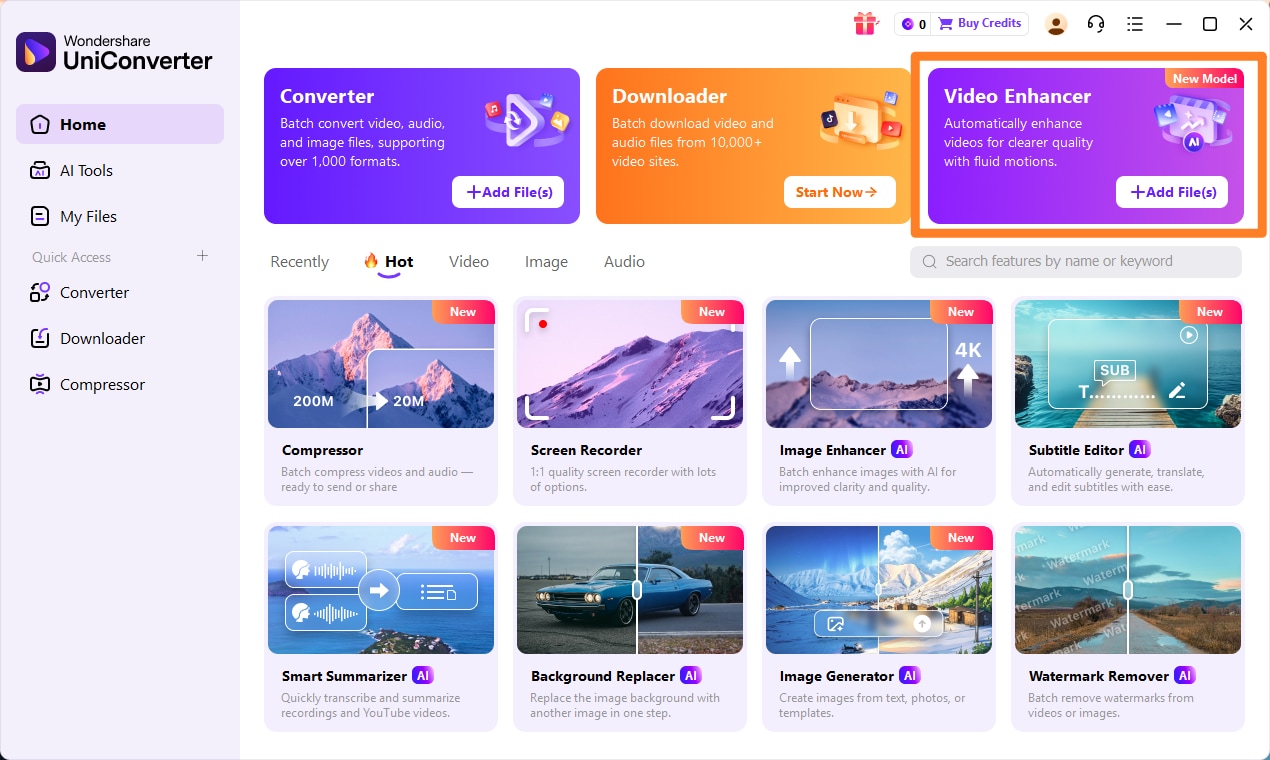
Step 1: Open UniConverter and Choose Video Enhancer
Launch Wondershare UniConverter on your computer. From the main interface, navigate to the "Toolbox" section. Here, you will find the "Video Enhancer" feature. Click on it to open the dedicated enhancement module.
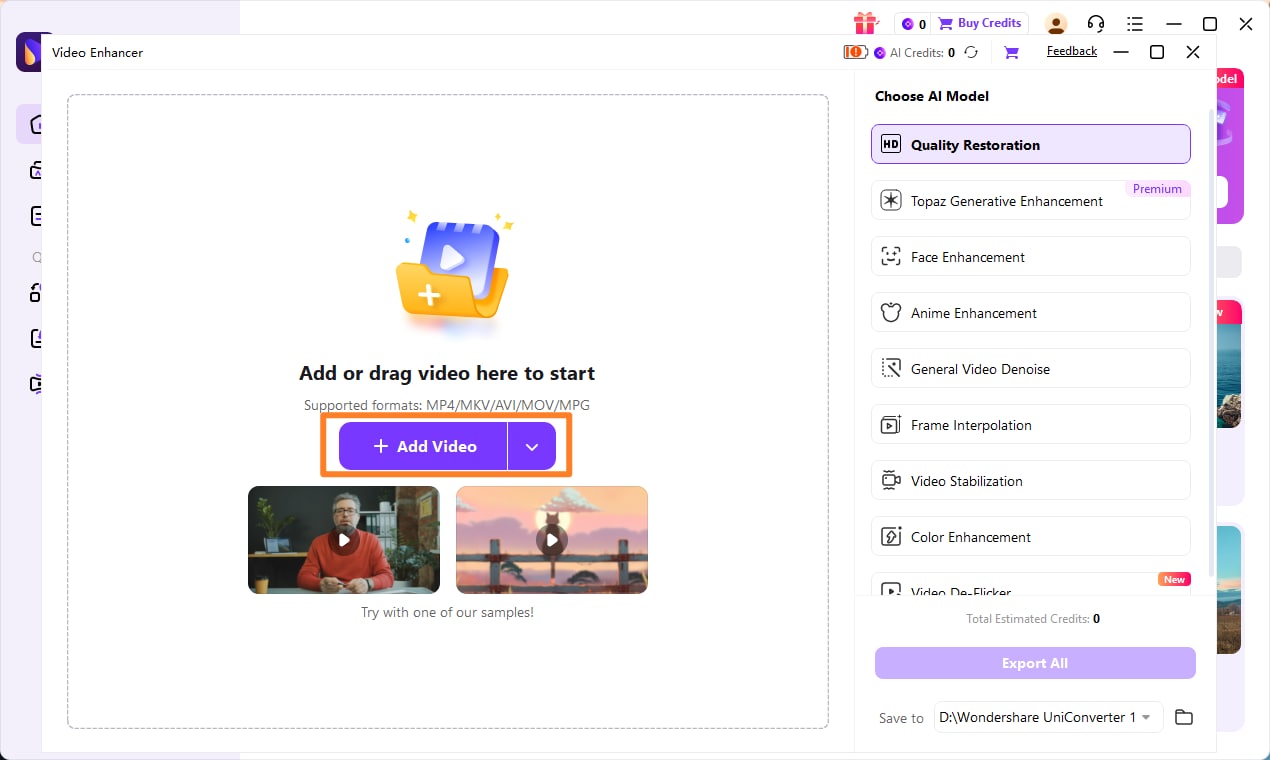
Step 2: Upload the Videos
In the Video Enhancer window, click the "Add Files" button or drag and drop your video files into the designated area. You can add multiple videos for batch processing, saving significant time.
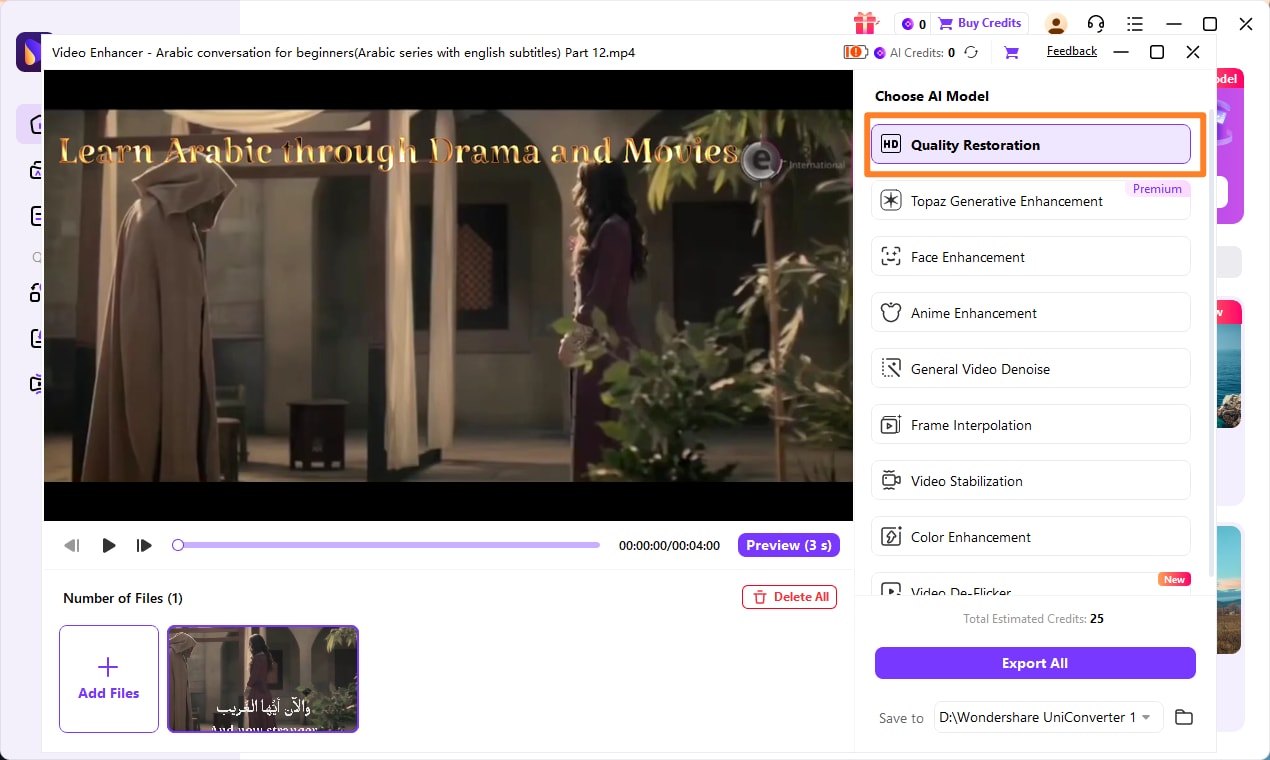
Step 3: Choose Enhancement Model
UniConverter offers various enhancement options. Select the desired enhancement model, such as "AI Upscale," "Denoise," "Brightness/Contrast Adjustment," or "Deinterlace." You can also customize parameters like resolution, frame rate, and bitrate. For instance, you might want to change your video background or remove the background without losing quality to achieve a specific visual effect. If you're working with images, you can also remove the background from an SVG to isolate subjects.
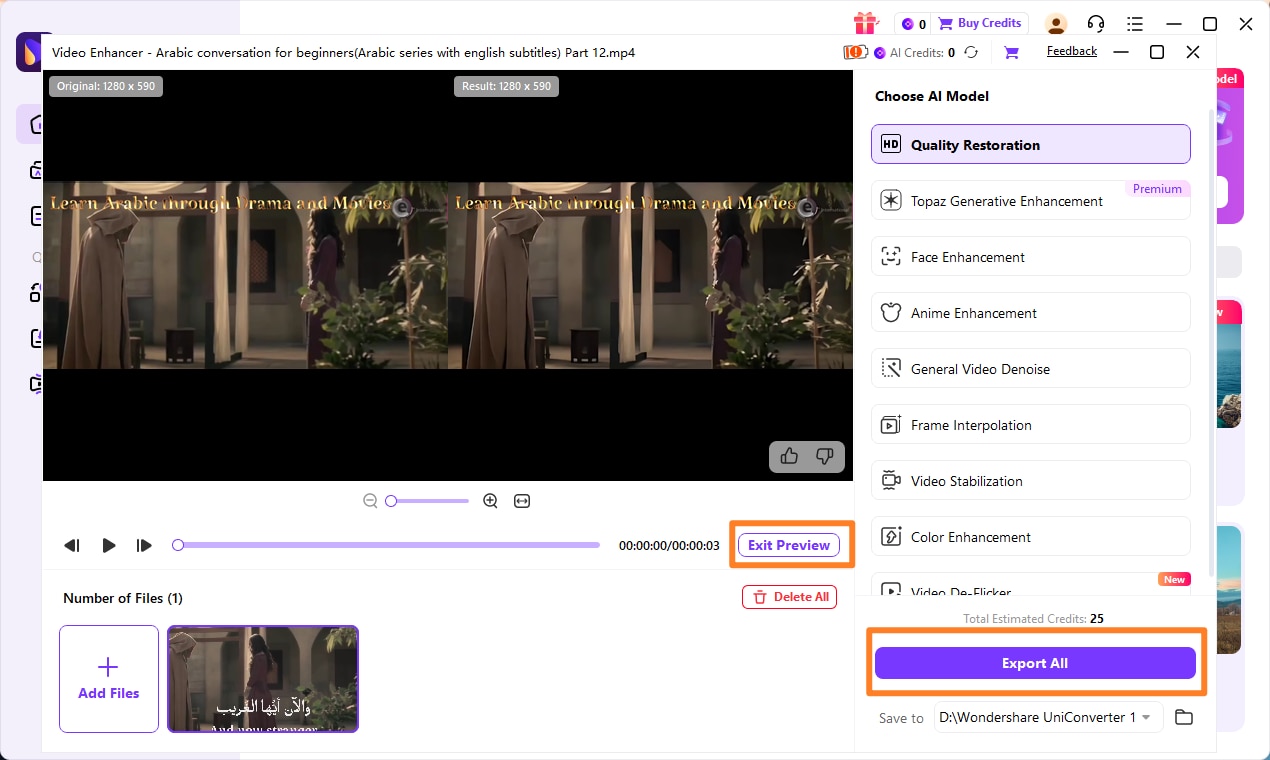
Step 4: Preview and Save the Enhanced Video
After selecting your enhancement settings, click the "Preview" button to see the changes before applying them. Once satisfied, choose your output format and destination folder, then click "Enhance" to process and save your improved video. This powerful tool can even help you achieve a high-definition background remover effect for your videos.

Enhance Videos Beyond OBS Studio
Part 7: Final Verdict and Recommendations
This OBS Studio video enhancer review concludes that while OBS Studio is an unparalleled tool for real-time streaming and recording, its capabilities as a dedicated video enhancer for post-production are limited. Its strength lies in live adjustments and customizable filters for technical users. However, for those seeking comprehensive, high-quality video enhancement, especially for pre-recorded content or without extensive technical knowledge, dedicated software offers superior results. UniConverter stands out as an excellent alternative for post-production, providing an intuitive interface, robust features, and efficient batch processing. Users should consider their primary workflow—whether real-time adjustments for live content or offline enhancement for polished videos—to make an informed decision. For quick, automated, and high-quality enhancements, particularly for non-technical users, investing in a specialized tool like UniConverter will yield more consistent and satisfying outcomes than relying solely on OBS Studio's built-in filters.
Part 8: FAQs
-
1. Can OBS Studio truly enhance video quality?
Yes, but primarily through optimizing capture settings and using specific filters like color correction, sharpening, and noise suppression. It does not offer dedicated AI-powered enhancement features found in specialized software.
-
2. Is OBS Studio suitable for beginners looking to enhance videos?
Not ideal for beginners seeking simple, one-click enhancement. Achieving good results in OBS Studio requires a technical understanding of video parameters and filter configurations, which can be challenging for novices.
-
3. What are the best plugins for video enhancement in OBS Studio?
Plugins like StreamFX offer advanced filters such as LUTs, sharpening, and color grading. However, their effectiveness depends heavily on user configuration and technical expertise.
-
4. How does OBS Studio compare to AI video enhancers?
OBS Studio lacks built-in AI enhancement. Dedicated AI enhancers, like Topaz Video AI, use sophisticated algorithms for automatic quality improvement, upscaling, and noise reduction, which OBS Studio cannot replicate with its filter-based system.
-
5. Is UniConverter a free alternative to OBS Studio for enhancement?
UniConverter offers a free trial with limited features. Its full enhancement capabilities are part of a paid subscription, making it different from OBS Studio, which is entirely free and open-source.
