
- MeGUI Overview: MeGUI offers granular control for video encoding, ideal for professionals and enthusiasts prioritizing precision and quality.
- Core Features: MeGUI excels with AviSynth scripting, codec flexibility, and advanced settings, enabling high-quality, customized output.
- Target Audience: Best for archivists and enthusiasts needing deep control over legacy formats; too complex for casual users.
- Comparison: MeGUI offers extensive customization but has a steep learning curve; UniConverter provides ease of use and AI enhancements.
- Risks: MeGUI's complexity, potential for suboptimal results, and lack of modern features require significant technical investment.
- UniConverter Alternative: UniConverter simplifies video enhancement with AI upscaling, noise reduction, and stabilization, bypassing MeGUI's complexities.
In this article
- Part 1: What is MeGUI Video Enhancer?
- Part 2: MeGUI Video Enhancer: Core Features, Pros, and Cons
- Part 3: Target Users and Use Cases
- Part 4: MeGUI Video Enhancer and Alternatives Comparison
- Part 5: Risks and Pitfalls When Using MeGUI Video Enhancer
- Part 6: How to Use UniConverter for Efficient Video Enhancement
- Part 7: Conclusion
- Part 8: FAQs
MeGUI, a powerful open-source video encoding application, has long been a go-to tool for video enthusiasts and professionals seeking granular control over their video processing workflows. This MeGUI Video Enhancer review delves into its capabilities, comparing it against popular alternatives to help users navigate the complex landscape of video enhancement and conversion. We will explore MeGUI's core features, its ideal use cases, and the potential pitfalls, ultimately providing a comprehensive guide for making informed decisions in your video projects.
Part 1: What is MeGUI Video Enhancer?
MeGUI is a comprehensive open-source video encoding application primarily designed for converting video and audio into various formats, with a strong emphasis on quality and customization. It acts as a graphical user interface (GUI) for a multitude of command-line tools, including AviSynth, x264, and FFmpeg, allowing users to harness their power without needing to master complex command-line syntax. Its core purpose revolves around providing advanced users with unparalleled control over every aspect of the encoding process, from selecting specific codecs and filters to fine-tuning bitrates and resolutions. MeGUI has carved out a niche in the video encoding landscape as a tool for those who prioritize precision and quality over simplicity, particularly for archiving and remastering legacy video content.
Market Background and User Pain Points:
* Need for Granular Control: Many users require precise control over encoding parameters for specific projects, which simpler tools often lack.
* Legacy Format Support: Dealing with older video formats and codecs often necessitates specialized tools for optimal conversion and enhancement.
* Quality Preservation: Professionals and enthusiasts demand high-quality output, minimizing loss during conversion and enhancement processes.
* Cost-Effective Solutions: The desire for powerful, free tools that can compete with commercial offerings.
Part 2: MeGUI Video Enhancer: Core Features, Pros, and Cons
MeGUI's core strength lies in its ability to integrate and manage various powerful open-source video processing tools, offering a highly customizable encoding experience. It supports a vast array of codecs, including x264 for H.264, x265 for H.265 (HEVC), and various audio codecs. Users can apply a wide range of filters through AviSynth scripts, enabling advanced video enhancements like deinterlacing, denoising, resizing, and color correction. Its robust job queue system allows for efficient batch processing of multiple encoding tasks.
Core Features:
* AviSynth Scripting Integration: Allows for highly customizable video filtering and processing.
* Codec Flexibility: Supports a wide range of video and audio codecs, including x264, x265, AAC, AC3.
* Advanced Encoding Settings: Provides granular control over bitrate, resolution, frame rate, and other encoding parameters.
* Job Queue Management: Efficiently handles multiple encoding tasks in a queue.
* Chapter and Subtitle Support: Integrates options for adding chapters and subtitles to encoded videos.
Pros:
* Advanced Customization for Expert Users: Offers unparalleled control over encoding parameters and filtering.
* High-Quality Encoding Output: Capable of producing professional-grade video and audio quality.
* Open-Source and Free to Use: Provides powerful tools without any cost.
Cons:
* Steep Learning Curve for Beginners: Requires significant technical knowledge to master.
* Outdated User Interface and Limited Support: The UI can feel clunky, and official support is community-driven.
Part 3: Target Users and Use Cases
MeGUI Video Enhancer is specifically tailored for a niche audience: individuals and organizations with a deep understanding of video encoding principles and a need for precise control over their output. It is not designed for casual users seeking quick, automated solutions.
Best Use Case:
Professional archivists and enthusiasts seeking granular control over video encoding parameters for legacy formats. For example, a film archivist might use MeGUI to meticulously convert old analog video tapes into modern digital formats, applying specific deinterlacing and denoising filters to preserve the original quality while optimizing for contemporary playback devices. Similarly, a video enthusiast might use it to re-encode their Blu-ray collection to a smaller file size without compromising visual fidelity, fine-tuning every setting to achieve the perfect balance.
Limited Use Case:
Casual users needing quick, automated video enhancements for social media or everyday playback. Someone looking to quickly crop a video for Instagram or apply a simple color filter for a family video would find MeGUI overly complex and time-consuming. Its extensive options and manual configuration requirements make it unsuitable for users who prioritize speed and simplicity over deep customization.
Part 4: MeGUI Video Enhancer and Alternatives Comparison
| Feature/Scenario | MeGUI Video Enhancer | HandBrake | FFmpeg | UniConverter |
| Ease of Use | Complex | Moderate | Command-Line | Very Easy |
| Customization | Extensive | Good | Unlimited | Basic |
| Output Quality | Excellent | Excellent | Excellent | Excellent |
| Learning Curve | High | Moderate | Very High | Low |
| Supported Formats | Broad | Broad | Very Broad | Broad |
| Batch Processing | Yes | Yes | Yes | Yes |
| Price | Free | Free | Free | Paid |
MeGUI excels in deep-dive customization for specific codecs and filters, making it the preferred choice for users who need to fine-tune every aspect of their video encoding. HandBrake offers a more balanced approach, providing a user-friendly interface with good customization options, suitable for general users who want quality without extreme complexity. FFmpeg provides ultimate flexibility and power but demands command-line expertise, making it ideal for developers and advanced scripters. UniConverter stands out for its extreme ease of use and comprehensive feature set, catering to users who prioritize simplicity and a wide range of functionalities, including AI-driven enhancements, without the steep learning curve.
Part 5: Risks and Pitfalls When Using MeGUI Video Enhancer
Using MeGUI, while powerful, comes with its own set of challenges and potential pitfalls, particularly for those unfamiliar with its intricacies. These risks can lead to frustration, wasted time, and suboptimal results if not properly addressed.
Complexity and Time Investment:
MeGUI's extensive feature set and reliance on external tools mean a significant time investment is required to master its interface and understand the underlying encoding principles. Beginners often find themselves overwhelmed by the sheer number of options and settings, leading to a steep learning curve that can deter casual users.
Potential for Suboptimal Results:
Incorrect configuration of settings, such as choosing the wrong codec, bitrate, or filter, can lead to poor quality output, including pixelation, artifacts, or excessive file sizes. Without a solid understanding of video encoding, users might inadvertently degrade their video quality or create files that are disproportionately large for their intended use.
Lack of Modern Features:
As a community-driven open-source project, MeGUI may not always integrate the latest hardware acceleration technologies or cutting-edge AI-driven enhancement features found in more actively developed commercial software. This can result in slower encoding times on modern hardware or a lack of advanced enhancement capabilities.
Community-Driven Support:
While a dedicated community exists, official, structured support for MeGUI is limited. Users encountering issues must rely on forums, wikis, and community discussions for troubleshooting, which can be less efficient than dedicated customer support channels offered by commercial products.
Compatibility Issues with External Tools:
MeGUI acts as a wrapper for various command-line tools. Ensuring compatibility and proper configuration of all these external components (like AviSynth, x264, FFmpeg) can be a source of errors and instability, requiring users to frequently update and manage these dependencies manually.
Part 6: How to Use UniConverter for Efficient Video Enhancement
When other tools fall short in batch processing, stable enhancement, or delivering noticeable improvements, UniConverter emerges as a robust and user-friendly alternative. It bypasses the complexities of manual configuration, offering a streamlined experience for enhancing videos with features like AI upscaling, noise reduction, and stabilization, all while maintaining high output quality. UniConverter provides a comprehensive, ad-free solution with extensive format support, GPU acceleration for faster processing, and stable, lossless batch enhancement capabilities, making it an ideal all-in-one solution for various video enhancement needs. For instance, if you're looking to change video background or remove background without losing quality, UniConverter offers precise tools. You can even remove background from SVG images with ease. Its advanced features allow for a seamless video background changer experience, ensuring your visuals are always top-notch.
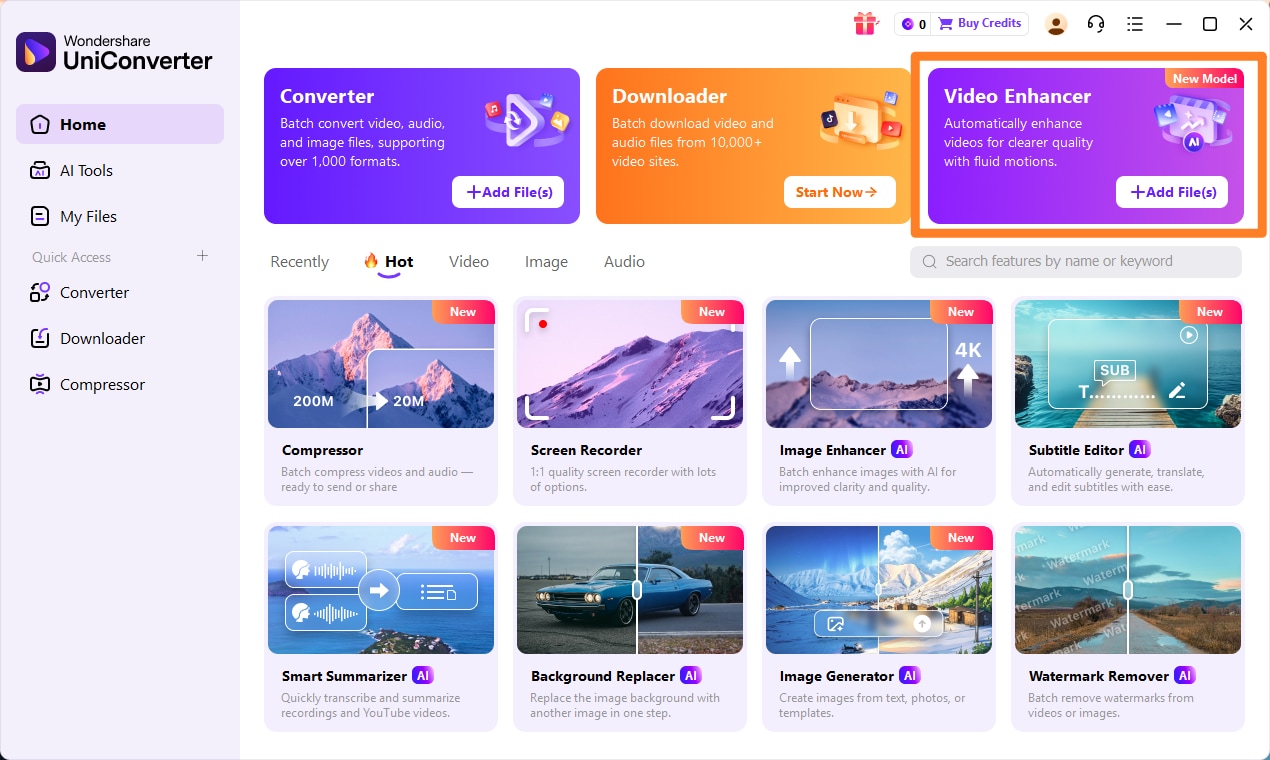
Step 1: Open UniConverter and Choose Video Enhancer
Launch UniConverter and navigate to the "AI Lab" section. Select the "Video Enhancer" tool to begin your enhancement process.
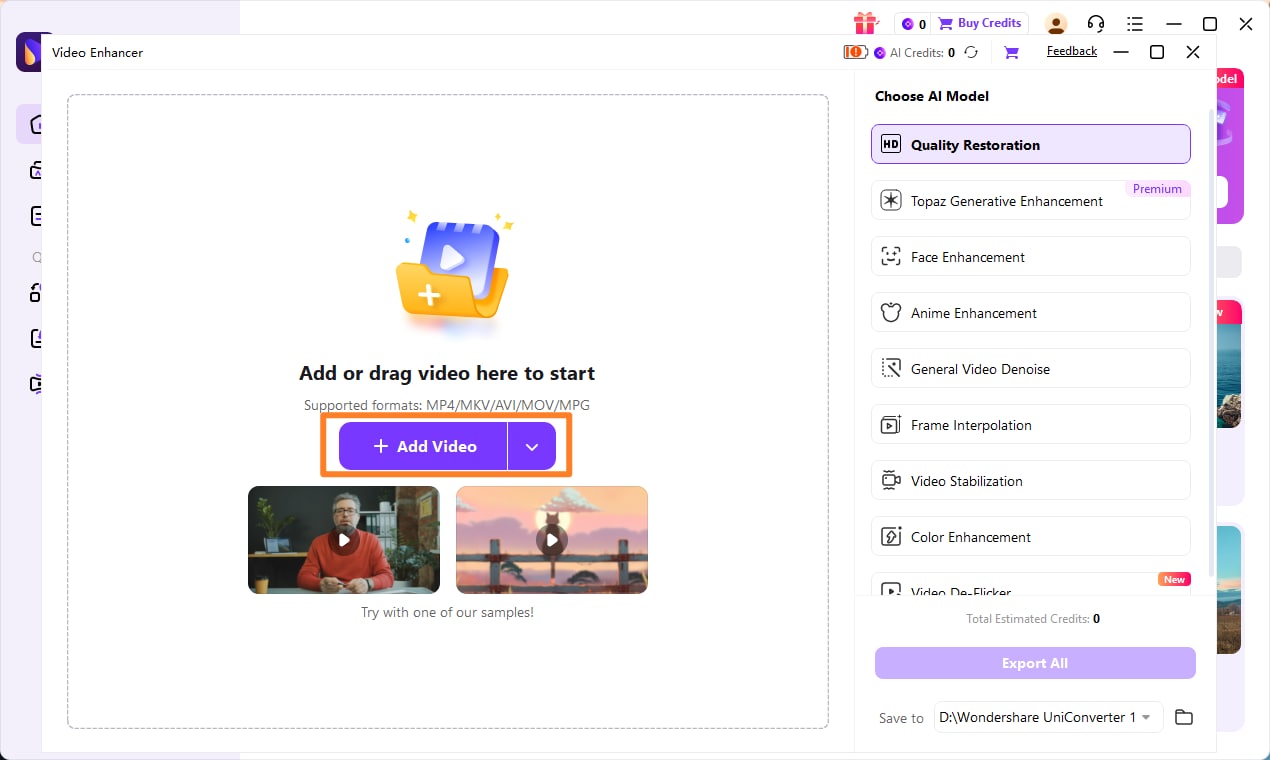
Step 2: Upload the Videos
Click the "Add Files" button or drag and drop your video files into the UniConverter interface. You can add multiple videos for batch processing.
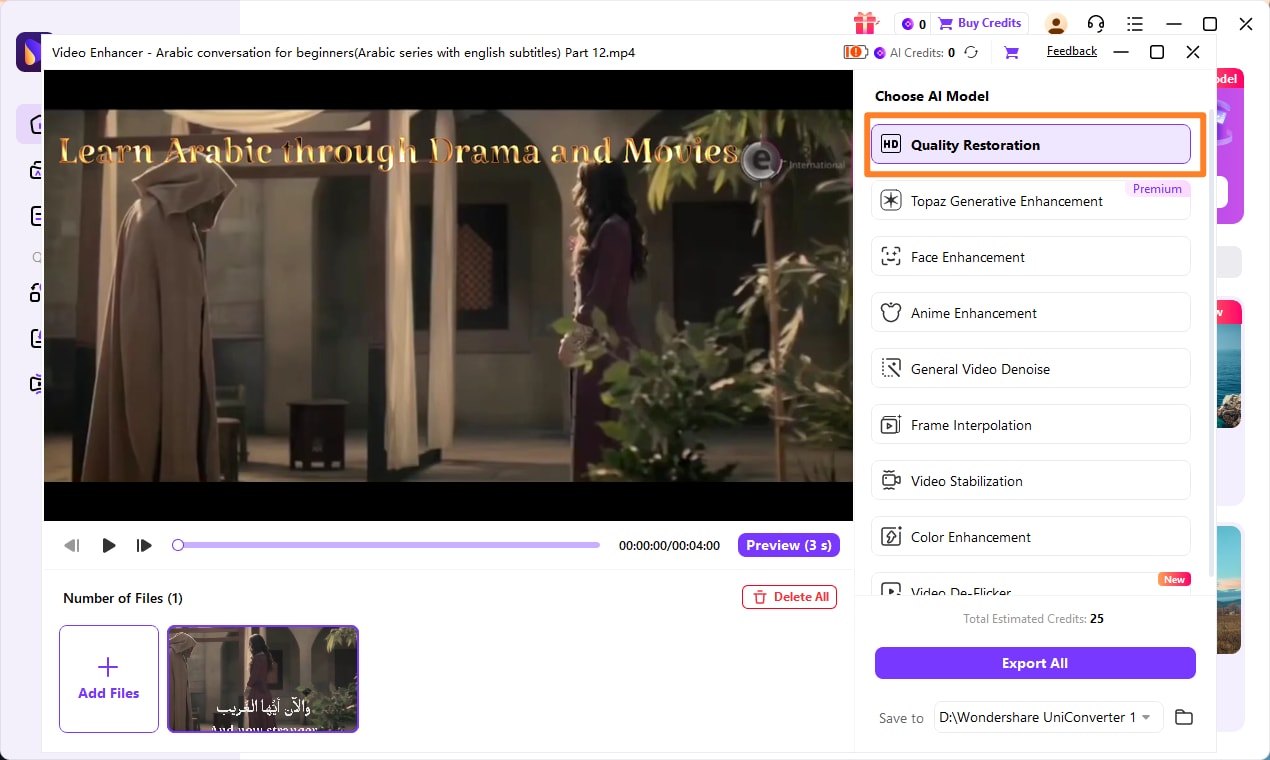
Step 3: Choose Enhancement Model
Select the desired enhancement model from the available options, such as AI Upscaling, Denoise, or Stabilization. Adjust any specific parameters for the chosen model.
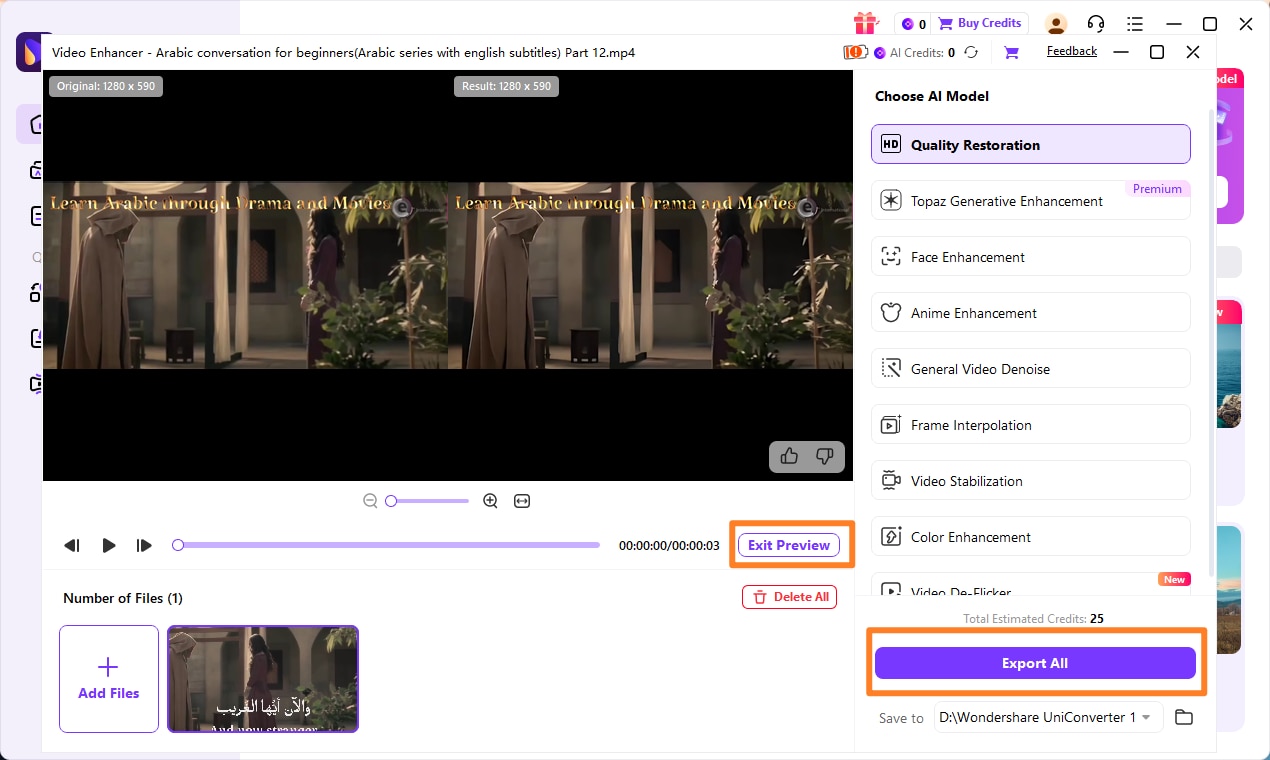
Step 4: Preview and Save the Enhanced Video
Preview the enhanced video to ensure it meets your expectations. Once satisfied, choose your desired output format and destination folder, then click "Export" to save the enhanced video.

Seeking a Simpler MeGUI Video Enhancer Alternative?
Part 7: Conclusion
The MeGUI Video Enhancer review highlights its unparalleled power for users demanding ultimate control over video encoding and enhancement. It stands as a testament to open-source capabilities, offering extensive customization for specific codecs and filters, making it ideal for professional archivists and dedicated enthusiasts. However, its steep learning curve, outdated interface, and reliance on community support present significant barriers for casual users. For the majority, simpler alternatives like HandBrake offer a more balanced approach, providing good quality and ease of use. For those prioritizing extreme simplicity, a broad feature set, and AI-driven enhancements without the technical overhead, UniConverter presents a compelling paid solution. Ultimately, the choice between MeGUI and its competitors hinges on your technical proficiency, the specific requirements of your project, and your willingness to invest time in mastering complex tools versus opting for user-friendly, albeit less customizable, alternatives.
Part 8: FAQs
-
1. **Is MeGUI still actively developed?**
While not as frequently updated as commercial software, MeGUI still receives maintenance updates and contributions from its dedicated open-source community, ensuring its continued functionality.
-
2. **Can MeGUI enhance video quality automatically?**
No, MeGUI requires manual configuration of filters and settings for enhancement. It does not offer automated, one-click enhancement features; users must understand and apply specific parameters.
-
3. **Is MeGUI safe to download and use?**
Yes, MeGUI is open-source and generally considered safe. However, always download it from official sources or trusted repositories to avoid modified or malicious versions.
-
4. **What are the system requirements for MeGUI?**
MeGUI itself is relatively lightweight, but the encoding process, especially for high-resolution videos or complex filters, benefits significantly from a powerful multi-core CPU and ample RAM for faster processing times.
-
5. **Does MeGUI support 4K video?**
Yes, MeGUI can process 4K video. However, encoding 4K content with advanced filters and high-quality settings can be extremely time-consuming, potentially taking many hours or even days depending on your hardware.
