
- Magnific AI Value: Excels in detail reconstruction and customization for professionals.
- Target Audience: Ideal for professional photographers and designers needing high-quality enhancements.
- Cost & Performance: Subscription model and high hardware demands are key considerations.
- Comparison: Magnific AI offers superior control; UniConverter provides versatile, fast, and balanced enhancement.
- Risks: Be aware of privacy, over-enhancement, subscription lock-in, and hardware needs.
- UniConverter Advantage: Offers efficient, stable, and comprehensive image enhancement as an all-in-one media solution.
In this article
- Part 1: What is Magnific AI Image Enhancer?
- Part 2: Magnific AI Image Enhancer: Core Features, Pros & Cons
- Part 3: Target Audience and Use Cases
- Part 4: Magnific AI Image Enhancer and Alternatives Comparison
- Part 5: Risks and Pitfalls Analysis
- Part 6: How to Use UniConverter for Efficient Image Enhancement
- Part 7: Conclusion
- Part 8: FAQs
When I first heard about AI image enhancers, I was skeptical. Could a program really “fix” a blurry photo or bring out details in a low-resolution image? My journey into the world of digital image enhancement led me to Magnific AI image enhancer review, a tool that promises to do just that. This review will delve into its capabilities, comparing it against other popular options to help you understand where it truly shines and where alternatives might be a better fit. We'll explore its features, ideal use cases, and potential pitfalls, providing a comprehensive guide for anyone looking to elevate their digital imagery.
Part 1: What is Magnific AI Image Enhancer?
Magnific AI Image Enhancer emerged as a powerful solution in the burgeoning field of artificial intelligence-driven image processing. It's designed to take your low-resolution, pixelated, or detail-lacking images and transform them into high-quality, sharp, and vibrant visuals. My initial impression was that it was just another upscaling tool, but I quickly learned it goes far beyond simple resolution bumps. This review aims to clarify its unique position in the market and help you decide if it's the right tool for your specific needs.
Addressing Common User Pain Points in Image Enhancement
* Struggling with low-resolution source material: Many of us work with images that simply aren't high enough quality for our intended use, whether it's an old family photo or a client's low-res logo.
* Desire for intricate detail recovery: Standard upscaling often just blurs pixels; the real challenge is to intelligently reconstruct lost details.
* Need for fine-grained control over the enhancement process: Automated tools can be convenient, but sometimes you need to tweak every parameter to get the perfect result.
* Balancing quality with processing time and cost: Finding a tool that delivers professional results without breaking the bank or taking forever to process is a constant struggle.
Part 2: Magnific AI Image Enhancer: Core Features, Pros & Cons
From my experience, Magnific AI Image Enhancer isn't just about making images bigger; it's about making them better. Its core strength lies in its sophisticated AI algorithms that don't just interpolate pixels but intelligently reconstruct textures and details, often making a low-res image look like it was originally captured at a much higher resolution. I found its ability to bring out subtle patterns and sharpen edges truly impressive.
* Advanced Detail Reconstruction: This is where Magnific AI truly shines. It can intelligently guess and recreate missing details, making blurry images surprisingly sharp.
* Highly Customizable Parameters: You're not stuck with a one-size-fits-all approach. I could adjust everything from noise reduction to texture enhancement, giving me precise control over the final output.
* Intuitive User Interface: Despite its advanced capabilities, I found the interface surprisingly easy to navigate, allowing me to dive into complex settings without feeling overwhelmed.
* AI-Powered Upscaling: Beyond simple enlargement, it uses AI to intelligently scale images, adding detail rather than just stretching pixels.
* Batch Processing Capability: For professionals dealing with multiple images, the ability to process several files at once is a huge time-saver.
Pros:
* Unparalleled detail reconstruction for low-resolution images, often exceeding my expectations.
* Highly customizable enhancement parameters, allowing me to fine-tune results exactly how I wanted them.
* The intuitive user interface makes advanced features accessible, even if you're not an AI expert.
Cons:
* High processing demands, which meant my older laptop struggled, leading to slower processing times.
* The subscription-based model can be costly for casual users who only need it occasionally.
Part 3: Target Audience and Use Cases
From my perspective, Magnific AI Image Enhancer isn't for everyone. If you're just looking to quickly touch up a selfie for Instagram, it's probably overkill. However, if you're serious about image quality and work with visuals professionally, this tool becomes incredibly valuable.
Best Use Case: Professional Photographers and Graphic Designers
For me, as someone who often deals with client work, Magnific AI has been a game-changer. I've used it to:
* Enhance archival photos for print or high-resolution displays: I had a collection of old, low-res photos that needed to be printed large, and Magnific AI brought them to life in a way I didn't think was possible.
* Upscale client-provided low-res images for marketing materials: Often, clients send me logos or product shots that are too small for print. Magnific AI allows me to upscale them without noticeable pixelation, saving me from having to request higher-res versions.
Limited Use Case: Casual Social Media Users
Honestly, if you're just posting to social media, this tool is probably more than you need.
* It's overkill for simple social media posts where minor imperfections are often acceptable, and free filters can do the trick.
* The cost-prohibitive nature for infrequent use means you'd be paying a premium for something you rarely use, especially when free alternatives exist for basic enhancements.
Part 4: Magnific AI Image Enhancer and Alternatives Comparison
When I was looking for an image enhancer, I didn't just stumble upon Magnific AI. I explored several options, and here's how I found it stacked up against some of the big players, including UniConverter.
| Feature/Scenario | Magnific AI Image Enhancer | UniConverter | Topaz Photo AI | Gigapixel AI |
| Detail Reconstruction | Excellent, highly customizable | Very Good, balanced | Very Good, automated | Good, focused on upscaling |
| Ease of Use | Good, but with learning curve for advanced features | Excellent, user-friendly | Excellent, user-friendly | Good, straightforward |
| Processing Speed | Moderate, resource-intensive | Fast, GPU accelerated | Fast, optimized | Fast, efficient |
| Pricing Model | Subscription | One-time purchase | One-time purchase | One-time purchase |
| Specific Use Case (e.g., old photo restoration) | Superior | Good, with versatile tools | Good | Moderate |
From my experience, Magnific AI excels in granular control over enhancement, offering a level of detail reconstruction often unmatched, especially when I needed to bring out specific textures. UniConverter, on the other hand, impressed me with its speed and versatility, offering a great balance of quality and ease of use, especially for general enhancement tasks. Topaz Photo AI and Gigapixel AI are strong contenders, particularly if you prioritize automated workflows and a one-time purchase model, but I found their customization options less extensive than Magnific AI's. If you're looking for an all-in-one media solution, UniConverter's broader feature set makes it a compelling choice.
Part 5: Risks and Pitfalls Analysis
While Magnific AI offers impressive capabilities, my experience has taught me that no tool is without its drawbacks. It's important to be aware of these before committing.
Privacy Concerns with Data Handling
When I upload my images to a cloud-based service, I always wonder about data privacy. Magnific AI processes images on its servers, which means your original files are temporarily stored. While they state they don't claim ownership or use your images for training without consent, it's a factor to consider, especially for sensitive client work. I always make sure to read their privacy policy carefully.
Over-enhancement Artifacts
I've definitely pushed the enhancement parameters too far a few times, resulting in images that looked unnatural or had strange, AI-generated artifacts. It's a fine line between enhancing and distorting. You need to exercise judgment and often, less is more. My advice is to always start with subtle adjustments and gradually increase them while monitoring the preview.
Subscription Lock-in
The subscription model is a double-edged sword. While it provides continuous updates and access to new features, it also means I'm dependent on continuous payment for access. If I stop subscribing, I lose access to the advanced features, which can be a significant cost over time compared to a one-time purchase model.
Demanding Hardware Requirements
I learned this the hard way: Magnific AI is resource-intensive. My older machine struggled, leading to longer processing times and sometimes even crashes. For optimal performance, especially with large images or batch processing, you really need a powerful CPU and a dedicated GPU. If your hardware isn't up to par, be prepared for a slower experience.
Learning Curve for Advanced Features
While the basic interface is intuitive, getting the best results from Magnific AI requires understanding its various parameters and how they interact. It's not entirely plug-and-play if you want to achieve professional-grade enhancements. I spent a fair bit of time experimenting and learning to truly master its capabilities.
Part 6: How to Use UniConverter for Efficient Image Enhancement
Sometimes, you might find that specialized tools like Magnific AI are overkill or too complex for your everyday needs, especially if you're dealing with a variety of media tasks beyond just image enhancement. That's where I found UniConverter to be an incredibly versatile and efficient alternative. It's not just an image enhancer; it's an all-in-one media toolkit that offers robust AI image enhancement capabilities without the steep learning curve or the high processing demands of some dedicated tools. If you're looking for a solution that can handle batch processing, offer stable and lossless enhancement, and support a wide range of formats with GPU acceleration, UniConverter is a strong contender. It provides a cost-effective and comprehensive solution for various media needs, making it a great choice when other tools fall short in terms of batch processing, stability, or overall enhancement quality. For instance, it can help you fix pixelated videos or even upscale anime with ease.
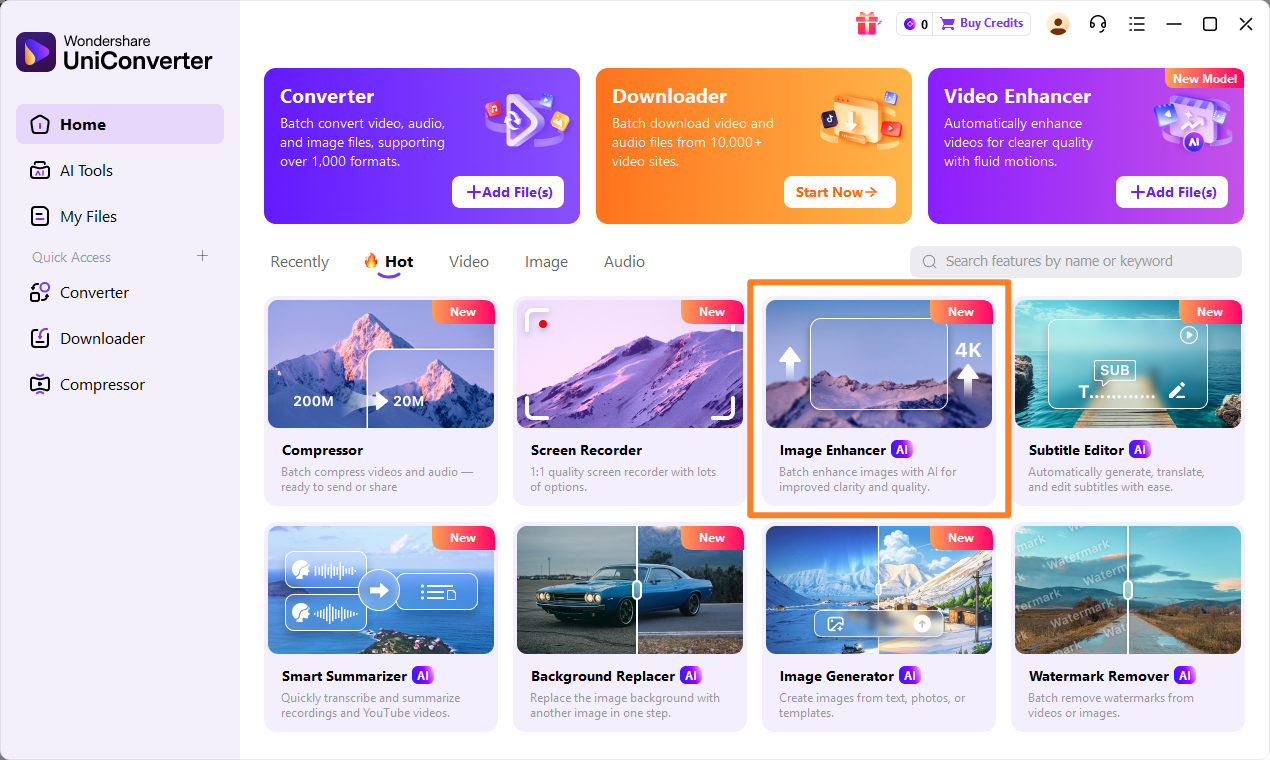
Step 1: Open UniConverter and Choose Image Enhancer
Start UniConverter and head to the Image Enhancer tool from the main dashboard.
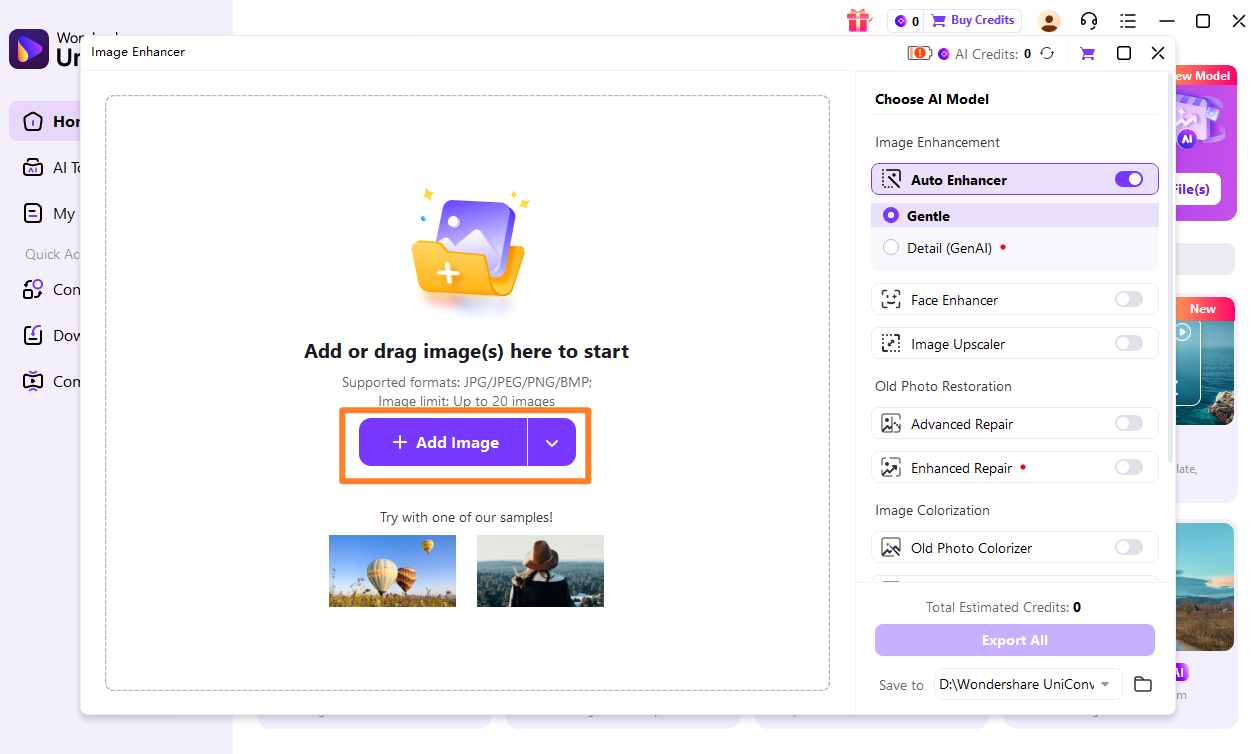
Step 2: Upload the Images
Add your images by clicking + Add Files or dragging them into the interface. Batch uploads are supported.
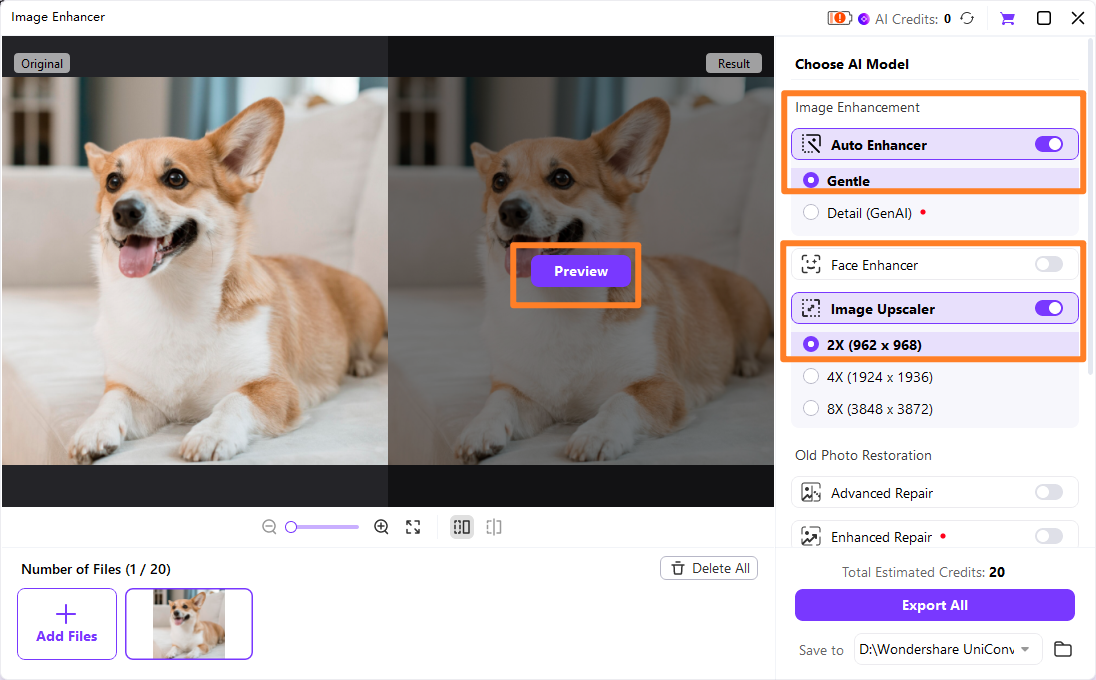
Step 3: Choose Enhancement Model
Choose the model that fits your needs—upscaling, portrait enhancement, or photo restoration.
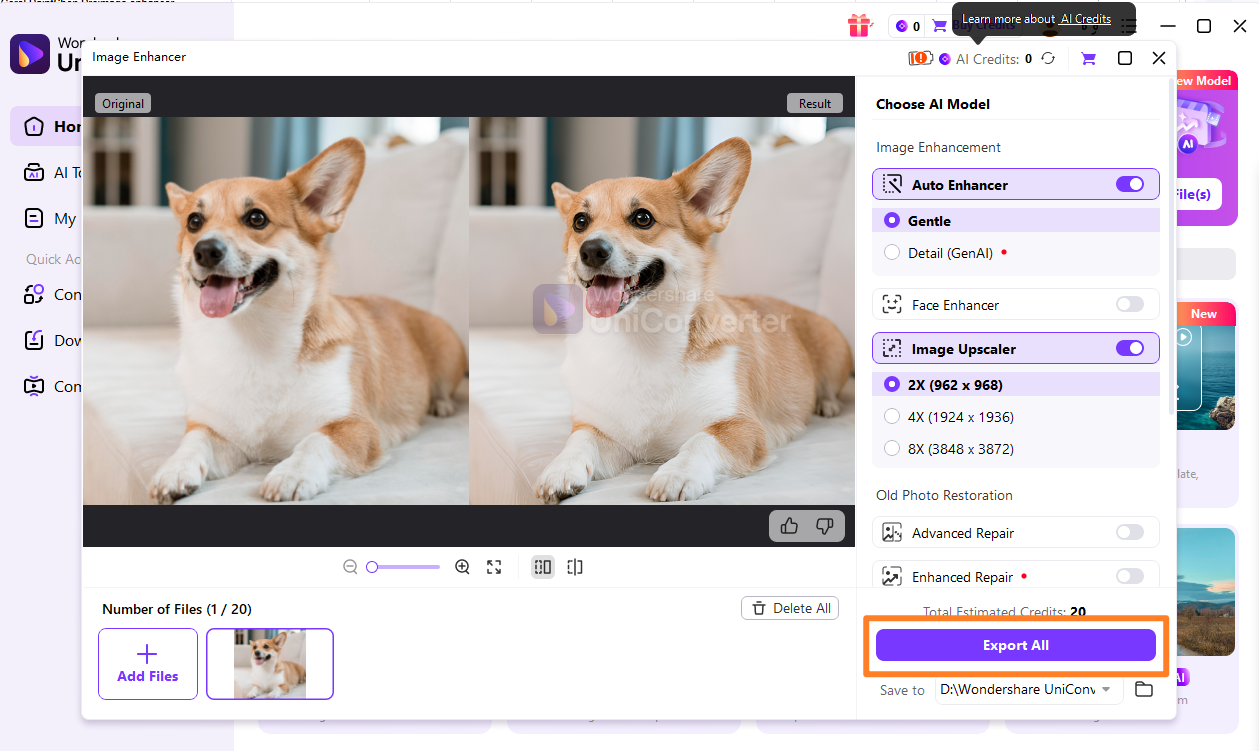
Step 4: Preview and Save the Enhanced Images
Preview the results, then click Export to save your enhanced images.

Enhance Images Beyond Magnific AI
Part 7: Conclusion
After spending considerable time with Magnific AI image enhancer review and its competitors, my conclusion is clear: it's a powerful and highly specialized tool. For professionals like photographers, graphic designers, or anyone requiring the absolute highest level of detail reconstruction and granular control over their image enhancement, Magnific AI is a top-tier choice, despite its subscription cost and hardware demands. The ability to meticulously fine-tune every aspect of the enhancement process is truly unmatched. However, for budget-conscious users or those who need a more versatile, all-in-one media solution, UniConverter offers a compelling alternative, providing excellent enhancement quality alongside a suite of other useful tools. If speed and simplicity are your main priorities, and you're comfortable with more automated workflows, then competitors like Topaz Photo AI or Gigapixel AI might be a better fit. Ultimately, the best tool depends entirely on your specific needs, budget, and technical comfort level.
Part 8: FAQs
-
1. Is Magnific AI Image Enhancer worth the subscription cost?
For professionals who require precise control, superior detail reconstruction, and frequently work with low-resolution source images, yes, it can be a worthwhile investment. For casual users, the cost might be prohibitive for infrequent use.
-
2. Can Magnific AI restore severely damaged photos?
It can significantly improve severely damaged photos by reconstructing details and reducing noise. However, complete restoration depends on the original damage level; it can't magically invent information that's entirely missing.
-
3. How does Magnific AI compare to free online enhancers?
Magnific AI offers vastly superior quality, control, and detail reconstruction compared to most free online options, which often provide basic upscaling or limited enhancement capabilities.
-
4. What are the minimum system requirements for Magnific AI?
While specific minimums aren't always explicitly stated, based on my experience, it requires a powerful CPU and a dedicated GPU with ample VRAM for optimal performance, especially when processing large images or batches.
-
5. Does UniConverter offer similar image enhancement quality to Magnific AI?
UniConverter provides excellent image enhancement, often sufficient for most users, offering a great balance of quality, speed, and ease of use. While Magnific AI might offer finer, more granular control for niche professional needs, UniConverter's quality is impressive for a multi-functional tool.
