
- Luma AI Strengths: Excels in professional-grade video upscaling and detail recovery for high-quality projects.
- Luma AI Limitations: Resource-intensive, requiring powerful hardware and a subscription model, potentially costly.
- Target Users: Ideal for professional filmmakers and content creators needing top-tier AI enhancement.
- Alternatives: UniConverter offers a balanced solution with excellent ease of use, speed, and comprehensive features.
- Risks: Cloud processing raises data privacy concerns; AI can produce "unnatural" looks; high hardware demands.
- Decision: Choose Luma AI for peak quality with robust hardware; UniConverter for versatility, speed, and value.
In this article
- Part 1: What is Luma AI Video Enhancer?
- Part 2: Luma AI Video Enhancer: Core Features, Pros, and Cons
- Part 3: Target Users and Use Cases
- Part 4: Luma AI Video Enhancer and Alternatives Comparison
- Part 5: Risks and Pitfalls of Using AI Video Enhancers
- Part 6: How to Use UniConverter for Efficient Video Enhancement
- Part 7: Conclusion
- Part 8: FAQs
Luma AI Video Enhancer Review: A Deep Dive into AI-Powered Video Upscaling
In the rapidly evolving landscape of digital media, the demand for high-quality video content has never been greater. From professional filmmakers to social media creators, everyone seeks to deliver visually stunning experiences. This pursuit often involves enhancing existing footage, especially when dealing with older archives or lower-resolution captures. Enter Luma AI, a prominent player in the burgeoning field of AI-powered video enhancement. This Luma AI video enhancer review will delve into its capabilities, compare it with leading alternatives, and help you understand if it's the right tool for your specific needs. We'll explore its core features, ideal use cases, potential pitfalls, and provide a comprehensive comparison to guide your decision-making process.
Part 1: What is Luma AI Video Enhancer?
Luma AI Video Enhancer represents a significant leap in video post-production, leveraging advanced artificial intelligence to transform low-resolution or sub-optimal video footage into stunning, high-definition visuals. Born from the innovative strides in AI research, Luma AI aims to democratize access to professional-grade video upscaling and restoration. This review seeks to address the critical question: Can Luma AI truly deliver on its promise of superior video enhancement, and how does it stack up against a competitive market?
The Rise of AI in Video Production
* Addressing Legacy Footage: AI enhances old, low-resolution videos for modern displays.
* Improving Production Value: Even good footage can be made great with AI-driven detail recovery.
* Democratizing Professional Tools: AI makes complex enhancement accessible to a wider audience.
* Overcoming Technical Limitations: AI can compensate for limitations in original recording equipment.
Part 2: Luma AI Video Enhancer: Core Features, Pros, and Cons
Luma AI Video Enhancer stands out with its sophisticated AI algorithms designed to intelligently reconstruct and enhance video frames. Its core capabilities revolve around upscaling resolution, reducing noise, and recovering lost details, all while striving to maintain a natural and realistic aesthetic. The software employs deep learning models trained on vast datasets to understand and predict how missing information should appear, resulting in remarkably improved video quality.
Pros:
* Exceptional detail recovery for low-resolution footage, bringing out textures and fine elements that were previously indistinct.
* Intuitive user interface for quick enhancements, allowing users to achieve professional results without extensive technical knowledge.
* Advanced AI models for realistic upscaling, minimizing the "AI look" often associated with less sophisticated enhancers.
Cons:
* Resource-intensive processing, requiring powerful hardware (especially a capable GPU) for efficient operation.
* Occasional artifacts with highly compressed source material, where the AI struggles to infer accurate details from severely degraded data.
Part 3: Target Users and Use Cases
Luma AI Video Enhancer is primarily designed for users who prioritize visual fidelity and are willing to invest in the necessary hardware and subscription. Its advanced capabilities make it a powerful tool for professionals, but its ease of use also extends its appeal to dedicated enthusiasts.
Best Use Case: Professional Filmmakers and Content Creators Seeking High-Quality Deliverables
Professional filmmakers, videographers, and content creators who need to upscale archival footage, enhance B-roll, or deliver projects in higher resolutions will find Luma AI invaluable. Its ability to recover fine details and produce realistic upscales makes it suitable for broadcast, cinematic releases, and high-end digital platforms where visual quality is paramount. For instance, a documentary filmmaker restoring historical footage or a YouTube creator wanting to re-release older content in 4K would benefit immensely.
Limited Use Case: Casual Users with Basic Hardware and Minimal Editing Needs
Casual users with basic computer hardware or those who only occasionally need minor video improvements might find Luma AI to be overkill. The software's resource demands and subscription cost could be prohibitive for simple tasks like enhancing a family vacation video for personal viewing. For these users, simpler, less demanding, or free alternatives might be more appropriate.
Part 4: Luma AI Video Enhancer and Alternatives Comparison
When evaluating video enhancers, it's crucial to compare Luma AI against its competitors to understand its unique positioning. Here's a comparative analysis focusing on key performance indicators.
| Feature/Scenario | Luma AI Video Enhancer | Topaz Video AI | DaVinci Resolve (Neural Engine) | UniConverter |
| Upscaling Quality (Low-Light) | Excellent | Very Good | Good | Very Good |
| Speed (4K to 8K) | Moderate | Fast | Moderate | Fast |
| Ease of Use (Beginner) | Good | Excellent | Moderate | Excellent |
| Cost (One-time vs. Subscription) | Subscription | One-time | Free/Studio | One-time |
| Integration with NLEs | Limited | Good | Excellent | Good |
Luma AI excels in delivering exceptional upscaling quality, particularly in challenging low-light scenarios, focusing on realistic detail recovery. Topaz Video AI often leads in processing speed, making it a strong contender for users with large volumes of footage. DaVinci Resolve, with its integrated Neural Engine, offers seamless workflow integration for existing Resolve users, though its upscaling quality might not always match dedicated enhancers. UniConverter provides a balanced approach, offering very good quality at a competitive speed and excellent ease of use, making it a versatile option.
Part 5: Risks and Pitfalls of Using AI Video Enhancers
While AI video enhancers offer incredible potential, users should be aware of several risks and pitfalls that can impact their workflow, output quality, and even data security.
Data Privacy Concerns with Cloud-Based Processing
Many advanced AI video enhancers, including some aspects of Luma AI, might utilize cloud-based processing. This raises significant data privacy concerns, especially for sensitive or proprietary footage. Users must scrutinize the service's privacy policy to understand how their data is handled, stored, and protected. Unencrypted uploads or third-party access could lead to data breaches or unauthorized use of content.
Potential for "AI Look" and Unnatural Enhancements
Despite advancements, AI models can sometimes produce an "AI look" – an overly smooth, plastic, or hyper-realistic appearance that deviates from natural video aesthetics. This can manifest as unnatural skin textures, over-sharpened edges, or a loss of filmic grain, making the enhanced footage appear artificial. Users need to carefully review the output and adjust settings to avoid these undesirable effects.
High Hardware Requirements and Processing Times
AI video enhancement is computationally intensive. Tools like Luma AI often require powerful GPUs and significant RAM, leading to substantial hardware investments. Even with high-end systems, processing 4K or 8K footage can take hours, if not days, for longer projects. This can significantly impact production timelines and energy consumption.
Subscription Model vs. One-Time Purchase Value
Many AI enhancement tools, including Luma AI, operate on a subscription model. While this provides continuous updates and access to new features, it can become costly over time compared to a one-time purchase model offered by some competitors. Users must weigh the long-term financial commitment against their usage frequency and budget.
Limitations with Severely Damaged or Out-of-Focus Footage
While AI can work wonders, it has limitations. Severely damaged, extremely low-resolution, or heavily out-of-focus footage may not be salvageable, even with the most advanced AI. The AI can only infer missing information to a certain extent; if the original data is too degraded, the enhancement might introduce artifacts, blurriness, or simply fail to produce a usable result.
Part 6: How to Use UniConverter for Efficient Video Enhancement
When other tools fall short in terms of batch processing, stability, or enhancement effectiveness, UniConverter emerges as a robust alternative. It offers a comprehensive suite of video solutions, including powerful enhancement features that are stable, lossless, and GPU-accelerated, ensuring high-quality results without ads or watermarks. UniConverter supports a vast array of formats and provides an all-in-one solution for all your video editing and enhancement needs. For instance, you can easily change video background or utilize its advanced background replacer capabilities. You can even remove background without losing quality with its specialized tools.
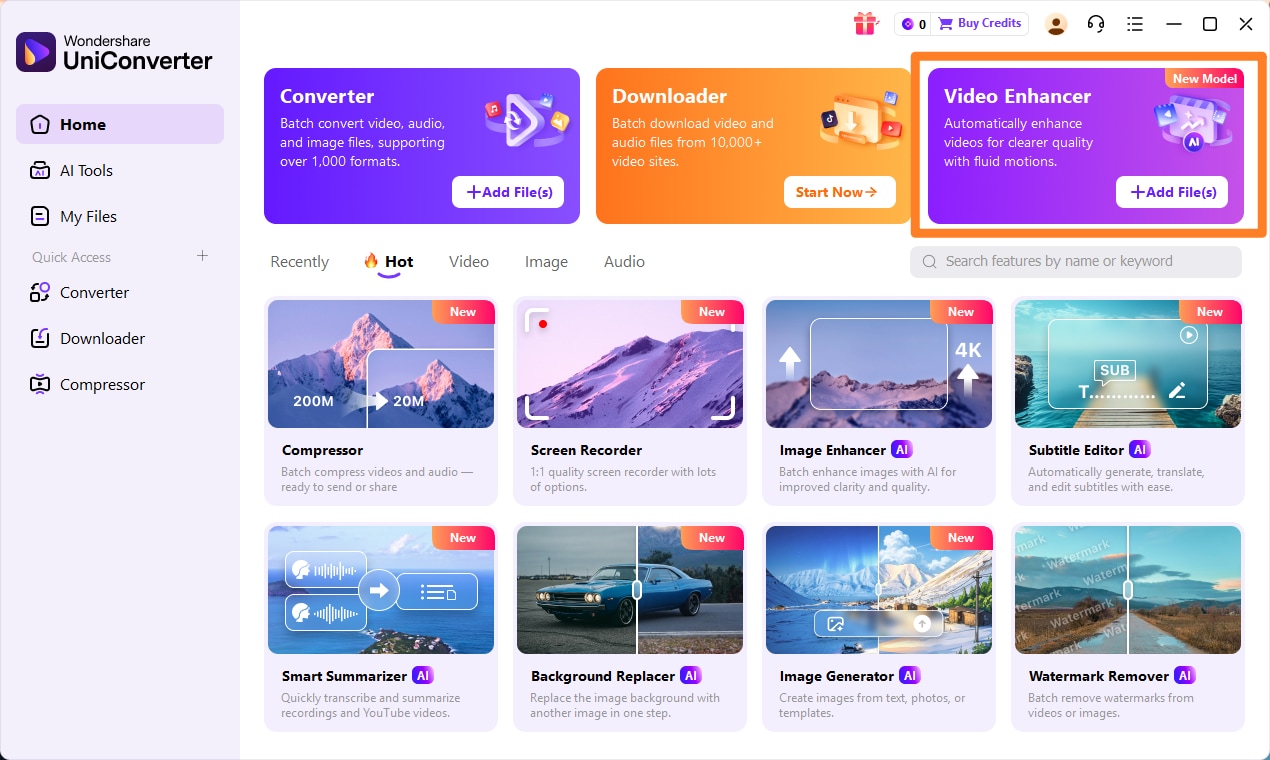
Step 1: Open UniConverter and Choose Video Enhancer
Launch UniConverter and navigate to the "Video Enhancer" tool from the main interface.
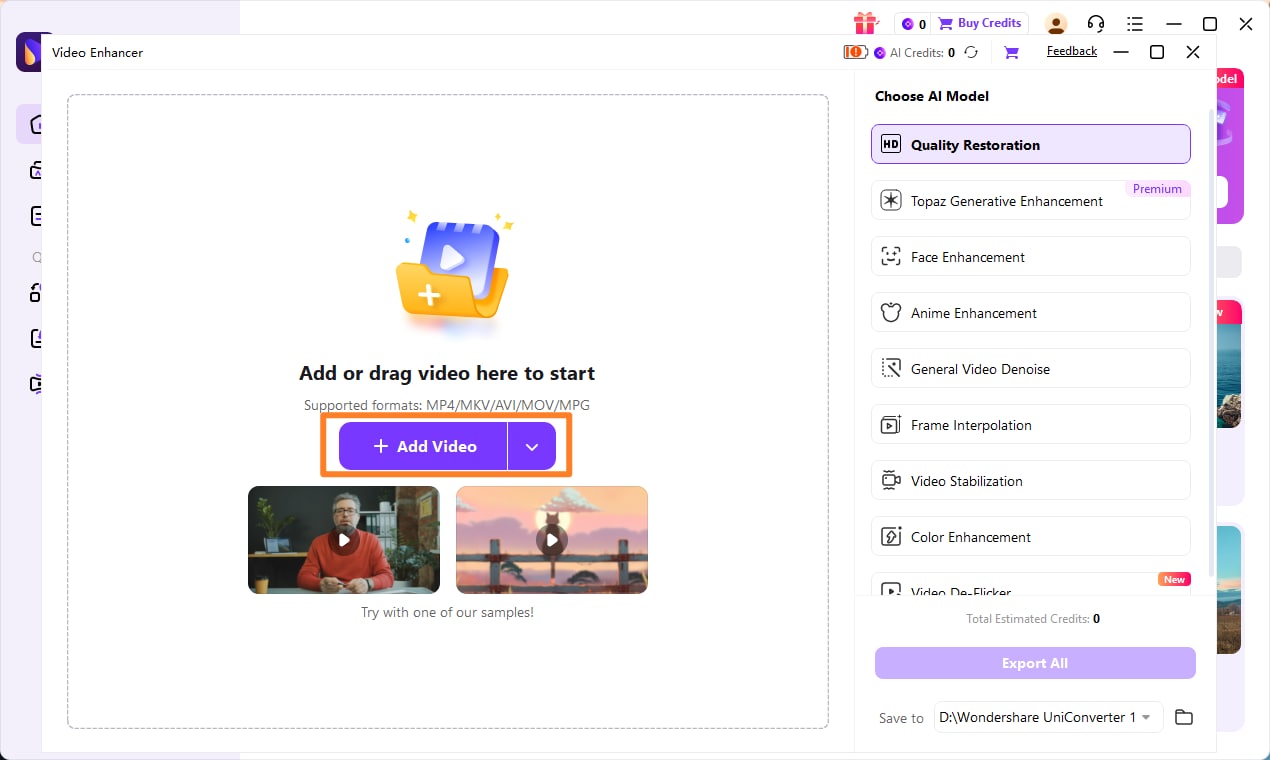
Step 2: Upload the Videos
Click on "Add Files" or drag and drop your video files into the UniConverter interface.
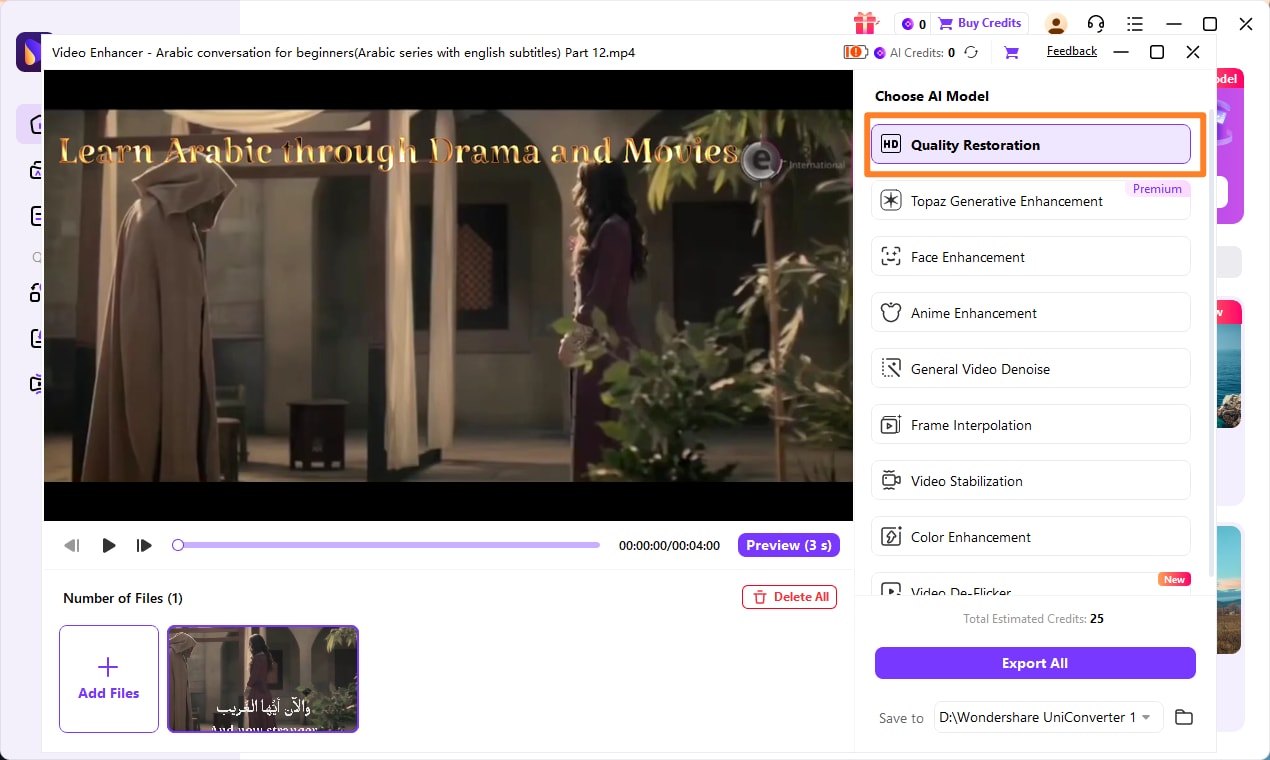
Step 3: Choose Enhancement Model
Select your desired enhancement options, such as upscaling, de-noising, or brightness adjustment.
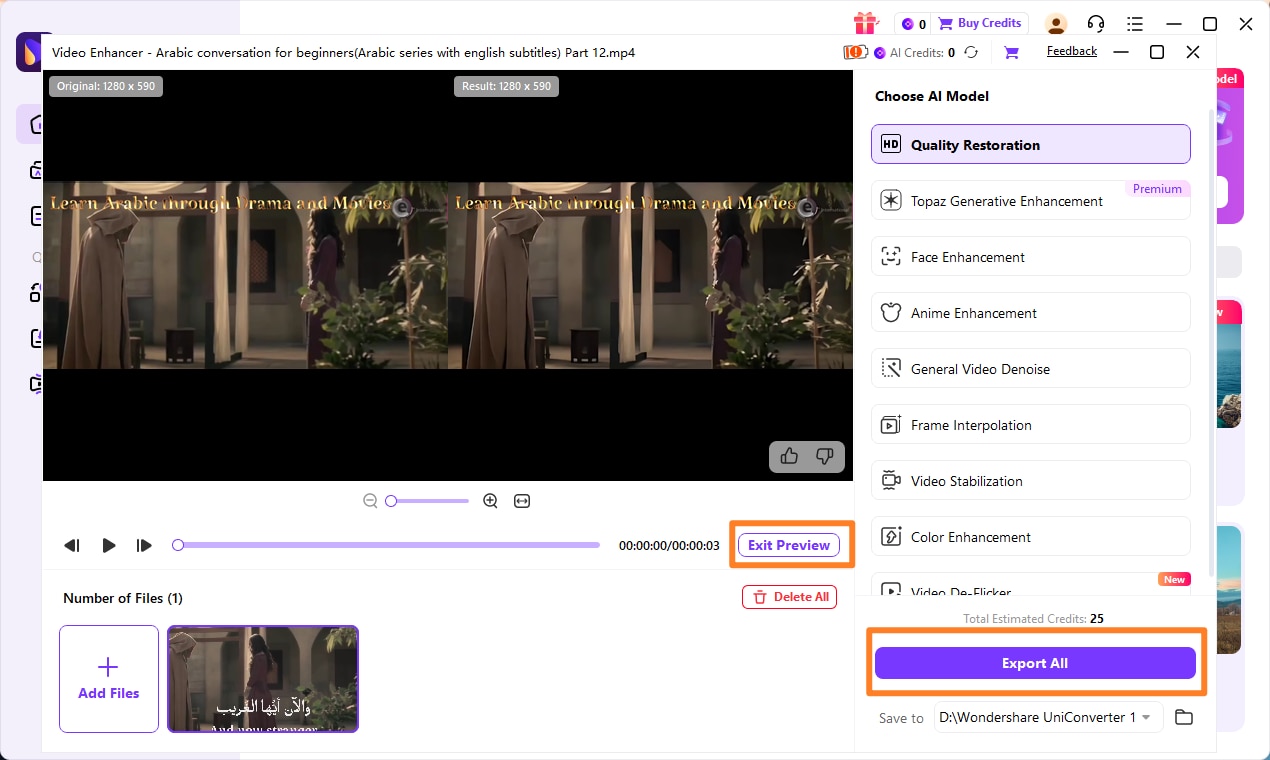
Step 4: Preview and Save the Enhanced Video
Preview the enhanced video to ensure satisfaction, then click "Export" to save your high-quality output.

Seeking a Luma AI Video Enhancer Alternative?
Part 7: Conclusion
This Luma AI video enhancer review highlights its strengths as a cutting-edge tool for professional-grade video upscaling and detail recovery. While Luma AI excels in delivering exceptional visual quality, especially for demanding projects, its resource intensity and subscription model might not suit all users. Professionals prioritizing the absolute best in AI-driven enhancement and possessing robust hardware will find Luma AI invaluable. However, for users seeking a more balanced solution with excellent ease of use, faster processing, and a comprehensive feature set for various video tasks, UniConverter presents a compelling alternative. Ultimately, the best choice depends on your specific workflow, budget, hardware capabilities, and the desired balance between quality, speed, and versatility.
Part 8: FAQs
-
1. Is Luma AI Video Enhancer suitable for beginners?
While Luma AI has an intuitive interface, its advanced features and resource demands might be better suited for users with some experience in video editing or those dedicated to achieving professional-level enhancements.
-
2. What kind of input video formats does Luma AI support?
Luma AI typically supports a wide range of common video formats, including MP4, MOV, AVI, and more. However, specific format compatibility can vary and is usually detailed in the software's documentation.
-
3. Can Luma AI improve highly pixelated videos?
Luma AI can significantly improve pixelated videos by intelligently inferring missing details and upscaling resolution. However, severely pixelated or extremely low-quality source material may still result in some artifacts or limitations in the final output.
-
4. How does Luma AI compare to free online video enhancers?
Luma AI generally offers vastly superior quality and more advanced features compared to most free online video enhancers. Free tools often have limitations in resolution, processing power, and the sophistication of their AI models, leading to less impressive results and potential watermarks.
-
5. What are the system requirements for running Luma AI Video Enhancer effectively?
For effective operation, Luma AI typically requires a powerful multi-core processor, a dedicated high-end GPU (NVIDIA RTX series or equivalent is often recommended), and a substantial amount of RAM (16GB or more). Specific requirements can be found on the official Luma AI website.
