
- Kapwing Overview: Online AI upscaler, part of Kapwing's editing suite; enhances resolution and quality for older/lower-res videos.
- Pros & Cons: Intuitive UI, cloud-based, integrated with Kapwing. Limited customization, potential artifacts on poor footage.
- Target Audience: Ideal for social media creators needing quick, easy enhancements; less suited for professional broadcast quality.
- Comparison Insights: Kapwing excels in ease of use; Topaz AI and UniConverter offer superior quality, control, and GPU acceleration.
- Risks & Pitfalls: Data privacy concerns with cloud processing, potential visual artifacts, recurring subscription costs, and internet dependency.
- UniConverter Solution: Reliable desktop alternative with GPU acceleration, batch processing, and high-quality AI enhancement for diverse needs.
In this article
- Part 1: What is Kapwing AI Video Upscaler?
- Part 2: Core Features, Pros, and Cons
- Part 3: Target Users and Use Cases
- Part 4: Kapwing AI Video Upscaler and Alternatives Comparison
- Part 5: Risks and Pitfalls to Consider When Using AI Video Upscalers
- Part 6: How to Use UniConverter for Reliable Video Upscaling
- Part 7: Conclusion
- Part 8: FAQs
The digital landscape is increasingly dominated by visual content, making video quality a critical factor for engagement and professionalism. As older footage and lower-resolution captures proliferate, the need for effective enhancement tools has surged. This Kapwing AI Video Upscaler review delves into a prominent player in this space, offering a detailed analysis of its capabilities, comparing it against key competitors, and guiding users through its optimal applications. This comprehensive evaluation aims to provide a clear understanding of Kapwing's strengths and weaknesses, helping content creators, marketers, and casual users make informed decisions about their video enhancement strategies.
Part 1: What is Kapwing AI Video Upscaler?
Kapwing AI Video Upscaler is an online tool designed to improve the resolution and visual quality of videos using artificial intelligence. As part of the broader Kapwing online video editing suite, it leverages AI algorithms to intelligently add pixels, sharpen details, and reduce noise, transforming lower-resolution footage into higher-definition content. This integration within a comprehensive editing platform makes it particularly appealing for users already familiar with Kapwing's ecosystem, offering a seamless workflow from enhancement to final production.
The core problem this tool addresses is the widespread availability of older, lower-resolution video content that no longer meets modern viewing standards. Whether it's archival footage, user-generated content, or simply videos shot on older devices, the desire to present crisp, clear visuals is paramount in today's visually-driven world. This review aims to clarify how effectively Kapwing addresses these challenges and where it stands in a competitive market.
The Growing Demand for AI-Powered Video Enhancement
The increasing demand for AI-powered video enhancement stems from several key factors:
* Proliferation of Legacy Content: A vast amount of valuable video content exists in lower resolutions, unsuitable for modern displays and platforms.
* Accessibility of Creation Tools: More people are creating videos, often with varying quality, driving the need for easy enhancement.
* Platform Requirements: Social media and streaming platforms increasingly favor high-quality video, pushing creators to upgrade their content.
* Technological Advancements: AI has made significant strides in image and video processing, offering sophisticated enhancement capabilities previously unavailable.
Part 2: Core Features, Pros, and Cons
Kapwing AI Video Upscaler stands out with its user-friendly approach to video enhancement. Its core capability lies in its AI-driven algorithms that analyze video frames to reconstruct and enhance details, effectively increasing resolution without simply stretching pixels. This process aims to deliver a sharper, clearer image, making older or lower-quality videos more presentable. The tool supports various input formats and resolutions, offering flexibility for different types of source material. It also provides options for adjusting enhancement levels, giving users some control over the final output.
Pros:
* Intuitive User Interface for Quick Enhancements: The platform is designed for ease of use, allowing users to upload, upscale, and export videos with minimal technical knowledge.
* Cloud-Based Processing for Accessibility: Being entirely online, it's accessible from any device with an internet connection, requiring no software installation.
* Integration with Kapwing's Editing Suite: Seamlessly fits into Kapwing's broader video editing workflow, enabling users to enhance and then further edit their videos within the same platform.
Cons:
* Limited Advanced Customization Options: Lacks the granular control over AI models, noise reduction, and artifact suppression found in dedicated professional upscaling software.
* Potential for Artifacts on Highly Compressed Footage: While generally effective, extremely low-quality or heavily compressed source videos may still exhibit noticeable artifacts post-upscaling.
Part 3: Target Users and Use Cases
Kapwing AI Video Upscaler is primarily designed for individuals and small teams who need a quick and accessible solution for improving video quality without delving into complex software. Its online, intuitive nature makes it ideal for those who prioritize speed and ease of use over highly specialized controls.
Best Use Case: Social Media Content Creators Enhancing Older Clips
Social media influencers, YouTubers, and digital marketers often repurpose older content or use user-generated footage that might not be in high definition. Kapwing allows them to quickly upscale these videos, making them more visually appealing for platforms like Instagram, TikTok, or YouTube, where visual quality significantly impacts engagement. For instance, a vlogger might use it to enhance clips from an older camera for a new compilation video.
Limited Use Case: Professional Filmmakers Requiring Broadcast-Quality Upscaling
While Kapwing is excellent for general enhancement, it falls short for professional filmmakers or broadcasters who require pixel-perfect, broadcast-quality upscaling for feature films, documentaries, or high-end commercials. These professionals typically need advanced controls over every aspect of the upscaling process, including specific AI models, intricate noise reduction, and precise artifact removal, which dedicated desktop software offers. For example, a studio preparing a film for 4K release would find Kapwing's options too restrictive.
Part 4: Kapwing AI Video Upscaler and Alternatives Comparison
| Feature/Tool | Kapwing AI Video Upscaler | Topaz Video AI | DaVinci Resolve (with AI plugins) | UniConverter |
| Ease of Use | High | Medium | Low | High |
| AI Upscaling Quality | Good | Excellent | Very Good | Excellent |
| Price Model | Subscription (part of Kapwing) | One-time purchase | Free (Studio version paid) | One-time purchase / Subscription |
| Integration | Kapwing Ecosystem | Standalone | Extensive NLE | Standalone / Integrated toolkit |
| Advanced Controls | Limited | Extensive | Extensive | Moderate |
| Processing Speed | Cloud-dependent | GPU-accelerated | GPU-accelerated | GPU-accelerated |
| Output Formats | Standard web formats | Wide range | Wide range | Wide range |
Key Differentiators:
Kapwing excels in ease of use and integration for quick edits within its online ecosystem, making it perfect for casual users. Topaz Video AI offers superior quality and extensive control, catering to users who demand the best possible upscaling results, often for professional projects. DaVinci Resolve provides a comprehensive video editing suite with powerful AI capabilities via plugins, ideal for those seeking an all-in-one post-production solution. UniConverter stands out for its balance of high-quality upscaling, ease of use, and robust feature set, offering a reliable desktop alternative with GPU acceleration for faster processing.
Part 5: Risks and Pitfalls to Consider When Using AI Video Upscalers
While AI video upscalers offer significant advantages, users should be aware of potential risks and pitfalls, especially when relying on cloud-based or less reputable services. Understanding these challenges can help in making informed decisions and mitigating negative outcomes.
Data Privacy Concerns with Cloud Processing
Uploading sensitive or proprietary video content to cloud-based upscalers raises significant data privacy concerns. Users must carefully review the service's privacy policy to understand how their data is stored, processed, and secured. There's always a risk of unauthorized access or data breaches, especially if the service lacks robust security measures. For businesses, this could mean exposing confidential information or intellectual property.
Potential for Unwanted Visual Artifacts
Despite advancements in AI, upscaling isn't perfect. Highly compressed, very low-resolution, or poorly shot source footage can sometimes result in unwanted visual artifacts, such as "hallucinations" (AI generating non-existent details), unnatural textures, or a "plastic" look. These artifacts can degrade the overall quality rather than enhance it, making the video appear artificial or distorted. Users should always preview the enhanced video thoroughly before final export.
Subscription Costs vs. One-Time Purchases
Many AI upscaling tools operate on a subscription model, which can become a significant recurring expense over time. While some offer free trials or limited free tiers, continuous use often requires payment. Users should weigh the long-term cost of subscriptions against one-time purchase options (like Topaz Video AI or UniConverter), which might be more economical for frequent or long-term use. Hidden costs or complex pricing tiers can also be a pitfall.
Over-Reliance on AI for Subpar Source Footage
There's a common misconception that AI can magically transform any low-quality video into pristine 4K footage. While AI can enhance, it cannot create information that was never present. Over-reliance on AI for extremely subpar source footage can lead to disappointing results, as the AI struggles to infer details from insufficient data. It's crucial to manage expectations and understand that the quality of the original input significantly impacts the output.
Internet Dependency for Cloud-Based Solutions
Cloud-based AI upscalers, like Kapwing, are entirely dependent on a stable and fast internet connection. Slow internet speeds can lead to lengthy upload and processing times, hindering productivity. Furthermore, any service outages or technical issues on the provider's end can make the tool temporarily unusable, disrupting workflows. For users in areas with unreliable internet, this dependency can be a major drawback.
Part 6: How to Use UniConverter for Reliable Video Upscaling
When other tools fall short in batch processing, provide unstable enhancements, or deliver weak results, [[Wondershare UniConverter|UniConverter|https://videoconverter.wondershare.com]] emerges as a robust and reliable alternative. It bypasses common issues like intrusive ads, watermarks, and inconsistent quality, offering a seamless and powerful [[video enhancement|online-tools/video-enhancer.html|https://videoconverter.wondershare.com/online-tools/video-enhancer.html]] experience. UniConverter provides a comprehensive suite of video tools, including a highly effective [[AI video upscaler|ai-video-enhancer.html|https://videoconverter.wondershare.com/ai-video-enhancer.html]] that leverages GPU acceleration for rapid processing. It supports a vast array of formats, ensures stable and lossless enhancement, and allows for efficient batch processing, making it an all-in-one ultimate solution for all your video needs.
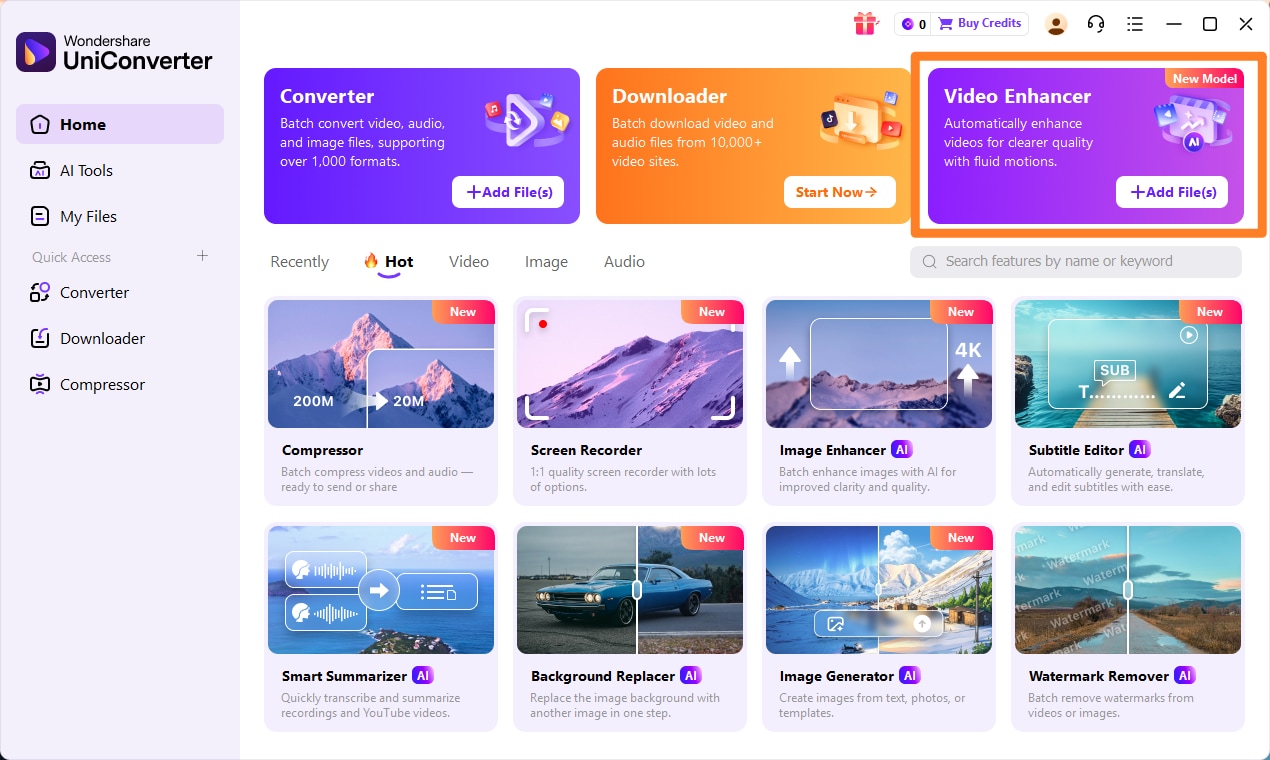
Step 1: Open UniConverter and Choose Video Enhancer
Launch UniConverter on your computer. From the main interface, navigate to the "AI Lab" section and select the "AI Video Enhancer" feature.
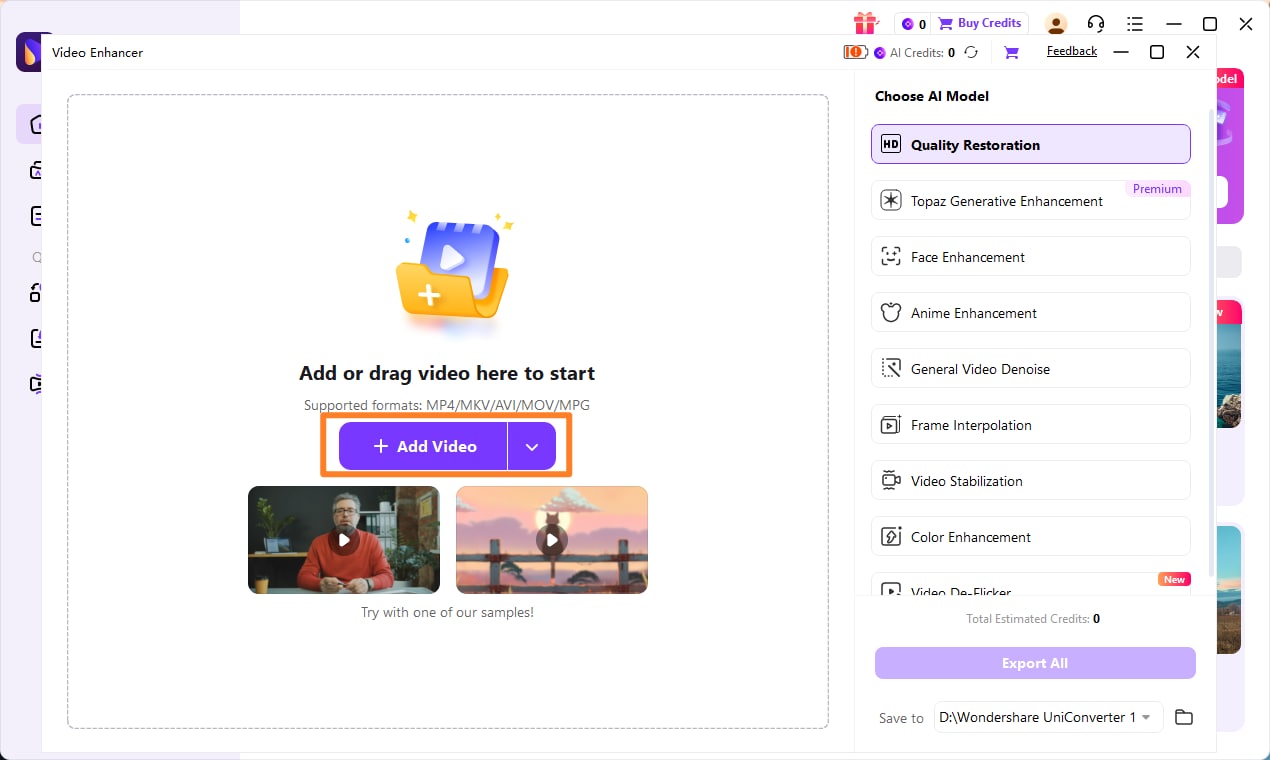
Step 2: Upload the Videos
Click on the "Add Files" button or drag and drop your video files into the UniConverter interface. You can add multiple videos for batch processing.
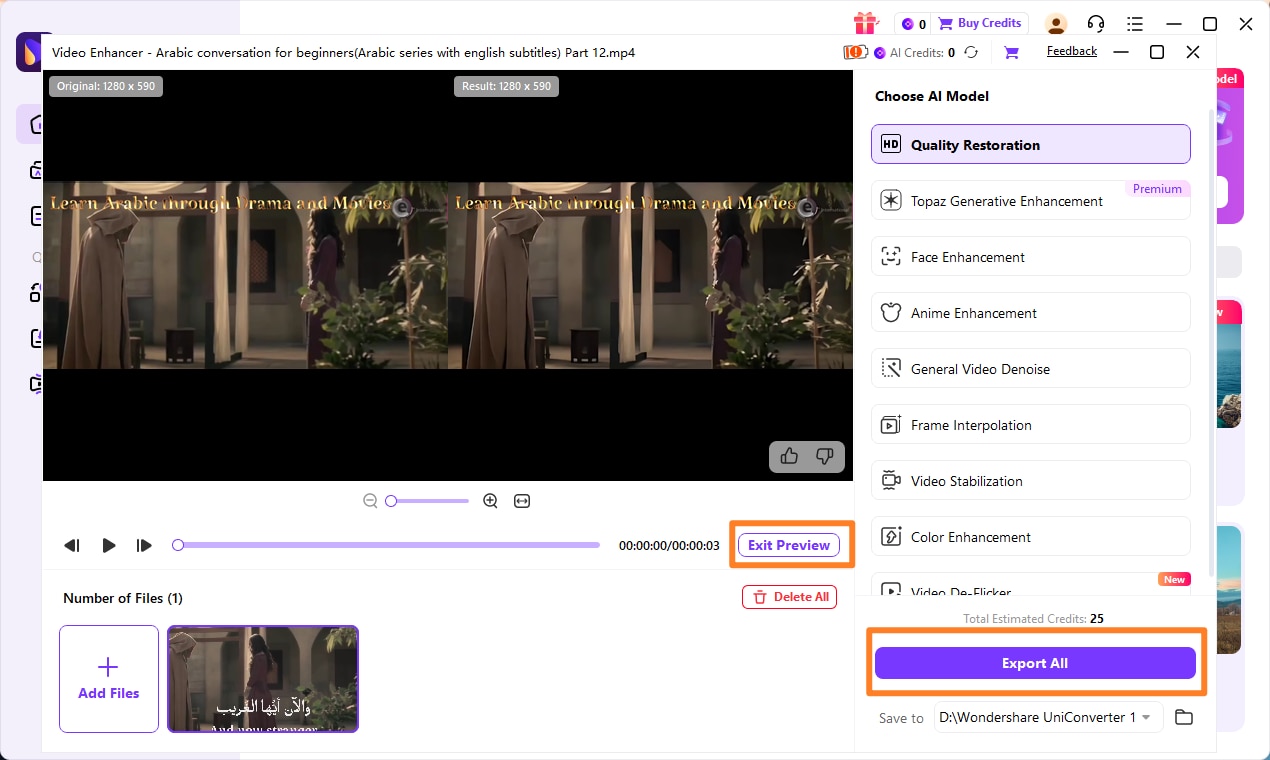
Step 3: Choose Enhancement Model
Select your desired AI enhancement model (e.g., "AI Upscale," "AI Denoise," "AI Color Correction") and adjust settings like output resolution, format, and quality. For instance, you can [[upscale video to 4K|free-video-upscaler.html|https://videoconverter.wondershare.com/ai-video-enhancer-tips/free-video-upscaler.html]] or [[fix pixelated videos|how-to-fix-pixelated-videos.html|https://videoconverter.wondershare.com/ai-video-enhancer-tips/how-to-fix-pixelated-videos.html]] with ease.

Step 4: Preview and Save the Enhanced Video
Preview the enhanced video to ensure satisfaction. Once ready, click the "Export" button to save your high-quality, [[upscaled video|free-video-upscaler.html|https://videoconverter.wondershare.com/ai-video-enhancer-tips/free-video-upscaler.html]] to your chosen destination.

Seeking a Kapwing AI Video Upscaler Alternative?
Part 7: Conclusion
In conclusion, the Kapwing AI Video Upscaler review reveals it as a highly accessible and user-friendly tool, particularly well-suited for social media content creators and casual users who prioritize speed and integration within an online editing ecosystem. Its cloud-based nature and intuitive interface make it an excellent choice for quick enhancements of older or lower-resolution footage. However, for professional filmmakers and those requiring granular control, broadcast-quality output, or dealing with highly sensitive data, dedicated desktop solutions like Topaz Video AI or UniConverter offer superior quality, advanced customization, and enhanced privacy. While Kapwing provides a valuable service for its target audience, users must weigh its convenience against potential limitations in advanced features and the inherent risks of cloud processing. Ultimately, the best choice depends on individual needs, technical proficiency, and the specific demands of the project at hand.
Part 8: FAQs
-
1. How does Kapwing AI Video Upscaler work?
Kapwing AI Video Upscaler uses artificial intelligence algorithms to analyze and enhance video resolution, often by intelligently adding pixels and sharpening details.
-
2. Is Kapwing AI Video Upscaler free to use?
Kapwing offers a free tier with limited features, but advanced AI upscaling typically requires a paid subscription.
-
3. Can AI upscaling truly improve video quality?
While AI upscaling can significantly improve perceived quality, it cannot magically create information that wasn't present in the original footage. It's an enhancement, not a recreation.
-
4. What are the main differences between Kapwing and Topaz Video AI?
Kapwing is a broader online video editor with an upscaling feature, prioritizing ease of use. Topaz Video AI is a dedicated, professional-grade upscaling software offering more control and higher quality.
-
5. Are there any privacy concerns with uploading videos to cloud-based upscalers?
Yes, users should always review the privacy policy of any cloud-based service to understand how their data is handled and stored.
