
- HandBrake's Role: Primarily a transcoder, not a true video enhancer. Optimizes for compatibility, not AI-driven quality.
- Core Strengths: Free, open-source, versatile codec support, and advanced customization for technical users.
- Key Limitations: Steep learning curve, lacks AI enhancement (upscaling, noise reduction), and can cause quality loss if misused.
- Ideal Use Case: Batch transcoding and format conversion for archiving or device compatibility, not professional enhancement.
- UniConverter Advantage: Offers comprehensive, user-friendly AI-powered enhancement, editing, and conversion for superior results.
- Decision Factor: Choose HandBrake for free conversion; UniConverter for balanced enhancement and ease of use; specialized AI tools for pro-grade quality.
In this article
- Part 1: Understanding the Video Enhancement Landscape
- Part 2: HandBrake: Core Features, Strengths, and Weaknesses
- Part 3: HandBrake: Ideal Users and Practical Scenarios
- Part 4: HandBrake and Alternatives Comparison
- Part 5: Risks and Pitfalls When Using HandBrake
- Part 6: How to Use UniConverter for Comprehensive Video Enhancement
- Part 7: Conclusion
- Part 8: FAQs
HandBrake Video Enhancer Review: Is It the Right Choice for Your Needs?
HandBrake has long been a go-to tool for video enthusiasts and professionals alike, primarily known for its robust video transcoding capabilities. However, its role in the broader video enhancement landscape often leads to confusion. This HandBrake video enhancer review aims to clarify HandBrake's true strengths and limitations, especially when compared to dedicated video enhancement software. We will delve into its core features, ideal use cases, and potential pitfalls, providing a comprehensive analysis to help you determine if HandBrake aligns with your specific video processing needs.
Part 1: Understanding the Video Enhancement Landscape
HandBrake, at its core, is an open-source video transcoder, designed to convert video from nearly any format to a selection of modern, widely supported codecs. While often associated with "improving" video, its primary function is not true enhancement in the sense of upscaling resolution, reducing noise, or sharpening details through advanced algorithms. Instead, it optimizes video for different devices or storage, which can sometimes result in a perceived quality improvement due to better compression or format compatibility. This review seeks to address the common misconception that HandBrake is a dedicated video enhancer, and instead positions it within its true domain: efficient video conversion and compression.
The Growing Demand for Video Enhancement
* Proliferation of Low-Quality Footage: With ubiquitous mobile recording, much content suffers from poor lighting, low resolution, or shaky capture.
* Archival and Restoration Needs: Older videos, often on outdated formats, require digital enhancement for modern viewing and preservation.
* Professional Content Creation: Creators constantly seek tools to elevate their visual storytelling, demanding sophisticated enhancement capabilities.
* Streaming and Display Demands: High-resolution displays and streaming platforms necessitate high-quality source material to deliver optimal viewing experiences.
Part 2: HandBrake: Core Features, Strengths, and Weaknesses
HandBrake is a powerful, free, and open-source tool primarily focused on transcoding and converting video files. It allows users to convert videos from almost any format to modern codecs, making them compatible with various devices and platforms. While it doesn't offer true AI-powered enhancement, its extensive customization options can optimize video output for specific needs.
Core Capabilities:
* Video Transcoding: Converts video from one format to another (e.g., MKV to MP4).
* Codec Support: Supports a wide range of video and audio codecs (H.264, H.265, VP8, VP9, AAC, MP3, etc.).
* Batch Processing: Allows users to queue multiple videos for conversion.
* Subtitle Integration: Supports adding, removing, or burning in subtitles.
* Chapter Markers: Enables the creation and use of chapter markers.
Pros:
* Versatile Codec Support for Broad Compatibility: HandBrake supports a vast array of input and output formats, ensuring your videos can be played on virtually any device.
* Advanced Customization for Technical Users: Offers granular control over video and audio settings, including bitrate, frame rate, resolution, and filters, catering to users who need precise control.
* Open-Source and Free to Use: Being open-source, HandBrake is completely free, making it an accessible option for budget-conscious users.
Cons:
* Steep Learning Curve for Beginners: The extensive options and technical terminology can be overwhelming for new users.
* Limited True "Enhancement" Capabilities (Focus on Transcoding): HandBrake lacks dedicated features for AI-powered upscaling, noise reduction, or sharpening that genuinely improve video quality beyond basic optimization.
Part 3: HandBrake: Ideal Users and Practical Scenarios
HandBrake is best suited for users who are comfortable with technical settings and primarily need to convert video formats, compress files, or prepare videos for specific devices without necessarily "enhancing" their visual quality in an AI-driven sense. It's a powerful utility for managing video libraries and ensuring compatibility.
Best Use Case: Batch Transcoding and Format Conversion for Archiving
Imagine you have a large collection of old home videos in various outdated formats like AVI or WMV. You want to convert them all to a more modern, space-efficient format like H.265 (HEVC) MP4 for long-term archiving and easy playback on contemporary devices. HandBrake excels here. You can set up a batch queue, configure the desired output settings (codec, resolution, bitrate), and let it run, efficiently processing dozens or hundreds of files. This ensures your precious memories are preserved in a widely compatible and smaller file size without significant visual degradation.
Limited Use Case: Professional Video Upscaling and AI-Powered Enhancement
Consider a scenario where a filmmaker has shot footage in 1080p but needs to deliver a 4K master, or they have noisy, low-light footage that requires significant cleanup and detail recovery. HandBrake would be a poor choice for this. While it can technically "upscale" by changing the resolution, it simply stretches the existing pixels without adding any new detail or intelligence. It cannot perform AI-driven noise reduction, de-interlacing, or smart sharpening that dedicated video enhancement tools offer. For professional-grade upscaling and true quality improvement, HandBrake falls short.
Part 4: HandBrake and Alternatives Comparison
When it comes to video processing, HandBrake serves a specific niche. However, for true video enhancement, several alternatives offer more specialized capabilities.
| Feature/Tool | HandBrake | UniConverter | Topaz Video AI | DaVinci Resolve |
| Primary Function | Transcoding/Conversion | All-in-one Video Toolbox | AI Upscaling/Enhancement | Professional Editing |
| Ease of Use | Moderate | High | Moderate | Low |
| Output Quality (Enhancement) | Basic | Good | Excellent | Good |
| Price | Free | Paid (Subscription/Lifetime) | Paid (One-time) | Free/Paid Studio |
| Target User | Tech-savvy | Casual/Pro | Pro/Enthusiast | Pro |
HandBrake shines in its free, open-source nature and extensive customization for transcoding and format conversion. For users needing to convert videos for compatibility or reduce file sizes, it's an excellent choice. However, when the goal is genuine video enhancement, UniConverter offers a more user-friendly experience with a broader suite of tools, including basic enhancement features. Topaz Video AI stands out for its cutting-edge AI-powered upscaling and de-noising, delivering superior quality for professional enhancement tasks, albeit at a higher price point and with a steeper learning curve than UniConverter. DaVinci Resolve, while a powerful professional editor, includes some enhancement capabilities but is primarily focused on post-production. UniConverter strikes a balance, providing a comprehensive toolkit that includes conversion, editing, and enhancement, making it a versatile option for many users.
Part 5: Risks and Pitfalls When Using HandBrake
While HandBrake is a powerful and free tool, its nature as a transcoder rather than an enhancer, combined with its technical interface, presents several risks and pitfalls for users, especially those seeking genuine video quality improvement.
Potential for Quality Loss During Aggressive Compression
HandBrake's primary function is compression, and if not configured carefully, aggressive settings can lead to noticeable quality degradation. Reducing bitrates too much or choosing highly compressed codecs without understanding their implications can result in blockiness, loss of fine detail, and color banding, especially in fast-moving scenes or areas with subtle gradients. Users often mistakenly believe smaller file size always means better, but it frequently comes at the cost of visual fidelity.
Lack of Dedicated AI Enhancement Features
A significant pitfall is the expectation that HandBrake can "enhance" video in the modern sense. It lacks any AI-driven algorithms for upscaling, noise reduction, de-interlacing, or sharpening. Attempting to "upscale" a 720p video to 1080p in HandBrake merely stretches the existing pixels, resulting in a blurry or pixelated image rather than a genuinely sharper one. This can lead to wasted time and disappointment for users looking for true quality improvement.
User Interface Complexity Leading to Errors
HandBrake's extensive array of settings, codecs, and filters can be overwhelming. Beginners often struggle to navigate the interface, leading to incorrect settings being applied. This can result in corrupted files, videos that won't play, or outputs that are far from the user's intended quality. The sheer number of options, while powerful for experts, is a significant barrier and source of errors for casual users.
Dependence on External Codecs and Libraries
While HandBrake is self-contained for many operations, some advanced features or specific format supports might implicitly rely on system-wide codecs or libraries. Issues with these external components can lead to unexpected errors, crashes, or failed conversions. Troubleshooting such problems can be challenging, requiring users to delve into system-level configurations.
No Built-in Privacy Features for Sensitive Content
As an offline, open-source tool, HandBrake itself doesn't transmit user data. However, it also offers no built-in privacy features for handling sensitive content. Users processing confidential or personal videos must rely on their own system security. There are no encryption options within HandBrake, nor any mechanisms to prevent unauthorized access to the processed files once they are outputted.
Part 6: How to Use UniConverter for Comprehensive Video Enhancement
When other tools fall short in batch processing, stable enhancement, or delivering noticeable improvements, UniConverter emerges as a robust solution. It bypasses common issues like unstable enhancements, weak effects, and lack of batch processing found in many free or less comprehensive tools. UniConverter offers a seamless, ad-free experience with extensive format support, GPU acceleration for speed, and stable, lossless batch enhancement, positioning it as an all-in-one ultimate solution for your video needs.
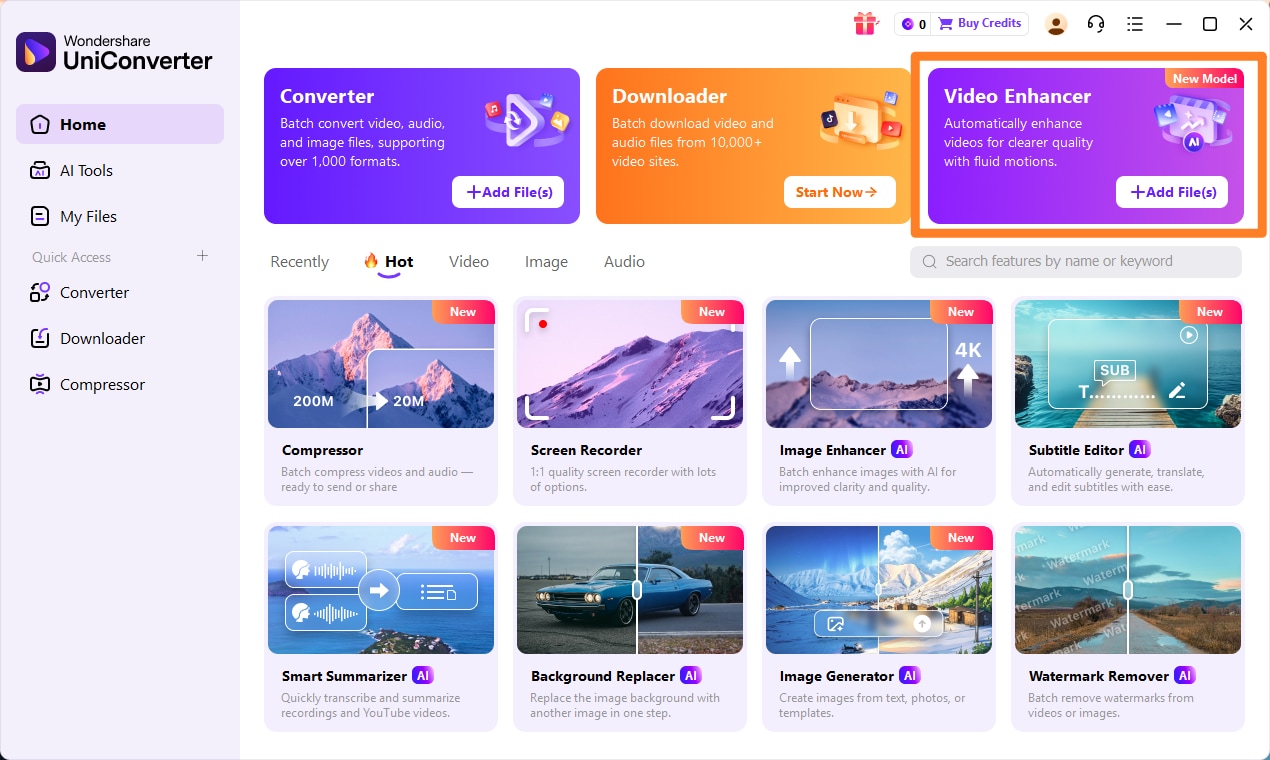
### Step 1: Open UniConverter and Choose Video Enhancer
Launch Wondershare UniConverter on your computer. From the main interface, navigate to the "AI Lab" section and select the "Video Enhancer" tool.
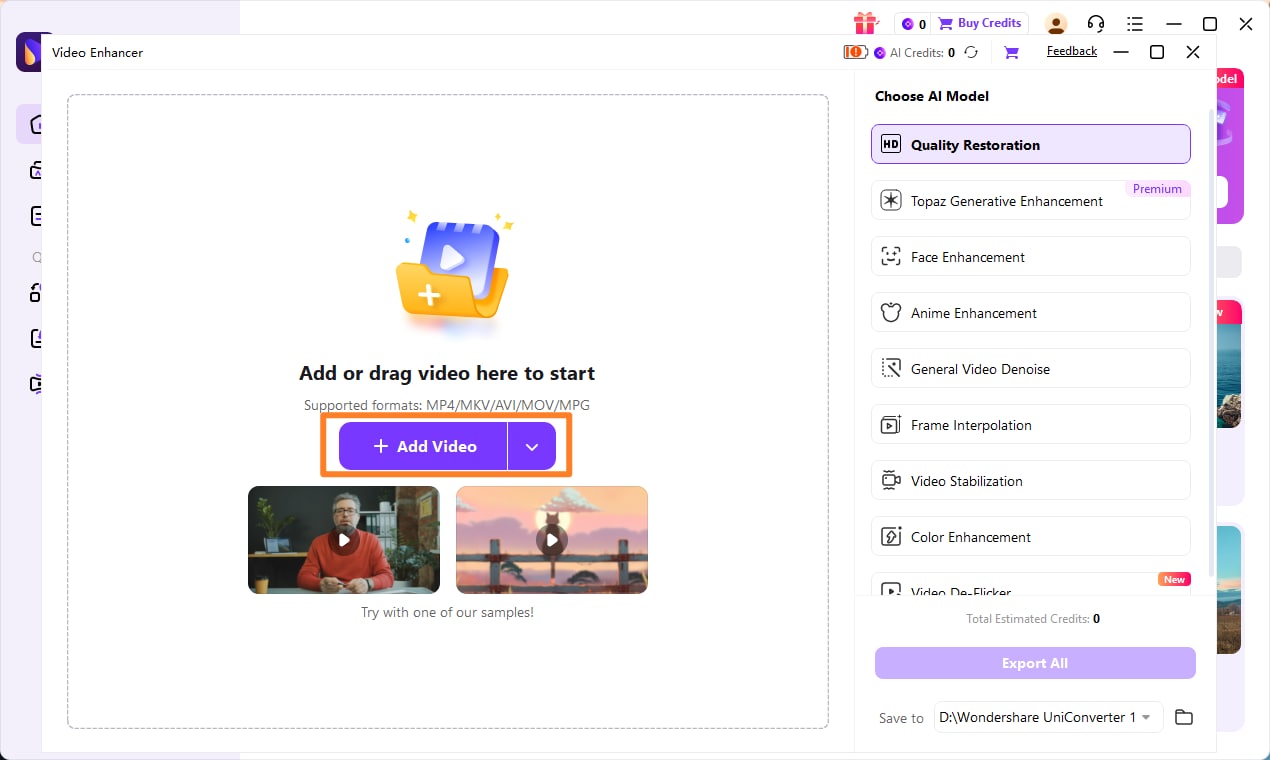
### Step 2: Upload the Videos
Click on the "Add Files" button or drag and drop your video files directly into the UniConverter interface. You can add multiple videos for batch processing.
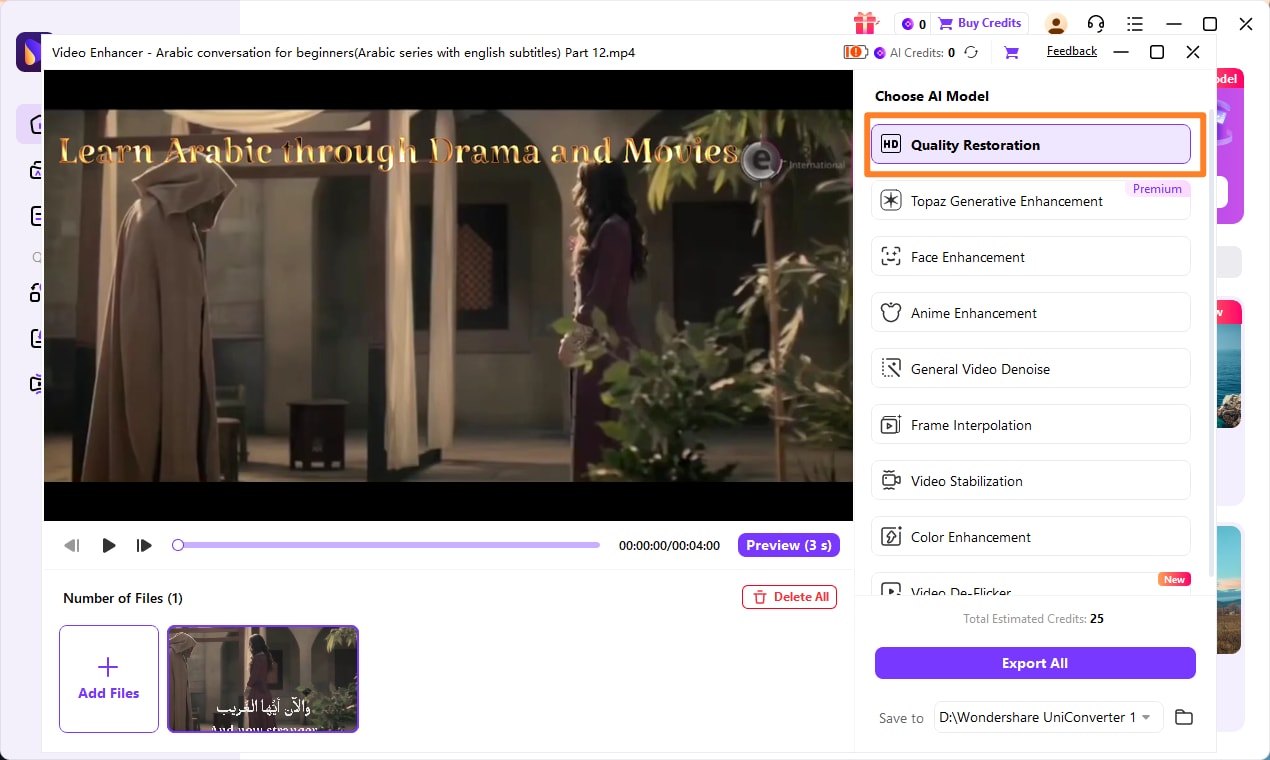
### Step 3: Choose Enhancement Model
UniConverter offers various AI enhancement models. Select the model that best suits your needs, such as "AI Upscale" for resolution improvement, "AI Denoise" for removing grain, or "AI Deblur" for sharpening. Adjust other parameters like output format and resolution as required. For advanced editing, consider exploring features like video background changer to further refine your visuals. You can also utilize the background replacer to modify or remove backgrounds with ease.
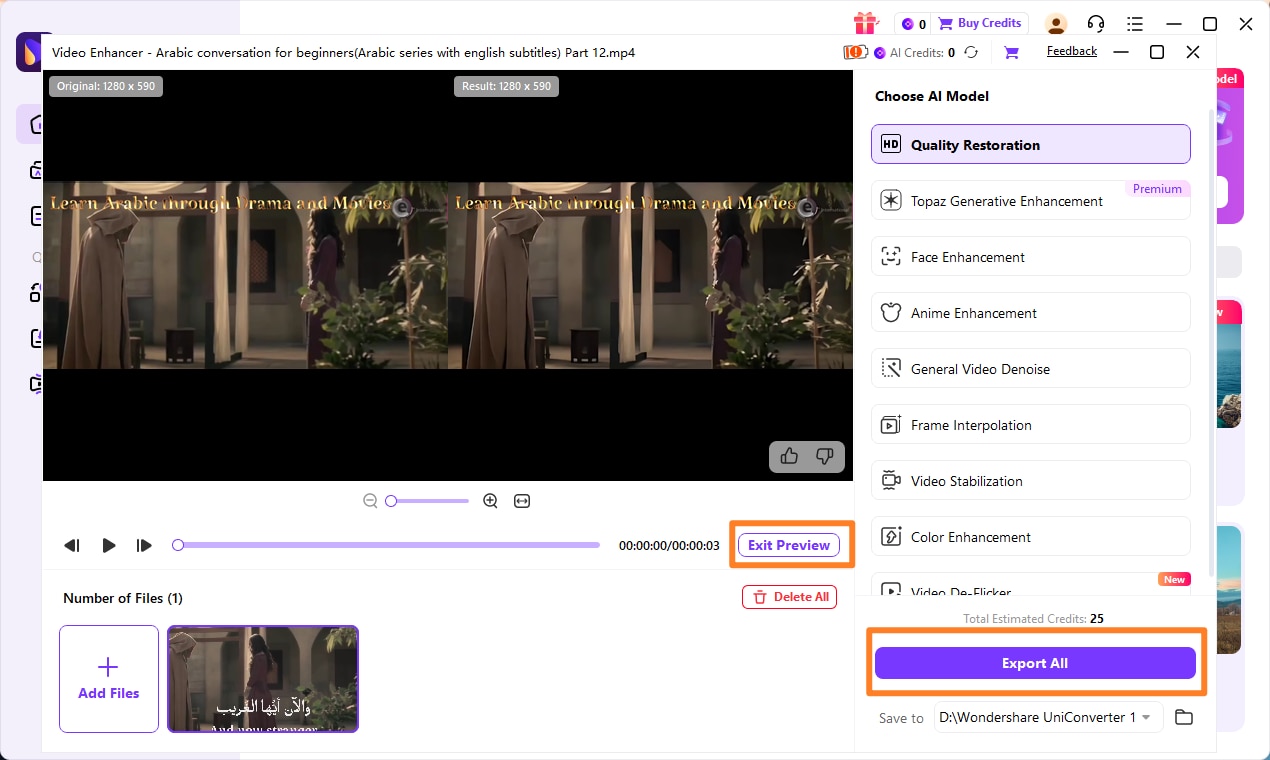
### Step 4: Preview and Save the Enhanced Video
Before finalizing, use the "Preview" feature to compare the original and enhanced video. Once satisfied, click the "Export" button to save your high-quality, enhanced video to your desired destination. For users interested in maintaining video quality, UniConverter also provides options for high-definition background removal and removing backgrounds without losing quality.

Seeking a HandBrake Alternative for Video Enhancement?
Part 7: Conclusion
This HandBrake video enhancer review has highlighted that while HandBrake is an indispensable, free, and open-source tool for video transcoding and format conversion, it is not a true video enhancer in the modern sense. Its strengths lie in broad codec support, advanced customization for technical users, and efficient batch processing for archiving and compatibility. However, its steep learning curve and lack of AI-powered enhancement capabilities mean it falls short for users seeking genuine quality improvement like upscaling, noise reduction, or sharpening. For basic transcoding and file management, HandBrake remains an excellent choice for tech-savvy individuals. For those requiring comprehensive video enhancement, including AI-driven upscaling, noise reduction, and a more user-friendly experience, alternatives like UniConverter or specialized tools like Topaz Video AI offer superior results. Ultimately, choosing the right tool depends on your specific project demands: HandBrake for robust conversion, UniConverter for a balanced all-in-one solution with enhancement, and dedicated AI tools for professional-grade quality improvement.
Part 8: FAQs
-
1. Can HandBrake truly enhance video quality?
HandBrake primarily focuses on transcoding and compression, which can sometimes improve perceived quality by reducing file size or converting to a more efficient format. However, it lacks dedicated AI-powered enhancement features found in specialized tools.
-
2. Is HandBrake safe to download and use?
Yes, HandBrake is open-source and generally considered safe. Always download it from the official website to avoid modified versions.
-
3. What are the main differences between HandBrake and UniConverter?
HandBrake excels at free, open-source video transcoding and format conversion with extensive customization. UniConverter offers a broader suite of tools, including AI-powered video enhancement, editing, and conversion, often with a more user-friendly interface.
-
4. Does HandBrake support 4K video enhancement?
HandBrake can process 4K videos for transcoding and compression, but it does not offer true 4K upscaling or AI-driven enhancement to improve the resolution or detail of lower-resolution footage to 4K.
-
5. What kind of users would benefit most from HandBrake?
HandBrake is best suited for users who need a free, powerful tool for converting video formats, compressing large files, or preparing videos for specific devices, and who are comfortable with a more technical interface.
