
- Gigapixel AI: Excels in AI-powered video upscaling and detail recovery for archival footage.
- Core Features: AI upscaling up to 8K, detail reconstruction, noise reduction, and deinterlacing.
- Pros: Exceptional detail recovery, realistic AI upscaling, and user-friendly interface.
- Cons: Resource-intensive, requires powerful hardware, and can introduce artifacts on low-quality sources.
- Target Users: Ideal for documentary filmmakers and archivists restoring old, low-resolution footage.
- Limited Use: Not suitable for real-time applications like gaming upscaling or live streaming due to high processing demands.
- Comparative Analysis: Gigapixel AI offers high AI sophistication and excellent output quality, but UniConverter provides faster processing and better ease of use.
- Risks: Potential for "AI hallucinations" (unnatural details), high hardware requirements, and licensing restrictions.
- UniConverter: A robust alternative offering efficient batch processing, stability, and lossless quality with GPU acceleration.
- Decision: Choose based on specific needs: Gigapixel AI for critical restoration, UniConverter for balanced, efficient enhancement.
In this article
- Part 1: What is Gigapixel AI Video Enhancer?
- Part 2: Gigapixel AI Video Enhancer: Core Features, Pros & Cons
- Part 3: Target Users and Usage Scenarios
- Part 4: Gigapixel AI Video Enhancer and Alternatives: A Comparative Analysis
- Part 5: Risks and Pitfalls to Avoid
- Part 6: How to Use UniConverter for Efficient Video Enhancement
- Part 7: Conclusion
- Part 8: FAQs
In the rapidly evolving landscape of digital media, the demand for high-quality video content has never been greater. From restoring cherished family memories to producing professional-grade documentaries, the ability to enhance and upscale video footage is a critical capability. This Gigapixel AI Video Enhancer review delves into the intricate world of AI-powered video processing, examining its core functionalities, comparing it against leading alternatives, and providing a comprehensive guide for users seeking to elevate their video quality. We will explore how AI video enhancement addresses common pain points in video production and help you make an informed decision about the best tools for your specific needs.
Part 1: What is Gigapixel AI Video Enhancer?
Gigapixel AI Video Enhancer emerges from the lineage of Topaz Labs' renowned image upscaling technology, extending its sophisticated AI algorithms to the realm of video. This software is designed to intelligently upscale video footage, enhancing resolution and detail without introducing the blurriness or artifacts commonly associated with traditional upscaling methods. Its core promise lies in transforming standard-definition or low-resolution videos into stunning high-definition or even 4K quality, breathing new life into old content and improving the visual fidelity of contemporary productions.
The primary objective of this review is to dissect the capabilities of Gigapixel AI Video Enhancer, providing a clear understanding of its strengths and weaknesses, and ultimately guiding users toward an optimal video enhancement solution.
Market Background and User Pain Points:
* Legacy Footage Limitations: Many users possess valuable archival footage trapped in lower resolutions, unsuitable for modern displays.
* Quality Discrepancies: Content creators often struggle with varying video qualities from different sources, needing a unified enhancement solution.
* Time-Consuming Manual Enhancement: Traditional video enhancement techniques are often manual, labor-intensive, and require specialized skills.
* Desire for Professional Output: Professionals and enthusiasts alike seek to produce visually superior videos that stand out in a competitive digital landscape.
Part 2: Gigapixel AI Video Enhancer: Core Features, Pros & Cons
Gigapixel AI Video Enhancer leverages advanced artificial intelligence to achieve its impressive results. Its core capabilities revolve around intelligent upscaling, noise reduction, and detail recovery, making it a powerful tool for a variety of video enhancement tasks.
Core Capabilities:
* AI-Powered Upscaling: Utilizes deep learning models to intelligently increase video resolution up to 8K.
* Detail Reconstruction: Recovers lost details and sharpens edges, making footage appear more crisp and defined.
* Noise Reduction: Effectively removes digital noise and grain without sacrificing important image information.
* Deinterlacing: Converts interlaced video into progressive scan, improving fluidity and reducing visual artifacts.
* Frame Interpolation (Limited): Offers some capabilities to smooth out motion in certain scenarios.
Pros:
* Exceptional detail recovery for vintage footage: Particularly adept at bringing out hidden details in older, lower-resolution videos.
* Advanced AI models for realistic upscaling: Produces natural-looking results that avoid the artificiality of traditional upscaling.
* User-friendly interface for quick processing: Despite its complexity, the software is intuitive to navigate, allowing for efficient workflows.
Cons:
* Resource-intensive, requiring powerful hardware: Demands significant CPU and GPU power, leading to longer processing times on less capable machines.
* Can introduce artifacts on highly compressed or low-quality sources: While generally excellent, it can struggle with severely degraded footage, sometimes creating unwanted visual anomalies.
Part 3: Target Users and Usage Scenarios
Gigapixel AI Video Enhancer caters to a specific demographic of users who prioritize video quality and are willing to invest in powerful tools to achieve it. Its strengths lie in transforming challenging video sources into high-quality outputs.
Best Use Case: Restoring and Upscaling Archival Footage for Documentaries
For documentary filmmakers, archivists, and historical researchers, Gigapixel AI Video Enhancer is an invaluable asset. It excels at taking decades-old, low-resolution footage – often from VHS, film reels, or early digital cameras – and upscaling it to modern resolutions (e.g., 4K). This process not only increases the pixel count but also intelligently reconstructs lost details, reduces analog noise, and corrects color inconsistencies. The result is historically significant content that is presentable on contemporary screens, allowing for a more immersive and engaging viewing experience for audiences. This capability is crucial for preserving cultural heritage and making it accessible to future generations in a high-fidelity format.
Limited Use Case: Real-time Gaming Upscaling or Live Streaming
While Gigapixel AI Video Enhancer is powerful, it is not designed for real-time applications such as live gaming upscaling or live streaming. The computational demands of its AI models mean that processing a video takes a significant amount of time, often many times the duration of the video itself. Therefore, it cannot provide the instantaneous frame-by-frame enhancement required for live content. Users looking for real-time upscaling solutions for gaming or streaming would need to explore hardware-based upscalers or other software solutions specifically designed for low-latency processing, which typically employ less intensive algorithms and offer different compromises in quality.
Part 4: Gigapixel AI Video Enhancer and Alternatives: A Comparative Analysis
When evaluating video enhancement tools, it's crucial to compare Gigapixel AI Video Enhancer against its competitors to understand its position in the market.
| Feature/Product | Gigapixel AI Video Enhancer | UniConverter | VideoProc Converter AI | DaVinci Resolve Studio |
| AI Model Sophistication | High | Medium | Medium | High |
| Output Quality | Excellent | Good | Good | Excellent |
| Processing Speed | Moderate | Fast | Fast | Moderate |
| Ease of Use | High | High | High | Medium |
| Price | Premium | Mid-range | Mid-range | Premium |
| Customer Support | Good | Excellent | Good | Good |
| Security | High | High | High | High |
Key Differentiators:
Gigapixel AI Video Enhancer excels in detail preservation and natural-looking upscaling, making it ideal for critical restoration projects. UniConverter offers a balance of speed and quality, making it a versatile choice for general video processing tasks. VideoProc Converter AI provides fast processing, especially for 4K and 8K videos, and includes a comprehensive suite of video editing tools. DaVinci Resolve Studio stands out with its professional-grade color grading and editing capabilities, with AI enhancement as an integrated feature, catering to high-end post-production workflows.
Part 5: Risks and Pitfalls to Avoid
While AI video enhancement tools like Gigapixel AI Video Enhancer offer incredible potential, users must be aware of several risks and pitfalls to ensure optimal results and avoid disappointment.
Potential for "AI Hallucinations" and Unnatural Details
One significant risk is the phenomenon of "AI hallucinations." When the AI model encounters areas of extreme detail loss or ambiguity in the original footage, it may "invent" details that were never present. These generated details, while sometimes plausible, can also appear unnatural, repetitive, or even bizarre upon close inspection. This can lead to an uncanny valley effect, where the enhanced video looks artificial rather than genuinely improved. Users should always critically review the output for such artifacts, especially in areas with complex textures or faces.
High Hardware Requirements and Processing Time
AI video enhancement is computationally intensive. Gigapixel AI Video Enhancer requires a powerful GPU with ample VRAM (preferably 8GB or more) and a robust CPU to operate efficiently. Without adequate hardware, processing times can be excruciatingly long, turning a short video enhancement task into an overnight or even multi-day endeavor. This can be a significant barrier for users with older or less powerful systems, making the software impractical for regular use.
Understanding Licensing and Commercial Use Restrictions
Before using any enhanced video for commercial purposes, it is crucial to understand the licensing terms of the software. Some tools may have restrictions on commercial use, or require specific attribution. Failing to comply with these terms could lead to legal issues. Additionally, if the original footage has its own copyright or licensing restrictions, enhancing it does not automatically grant new usage rights. Users must ensure they have the necessary permissions for both the software and the source material.
Impact on Original Video Fidelity and Compression Artifacts
While AI enhancers aim to improve quality, they can sometimes exacerbate existing compression artifacts or introduce new ones if not handled carefully. Highly compressed source videos, especially those with visible blockiness or banding, can be challenging for AI models. The enhancement process might amplify these imperfections or create new, subtle artifacts that degrade the overall fidelity rather than improving it. It's essential to start with the highest quality source material possible and experiment with settings to find the optimal balance.
Part 6: How to Use UniConverter for Efficient Video Enhancement
When other tools fall short in batch processing, stability, or enhancement quality, UniConverter stands out as a reliable alternative. It provides a robust solution for enhancing videos without the common issues of instability or weak enhancement effects often found in less comprehensive tools. UniConverter offers a seamless experience, free from ads, and supports a vast array of formats. Its GPU acceleration ensures fast and stable processing, delivering lossless quality with powerful batch enhancement capabilities, making it an ultimate all-in-one solution for your video needs.
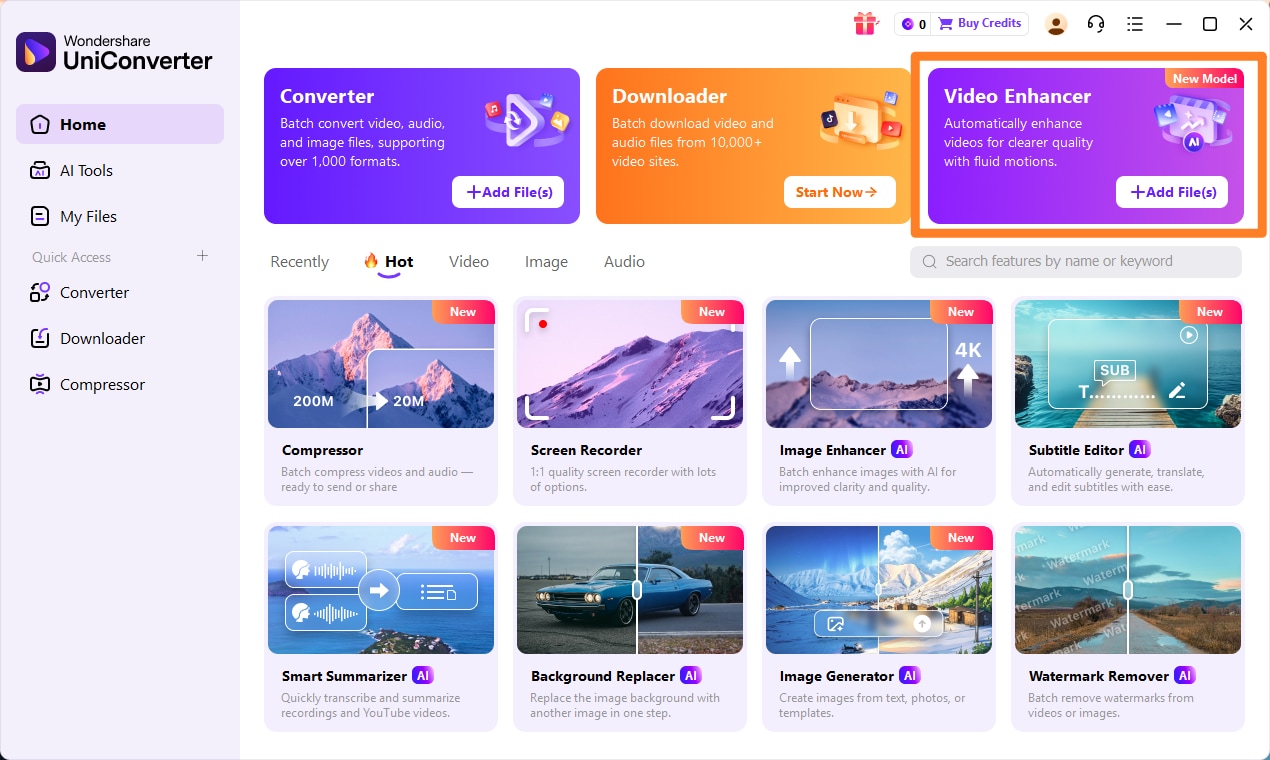
Step 1: Open UniConverter and Choose Video Enhancer
Launch UniConverter on your computer. From the main interface, navigate to the "Video Enhancer" tool. This dedicated feature is designed to streamline the enhancement process.
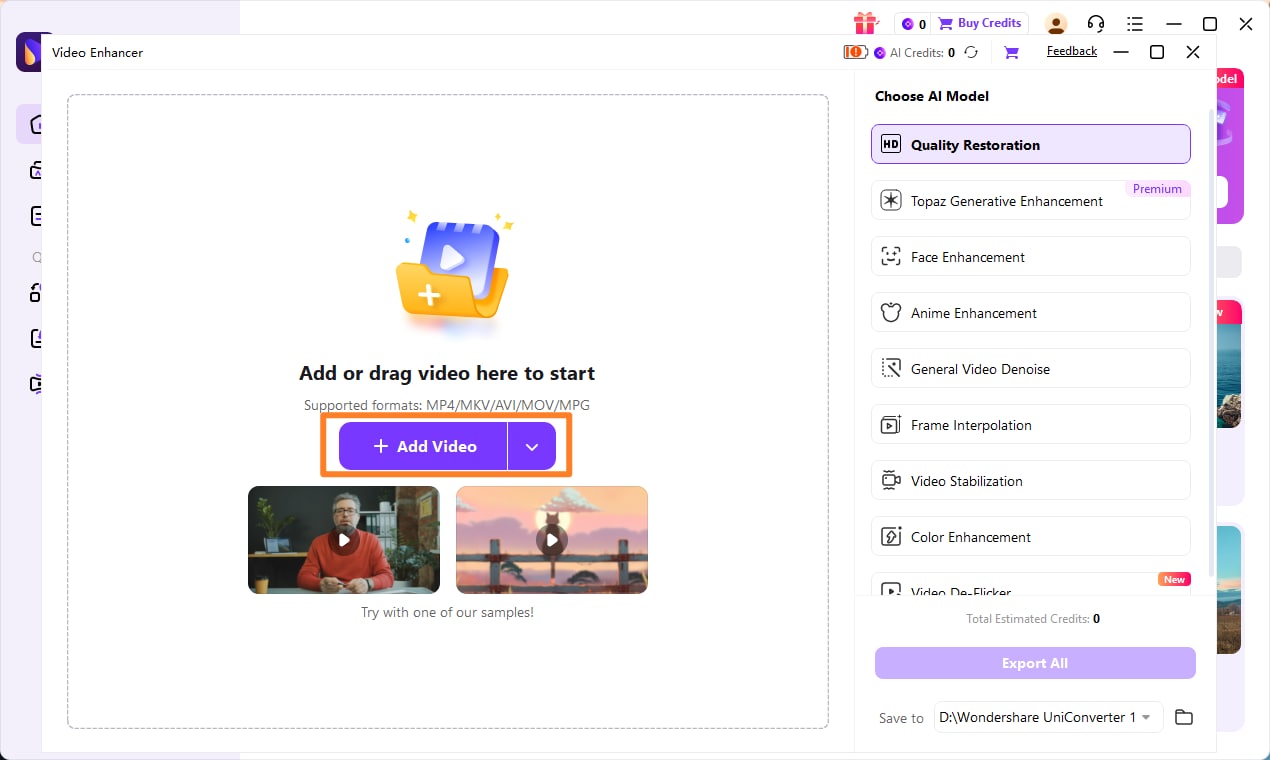
Step 2: Upload the Videos
Click on the "Add Files" button or simply drag and drop the video files you wish to enhance into the UniConverter window. You can add multiple videos for batch processing.
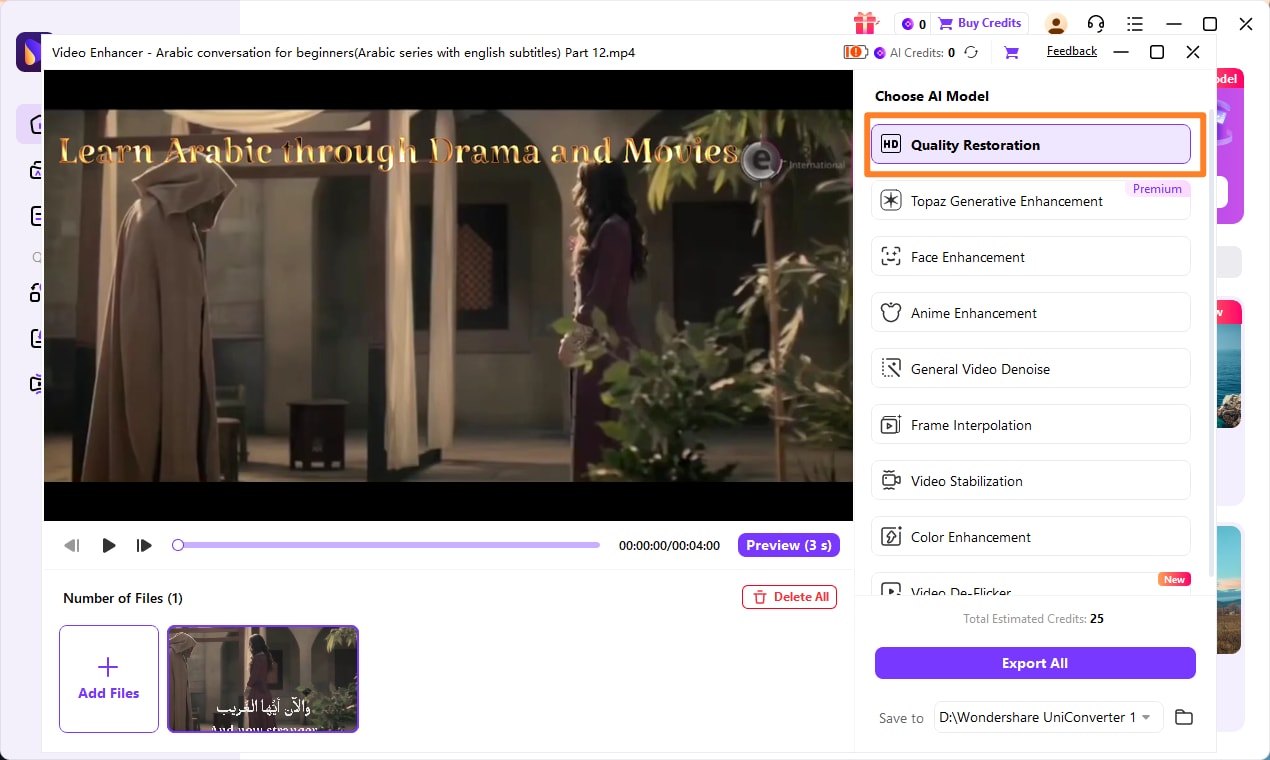
Step 3: Choose Enhancement Model
Once your video is loaded, UniConverter will present various enhancement options. Select the desired AI model for upscaling, noise reduction, or other improvements based on your video's specific needs. For instance, you might want to utilize a background replacer to change the visual context of your video, or explore options for a video background changer to achieve a more dynamic look.
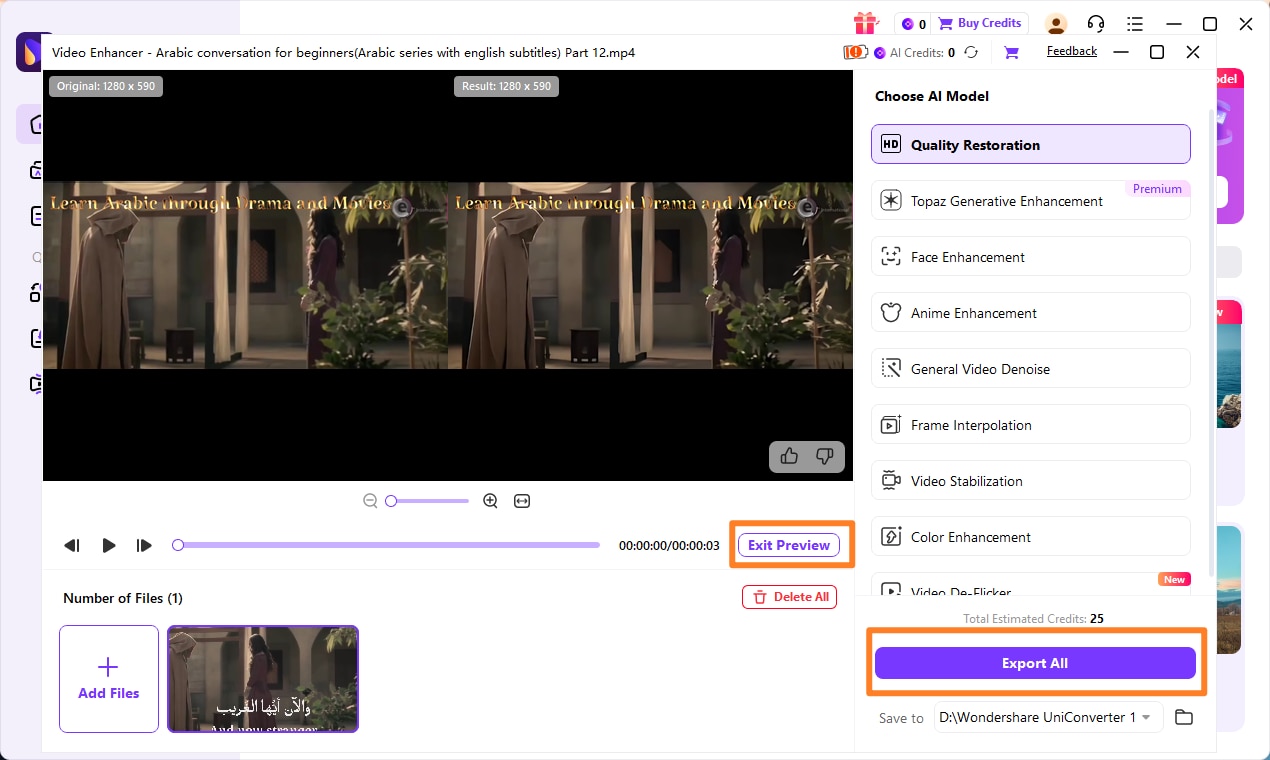
Step 4: Preview and Save the Enhanced Video
After selecting your enhancement settings, you can often preview a segment of the enhanced video to ensure the desired outcome. Once satisfied, click "Start All" or "Export" to save your high-quality, enhanced video. This process allows for removing background without losing quality and ensures a professional finish.

Seeking a Gigapixel AI Video Enhancer alternative?
Part 7: Conclusion
The Gigapixel AI Video Enhancer review reveals a powerful tool for specific video enhancement needs, particularly in the realm of archival restoration and high-quality upscaling. Its advanced AI models deliver exceptional detail recovery and natural-looking results, making it a top choice for professionals and enthusiasts who demand the best in visual fidelity. However, its resource-intensive nature and potential for artifacts on poor source material mean it's not a one-size-fits-all solution. For professional archivists and filmmakers, the investment in hardware and the software itself is justified by the superior output quality. Casual users and content creators might find the processing times and hardware requirements prohibitive, potentially benefiting more from a balanced solution like UniConverter, which offers a broader suite of tools and faster processing for general use. Budget-conscious individuals should explore alternatives that provide decent results at a lower cost or with less demanding system requirements. Ultimately, the best choice depends on individual needs, technical capabilities, and the specific demands of the video enhancement project.
Part 8: FAQs
-
1. What is the difference between upscaling and enhancing?
Upscaling primarily increases the resolution of a video by adding more pixels, often through interpolation. Enhancing, on the other hand, goes beyond just resolution; it involves improving overall image quality by reducing noise, sharpening details, correcting colors, and sometimes even reconstructing missing information, often using AI algorithms.
-
2. Can AI video enhancers truly create missing details?
AI video enhancers don't "create" details in the sense of inventing entirely new, accurate information. Instead, they use deep learning models trained on vast datasets to intelligently infer and reconstruct plausible details based on surrounding pixels and learned patterns. While this often results in a more detailed and sharper image, these "created" details are estimations and not the original, lost information.
-
3. How much does a good video enhancer cost?
The cost of video enhancers varies widely. Basic or free options might offer limited features and quality. Mid-range software can cost anywhere from $50 to $200 for a perpetual license or annual subscription. Premium, professional-grade AI enhancers like Gigapixel AI Video Enhancer or DaVinci Resolve Studio can range from $200 to $300 or more, reflecting their advanced capabilities and resource demands.
-
4. Are there any free AI video enhancers?
Yes, there are some free AI video enhancers available, often as online tools or open-source projects. Examples include some features within VLC Media Player (though not AI-driven upscaling), or specific open-source AI models that require technical expertise to implement. However, these free options typically come with limitations in terms of features, output quality, processing speed, or ease of use compared to commercial software.
-
5. What hardware do I need for effective video enhancement?
For effective AI video enhancement, especially with demanding software like Gigapixel AI Video Enhancer, a powerful computer is essential. This typically includes a modern multi-core CPU (Intel i7/i9 or AMD Ryzen 7/9), a dedicated GPU with at least 8GB of VRAM (NVIDIA RTX series or AMD Radeon RX series are recommended), 16GB or more of RAM, and a fast SSD for both the operating system and project files to ensure smooth processing.
