
- <b>FFmpeg Power:</b> Unparalleled control for advanced users, but demands technical expertise.
- <b>User-Friendly Alternatives:</b> UniConverter offers intuitive GUI, balancing features and accessibility.
- <b>Cost vs. Ease:</b> FFmpeg is free but complex; alternatives offer ease for a fee.
- <b>Decision Factor:</b> Choose based on technical skill, project needs, and desired workflow efficiency.
In this article
- Part 1: What is FFmpeg Video Enhancer?
- Part 2: FFmpeg Video Enhancer: Core Features, Pros, and Cons
- Part 3: Target Audience and Use Cases for FFmpeg Video Enhancer
- Part 4: FFmpeg Video Enhancer vs. Alternatives Comparison
- Part 5: Risks and Pitfalls of Using FFmpeg for Video Enhancement
- Part 6: How to Use UniConverter for Seamless Video Enhancement
- Part 7: Conclusion
- Part 8: FAQs
FFmpeg, a powerful open-source multimedia framework, has long been the go-to solution for advanced video manipulation. Its command-line interface offers unparalleled control over video processing, including a wide array of enhancement capabilities. However, the complexity of FFmpeg often poses a significant barrier for users without technical expertise. This FFmpeg Video Enhancer review delves into its core functionalities, comparing it with user-friendly alternatives to help you navigate the landscape of video enhancement tools. We will explore scenarios where FFmpeg shines and where more intuitive software might be a better fit, providing a comprehensive guide for both seasoned professionals and casual users.
Part 1: What is FFmpeg Video Enhancer?
FFmpeg is a free and open-source project consisting of a vast suite of libraries and programs for handling video, audio, and other multimedia files and streams. At its core, FFmpeg provides a robust command-line tool that can convert, stream, and process virtually any multimedia format. When it comes to video enhancement, FFmpeg offers a powerful, albeit complex, set of filters and options to improve video quality, such as upscaling, noise reduction, deinterlacing, and color correction. This review aims to address the fundamental question of whether FFmpeg is the right tool for your video enhancement needs, especially when compared to more accessible, GUI-based alternatives.
Market Background and User Pain Points
The demand for high-quality video content is ever-increasing, leading to several user pain points:
* Desire for improved video quality: Users often have old or low-resolution videos they wish to enhance.
* Complexity of professional tools: Many powerful video enhancement tools are difficult for average users to master.
* Cost of premium software: High-quality video enhancement software can be expensive, pushing users towards free alternatives.
* Time-consuming enhancement processes: Achieving optimal video enhancement can be a lengthy and iterative process.
Part 2: FFmpeg Video Enhancer: Core Features, Pros, and Cons
FFmpeg's core capability lies in its command-line interface, allowing users to execute complex video processing tasks with precision. Its extensive library support means it can handle almost any video or audio codec and format imaginable. For video enhancement, FFmpeg provides filters like `scale` for upscaling, `denoise` for noise reduction, `yadif` for deinterlacing, and `colorlevels` for color correction, among many others.
Pros:
* Unparalleled Customization and Control for Advanced Users: FFmpeg offers granular control over every aspect of video enhancement, allowing for highly specific and tailored adjustments.
* Open-Source and Cost-Effective Solution: Being free and open-source, FFmpeg is accessible to everyone without any licensing fees.
* Extensive Codec and Format Support: It supports an incredibly wide range of codecs and formats, making it a versatile tool for any video project.
Cons:
* Steep Learning Curve for Beginners: The command-line interface and vast array of options can be intimidating and difficult for new users to grasp.
* Lack of a User-Friendly Graphical Interface: Without a GUI, users must rely on text commands, which can be prone to errors and less intuitive for visual tasks.
Part 3: Target Audience and Use Cases for FFmpeg Video Enhancer
FFmpeg Video Enhancer is primarily suited for a specific demographic: users with a strong technical background, developers, and video professionals who require precise control and automation. Its command-line nature makes it ideal for integrating into scripts and workflows.
Best Use Case: Professional Video Production and Batch Processing
For professional video editors, developers, or researchers who need to process large volumes of video files with specific, repeatable enhancements, FFmpeg is an invaluable tool. Its scripting capabilities allow for automated batch processing, applying complex enhancement filters across hundreds or thousands of files efficiently. For example, a studio might use FFmpeg to upsample an entire archive of standard definition footage to HD, or to apply a consistent noise reduction filter across all clips in a project.
Limited Use Case: Quick Edits and Casual Users
For casual users who simply want to quickly improve the quality of a few personal videos without delving into technical commands, FFmpeg is largely unsuitable. Tasks like brightening a dark video or removing minor shakiness become cumbersome and time-consuming due to the lack of a visual interface and the need to manually configure parameters. Users looking for immediate, intuitive results will find FFmpeg's learning curve prohibitive.
Part 4: FFmpeg Video Enhancer vs. Alternatives Comparison
When evaluating video enhancement tools, it's crucial to consider ease of use, customization, cost, and the overall user experience.
| Feature/Scenario | FFmpeg Video Enhancer | UniConverter | Topaz Video AI | DaVinci Resolve |
| Ease of Use | Command-line | GUI-based | GUI-based | GUI-based |
| Customization | High | Moderate | High | Very High |
| Cost | Free | Subscription | One-time purchase | Free/Studio License |
| Batch Processing | Excellent | Good | Excellent | Good |
| Learning Curve | High | Low | Medium | Very High |
| Output Quality | Excellent (with expertise) | Good | Excellent | Excellent |
| Customer Support | Community | Dedicated | Dedicated | Community/Dedicated |
FFmpeg stands out for its unparalleled customization and zero cost, making it a favorite for technically proficient users who demand absolute control. However, its steep learning curve and lack of a GUI are significant drawbacks for others. UniConverter offers a balanced approach, providing a user-friendly interface with decent enhancement capabilities for a subscription fee. Topaz Video AI excels in AI-powered upscaling and denoising, delivering impressive results with a more accessible interface than FFmpeg, albeit at a premium price. DaVinci Resolve, while a full-fledged professional editing suite, also includes powerful enhancement tools, offering a free version with a very high learning curve. For sheer flexibility and cost-effectiveness, FFmpeg is unmatched, but for ease of use and dedicated support, UniConverter or Topaz Video AI might be better choices.
Part 5: Risks and Pitfalls of Using FFmpeg for Video Enhancement
While FFmpeg offers immense power, its complexity introduces several risks and potential pitfalls, especially for those new to command-line tools or video processing. Understanding these challenges is crucial before committing to FFmpeg for your enhancement needs.
Potential for Quality Degradation with Incorrect Parameters
One of the most significant risks is inadvertently degrading video quality. FFmpeg's filters require precise parameter settings. Using incorrect values for scaling, denoising, or color correction can lead to artifacts, blurring, color shifts, or even a reduction in overall quality rather than an improvement. For instance, aggressive denoising can remove fine details, making the video appear plastic or artificial.
Time-Consuming Trial and Error for Optimal Results
Achieving the desired enhancement effect often involves a lengthy process of trial and error. Since there's no real-time visual preview within the command line, users must apply parameters, render a portion of the video, review the output, and then adjust parameters again. This iterative process can be incredibly time-consuming and frustrating, particularly for complex enhancements.
Dependency on Command-Line Proficiency
FFmpeg's entire operation relies on command-line proficiency. Users must be comfortable with syntax, understanding various flags, options, and filter chains. A simple typo or misunderstanding of a parameter's function can lead to errors or unexpected results, making it inaccessible for individuals without this technical skill set.
Lack of Dedicated Customer Support
As an open-source project, FFmpeg does not offer dedicated customer support. While there's a vibrant community and extensive documentation available, troubleshooting specific issues or getting personalized guidance can be challenging. Users are largely reliant on community forums and their own research to resolve problems, which can be a significant hurdle for urgent projects.
Part 6: How to Use UniConverter for Seamless Video Enhancement
When other tools fall short with unstable enhancements, poor quality, or lack of batch processing, UniConverter emerges as a robust and user-friendly alternative. It provides a stable, high-quality, and efficient solution for video enhancement, free from ads, with extensive format support, GPU acceleration, and lossless batch processing. UniConverter is designed as an all-in-one ultimate solution for your video needs.
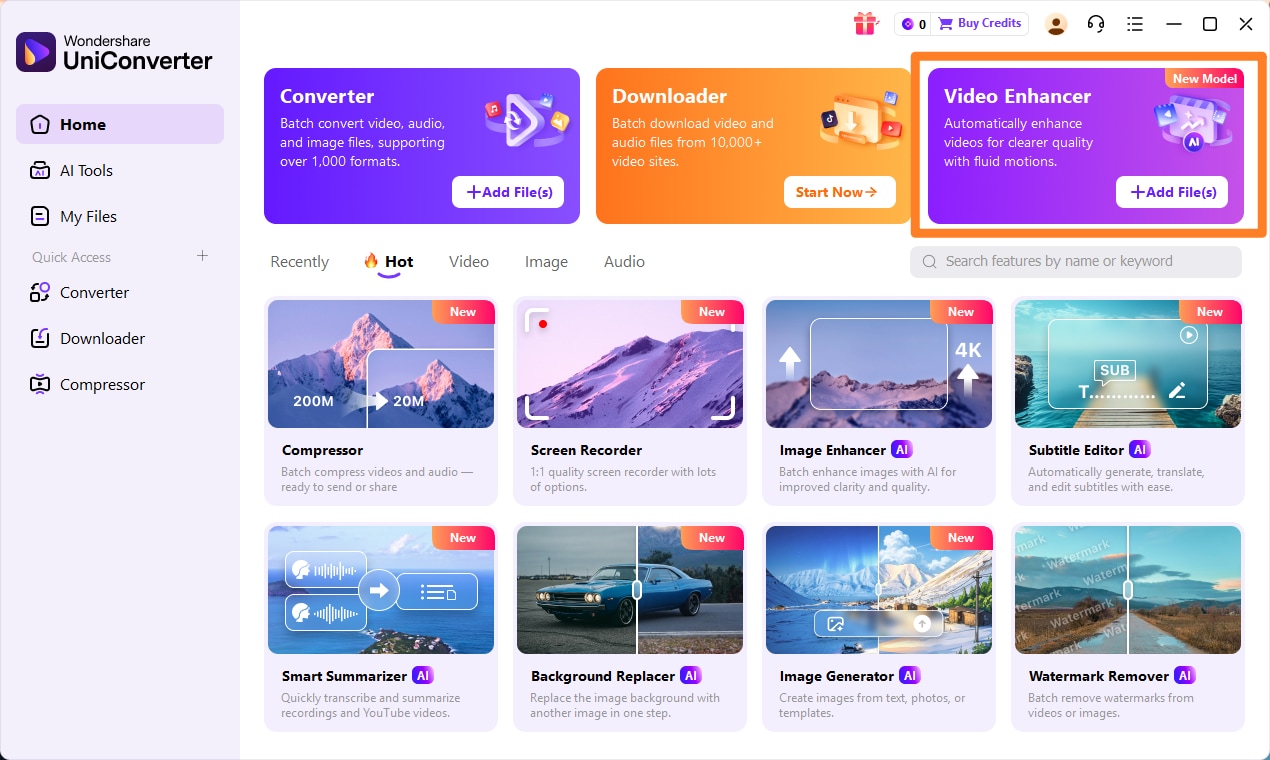
Step 1: Open UniConverter and Choose Video Enhancer
Launch UniConverter on your computer. From the main interface, navigate to the "Toolbox" section and select the "Video Enhancer" feature.
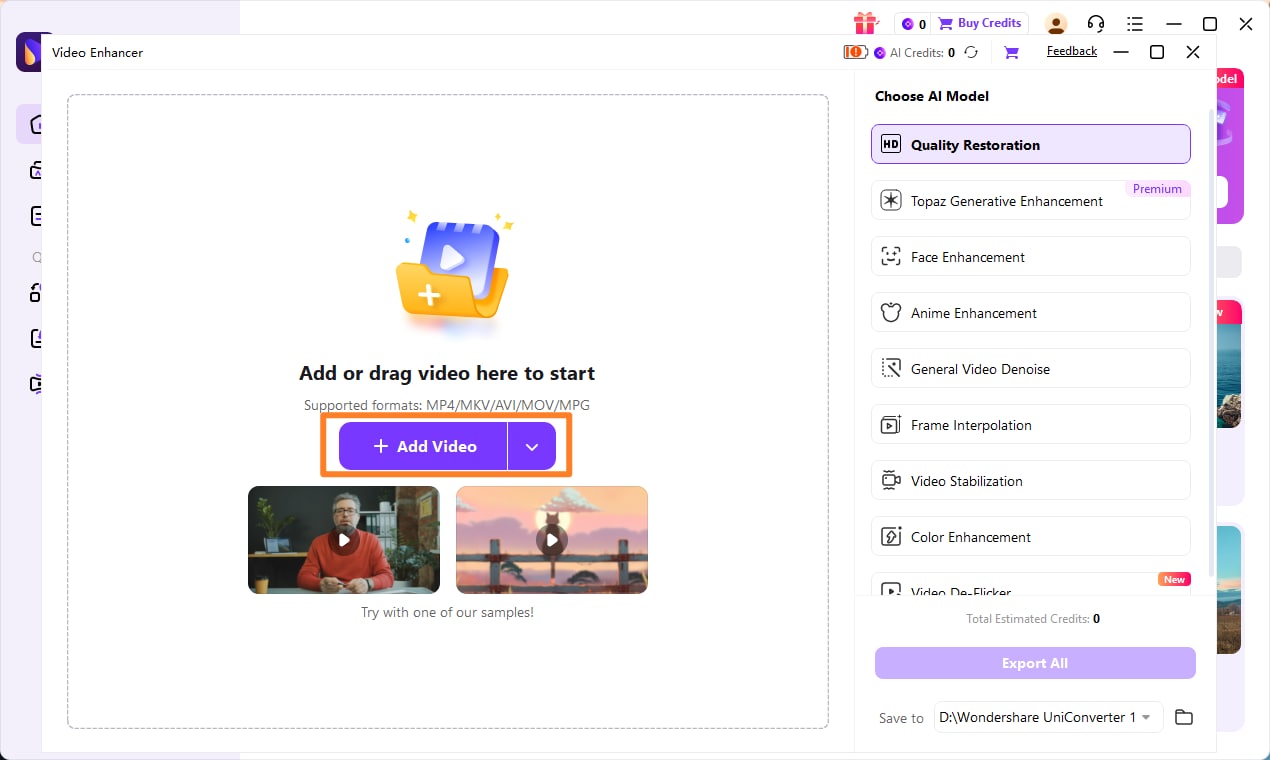
Step 2: Upload the Videos
Click on the "Add Files" button or drag and drop your video files directly into the UniConverter interface. You can add multiple videos for batch processing.
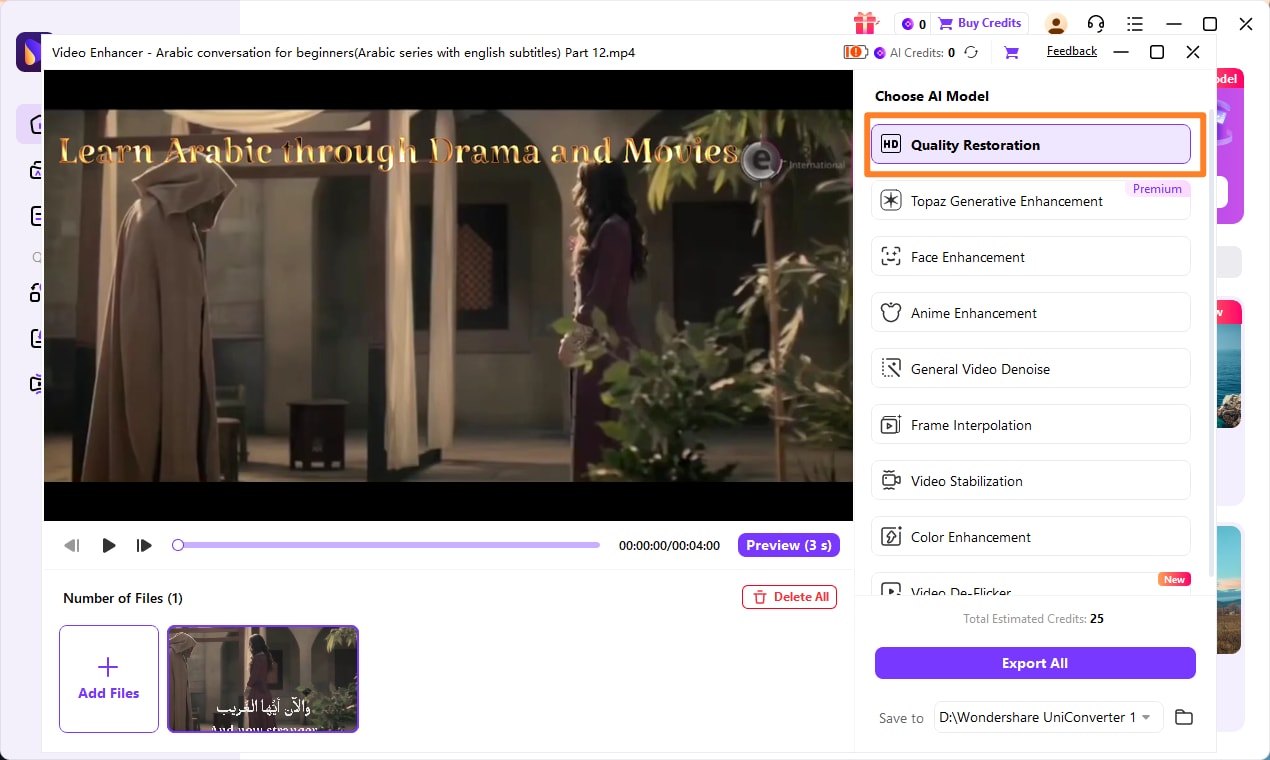
Step 3: Choose Enhancement Model
UniConverter offers various enhancement models, such as "AI Upscale," "Brightness/Contrast," "Denoise," and "Stabilization." Select the appropriate model based on your video enhancement needs. You can also adjust parameters like resolution, brightness, and contrast. For instance, you can easily upscale video or stabilize shaky footage.
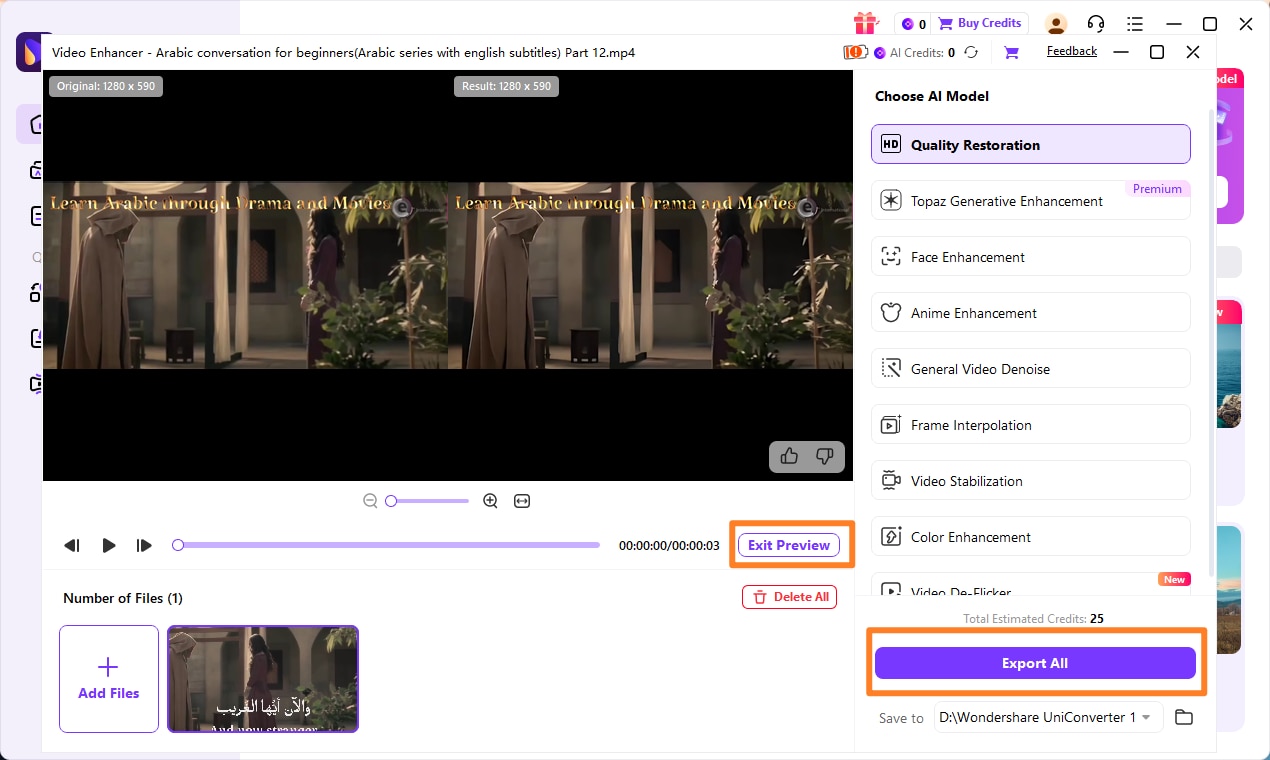
Step 4: Preview and Save the Enhanced Video
After selecting your desired enhancements, click "Preview" to see the changes in real-time. Once satisfied, choose your output format and destination folder, then click "Enhance" to save your improved video. This allows you to fix pixelated videos and achieve clearer results.

Enhance Videos Beyond FFmpeg's Limits?
Part 7: Conclusion
In conclusion, the choice between FFmpeg Video Enhancer review and its alternatives hinges entirely on user expertise and specific project requirements. FFmpeg, with its open-source nature and command-line interface, offers unparalleled control and customization, making it an indispensable tool for technical users, developers, and professionals engaged in complex, automated video processing tasks. Its zero cost and extensive format support are significant advantages for those willing to invest time in mastering its intricacies. However, its steep learning curve, lack of a graphical user interface, and the potential for quality degradation with incorrect parameters make it less suitable for beginners or users seeking quick, intuitive solutions. For individuals prioritizing ease of use, dedicated support, and a more streamlined workflow, alternatives like UniConverter provide a compelling proposition, offering a balance of features and accessibility. Ultimately, understanding your technical comfort level and the specific demands of your video enhancement projects will guide you to the most appropriate tool.
Part 8: FAQs
-
1. Is FFmpeg truly free to use for video enhancement?
Yes, FFmpeg is open-source and completely free to use.
-
2. Can FFmpeg enhance video quality automatically?
No, FFmpeg requires manual configuration of parameters for enhancement.
-
3. What kind of video enhancement can FFmpeg perform?
FFmpeg can perform various enhancements like upscaling, noise reduction, deinterlacing, and color correction.
-
4. Is UniConverter a good alternative for professional video editors?
UniConverter offers a good balance of features and ease of use, suitable for both beginners and semi-professionals.
-
5. How does FFmpeg compare to paid video enhancement software in terms of output quality?
With proper configuration, FFmpeg can achieve comparable or even superior results to paid software, but it demands more technical expertise.
