
- ESRGAN GUI Defined: AI-powered video upscaler with a user-friendly interface, making advanced enhancement accessible.
- Core Features: Offers AI upscaling, batch processing, flexible output, and adjustable factors for enhanced video quality.
- Pros & Cons: High-quality upscaling and user-friendly, but resource-intensive with limited customization options.
- Ideal Users: Perfect for hobbyists, content creators, and archivists needing straightforward video enhancement for archival footage.
- Comparison Value: Free, open-source AI upscaling; alternatives like UniConverter offer broader features and ease of use.
- Risks & Pitfalls: Beware of AI artifacts, high hardware demands, privacy concerns with cloud tools, and lack of dedicated support.
- UniConverter Advantage: Offers stable, lossless, GPU-accelerated video enhancement with batch processing, bypassing common issues.
- Decision Factor: Choose based on budget, technical skill, and specific needs: free ESRGAN GUI or versatile UniConverter.
In this article
- Part 1: What is ESRGAN GUI Video Enhancer?
- Part 2: ESRGAN GUI Video Enhancer: Core Features, Pros, and Cons
- Part 3: Ideal Users and Use Cases
- Part 4: ESRGAN GUI Video Enhancer and Alternatives Comparison
- Part 5: Risks and Pitfalls to Consider
- Part 6: How to Use UniConverter to Efficiently Enhance Videos
- Part 7: Conclusion
- Part 8: FAQs
The digital age has ushered in an unprecedented demand for high-quality visual content. From revitalizing cherished family memories to preparing archival footage for modern audiences, the need for effective video enhancement tools has never been greater. This review delves into ESRGAN GUI Video Enhancer, a powerful AI-driven solution designed to breathe new life into low-resolution videos. We will explore its core functionalities, weigh its advantages and disadvantages, and conduct a thorough comparison with leading competitors to help users make informed decisions about their video enhancement needs.
Part 1: What is ESRGAN GUI Video Enhancer?
ESRGAN GUI Video Enhancer is a software application that leverages the power of the Enhanced Super-Resolution Generative Adversarial Networks (ESRGAN) model to upscale and improve the visual quality of videos. Unlike command-line versions of ESRGAN, this tool provides a user-friendly graphical interface, making advanced AI-driven video enhancement accessible to a broader audience, including those without extensive technical expertise. This review aims to address the critical question of whether ESRGAN GUI Video Enhancer stands as a viable and efficient solution for various video enhancement tasks, particularly when compared to other market offerings.
The Rise of AI Video Enhancement in Content Creation
The increasing reliance on visual content across various platforms has highlighted several pain points for creators and consumers alike:
* Legacy Footage Integration: The challenge of seamlessly integrating older, lower-resolution footage into modern high-definition projects.
* Quality Discrepancies: The struggle to maintain visual consistency when combining videos from different sources and resolutions.
* Accessibility of Advanced Tools: The need for powerful yet user-friendly tools that democratize complex AI technologies for everyday use.
Part 2: ESRGAN GUI Video Enhancer: Core Features, Pros, and Cons
ESRGAN GUI Video Enhancer offers a streamlined approach to video upscaling, focusing on delivering enhanced visual fidelity through AI. Its core capabilities revolve around applying the ESRGAN model to video frames, processing them sequentially to achieve a higher resolution output.
Core Features:
* AI-Powered Upscaling: Utilizes the ESRGAN model for advanced resolution enhancement.
* Batch Processing: Supports processing multiple video files or frames in a single session.
* Output Format Flexibility: Allows users to choose various output video formats.
* Adjustable Upscaling Factors: Offers options to scale videos by different multiples (e.g., 2x, 4x).
* Preview Functionality: Provides a glimpse of the enhanced output before final rendering.
Pros:
* High-Quality Upscaling: Leverages advanced AI models for significant resolution and detail improvement.
* User-Friendly Interface: Provides a graphical user interface, simplifying complex AI processes for non-technical users.
* Offline Processing Capability: Allows for local video enhancement without relying on internet connectivity.
Cons:
* Resource Intensive: Requires powerful hardware (GPU) for efficient processing, especially for high-resolution videos.
* Limited Customization Options: May lack advanced fine-tuning controls compared to command-line versions or professional software.
Part 3: Ideal Users and Use Cases
ESRGAN GUI Video Enhancer is particularly well-suited for individuals and small teams who require a straightforward yet effective solution for video upscaling without the steep learning curve associated with professional-grade software. Its ease of use makes it accessible to hobbyists, content creators, and archivists.
Best Use Case: Revitalizing Archival Footage for Modern Displays
* Scenario: A documentary filmmaker needs to upscale old, low-resolution archival video clips (e.g., 480p) to 1080p or 4K for inclusion in a new production, ensuring visual consistency with high-definition contemporary footage. ESRGAN GUI can efficiently process these clips, enhancing details and reducing artifacts to make them presentable on modern screens.
Limitation Scenario: Real-time Live Stream Enhancement
* Scenario: A live streamer wants to enhance their 720p webcam feed to 1080p in real-time during a broadcast. ESRGAN GUI, being a post-processing tool, cannot provide this immediate, live enhancement. Its architecture is designed for offline, pre-rendered video processing, making it unsuitable for live applications where instantaneous output is required.
Part 4: ESRGAN GUI Video Enhancer and Alternatives Comparison
To provide a comprehensive understanding, let's compare ESRGAN GUI Video Enhancer with some prominent alternatives in the market.
| Feature/Tool | ESRGAN GUI Video Enhancer | Topaz Video AI | DaVinci Resolve (Studio) | UniConverter |
| AI Upscaling | Yes (ESRGAN) | Yes (Proprietary) | Yes (Super Scale) | Yes (AI Engine) |
| Ease of Use | High | Medium | Low | High |
| Offline Processing | Yes | Yes | Yes | Yes |
| Real-time Processing | No | No | No | No |
| Additional Features | Basic video editing | Denoise, stabilization | Full NLE, color grading | Convert, compress, edit |
| Price Model | Free/Open Source | Paid | Free/Paid | Paid |
Key Differentiators:
ESRGAN GUI excels in providing a free, open-source AI upscaling solution with a user-friendly interface, ideal for specific enhancement tasks where cost is a major factor. Topaz Video AI offers a more comprehensive suite of AI-powered enhancement tools, including advanced denoising and stabilization, but comes at a premium price. DaVinci Resolve provides professional-grade video editing with integrated upscaling, best suited for experienced editors who need a full non-linear editing suite. UniConverter offers a versatile all-in-one solution with AI enhancement as one of its many features, catering to a broader audience looking for a Swiss Army knife of video tools.
Part 5: Risks and Pitfalls to Consider
While AI video enhancement tools offer significant advantages, users should be aware of potential risks and pitfalls, especially when dealing with various software solutions.
Privacy Concerns with Cloud-Based Alternatives
Many online video enhancers require users to upload their footage to cloud servers. This raises significant privacy concerns, particularly for sensitive or proprietary content. Users should carefully review the privacy policies of such services to understand how their data is handled, stored, and potentially used.
Potential for "AI Artifacts" and Unnatural Results
AI upscaling, while powerful, is not perfect. It can sometimes introduce "AI artifacts" – unnatural textures, distortions, or a "plastic" look – that were not present in the original footage. Over-processing or using models not ideally suited for the source material can lead to results that appear artificial rather than genuinely enhanced.
Hardware Requirements and Performance Bottlenecks
High-quality AI video enhancement, especially with models like ESRGAN, is computationally intensive. It demands significant GPU power and RAM. Users with older or less powerful hardware may experience extremely slow processing times, making the tool impractical for larger projects or higher resolutions. This can lead to frustration and wasted time.
Misleading "Enhancement" Claims and Over-processing
Some tools might make exaggerated claims about their enhancement capabilities. Users should be wary of promises of miraculous transformations from extremely low-quality sources. Over-processing a video in an attempt to achieve unrealistic quality can often degrade the image further, introducing more artifacts and losing the original aesthetic.
Lack of Dedicated Customer Support for Open-Source Tools
While ESRGAN GUI is often free and open-source, this typically means a lack of dedicated customer support. Users encountering issues or needing assistance will largely rely on community forums, documentation, or their own troubleshooting skills, which can be a significant hurdle for less tech-savvy individuals.
Part 6: How to Use UniConverter to Efficiently Enhance Videos
When other tools fall short, offering unstable enhancements, weak effects, or lacking batch processing capabilities, UniConverter emerges as a robust solution. It bypasses common issues like intrusive ads, limited format support, and slow processing by offering GPU acceleration, stable and lossless enhancements, and efficient batch processing. UniConverter is an all-in-one ultimate solution for all your video needs.
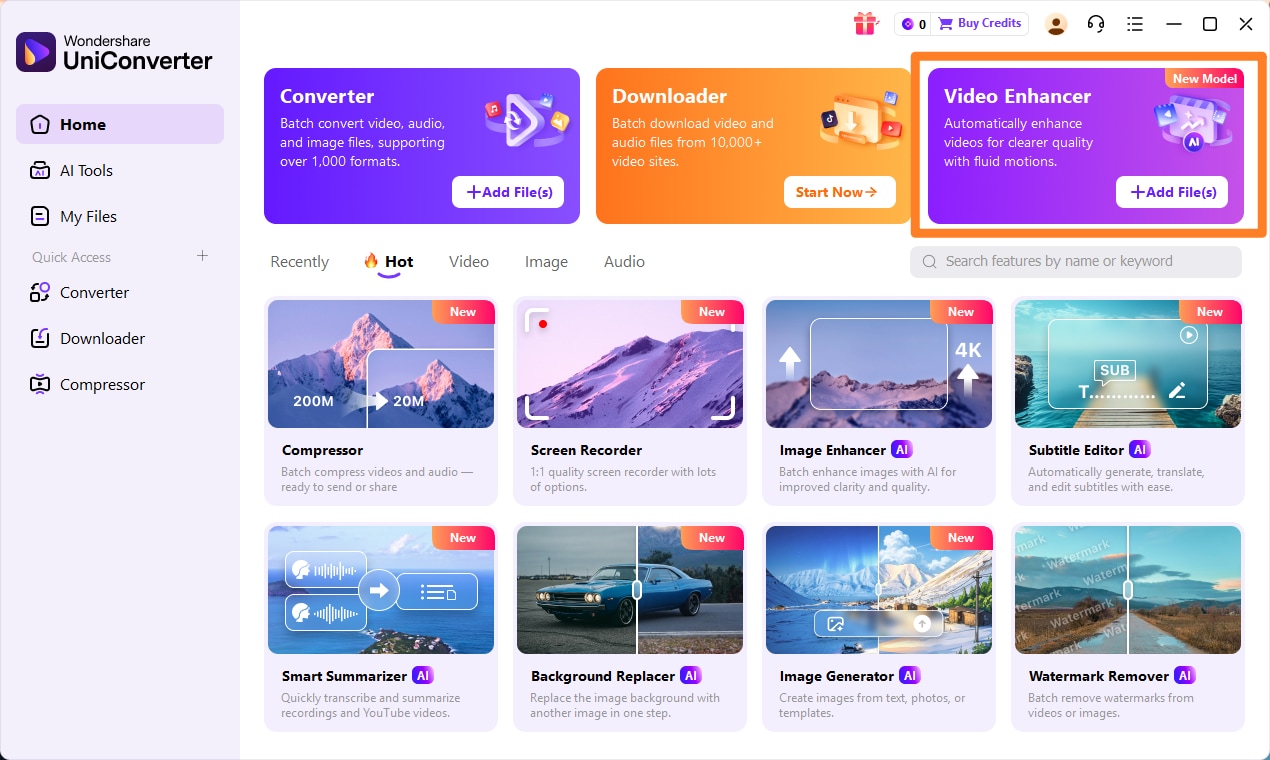
Step 1: Open UniConverter and Choose Video Enhancer
Launch Wondershare UniConverter on your computer. Navigate to the "AI Lab" section from the left sidebar and select the "Video Enhancer" tool.
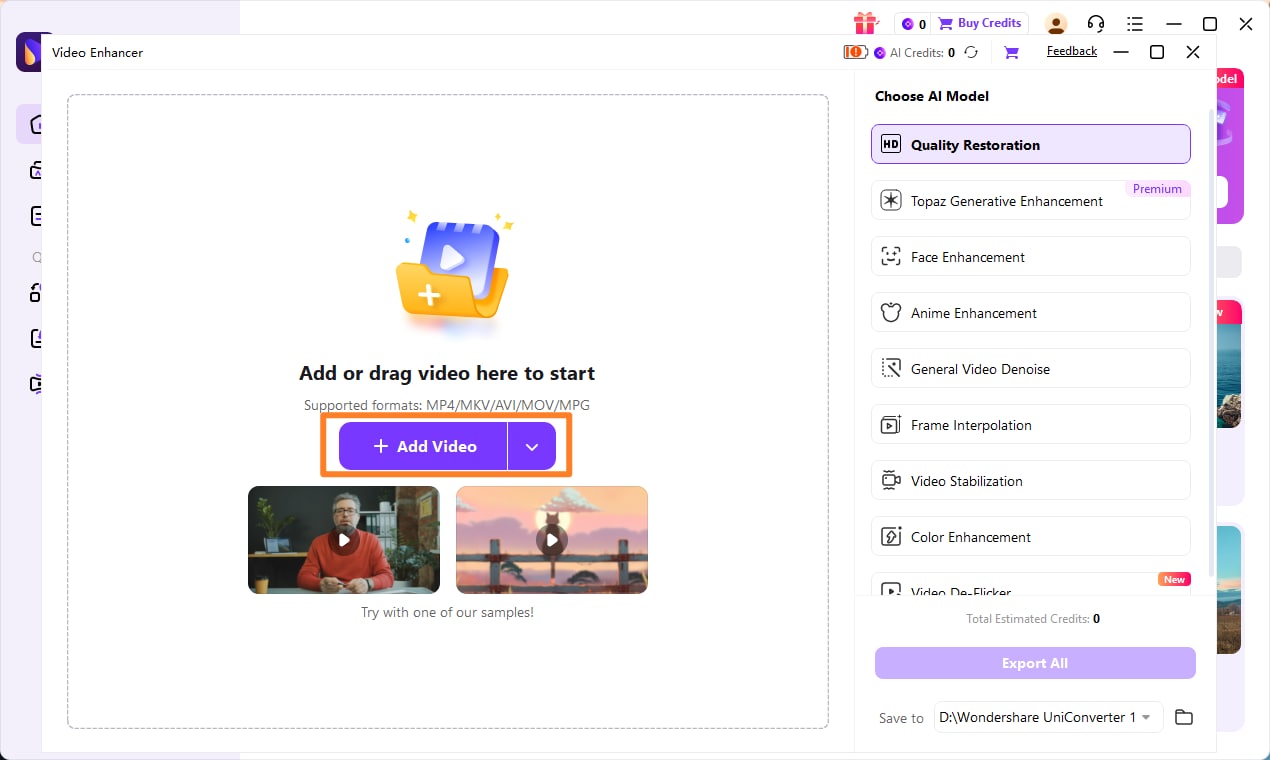
Step 2: Upload the Videos
Click on the "Add Files" button or drag and drop your video files into the UniConverter interface. You can add multiple videos for batch enhancement.
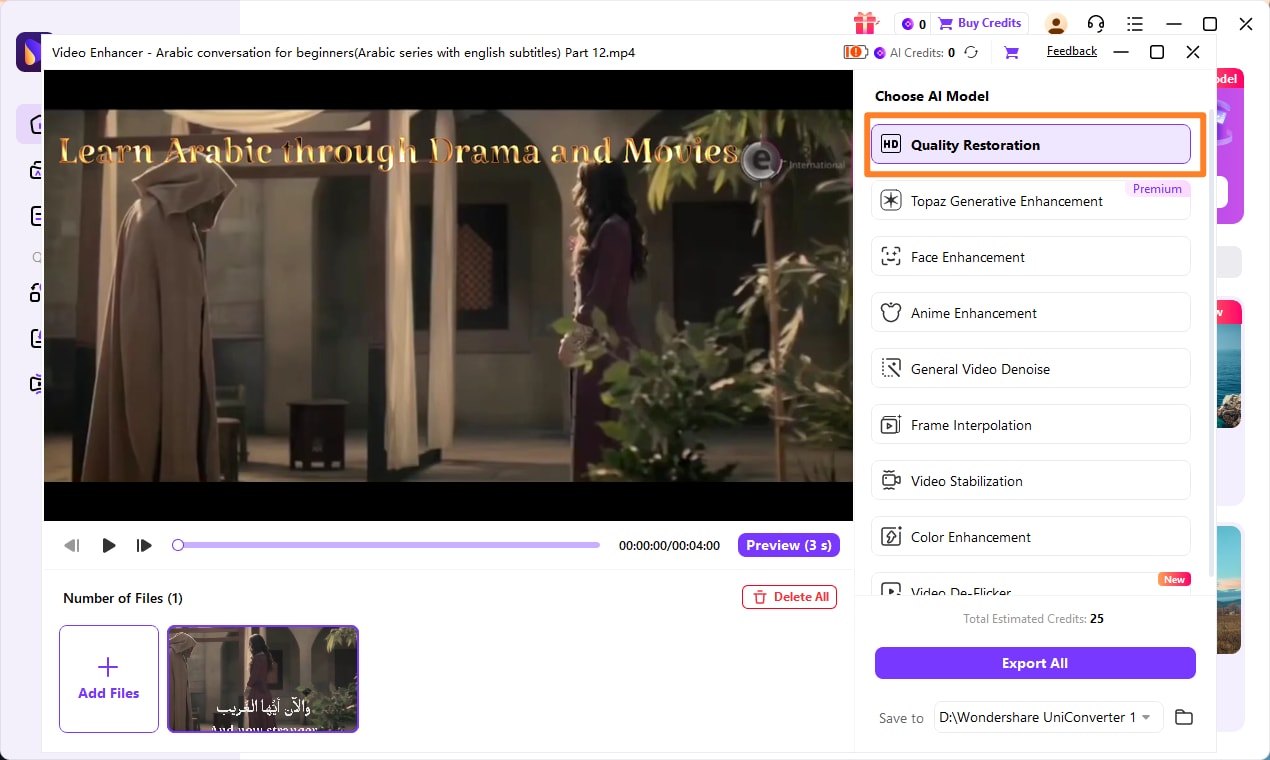
Step 3: Choose Enhancement Model
Once your videos are loaded, select the desired enhancement options. UniConverter offers various AI models for upscaling, denoising, and other improvements. Choose the resolution you want to upscale to (e.g., 1080p, 4K) and any other enhancement features. For instance, you might want to remove background without losing quality or utilize a high-definition background remover to refine your footage. You can also explore options to change video background or use the background replacer feature for creative edits.
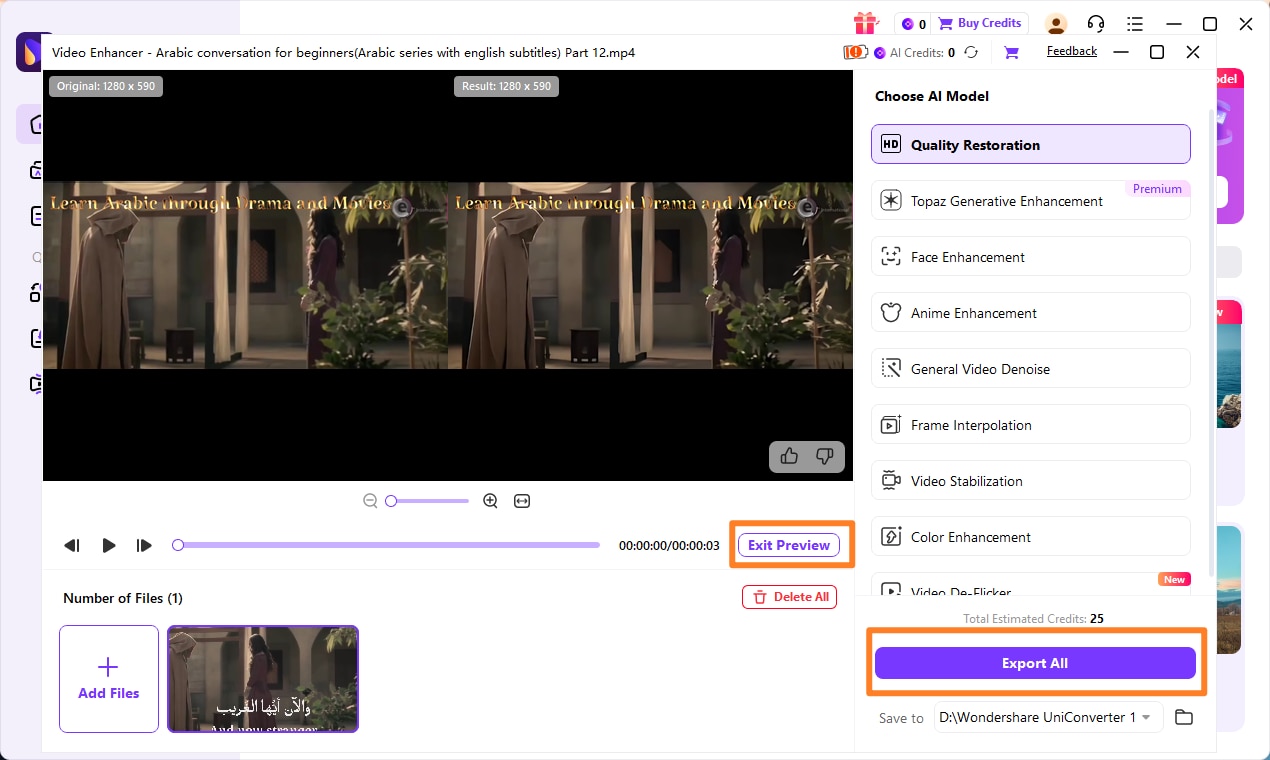
Step 4: Preview and Save the Enhanced Video
After configuring the settings, you can preview a short segment of the enhanced video to check the quality. Once satisfied, click the "Export" button to save your enhanced video to your desired output folder.

ESRGAN GUI Video Enhancer Alternative?
Part 7: Conclusion
The ESRGAN GUI Video Enhancer review highlights its significant value as a free, open-source tool for AI-powered video upscaling, particularly for users seeking a user-friendly interface for specific enhancement tasks. Its ability to revitalize archival footage makes it an excellent choice for documentary filmmakers and content creators on a budget. However, its resource-intensive nature and limited customization options mean it may not suit all users. For professionals requiring integrated workflows and extensive features, paid alternatives like Topaz Video AI or DaVinci Resolve offer more comprehensive solutions. Casual users or those needing an all-in-one video toolkit will find UniConverter to be a versatile and efficient option, balancing ease of use with robust AI enhancement capabilities. Ultimately, the best choice depends on individual needs, budget, and technical proficiency.
Part 8: FAQs
-
1. What is ESRGAN GUI Video Enhancer?
ESRGAN GUI Video Enhancer is a software that uses AI (specifically the ESRGAN model) to upscale and improve the quality of low-resolution videos through a user-friendly graphical interface.
-
2. Does ESRGAN GUI work on all types of video files?
While it supports common video formats, the effectiveness of enhancement can vary depending on the original video quality and compression. Heavily compressed or extremely low-resolution videos may not see dramatic improvements.
-
3. Is a powerful GPU necessary to use ESRGAN GUI effectively?
Yes, a dedicated and powerful GPU is highly recommended for faster processing times and optimal performance, especially for higher resolutions (e.g., 4K) and longer videos. Without a strong GPU, processing can be very slow.
-
4. Can ESRGAN GUI remove noise from old videos?
While its primary function is upscaling, the enhancement process can sometimes reduce noise as a byproduct of improving overall detail. However, dedicated denoise tools, often found in more comprehensive software like Topaz Video AI or UniConverter, might offer better and more controllable results for severe noise.
-
5. Are there any free alternatives to ESRGAN GUI for video enhancement?
While ESRGAN GUI itself is often free and open-source, other free alternatives might exist, though they may vary significantly in features, ease of use, AI model quality, and hardware requirements. Command-line versions of other AI upscaling models are also free but require technical expertise.
