
- Value: EnhanceFox excels at quick, AI-powered photo restoration, especially for old family photos and social media.
- Comparison: It offers simplicity over control, contrasting with professional tools like Topaz Photo AI or UniConverter's comprehensive features.
- Decision: Choose EnhanceFox for ease and speed; opt for UniConverter for batch processing, stability, and greater control.
- Risks: Be aware of data privacy, intrusive ads in the free version, and potential for artificial-looking results with EnhanceFox.
- UniConverter: A robust desktop alternative offering comprehensive, stable, and ad-free image enhancement with GPU acceleration.
In this article
- Part 1: What is EnhanceFox Image Enhancer?
- Part 2: EnhanceFox: Core Features, Pros, and Cons
- Part 3: EnhanceFox: Ideal Users and Use Cases
- Part 4: EnhanceFox and Alternatives: A Head-to-Head Comparison
- Part 5: Risks and Pitfalls to Consider
- Part 6: How to Use UniConverter for Comprehensive Image Enhancement
- Part 7: Conclusion
- Part 8: FAQs
When I first stumbled upon EnhanceFox image enhancer, I was intrigued by the promise of AI-powered image restoration, especially for those faded memories captured in old photographs. In this EnhanceFox image enhancer review, I’ll share my hands-on experience, comparing it with other tools I’ve used. We’ll dive into its features, pinpoint its strengths and weaknesses, and explore scenarios where it truly shines—or falls short. My goal is to help you decide if EnhanceFox is the right fit for your image enhancement needs, or if another solution might serve you better.
Part 1: What is EnhanceFox Image Enhancer?
EnhanceFox image enhancer positions itself as an AI-driven solution designed to breathe new life into your digital images, particularly those suffering from age, blur, or low resolution. It aims to simplify the often complex process of photo editing, making professional-grade enhancements accessible to everyone, regardless of their technical expertise. My initial impression was that it’s trying to democratize image enhancement, much like how Instagram made photo filters ubiquitous.
The Rise of AI Image Enhancement Tools
The market for AI image enhancement tools has exploded recently, driven by several key factors:
* The proliferation of digital photos: We're all snapping more pictures than ever, leading to a demand for tools that can quickly improve their quality.
* Nostalgia for physical memories: There's a growing desire to digitize and restore old family photos, preserving them for future generations.
* The limitations of smartphone cameras: Despite advancements, smartphone cameras still struggle in certain conditions, creating a need for post-processing enhancement.
* The power of AI: Artificial intelligence has reached a point where it can intelligently analyze and reconstruct image details, offering impressive results with minimal effort.
This review will tackle the core question: Does EnhanceFox truly deliver on its promise of effortless, high-quality image enhancement, especially when stacked against its competitors?
Part 2: EnhanceFox: Core Features, Pros, and Cons
EnhanceFox is built around the idea of making image enhancement as simple as possible, often with just a single tap. I’ve found its core capabilities to be quite impressive for certain tasks.
Here are the features I've used most:
* AI-powered one-tap enhancement: This is the star of the show. It analyzes your image and applies what it deems the best enhancements automatically.
* Old photo restoration: Specifically designed to fix scratches, tears, and discoloration in aged photographs.
* Colorization: Brings black and white photos to life with AI-generated colors.
* De-blurring: Aims to sharpen out-of-focus images.
* Upscaling: Increases image resolution without significant loss of quality.
Pros
* AI-powered one-tap enhancement for various image types: For quick fixes, especially on social media photos, it’s incredibly convenient.
* Specialized features for old photo restoration and colorization: This is where it truly shines for me. I’ve brought some truly faded family photos back to life.
* User-friendly interface for quick edits: The app is intuitive and easy to navigate, even for beginners.
Cons
* Limited advanced editing controls for professional users: If you're looking for granular control over curves, levels, or selective adjustments, you'll be disappointed.
* Potential for over-processing or artificial-looking results in some cases: Sometimes, the AI can be a bit too aggressive, making faces look a little too smooth or colors a bit too vibrant, losing some natural texture.
Part 3: EnhanceFox: Ideal Users and Use Cases
From my experience, EnhanceFox isn't a one-size-fits-all solution. It caters to specific needs and user types very well, while falling short for others.
Best Use Case: Revitalizing Old Family Photos for Sharing
This is, hands down, where EnhanceFox truly excels. I’ve used it to restore dozens of old, faded, and even slightly damaged family photos. The AI's ability to intelligently repair scratches, enhance facial details, and even colorize black and white images is genuinely impressive. For someone like me who wants to digitize and share these cherished memories with relatives without spending hours in Photoshop, EnhanceFox is a godsend. It makes those old sepia-toned pictures look vibrant and clear enough to post on social media or print out for a photo album. If you're just looking to spruce up your personal photo collection or prepare images for social media, it's incredibly effective.
Limited Use Case: Professional Photography Post-Processing for High-Resolution Prints
However, if you're a professional photographer or someone who demands absolute precision and control for high-resolution prints, EnhanceFox will likely leave you wanting more. I tried using it on some of my raw camera files, and while it did enhance them, the results often felt a bit artificial. The AI's automatic adjustments don't offer the nuanced control over color grading, noise reduction, or sharpening that a professional workflow requires. For large prints, any over-processing or loss of subtle detail becomes immediately apparent. It's simply not designed to replace dedicated professional editing software for critical, high-stakes image work.
Part 4: EnhanceFox and Alternatives: A Head-to-Head Comparison
When I look at EnhanceFox, I always compare it to other tools I've used. Here's how it stacks up against some popular alternatives.
| Feature/Scenario | EnhanceFox | Remini | Topaz Photo AI | UniConverter |
| Old Photo Restoration | Excellent | Excellent | Good | Good |
| Real-time Enhancement | Good | Good | Fair | Excellent |
| Batch Processing | Fair | Fair | Excellent | Excellent |
| Advanced Controls | Limited | Limited | Extensive | Moderate |
| Pricing Model | Freemium | Subscription | One-time purchase | One-time/Subscription |
Key Differentiators: Speed vs. Control, AI Accuracy vs. Manual Adjustments
From my perspective, EnhanceFox and Remini are very similar in their "one-tap" AI approach, making them great for quick fixes and social media. Remini might have a slight edge in facial enhancement, but EnhanceFox is broader in its restoration capabilities. Topaz Photo AI, on the other hand, is a beast for professionals. It offers incredible control and precision, especially for noise reduction and sharpening, but it comes with a steeper learning curve and a higher price tag. UniConverter sits somewhere in the middle; it’s surprisingly good at real-time enhancement and batch processing, offering a good balance of AI power and some adjustable parameters, making it a strong contender if you need more than just one-tap but don't want the complexity of a pro tool. For me, if speed and simplicity are paramount, EnhanceFox is great. If I need absolute control and the best possible output quality for professional work, I'd lean towards Topaz. But for a good all-rounder with strong batch capabilities, UniConverter is a solid choice.
Part 5: Risks and Pitfalls to Consider
While EnhanceFox offers some compelling features, especially for quick enhancements, I've learned that it's important to be aware of certain risks and limitations, particularly when using the free version or relying heavily on cloud-based processing.
Data Privacy Concerns with Cloud Processing
Like many AI enhancement tools, EnhanceFox often processes images in the cloud. This means your photos are uploaded to their servers. For casual photos, this might not be a big deal, but if you're uploading sensitive or personal images, you really need to read their privacy policy carefully. I always worry about where my data goes and how long it's stored, especially with tools that don't offer an offline processing option. It’s a trade-off between convenience and privacy that I constantly weigh.
Intrusive Advertisements in the Free Version
The free version of EnhanceFox, while functional, can be quite aggressive with ads. I've found myself constantly closing pop-ups or watching video ads just to process a few images. It significantly disrupts the workflow and can make the experience frustrating. It's a common tactic for freemium apps, but it definitely impacts the user experience, making me consider if the time saved on editing is lost to ad-watching.
Potential for Loss of Original Image Quality
When you enhance an image with AI, especially if it's heavily compressed or low-resolution to begin with, there's always a risk of introducing artifacts or making the image look unnatural. I've seen instances where EnhanceFox over-smoothes skin or creates a "plastic" look, or where fine details are lost in the AI's attempt to reconstruct them. It's not a true restoration of lost data, but an intelligent interpolation, and sometimes that interpolation isn't perfect, potentially degrading the artistic intent or authenticity of the original.
Subscription Model Value Proposition
EnhanceFox operates on a freemium model, meaning the best features are locked behind a subscription. While this is standard, I always evaluate if the subscription cost truly justifies the features offered, especially when compared to competitors. For me, if I'm only using it occasionally for old photos, the monthly cost might feel steep. If I were doing it frequently, I'd compare it closely with other subscription services or one-time purchase options that might offer more comprehensive tools for a similar or better value.
Over-reliance on AI for Critical Image Details
My biggest concern with any AI-only tool is the over-reliance on its algorithms for critical image details. If you're working on an image where accuracy and subtle nuances are paramount – say, for historical documentation or artistic expression – letting an AI make all the decisions can be risky. There's no manual override for specific areas, and what the AI deems "enhanced" might not align with your artistic vision or the true nature of the original image. It's a tool for convenience, not for absolute creative control.
Part 6: How to Use UniConverter for Comprehensive Image Enhancement
Sometimes, when I find that tools like EnhanceFox don't quite hit the mark – perhaps they lack batch processing, the enhancement isn't stable, or the effects are too subtle – I turn to UniConverter. It's a robust desktop solution that avoids many of the pitfalls of cloud-based or ad-heavy apps, offering a more stable and comprehensive enhancement experience. It’s my go-to for a more reliable, ad-free, and often faster enhancement process, especially when dealing with multiple images or needing more control. UniConverter excels with its GPU acceleration, ensuring quick processing, and its ability to handle various formats without quality loss. It’s truly an all-in-one solution for video, audio, and image needs, offering powerful batch enhancement capabilities that many other tools simply can't match. For instance, it can effectively fix pixelated videos and even upscale images to 4K.
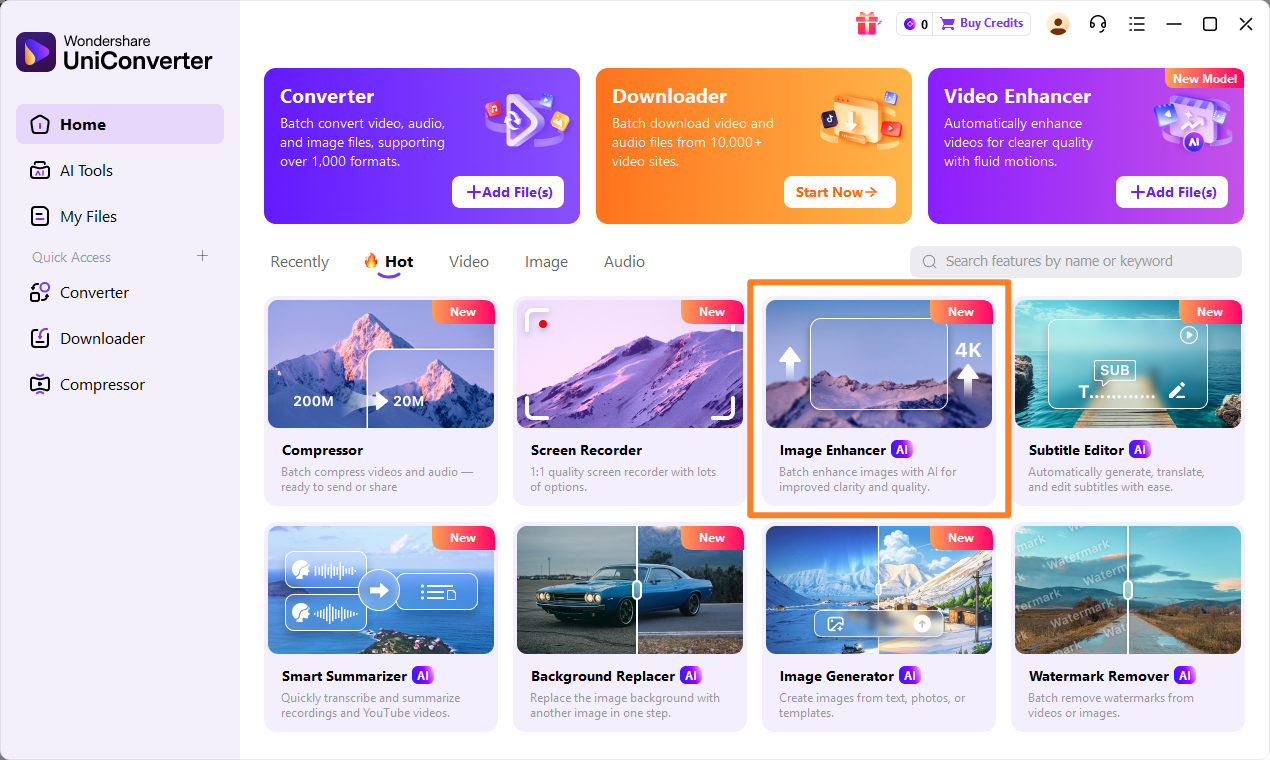
Step 1: Open UniConverter and Choose Image Enhancer
Launch UniConverter on your computer. On the main interface, navigate to the "AI Lab" section and select the "Image Enhancer" tool.
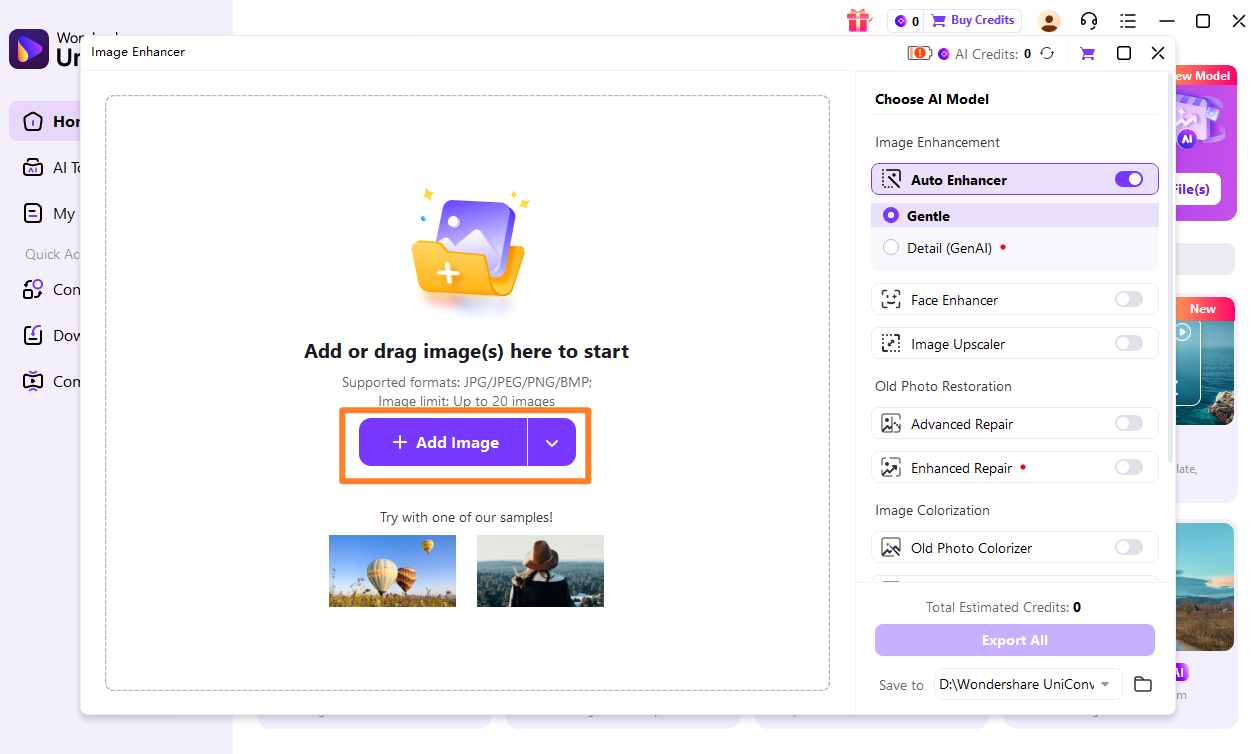
Step 2: Upload the Images
Click on the "Add Files" button or drag and drop the images you wish to enhance into the UniConverter window. You can add multiple images for batch processing.
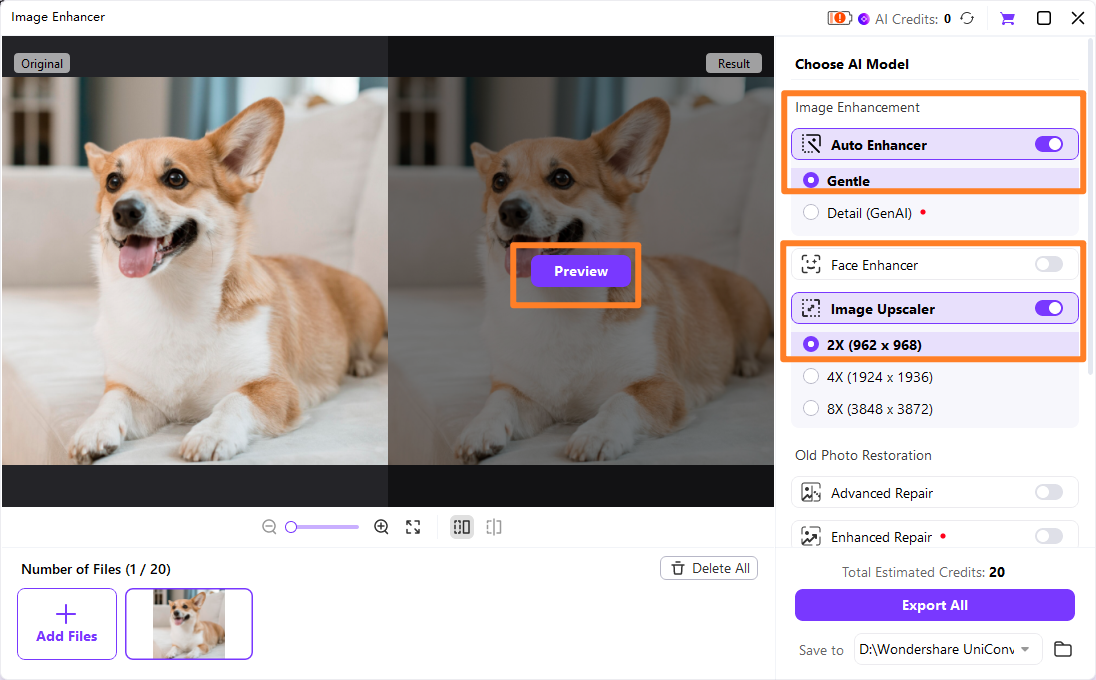
Step 3: Choose Enhancement Model
UniConverter offers various AI enhancement models. Select the one that best suits your image type and desired outcome (e.g., general enhancement, portrait enhancement, or old photo restoration). You can also adjust parameters like resolution and quality.
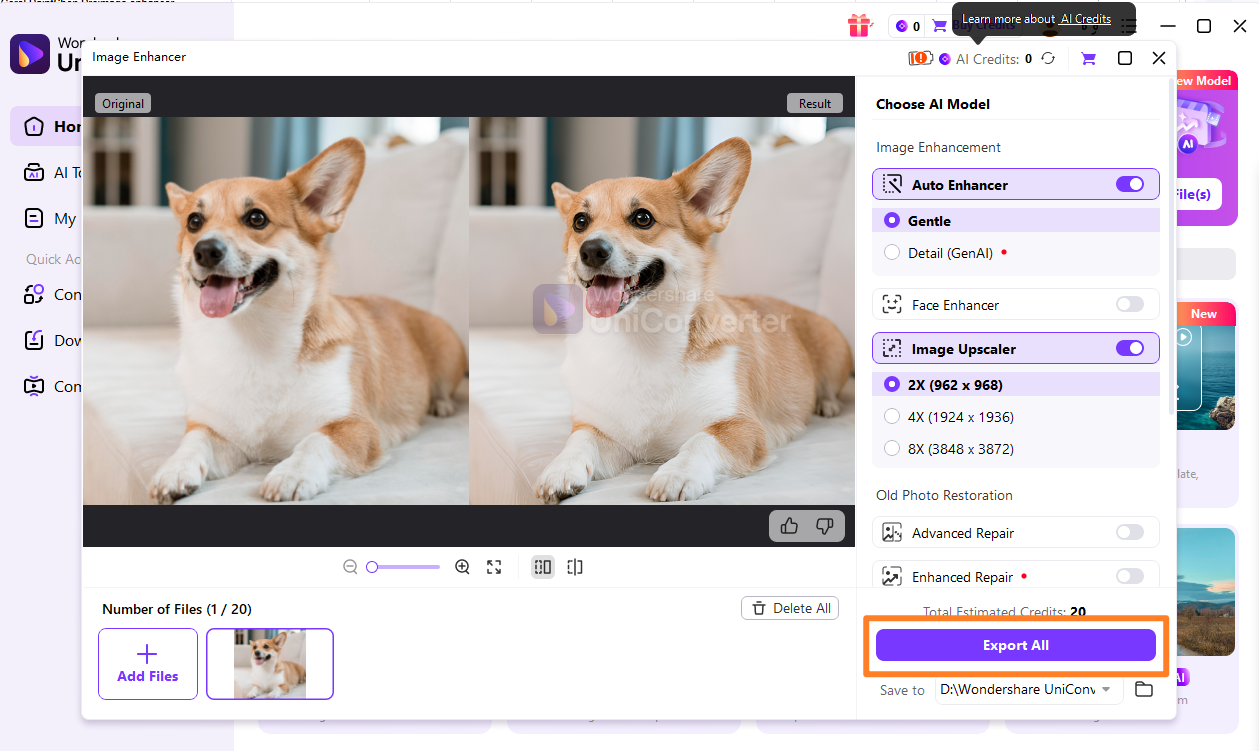
Step 4: Preview and Save the Enhanced Images
After applying the enhancement, UniConverter will provide a preview of the improved image. Once satisfied, choose your desired output format and destination folder, then click "Export" to save your enhanced images.

Seeking an EnhancFox Image Enhancer Alternative?
Part 7: Conclusion
After spending considerable time with EnhanceFox image enhancer review and comparing it against its peers, my final verdict is that it's a fantastic tool for specific use cases. If you're a casual user, a social media enthusiast, or someone looking to quickly restore cherished old family photos without diving into complex editing software, EnhanceFox will serve you exceptionally well. Its one-tap AI enhancement and specialized restoration features are genuinely impressive for these scenarios. However, for professional photographers or those who demand granular control, precise adjustments, and consistent high-quality output for large prints, its limitations in advanced editing and potential for over-processing become apparent. For those needing a more comprehensive, stable, and ad-free solution with robust batch processing capabilities, especially when dealing with critical image details or a large volume of photos, a desktop application like UniConverter offers a more balanced and powerful alternative. Ultimately, your choice should align with your specific needs, technical comfort, and the importance of creative control versus quick, AI-driven convenience.
Part 8: FAQs
-
1. Is EnhanceFox completely free to use?
EnhanceFox offers a freemium model with limited features; full access requires a subscription.
-
2. Can EnhanceFox improve the resolution of blurry photos significantly?
While EnhanceFox can enhance details, severely blurry photos may not achieve perfect clarity. It works best on moderately blurry images.
-
3. How does EnhanceFox handle privacy of uploaded images?
EnhanceFox's privacy policy outlines data handling, typically involving temporary storage for processing. It's always wise to review their policy for the most up-to-date information.
-
4. Are there any offline image enhancement tools similar to EnhanceFox?
Yes, some desktop software like UniConverter offers offline image enhancement capabilities, providing more control and often faster processing without cloud dependency.
-
5. What's the main difference between EnhanceFox and professional photo editing software?
EnhanceFox focuses on AI-powered quick enhancements and ease of use, while professional software like Adobe Photoshop or Lightroom provides extensive manual control, advanced editing tools, and non-destructive workflows for precise, high-quality results.
