
- DeepAI Overview: DeepAI Video Enhancer is an online, AI-powered tool for upscaling and enhancing video quality, ideal for non-technical users.
- Core Features: Offers AI upscaling, noise reduction, and basic color correction via a user-friendly, cloud-based interface.
- Pros & Cons: User-friendly for quick enhancements and batch processing, but lacks customization and may produce "AI artifacts."
- Ideal Use Cases: Best for revitalizing old family videos; unsuitable for professional film restoration requiring granular control.
- Comparison: DeepAI excels in ease of use but is outmatched by UniConverter, Topaz Video AI, and HitPaw in customization, output formats, and offline processing.
- Risks: Cloud-based processing raises data privacy concerns; potential for unnatural results and hidden subscription costs.
- UniConverter Alternative: UniConverter offers a robust, all-in-one solution with GPU acceleration, extensive format support, and stable, lossless enhancement.
- Final Verdict: DeepAI is good for quick, simple enhancements; for demanding needs, consider more comprehensive tools like UniConverter.
In this article
- Part 1: What is DeepAI Video Enhancer?
- Part 2: DeepAI Video Enhancer: Core Features, Pros, and Cons
- Part 3: DeepAI Video Enhancer: Ideal Users and Use Cases
- Part 4: DeepAI Video Enhancer and Alternatives Comparison
- Part 5: Risks and Pitfalls to Consider
- Part 6: How to Use UniConverter for Efficient Video Enhancement
- Part 7: Final Verdict and Recommendations
- Part 8: FAQs
The digital age has brought an explosion of video content, yet much of it remains trapped in lower resolutions or suffers from quality degradation over time. This is where AI video enhancement tools step in, promising to breathe new life into old footage. This DeepAI Video Enhancer review will delve into one such tool, examining its features, performance, and suitability for various users. We will provide a comprehensive comparison with leading alternatives, helping you understand its position in the market and whether it aligns with your specific video enhancement needs.
Part 1: What is DeepAI Video Enhancer?
DeepAI Video Enhancer is an online, AI-powered tool designed to improve the quality of video footage. Leveraging advanced artificial intelligence algorithms, it aims to upscale resolution, reduce noise, and enhance details, effectively transforming lower-quality videos into clearer, more vibrant productions. The platform positions itself as an accessible solution for individuals and small businesses looking to revitalize their video assets without requiring extensive technical expertise or expensive software. This review will critically assess its capabilities, ease of use, and overall value proposition in the crowded market of AI video enhancement.
The Rise of AI Video Enhancement Tools
The demand for high-quality video content continues to surge, driven by social media, professional presentations, and personal archiving. However, a vast amount of existing footage, from old home videos to historical archives, often falls short of modern visual standards. This gap has fueled the rapid development and adoption of AI video enhancement tools, which address several key pain points:
* Preserving Legacy Content: Many users want to restore and share old videos that hold sentimental or historical value.
* Meeting Modern Display Standards: With the prevalence of 4K and even 8K displays, lower-resolution videos appear pixelated and unappealing.
* Simplifying Complex Processes: Traditional video enhancement often requires specialized software and skills, which AI tools aim to democratize.
* Cost-Effectiveness: AI-powered online tools can offer a more affordable alternative to professional video restoration services.
Part 2: DeepAI Video Enhancer: Core Features, Pros, and Cons
DeepAI Video Enhancer provides a straightforward approach to improving video quality, focusing on accessibility and AI-driven automation. Its core capabilities revolve around upscaling and general enhancement, making it suitable for users who need quick and effective solutions. The tool primarily operates through a web interface, allowing users to upload their videos and receive enhanced versions.
Core Features:
* AI-powered Upscaling: Utilizes deep learning models to increase video resolution.
* Noise Reduction: Automatically identifies and minimizes visual noise in footage.
* Detail Enhancement: Aims to sharpen edges and bring out finer details.
* Color Correction (Basic): Offers some level of automatic color adjustment.
* Cloud-based Processing: All enhancements are handled on DeepAI's servers.
Pros:
* AI-powered Upscaling for Older Footage: Excels at improving the resolution and clarity of vintage or low-resolution videos.
* User-Friendly Interface for Quick Enhancements: The web-based platform is intuitive, making it easy for beginners to navigate and use.
* Batch Processing for Multiple Videos: Allows users to upload and enhance several videos simultaneously, saving time.
Cons:
* Limited Customization Options for Advanced Users: Lacks granular controls over enhancement parameters, which professional users might require.
* Potential for "AI Artifacts" in Complex Scenes: In some cases, the AI might introduce unnatural textures or distortions, especially in fast-moving or highly detailed areas.
Part 3: DeepAI Video Enhancer: Ideal Users and Use Cases
DeepAI Video Enhancer is best suited for individuals and small content creators who prioritize ease of use and quick results over extensive customization. Its AI-driven approach makes it an excellent choice for non-technical users looking to improve their video quality without a steep learning curve or significant investment in professional software.
Best Use Case: Revitalizing Archival Family Videos
Imagine you have a collection of old family videos shot on camcorders decades ago. These videos are often low-resolution, grainy, and faded, making them difficult to watch on modern high-definition screens. DeepAI Video Enhancer can be a game-changer here. Its AI upscaling and noise reduction capabilities can significantly improve the visual quality, making these cherished memories clearer, more vibrant, and enjoyable to share with family and friends. The batch processing feature is particularly useful for handling multiple short clips from the same event.
Limited Use Case: Professional Film Restoration Projects
While DeepAI Video Enhancer can improve general video quality, it falls short for professional film restoration projects. These projects often require highly specialized tools for frame-by-frame color grading, advanced artifact removal (e.g., dust, scratches, film grain management), precise stabilization, and intricate detail recovery that goes beyond simple upscaling. Professionals in this field need extensive control over every parameter and often work with raw or uncompressed footage, which DeepAI's simplified interface and cloud-based processing are not designed to accommodate. The potential for AI artifacts could also be detrimental in a professional context where absolute fidelity to the original is paramount.
Part 4: DeepAI Video Enhancer and Alternatives Comparison
When evaluating video enhancement tools, it's crucial to compare their strengths and weaknesses across key performance indicators. Here's a comparison of DeepAI Video Enhancer with some prominent alternatives: UniConverter, Topaz Video AI, and HitPaw Video Enhancer.
| Feature/Tool | DeepAI Video Enhancer | UniConverter | Topaz Video AI | HitPaw Video Enhancer |
| AI Upscaling Quality | Good | Excellent | Superior | Very Good |
| Ease of Use | High | High | Medium | Medium |
| Customization | Low | Medium | High | Medium |
| Price | Moderate | Moderate | High | Moderate |
| Processing Speed | Moderate | Fast | Moderate | Fast |
| Output Formats | Limited | Extensive | Extensive | Extensive |
| Offline Processing | No | Yes | Yes | Yes |
| Customer Support | Basic | Excellent | Good | Good |
Key Differentiators: DeepAI's Strengths and Weaknesses Against the Competition
DeepAI Video Enhancer stands out for its extreme ease of use and accessibility, making it a great entry point for casual users. Its entirely cloud-based nature means no software installation is required. However, this also limits its customization options and offline capabilities.
UniConverter offers a strong balance of quality, ease of use, and a broader feature set, including extensive format support and offline processing, making it a versatile choice for many users.
Topaz Video AI is a powerhouse for professional-grade enhancement, offering unparalleled AI upscaling quality and extensive customization. Its higher price point and steeper learning curve reflect its advanced capabilities.
HitPaw Video Enhancer provides a good middle ground, delivering very good AI quality with a user-friendly interface and decent customization, often at a competitive price.
For users prioritizing simplicity and quick online enhancements, DeepAI is a viable option. However, for those needing more control, offline processing, or superior output quality, UniConverter, Topaz Video AI, or HitPaw Video Enhancer would be more suitable.
Part 5: Risks and Pitfalls to Consider
While AI video enhancement tools offer compelling advantages, users of DeepAI Video Enhancer, particularly those relying on its cloud-based services, should be aware of several potential risks and pitfalls. Understanding these can help set realistic expectations and inform better decision-making.
Data Privacy Concerns with Cloud-Based Processing
As a cloud-based service, DeepAI Video Enhancer requires users to upload their video files to its servers for processing. This raises significant data privacy concerns, especially for sensitive or personal footage. Users should carefully review DeepAI's privacy policy to understand how their data is stored, processed, and protected. There's always an inherent risk when entrusting personal data to third-party servers, including potential breaches or unauthorized access.
Potential for Over-Processed or Unnatural Results
AI enhancement, while powerful, is not foolproof. There's a risk that the algorithms might over-process certain aspects of a video, leading to unnatural or "plastic-like" appearances. This is particularly noticeable in skin textures, fine details, or complex patterns. Instead of a natural improvement, the video might end up looking artificial or distorted, losing its original character. Users should be prepared for varying results and may need to experiment with different settings or even alternative tools to achieve a desired natural look.
Subscription Model and Hidden Costs
DeepAI Video Enhancer typically operates on a subscription model, often with different tiers offering varying features and processing limits. Users might initially be drawn in by a free trial or a seemingly low entry price, only to find that the features they truly need (e.g., higher resolution output, longer video processing, faster speeds) are locked behind more expensive subscriptions. Additionally, some services might have hidden costs associated with exceeding usage limits or accessing premium features, which can quickly add up.
Output Quality Limitations for Specific Video Types
While DeepAI can generally improve video quality, its effectiveness can vary significantly depending on the original footage. Videos with extreme compression artifacts, very low original resolution, severe motion blur, or complex lighting conditions might not see dramatic improvements. In some cases, the AI might struggle to accurately reconstruct missing information, leading to artifacts or a lack of genuine detail. Users with highly degraded or specialized video types (e.g., scientific footage, forensic video) might find the output quality insufficient for their specific needs.
Part 6: How to Use UniConverter for Efficient Video Enhancement
When other tools fall short, struggling with batch processing, unstable enhancements, or weak results, UniConverter emerges as a robust solution. It bypasses common issues like intrusive ads, offers extensive format support, leverages GPU acceleration for speed, ensures stable and lossless enhancement, and excels in batch processing. UniConverter is designed as an all-in-one ultimate solution for your video needs.
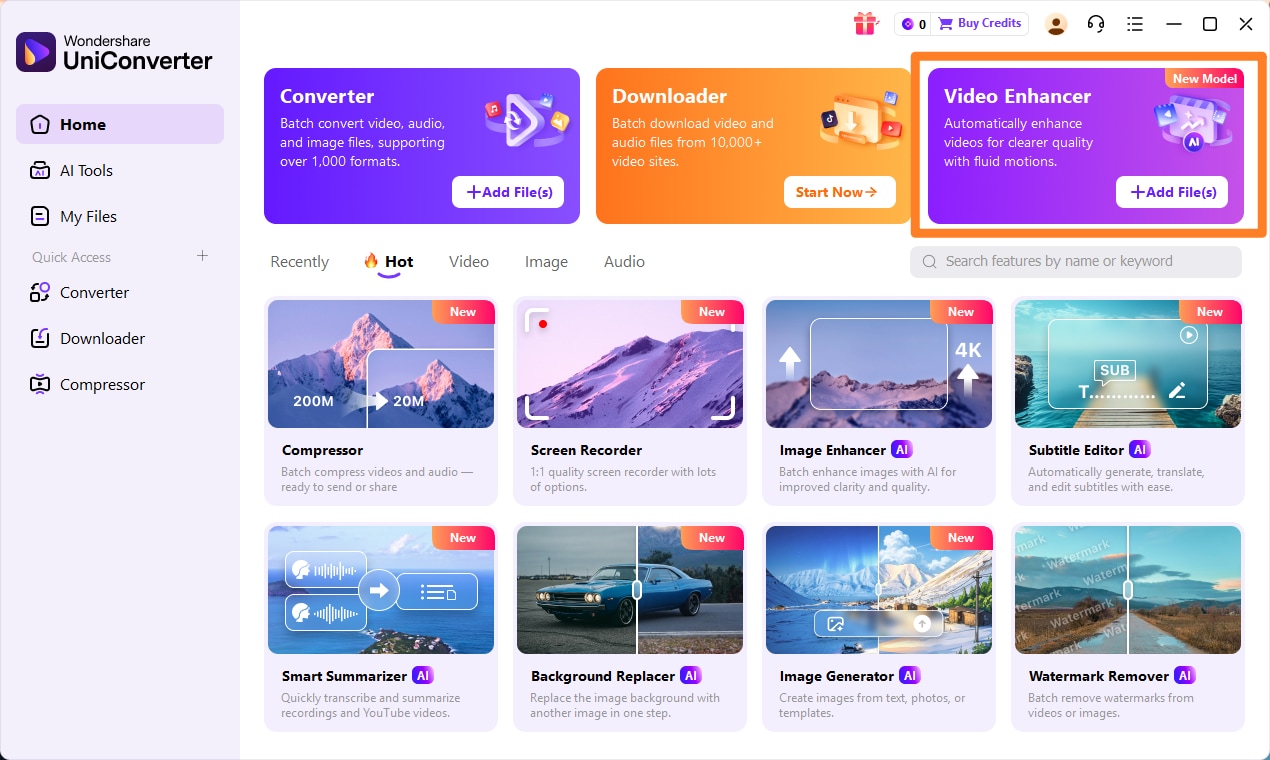
Step 1: Open UniConverter and Choose Video Enhancer
Launch UniConverter on your computer. From the main interface, navigate to the "AI Lab" section and select the Video Enhancer tool.
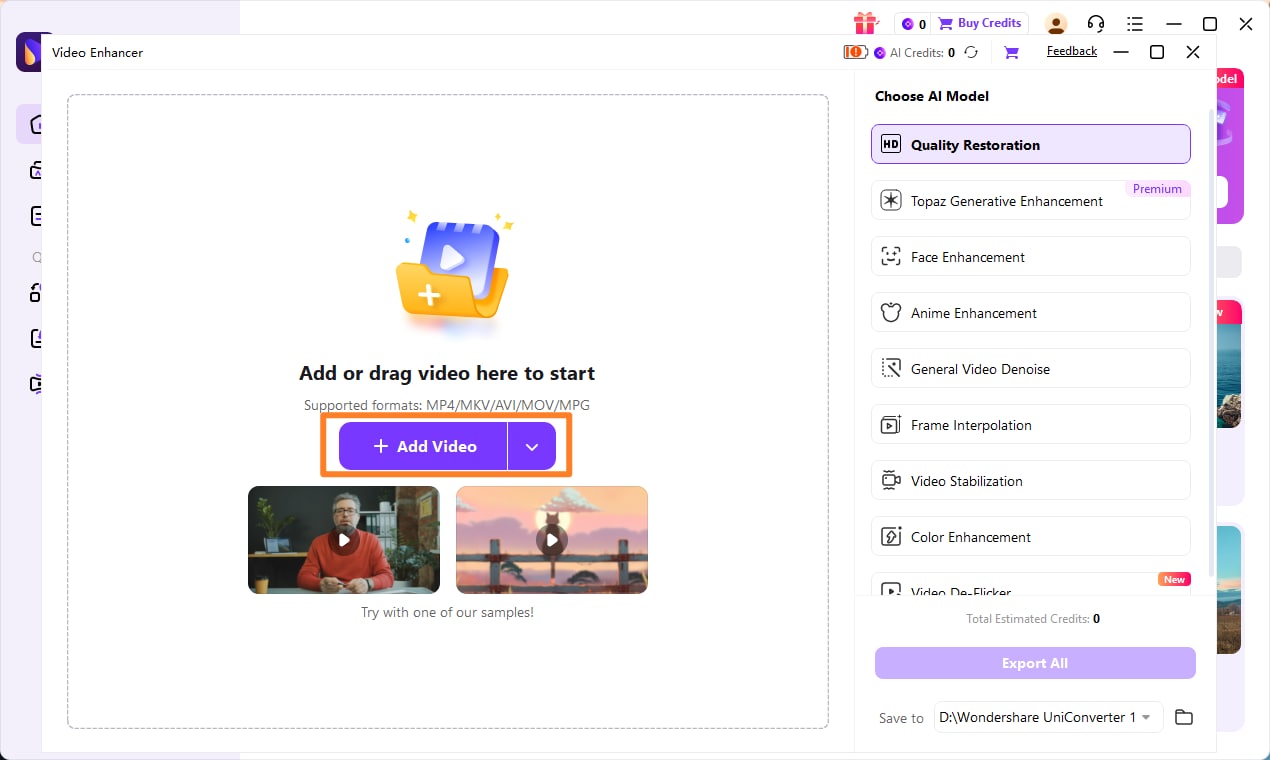
Step 2: Upload the Videos
Click on the "Add Files" button or drag and drop your video files directly into the UniConverter interface. You can upload multiple videos for batch processing.
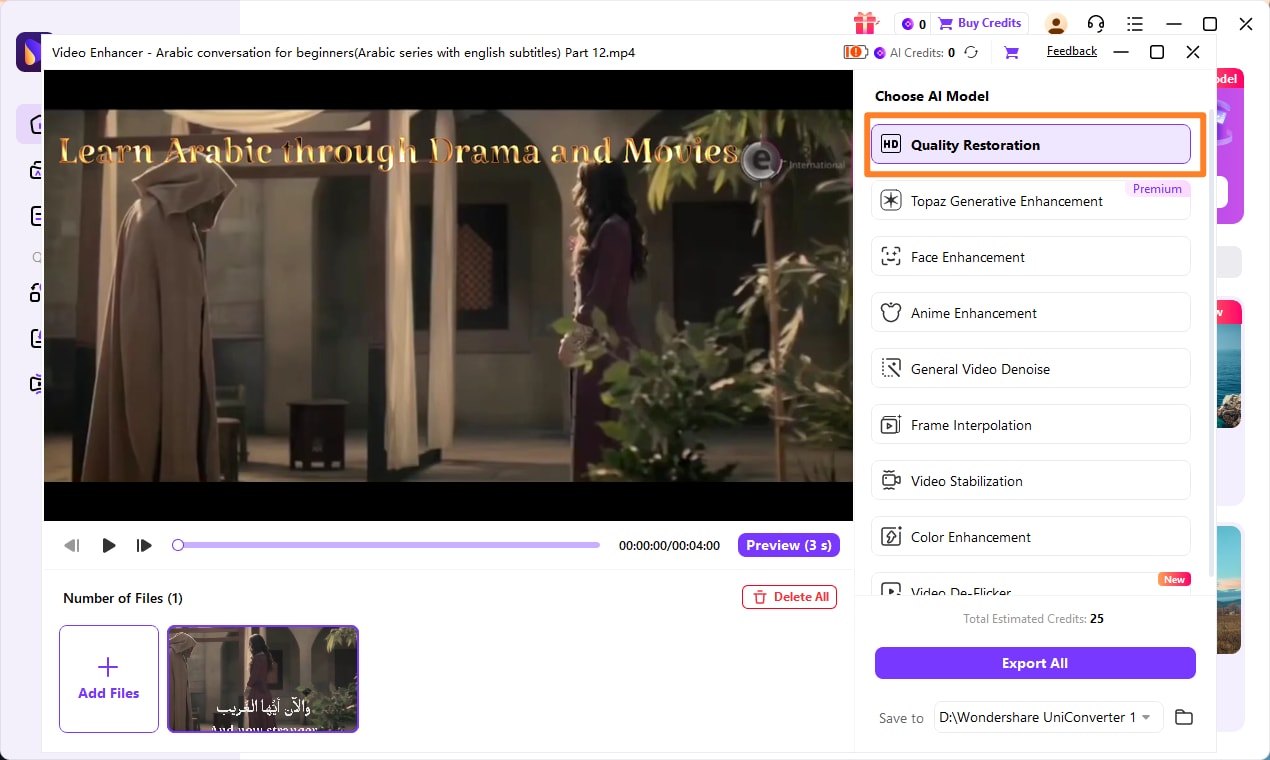
Step 3: Choose Enhancement Model
Once your videos are loaded, UniConverter will present various AI enhancement models. Select the model that best suits your needs, such as AI Upscaling for resolution improvement, "Denoise" for removing grain, or "Color Correction" for vibrancy. You can also adjust other settings like output resolution. For those looking to fix pixelated videos, this step is crucial.
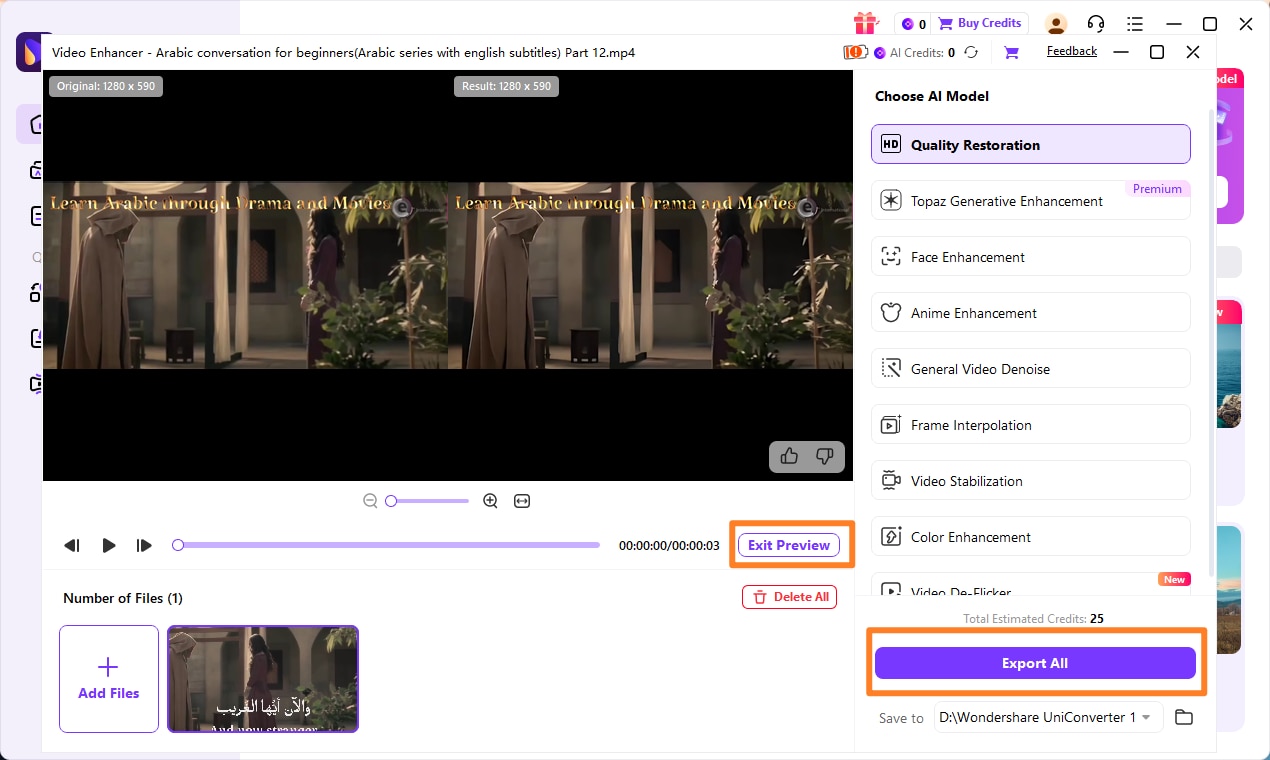
Step 4: Preview and Save the Enhanced Video
After selecting your enhancement options, click the "Preview" button to see a short clip of the enhanced result. If satisfied, choose your desired output format and destination folder, then click "Export" to save your enhanced video.

Seeking a DeepAI Video Enhancer Alternative?
Part 7: Final Verdict and Recommendations
The DeepAI Video Enhancer review reveals a tool that excels in accessibility and ease of use, making AI video enhancement available to a broader audience. Its cloud-based, AI-driven approach is particularly effective for general upscaling and noise reduction of older or lower-quality footage, such as archival family videos. However, its limitations in customization and the potential for AI artifacts mean it's not a one-size-fits-all solution. For users requiring precise control, professional-grade output, or handling highly sensitive data, alternatives like UniConverter, Topaz Video AI, or HitPaw Video Enhancer offer more robust features and offline processing capabilities. Ultimately, DeepAI Video Enhancer is a valuable tool for quick, straightforward enhancements, but users with more demanding needs should explore its more comprehensive competitors.
Part 8: FAQs
-
1. Is DeepAI Video Enhancer free to use?
DeepAI Video Enhancer typically offers a limited free trial or a freemium model with restrictions on output quality, length, or processing time. Full access to features usually requires a paid subscription.
-
2. What video formats does DeepAI Video Enhancer support?
DeepAI Video Enhancer generally supports common video formats like MP4, MOV, and AVI. However, for a comprehensive list, it's best to check their official website as supported formats can vary.
-
3. Can DeepAI Video Enhancer improve low-light footage?
Yes, DeepAI Video Enhancer can help improve low-light footage by reducing noise and enhancing overall brightness and contrast, though dramatic transformations are not always guaranteed.
-
4. How long does it take to enhance a video with DeepAI?
The enhancement time depends on several factors, including the video's length, resolution, the complexity of the chosen enhancement, and current server load. Longer and higher-resolution videos will take more time.
-
5. What is the best resolution for input videos for DeepAI Video Enhancer?
While DeepAI can work with various resolutions, inputting videos with at least 480p or 720p resolution generally yields better enhancement results compared to extremely low-resolution or heavily compressed footage.
