
- Value Proposition: CyberLink PowerDirector Video Enhancer offers AI-driven video quality improvement within the PowerDirector ecosystem, suitable for various users.
- Core Features: Key features include AI noise reduction, color correction, and video stabilization, enhancing footage efficiently.
- Target Audience: Ideal for hobbyists, social media creators, and aspiring filmmakers seeking automated video enhancements.
- Comparison Insights: While good, it faces competition from UniConverter (versatility, ease of use) and Topaz Video AI (specialized AI models).
- Potential Pitfalls: Users should be aware of over-processing risks, data privacy for cloud features, and potential hidden costs.
- UniConverter Alternative: UniConverter provides a stable, efficient, and versatile alternative for high-quality, batch video enhancement with GPU acceleration.
In this article
- Part 1: What is CyberLink PowerDirector Video Enhancer?
- Part 2: CyberLink PowerDirector Video Enhancer: Core Features, Pros, and Cons
- Part 3: Target Users and Use Cases
- Part 4: CyberLink PowerDirector Video Enhancer and Alternatives Comparison
- Part 5: Risks and Pitfalls to Consider
- Part 6: How to Use UniConverter to Efficiently Enhance Videos
- Part 7: Conclusion
- Part 8: FAQs
CyberLink PowerDirector Video Enhancer: A Comprehensive Scenario-Based Review
CyberLink PowerDirector Video Enhancer emerges as a powerful add-on within the renowned PowerDirector suite, designed to elevate video quality through advanced AI algorithms. This review delves into its capabilities, market positioning, and how it stacks up against competitors, offering a detailed analysis for potential users. We will explore its core features, ideal use cases, and potential pitfalls, ultimately guiding users toward informed decisions based on their specific needs and technical proficiency. By examining its strengths and weaknesses in various scenarios, this article aims to provide a holistic understanding of its value proposition in the dynamic video editing landscape.
Part 1: What is CyberLink PowerDirector Video Enhancer?
CyberLink PowerDirector Video Enhancer is an integrated feature within CyberLink's flagship video editing software, PowerDirector, rather than a standalone application. It leverages artificial intelligence to automatically improve video quality, addressing common issues such as noise, blur, and poor lighting. Its primary objective is to make professional-grade video enhancement accessible to a broader audience, from casual content creators to semi-professional videographers. This review aims to dissect its performance, ease of use, and overall value in the competitive market of video enhancement tools.
Market Context and User Pain Points
* Growing demand for high-quality content: Social media platforms and online video consumption drive the need for visually appealing videos.
* Challenges with imperfect footage: Many users struggle with footage shot in less-than-ideal conditions, requiring post-production enhancement.
* Complexity of traditional enhancement tools: Professional tools often have steep learning curves, deterring casual users.
* Desire for automated solutions: Users seek efficient, AI-driven solutions to save time and effort in video improvement.
Part 2: CyberLink PowerDirector Video Enhancer: Core Features, Pros, and Cons
CyberLink PowerDirector Video Enhancer is built upon a foundation of AI-driven algorithms designed to automatically detect and correct common video imperfections. Its core capabilities include sophisticated noise reduction, intelligent color correction, and robust video stabilization. These features are seamlessly integrated into the PowerDirector editing environment, allowing for a fluid workflow from raw footage to polished output. The enhancer also boasts features like de-interlacing and upscaling, making it versatile for various video sources.
Core Features
* AI-powered Noise Reduction: Effectively minimizes grain and digital noise from low-light or high-ISO footage.
* Intelligent Color Correction: Automatically adjusts white balance, exposure, and saturation for vibrant, natural-looking colors.
* Video Stabilization: Smooths out shaky footage, making handheld shots more watchable.
* De-interlacing: Converts interlaced video to progressive scan for better playback on modern displays.
* Video Upscaling: Enhances lower-resolution videos to higher definitions, improving clarity.
Pros
* Advanced AI-powered video enhancement tools (e.g., noise reduction, color correction, stabilization).
* Seamless integration with PowerDirector's editing suite for a streamlined workflow.
* User-friendly interface for both beginners and experienced editors.
Cons
* Resource-intensive, potentially slow performance on older hardware.
* Subscription-based model for full feature access can be costly.
Part 3: Target Users and Use Cases
CyberLink PowerDirector Video Enhancer caters to a broad spectrum of users, primarily those already familiar with or looking to adopt the PowerDirector ecosystem. Its intuitive design makes it accessible for hobbyists and social media creators, while its advanced AI capabilities offer tangible benefits for aspiring filmmakers and YouTubers seeking to elevate their production quality without extensive manual adjustments.
Best Use Case: Enhancing Home Videos and Vlogs for Social Media
For individuals looking to quickly improve the visual appeal of their personal videos, vlogs, or social media content, the Video Enhancer is an excellent tool. Imagine a vlogger who shot a segment in suboptimal lighting conditions; the AI-powered color correction and noise reduction can instantly transform dull, grainy footage into bright, clear, and engaging content suitable for platforms like YouTube, Instagram, or TikTok. The seamless integration within PowerDirector allows for rapid enhancement before final editing and export, saving significant time for creators who prioritize speed and quality.
Limited Use Case: Professional-Grade Film Restoration Projects
While capable of significant improvements, the CyberLink PowerDirector Video Enhancer may fall short for highly specialized, professional-grade film restoration projects. For instance, restoring severely damaged archival film footage with extensive scratches, dust, or color degradation often requires highly specialized, frame-by-frame manual intervention and dedicated restoration software. The automated nature of PowerDirector's enhancer, while powerful for general improvements, might not offer the granular control and precision needed for such intricate and historically sensitive tasks, where every detail matters.
Part 4: CyberLink PowerDirector Video Enhancer and Alternatives Comparison
Choosing the right video enhancement tool depends on a balance of performance, ease of use, and cost. Here's how CyberLink PowerDirector Video Enhancer stacks up against some notable alternatives.
| Feature / Product | CyberLink PowerDirector Video Enhancer | UniConverter | Topaz Video AI | DaVinci Resolve (with Studio) |
| Processing Speed | Moderate (GPU dependent) | Fast (GPU accelerated) | Very Fast (Highly optimized AI) | Moderate to Fast (Highly optimized) |
| Output Quality | Good (AI-driven improvements) | Excellent (AI upscaling, noise reduction) | Superior (Dedicated AI models) | Excellent (Professional-grade tools) |
| Ease of Use | High (Integrated, intuitive) | Very High (Simple, clear interface) | Moderate (Specific AI models) | Low (Steep learning curve) |
| Customer Support | Good (Online resources, tickets) | Excellent (24/7 support, extensive guides) | Good (Forum, email support) | Moderate (Community-driven, limited direct) |
| Security | Standard (Local processing) | High (Offline processing, secure) | High (Local processing) | High (Local processing) |
| Pricing Model | Subscription (PowerDirector suite) | One-time purchase / Subscription | One-time purchase | Free (Basic), One-time purchase (Studio) |
CyberLink PowerDirector Video Enhancer offers a balanced approach, providing solid AI enhancements within a user-friendly editing environment. UniConverter excels in its all-in-one functionality and ease of use, making it ideal for quick, high-quality enhancements and conversions. Topaz Video AI stands out for its specialized, cutting-edge AI models, delivering superior upscaling and de-noising, albeit with a steeper learning curve for its specific features. DaVinci Resolve, particularly the Studio version, offers an unparalleled professional suite for color grading and advanced editing, but its complexity makes it less suitable for casual users solely focused on enhancement.
Part 5: Risks and Pitfalls to Consider
When utilizing video enhancement tools, especially those leveraging AI, users should be aware of several potential risks and pitfalls that can impact the final output and overall experience. Understanding these can help in making informed decisions and managing expectations.
Potential for Over-Processing and Unnatural Results
One of the most significant risks with AI-powered enhancement is the tendency to over-process footage. While the goal is to improve quality, aggressive application of noise reduction, sharpening, or color correction can lead to an artificial, "plastic" look. Details might be smoothed away, colors could become oversaturated, or edges might appear unnaturally sharp, detracting from the original aesthetic and making the video look less authentic. This is particularly true for tools that offer limited manual control over the intensity of their AI algorithms.
Data Privacy Concerns with Cloud-Based AI Features
For tools that rely on cloud-based AI processing, data privacy becomes a critical concern. Uploading sensitive or personal video footage to external servers for enhancement raises questions about how that data is stored, processed, and secured. Users should always review the service's privacy policy to understand their data handling practices, especially if the footage contains identifiable individuals or proprietary information. Opting for desktop-based solutions can mitigate this risk.
Compatibility Issues with Certain Video Formats
Despite claims of broad format support, users might encounter compatibility issues with less common or legacy video formats. This can lead to conversion errors, incomplete processing, or the inability to import footage altogether. Before committing to a specific enhancer, it's crucial to test it with a variety of your typical video file types to ensure seamless integration into your workflow.
Hidden Costs Beyond Initial Subscription
While some products offer a clear subscription model, users should be wary of hidden costs. This could include additional charges for premium AI models, faster processing speeds, increased cloud storage, or even separate purchases for specific enhancement features that are not included in the base subscription. Always read the fine print and understand what features are truly covered by your initial payment.
Learning Curve for Advanced Features
Even with user-friendly interfaces, unlocking the full potential of advanced video enhancement features often involves a learning curve. Achieving optimal results may require understanding various parameters, experimenting with different settings, and grasping the nuances of each AI model. Users expecting instant, perfect results without any effort might find themselves frustrated by the need for deeper engagement to master the tool.
Part 6: How to Use UniConverter to Efficiently Enhance Videos
When other tools fall short in terms of batch processing, stability, or the effectiveness of their enhancement algorithms, UniConverter emerges as a robust alternative. It addresses common pain points by offering a stable, ad-free environment with extensive format support, GPU acceleration for faster processing, and lossless quality enhancement. UniConverter is designed as an all-in-one solution, capable of handling various video tasks beyond just enhancement, making it a versatile tool for any content creator. It ensures your enhanced videos retain their original quality while benefiting from advanced AI improvements, providing a seamless and efficient workflow. For those looking to upscale video or fix pixelated videos, UniConverter provides powerful AI video enhancement capabilities.
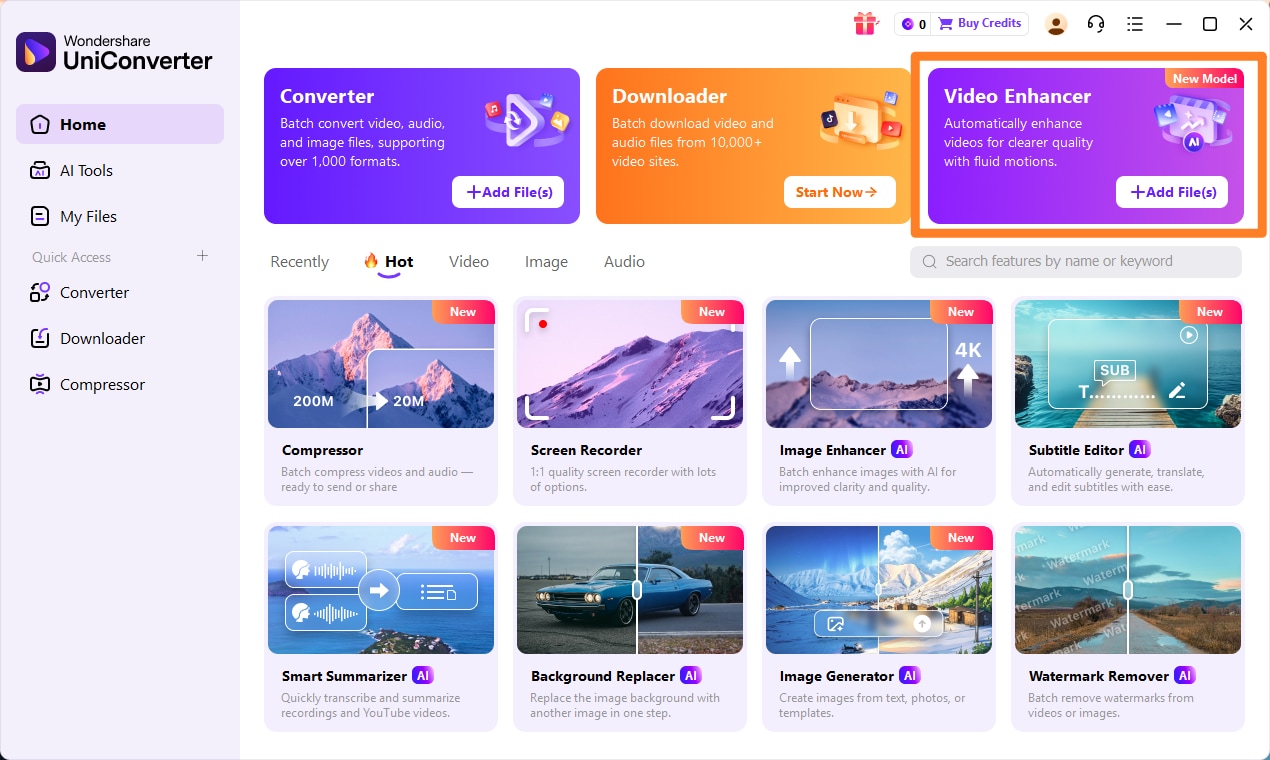
Step 1: Open UniConverter and Choose Video Enhancer
Launch UniConverter on your computer. From the main interface, navigate to the "AI Lab" section and select the "Video Enhancer" tool.
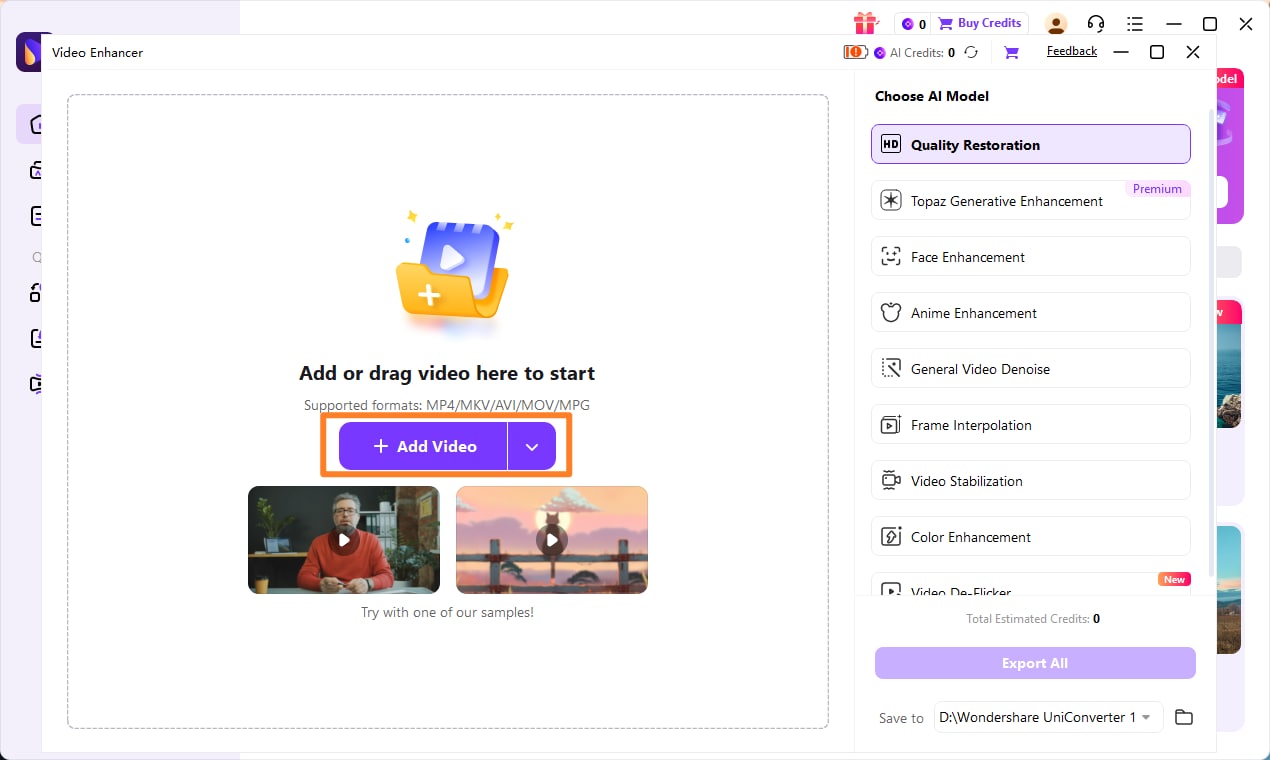
Step 2: Upload the Videos
Click on the "Add Files" button or drag and drop your video files directly into the UniConverter interface. You can add multiple videos for batch processing.
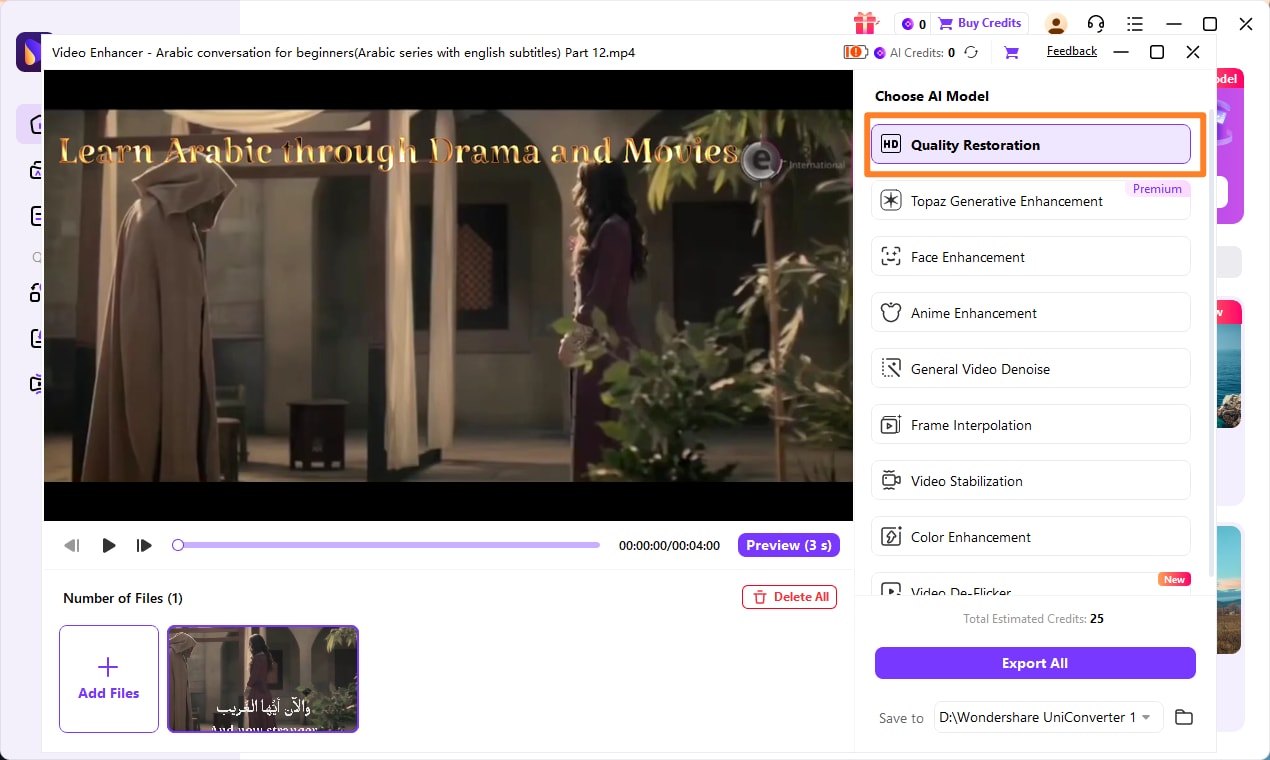
Step 3: Choose Enhancement Model
Once your video is loaded, select the desired enhancement model from the available options (e.g., AI Upscale, AI Denoise, AI Color Correction). Adjust any specific parameters if needed.
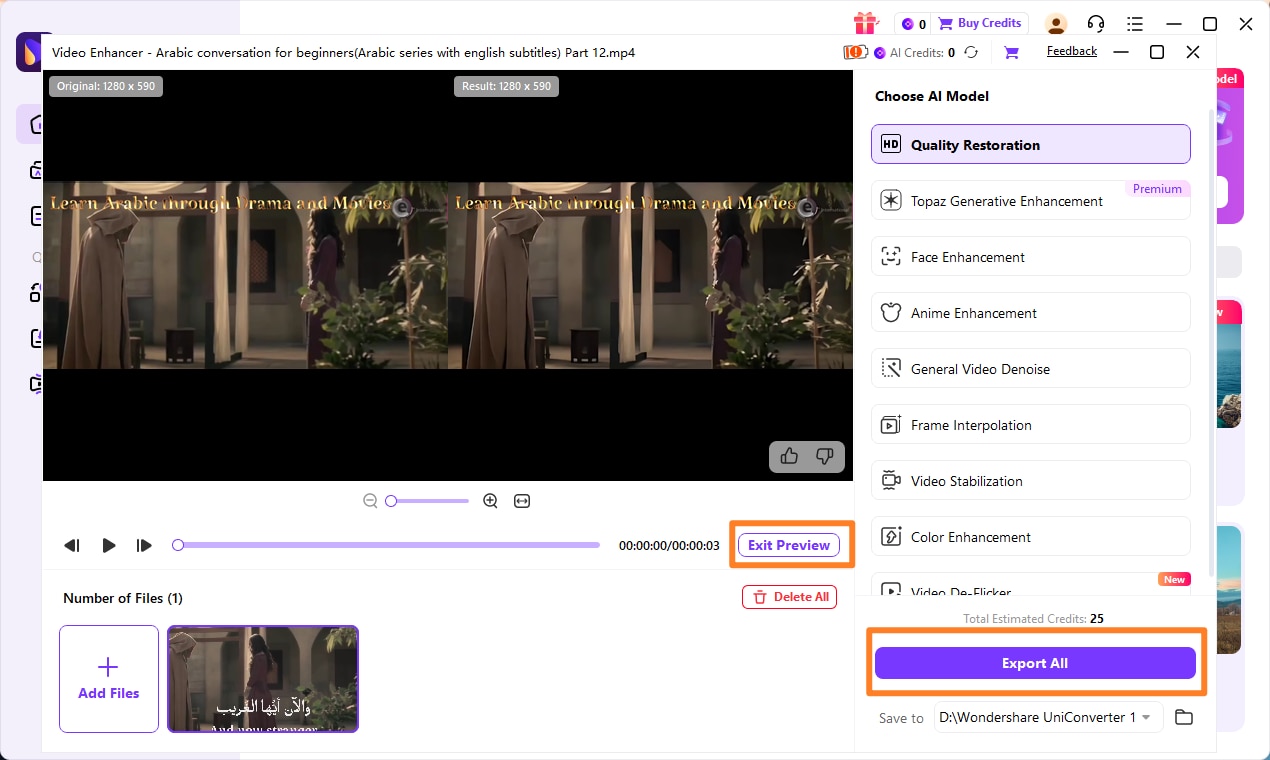
Step 4: Preview and Save the Enhanced Video
Click the "Preview" button to see the enhanced result. If satisfied, choose your desired output format and destination folder, then click "Export" to save your enhanced video.

CyberLink PowerDirector Alternative for Video Enhancement
Part 7: Conclusion
The CyberLink PowerDirector Video Enhancer review reveals it as a robust, AI-driven tool seamlessly integrated within the PowerDirector ecosystem, offering significant value for users seeking to improve video quality with relative ease. Its strengths lie in its advanced AI algorithms for noise reduction, color correction, and stabilization, coupled with a user-friendly interface that appeals to both novices and experienced editors. However, potential users should be mindful of its resource-intensive nature and the subscription-based model. For casual users and social media creators, it provides an efficient way to elevate content for platforms like YouTube and Instagram. Aspiring filmmakers and YouTubers will find its capabilities useful for polishing their productions, though it may not replace specialized professional tools for highly demanding restoration tasks. Professionals on a budget might consider it a valuable addition to their PowerDirector workflow, but for those needing a more versatile, all-in-one solution with strong batch processing and broader format support, alternatives like UniConverter offer compelling advantages, particularly with their one-time purchase options and dedicated customer support. Ultimately, the best choice depends on individual needs, technical proficiency, and budget constraints.
Part 8: FAQs
-
1. Is CyberLink PowerDirector Video Enhancer a standalone product?
No, it's typically an add-on or integrated feature within CyberLink PowerDirector.
-
2. Can it fix severely damaged video footage?
While it can improve quality, severely damaged footage may require specialized restoration tools.
-
3. What are the system requirements for optimal performance?
A powerful CPU, ample RAM, and a dedicated GPU are recommended for smooth operation.
-
4. Does it support 4K and 8K video enhancement?
Yes, it generally supports high-resolution video enhancement, but processing times will be longer.
-
5. Is there a free trial available for CyberLink PowerDirector Video Enhancer?
CyberLink often offers free trials for PowerDirector, which may include access to the enhancer features.
