
- Value: Clipchamp excels for quick social media content, offering an intuitive, cloud-based editor for basic enhancements.
- Comparison: Unlike professional desktop software, Clipchamp prioritizes accessibility over advanced features like noise reduction or 4K upscaling.
- Decision: Choose Clipchamp for simple, fast edits; opt for UniConverter or professional tools for robust, high-quality video enhancement.
- Limitations: Clipchamp's cloud-dependency, basic enhancements, and potential free-tier restrictions limit its use for complex or professional projects.
In this article
- Part 1: What is Clipchamp Video Enhancer?
- Part 2: Clipchamp Video Enhancer: Core Features, Pros, and Cons
- Part 3: Clipchamp Video Enhancer: Ideal Use Cases and Limitations
- Part 4: Clipchamp Video Enhancer & Alternatives
- Part 5: Risks and Pitfalls to Consider
- Part 6: How to Use UniConverter to Efficiently Enhance Videos
- Part 7: Conclusion
- Part 8: FAQs
Clipchamp Video Enhancer Review: A Deep Dive into Its Capabilities
Clipchamp, a browser-based video editor acquired by Microsoft, has steadily gained traction among casual creators and small businesses. Its promise of simplifying video editing, especially for social media content, is appealing. This Clipchamp video enhancer review will delve into its capabilities, particularly its video enhancement features, and compare it with leading competitors. We aim to provide a comprehensive analysis to help users understand where Clipchamp shines and where it falls short, enabling informed decisions for their video enhancement needs.
Part 1: What is Clipchamp Video Enhancer?
Clipchamp Video Enhancer is an integrated feature within the Clipchamp online video editor, designed to improve the visual quality of video footage. It leverages a cloud-based infrastructure, allowing users to access and edit their videos directly from a web browser without the need for powerful local hardware. This accessibility makes it a convenient option for quick edits and enhancements, particularly for those who frequently create content for social media platforms. The core problem it aims to solve is providing an easy-to-use tool for non-professionals to make their videos look better without complex software.
Market Position and Target Audience
Clipchamp positions itself as an accessible, user-friendly video editing solution. Its primary target audience includes:
* Social Media Creators: Individuals and small businesses looking to quickly produce engaging content for platforms like Instagram, TikTok, and YouTube.
* Beginner Editors: Users with little to no prior experience in video editing who need intuitive tools.
* Casual Users: Anyone needing to make simple improvements to personal videos without investing in expensive software or extensive learning curves.
* Collaborative Teams: Small teams requiring a shared workspace for video projects.
Part 2: Clipchamp Video Enhancer: Core Features, Pros, and Cons
Clipchamp's video enhancer capabilities are integrated within its broader editing suite, offering a streamlined experience for users. Its core features focus on basic visual adjustments rather than advanced, AI-driven enhancements.
* Brightness and Contrast Adjustment: Basic controls to fine-tune exposure.
* Saturation and Temperature Control: Adjusting color vibrancy and white balance.
* Filter Application: A selection of pre-set filters to change the video's aesthetic.
* Basic Color Correction: Simple sliders for hue and tint adjustments.
* Stabilization: An option to reduce camera shake in footage.
Pros
* Intuitive Interface for Quick Edits: The drag-and-drop interface is incredibly easy to navigate, making basic enhancements straightforward.
* Integrated Cloud Storage and Collaboration: Projects are saved in the cloud, facilitating access from different devices and enabling team collaboration.
* Wide Range of Built-in Templates and Stock Media: Offers a rich library of templates, stock videos, and audio, speeding up content creation.
Cons
* Limited Advanced Enhancement Options: Lacks sophisticated tools for noise reduction, upscaling, or complex color grading.
* Performance Issues with Large Files: Can experience slowdowns or crashes when processing high-resolution or lengthy video files, especially on less stable internet connections.
Part 3: Clipchamp Video Enhancer: Ideal Use Cases and Limitations
Clipchamp Video Enhancer excels in specific scenarios where speed and simplicity are paramount, but its capabilities have clear boundaries when professional-grade results are required.
Best Use Case: Quick Social Media Content Creation
Clipchamp is perfectly suited for creators who need to produce short, engaging videos for social media platforms rapidly. For instance, a small business owner can quickly enhance a product demo video by adjusting brightness, applying a filter, and adding text overlays directly in the browser. The intuitive interface and integrated stock media make it easy to churn out daily content without needing advanced editing skills or powerful software. It's ideal for vlogs, short tutorials, promotional clips, and event highlights where minor visual improvements are sufficient.
Limited Use Case: Professional-Grade Video Restoration
When it comes to restoring old, low-quality, or heavily damaged footage, Clipchamp's enhancement features fall short. For example, trying to significantly reduce grain from a vintage film, upscale a 480p video to 4K, or perform intricate color grading for a cinematic project would be beyond Clipchamp's capabilities. It lacks the advanced algorithms and granular controls found in professional software designed for such tasks. Users seeking to salvage poor-quality footage or achieve a polished, high-fidelity look for high-stakes projects will find Clipchamp's enhancement options too basic and ineffective.
Part 4: Clipchamp Video Enhancer & Alternatives
To provide a comprehensive view, let's compare Clipchamp's video enhancement capabilities with some prominent competitors in the market.
| Feature/Competitor | Clipchamp Video Enhancer | DaVinci Resolve | Adobe Premiere Pro | UniConverter |
| Ease of Use | High | Moderate | Moderate | High |
| Enhancement Depth | Basic | Advanced | Advanced | Moderate |
| Cloud Integration | Yes | No | Yes | No |
| Price Model | Freemium | Free/Paid | Subscription | One-time purchase |
| AI Features | Limited | Extensive | Extensive | Moderate |
| Processing Speed | Cloud-dependent | Fast (GPU) | Fast (GPU) | Very Fast (GPU) |
| Output Quality | Good for web | Excellent | Excellent | Very Good |
Key Differentiators: Cloud-Native vs. Desktop Power
Clipchamp's primary differentiator is its cloud-native architecture, offering unparalleled accessibility from any device with an internet connection. This is a significant advantage for quick edits and collaborative projects. However, this also means its performance is heavily reliant on internet speed and server load, and its enhancement depth is limited by what can be efficiently processed in a browser.
In contrast, DaVinci Resolve and Adobe Premiere Pro are desktop-based powerhouses, leveraging local hardware (especially GPUs) for advanced processing. They offer extensive, professional-grade enhancement tools, including sophisticated color grading, noise reduction, and upscaling, but come with a steeper learning curve and higher system requirements. UniConverter strikes a balance, offering a user-friendly desktop experience with robust enhancement features and excellent processing speed, making it a strong contender for users who need more than basic browser-based tools but don't require the full complexity of professional suites.
Part 5: Risks and Pitfalls to Consider
While Clipchamp offers convenience, users should be aware of several potential risks and limitations, especially when relying on its free tier or for sensitive projects.
Data Privacy and Security Concerns
As a cloud-based platform, uploading videos to Clipchamp means entrusting your data to Microsoft's servers. While Microsoft has robust security measures, any cloud service carries inherent risks of data breaches or unauthorized access. Users handling sensitive or confidential video content should carefully review Clipchamp's privacy policy and consider the implications of storing their footage online.
Potential for Watermarks or Feature Restrictions in Free Tier
The free version of Clipchamp often comes with limitations such as watermarks on exported videos or restrictions on output resolution. This can be a significant drawback for users aiming for a professional look without incurring costs. Advanced enhancement features, premium stock media, or higher export quality are typically locked behind a paid subscription, forcing users to upgrade for full functionality.
Dependence on Internet Connectivity
Being a browser-based tool, Clipchamp's performance is entirely dependent on a stable and fast internet connection. Slow internet can lead to frustrating delays, stuttering playback, and failed exports. This makes it unsuitable for users in areas with unreliable internet access or for those who need to work offline.
Output Quality Limitations for High-End Projects
While Clipchamp can improve video quality for casual use, its enhancement algorithms are not designed for high-end, professional projects. It may struggle with complex issues like severe noise, extreme blur, or significant color inaccuracies. The output quality, even with enhancements, might not meet the stringent standards required for broadcast, cinematic, or high-definition commercial productions.
Hidden Costs for Premium Features
Although Clipchamp offers a free tier, many desirable features, including advanced enhancement options, access to a wider range of stock assets, and higher resolution exports, are often part of a premium subscription. Users might find themselves needing to pay to unlock the full potential of the tool, which can add up over time, especially if they only need specific features occasionally.
Part 6: How to Use UniConverter to Efficiently Enhance Videos
When other tools fall short with batch processing, unstable enhancements, or weak results, UniConverter emerges as a powerful and reliable alternative. It offers a stable, lossless, and GPU-accelerated solution for batch video enhancement, free from ads and supporting a wide range of formats. UniConverter is an all-in-one ultimate solution for your video needs.
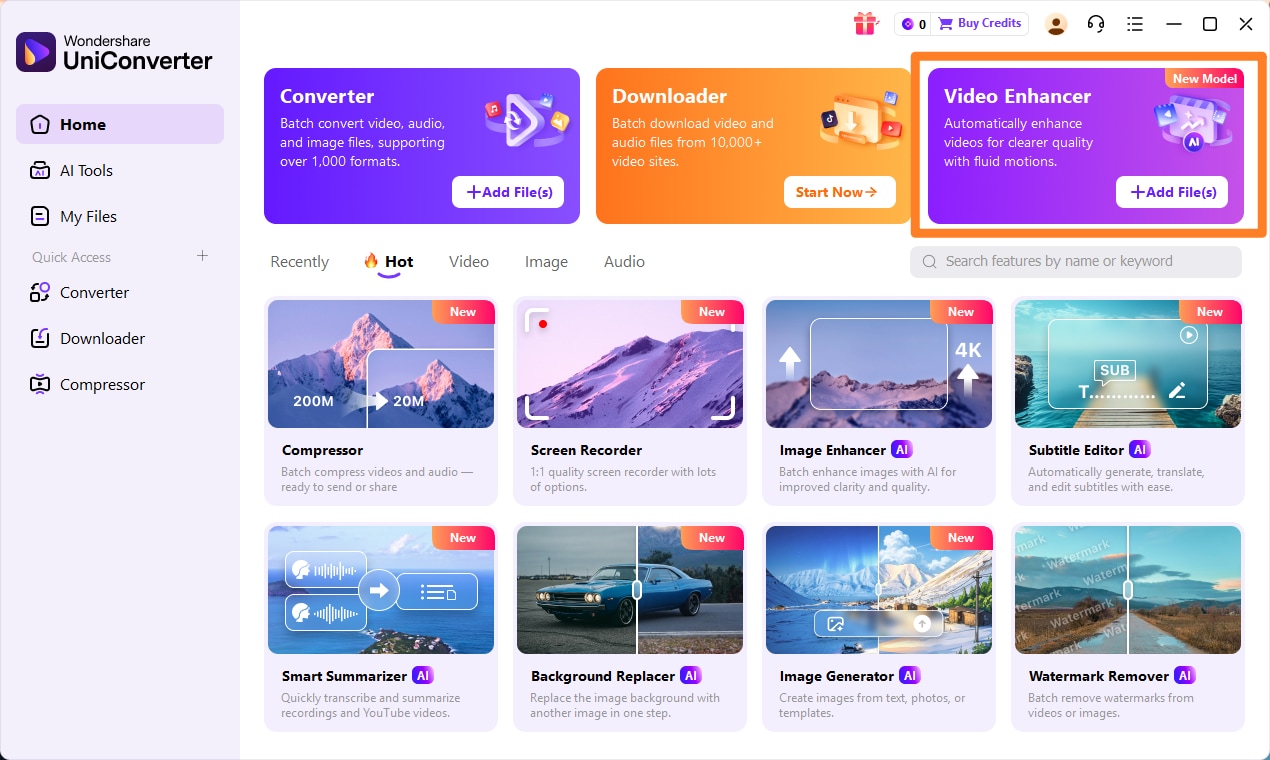
Step 1: Open UniConverter and Choose Video Enhancer
Launch Wondershare UniConverter on your desktop. On the main interface, navigate to the "AI Lab" section from the left sidebar and select the "Video Enhancer" tool.
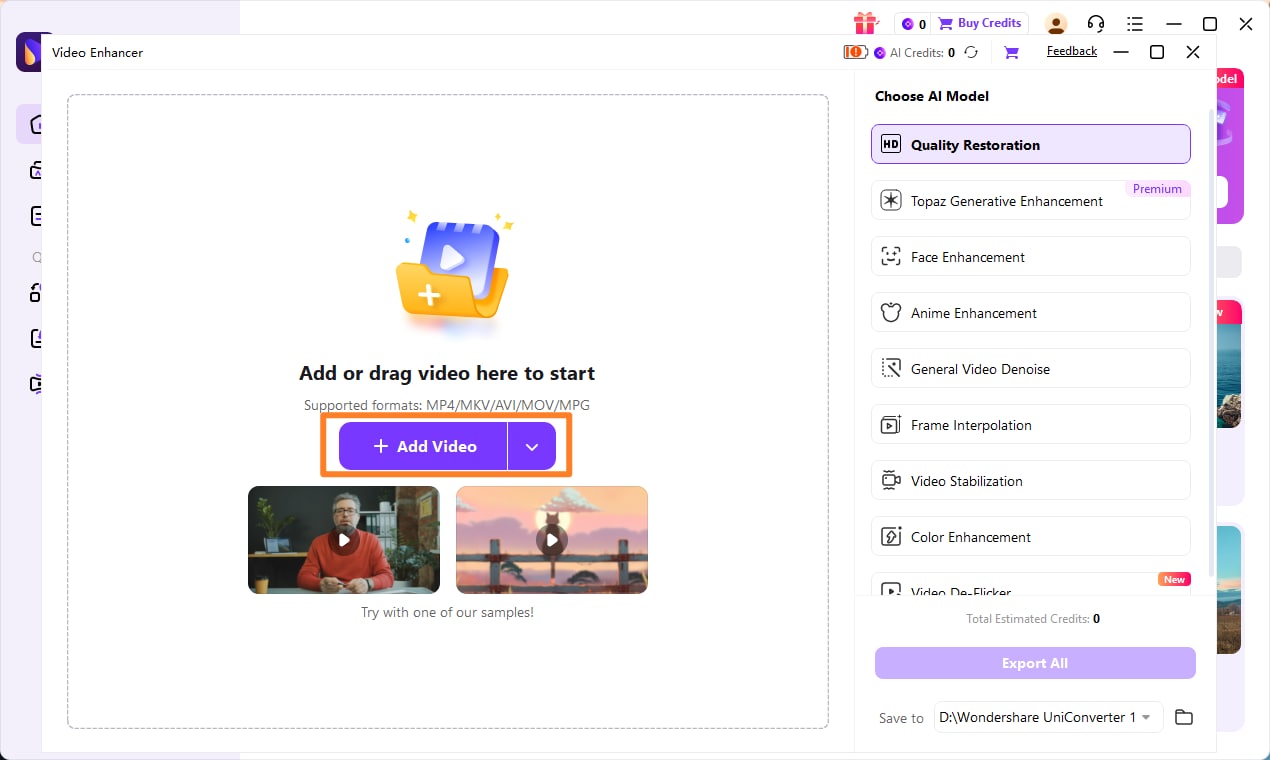
Step 2: Upload the Videos
Click on the "Add Files" button or drag and drop your video files directly into the UniConverter interface. You can add multiple videos for batch processing.
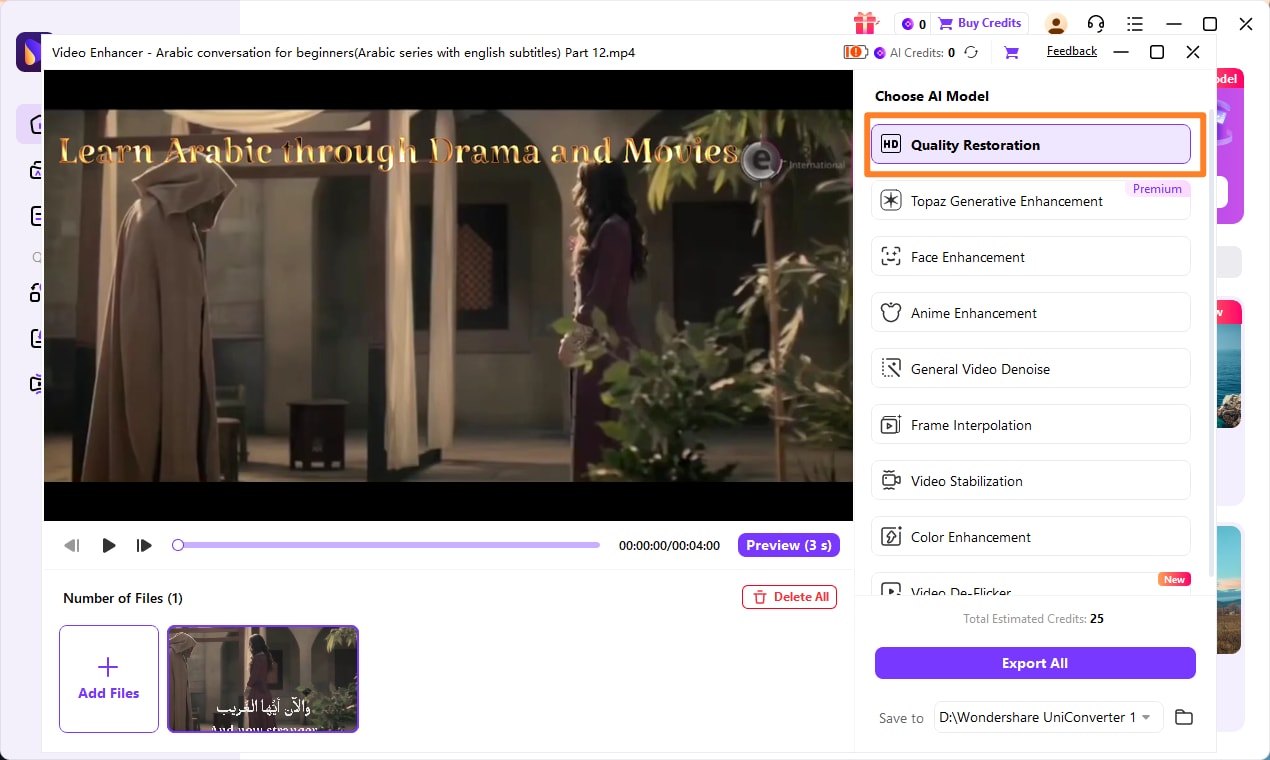
Step 3: Choose Enhancement Model
After uploading, UniConverter will display various AI enhancement models such as "AI Upscale," "AI Denoise," "AI Stabilization," and "AI Color Correction." Select the model(s) that best suit your video enhancement needs. You can also adjust output settings like resolution and format.
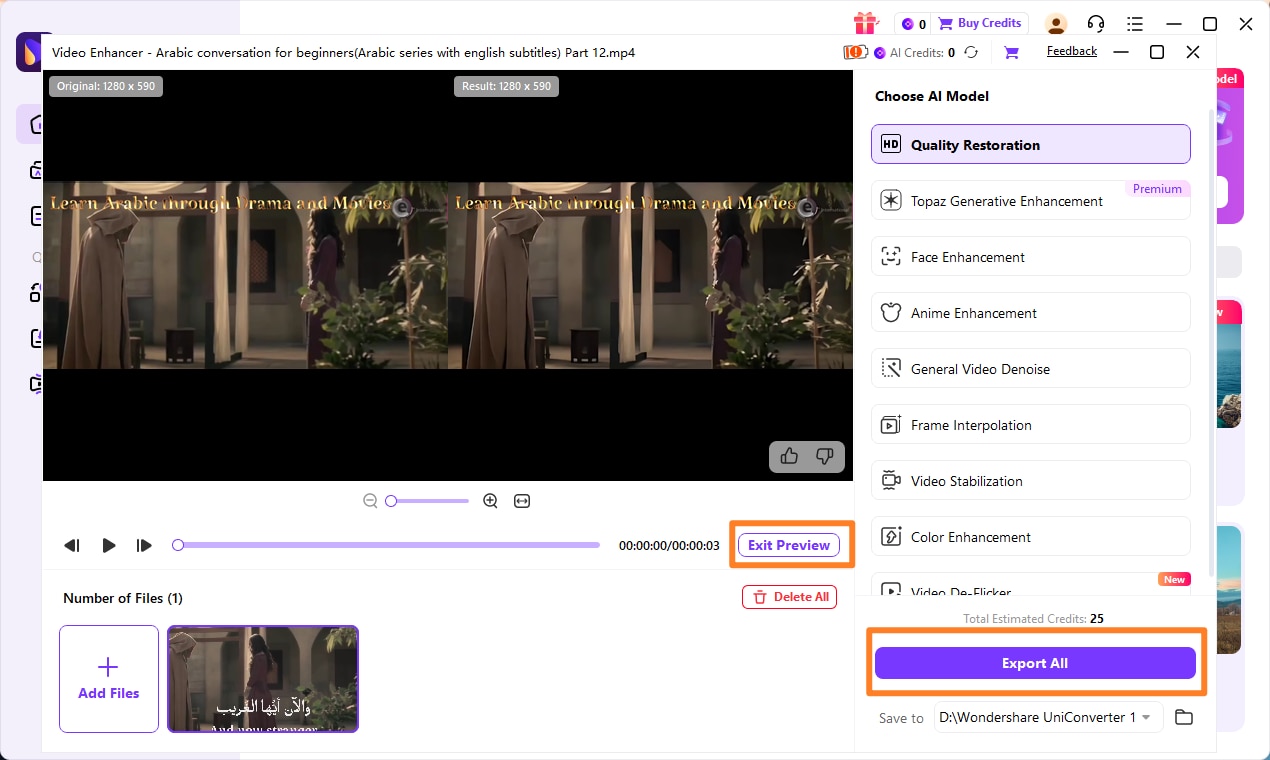
Step 4: Preview and Save the Enhanced Video
Before finalizing, use the "Preview" option to see the enhanced result. Once satisfied, choose your desired output folder and click the "Export" button to save your high-quality, enhanced video.

Seeking a Powerful Clipchamp Alternative for Video Enhancement?
Part 7: Conclusion
This Clipchamp video enhancer review highlights its strengths as an accessible, cloud-based tool for basic video improvements, particularly for social media content. Its intuitive interface and integration with Microsoft's ecosystem make it a convenient choice for casual creators and small businesses needing quick edits. However, its limitations in advanced enhancement, performance with large files, and dependence on internet connectivity mean it falls short for professional-grade restoration or complex projects. For users seeking more robust enhancement capabilities, greater control, and offline functionality, desktop alternatives like UniConverter offer a more comprehensive and powerful solution, providing superior output quality and faster processing without the inherent risks of cloud-based platforms. Ultimately, the best tool depends on the user's specific needs, technical proficiency, and the desired quality of the final output.
Part 8: FAQs
-
1. Is Clipchamp Video Enhancer truly free?
Clipchamp offers a free tier with basic editing and enhancement features, but it often includes limitations such as watermarks, lower resolution exports, and restricted access to premium stock media or advanced tools. Full functionality usually requires a paid subscription.
-
2. Can Clipchamp enhance video resolution?
Clipchamp can export videos at various resolutions, but its ability to truly "enhance" or upscale a low-resolution video to a higher, clearer resolution is limited. It primarily focuses on basic visual adjustments rather than AI-driven upscaling or sophisticated detail recovery.
-
3. How does Clipchamp compare to professional video editing software?
Clipchamp is designed for ease of use and quick edits, making it suitable for beginners and social media content. Professional software like Adobe Premiere Pro or DaVinci Resolve offers a vastly more comprehensive suite of tools for advanced editing, color grading, visual effects, and audio manipulation, catering to professional filmmakers and editors.
-
4. What are the best alternatives to Clipchamp for video enhancement?
For advanced enhancement, DaVinci Resolve (free and paid versions) and Adobe Premiere Pro are excellent professional options. For a balance of ease of use and powerful enhancement features, UniConverter is a strong desktop alternative that offers robust AI-driven tools for upscaling, denoising, and stabilization.
-
5. Is Clipchamp suitable for enhancing old or low-quality footage?
Clipchamp can make minor improvements to old or low-quality footage by adjusting brightness, contrast, and applying filters. However, it lacks the advanced algorithms and granular controls necessary for significant restoration tasks like severe noise reduction, artifact removal, or true resolution upscaling, which are better handled by dedicated video enhancement software.
