
- Clideo Overview: Clideo Video Enhancer is an online tool for basic video adjustments, ideal for quick fixes and casual users.
- Pros & Cons: Offers intuitive interface and cloud accessibility, but lacks advanced customization and requires internet connection.
- Target Audience: Best for social media creators needing quick edits; unsuitable for professional filmmaking due to limited features.
- Comparison Insights: Clideo prioritizes simplicity; UniConverter balances ease-of-use with advanced features; professional tools offer ultimate control.
- Potential Pitfalls: Be aware of data privacy, watermarks on free outputs, performance limits with large files, and basic output quality.
- UniConverter Alternative: UniConverter provides robust, offline video enhancement with advanced features and faster processing for superior results.
In this article
- Part 1: What is Clideo Video Enhancer?
- Part 2: Clideo Video Enhancer: Core Features, Pros, and Cons
- Part 3: Who is Clideo Video Enhancer For? Ideal Scenarios vs. Limitations
- Part 4: Clideo Video Enhancer vs. Competitors: A Head-to-Head Comparison
- Part 5: Potential Pitfalls and Considerations When Using Clideo Video Enhancer
- Part 6: How to Use UniConverter to Efficiently Enhance Videos
- Part 7: Final Verdict and Recommendations
- Part 8: Frequently Asked Questions (FAQs)
This Clideo Video Enhancer review delves into a popular online tool designed to simplify video improvement for everyday users. In an era where visual content dominates digital communication, the demand for accessible and effective video enhancement solutions has skyrocketed. This article will provide a comprehensive evaluation of Clideo Video Enhancer, examining its core features, advantages, and limitations. We will also conduct a head-to-head comparison with leading competitors, highlight potential pitfalls, and offer an alternative for more robust needs, ultimately guiding you to an informed decision about whether Clideo Video Enhancer is the right tool for your video editing workflow.
Part 1: What is Clideo Video Enhancer?
Clideo Video Enhancer is an online, browser-based tool that allows users to perform basic video adjustments and improvements without the need for complex software installations. It's part of the broader Clideo suite of online video editing tools, aiming to make video manipulation accessible to a wide audience. The platform focuses on simplicity and ease of use, enabling quick edits for common video issues like poor lighting, shaky footage, or low resolution. This review aims to clarify its position in the market and help users understand its capabilities and limitations.
The Growing Need for Accessible Video Enhancement Tools
* Rise of User-Generated Content: The proliferation of smartphones and social media has led to an explosion of user-generated video content, often captured without professional equipment or expertise.
* Demand for Quick Fixes: Users frequently need fast and straightforward ways to improve their videos before sharing them online, without investing in expensive software or learning complex editing techniques.
* Accessibility Across Devices: Online tools like Clideo cater to the need for video editing capabilities on various devices, from desktops to tablets, without platform-specific software requirements.
* Bridging the Skill Gap: These tools democratize video enhancement, allowing individuals with limited technical skills to achieve noticeable improvements in their video quality.
Part 2: Clideo Video Enhancer: Core Features, Pros, and Cons
Clideo Video Enhancer offers a streamlined approach to improving video quality directly from your web browser. Its core capabilities revolve around fundamental adjustments, making it a go-to for quick fixes. The platform supports various video formats and allows users to upload files directly or from cloud storage services. Key features include brightness and contrast adjustments, saturation control, color correction presets, and basic stabilization. It also provides options for resizing and cropping videos, along with simple audio adjustments.
Pros:
* Intuitive Interface for Quick Edits: The user interface is remarkably clean and straightforward, making it easy for beginners to navigate and apply enhancements without a steep learning curve.
* Cloud-Based Accessibility from Anywhere: Being an online tool, Clideo Video Enhancer can be accessed from any device with an internet connection, offering unparalleled flexibility for on-the-go editing.
* Wide Range of Basic Enhancement Options: It covers essential video improvement needs, from adjusting exposure and color to rotating and flipping footage, sufficient for most casual users.
Cons:
* Limited Advanced Customization: For users seeking granular control over color grading, noise reduction, or professional-grade stabilization, Clideo's options are quite basic and lack depth.
* Dependency on Internet Connection: As an entirely cloud-based service, a stable and fast internet connection is crucial for uploading, processing, and downloading videos, which can be a bottleneck for large files or unreliable networks.
Part 3: Who is Clideo Video Enhancer For? Ideal Scenarios vs. Limitations
Clideo Video Enhancer is primarily designed for individuals who need quick, straightforward video adjustments without delving into professional editing software. Its simplicity makes it ideal for casual users and those new to video editing. The tool shines in scenarios where speed and ease of use are prioritized over extensive customization and high-fidelity output. However, its online nature and limited feature set inherently restrict its applicability in more demanding environments.
Best Use Case: Quick Fixes for Social Media Content Creators
For social media influencers, small business owners managing their online presence, or anyone frequently sharing videos on platforms like Instagram, TikTok, or YouTube Shorts, Clideo Video Enhancer is an excellent tool. It allows for rapid adjustments to brightness, contrast, and color, ensuring that footage looks presentable and engaging before uploading. Its cloud-based nature means content creators can make edits on the fly, directly from their browser, without needing to download or install any software, making it perfect for last-minute tweaks to enhance visual appeal.
Limited Use Case: Professional Filmmaking and High-End Post-Production
Clideo Video Enhancer is not suitable for professional filmmakers, videographers, or anyone involved in high-end post-production workflows. These professionals require precise control over every aspect of video enhancement, including advanced color grading, sophisticated noise reduction, multi-track editing, and uncompressed output formats. The tool's basic features, reliance on internet speed for large files, and potential for compression artifacts make it inadequate for projects demanding cinematic quality or broadcast standards. For such tasks, dedicated desktop software with robust capabilities is indispensable.
Part 4: Clideo Video Enhancer vs. Competitors: A Head-to-Head Comparison
When evaluating video enhancement tools, it's crucial to compare Clideo Video Enhancer against its peers to understand its market position and specific strengths. We'll compare it with UniConverter, Adobe Premiere Pro, and DaVinci Resolve, representing a spectrum from comprehensive desktop solutions to professional-grade software.
| Feature/Tool | Clideo Video Enhancer | UniConverter | Adobe Premiere Pro | DaVinci Resolve |
| Ease of Use | Very High | High | Medium | Medium |
| Advanced Features | Low | Medium | Very High | Very High |
| Price | Freemium | Subscription/One-time purchase | Subscription | Freemium/Studio License |
| Offline Access | No | Yes | Yes | Yes |
| Output Quality | Good | Very Good | Excellent | Excellent |
| Processing Speed | Internet-dependent | Fast (GPU acceleration) | Fast (GPU acceleration) | Fast (GPU acceleration) |
| Customer Support | Email/FAQ | 24/7 Live Chat/Email | Extensive Docs/Community | Extensive Docs/Community |
| Security | Standard online | High (local processing) | High (local processing) | High (local processing) |
Key Differentiators: Simplicity vs. Power
Clideo Video Enhancer stands out for its extreme simplicity and accessibility. It's designed for users who need quick, basic adjustments without any prior editing experience. Its browser-based nature means no installation, making it incredibly convenient for occasional use. However, this simplicity comes at the cost of power and control.
UniConverter offers a balanced approach, providing a user-friendly interface with significantly more advanced features than Clideo, including robust enhancement tools, format conversion, and batch processing, all while operating offline. It's a strong contender for users who need more than basic edits but aren't ready for professional software.
Adobe Premiere Pro and DaVinci Resolve are the titans of video editing, offering unparalleled power, precision, and a vast array of professional-grade features. They are designed for experienced editors and filmmakers who require complete creative control, advanced color grading, complex effects, and high-fidelity output. While they have steeper learning curves and higher costs (especially Premiere Pro's subscription model), their capabilities are unmatched for professional workflows.
Ultimately, the choice depends on user needs: Clideo for ultimate simplicity and quick online fixes, UniConverter for a powerful yet accessible desktop solution, and Premiere Pro or DaVinci Resolve for professional-grade production.
Part 5: Potential Pitfalls and Considerations When Using Clideo Video Enhancer
While Clideo Video Enhancer offers convenience, users should be aware of several potential drawbacks and considerations, particularly when relying on free online tools for video processing. These pitfalls can impact the quality of your output, your privacy, and the overall efficiency of your workflow.
Data Privacy and Security Concerns
When uploading videos to any online platform, data privacy and security are paramount. While Clideo states it prioritizes user data security, the act of uploading personal or sensitive video content to a third-party server always carries an inherent risk. Users should carefully review Clideo's privacy policy to understand how their data is stored, processed, and potentially shared. For highly confidential or proprietary footage, relying on cloud-based services might not be the most secure option.
Watermarks on Free Tier Outputs
A common practice among freemium online tools, Clideo's free tier often includes watermarks on the enhanced video outputs. This can be a significant deterrent for users who want to present a professional image or simply prefer clean, unbranded content. To remove these watermarks, users typically need to subscribe to a paid plan, which adds to the overall cost if frequent use is anticipated.
Performance Limitations with Large Files
As an online tool, Clideo Video Enhancer's performance is heavily dependent on your internet connection speed and the size of your video files. Uploading and processing large, high-resolution videos can be time-consuming and prone to interruptions. This can lead to frustration, especially for users dealing with 4K footage or lengthy clips, where desktop applications often offer superior speed and stability due to local processing capabilities.
Output Quality for Professional Use
While Clideo can improve basic aspects of video quality, its enhancement algorithms are not designed for professional-grade results. Users seeking precise color correction, advanced noise reduction, or lossless compression for broadcast or cinematic purposes will find the output quality lacking. The tool may introduce compression artifacts or fail to significantly enhance truly low-quality footage, making it unsuitable for high-stakes projects.
In-App Advertisements
Users of the free version of Clideo Video Enhancer may encounter in-app advertisements. While these are a common way for free services to monetize, they can disrupt the user experience and make the editing process less efficient. For those who prefer an uninterrupted workflow, the presence of ads can be a notable annoyance, pushing users towards paid subscriptions or alternative ad-free solutions.
Part 6: How to Use UniConverter to Efficiently Enhance Videos
When online tools fall short, offering unstable enhancements, limited batch processing, or unsatisfactory results, UniConverter emerges as a robust desktop solution. It provides a comprehensive suite of video tools, ensuring stable, high-quality enhancements without the drawbacks of online services like ads or internet dependency. UniConverter is an all-in-one ultimate solution for video conversion, editing, and enhancement, leveraging GPU acceleration for faster processing and supporting a vast array of formats without compromising quality.
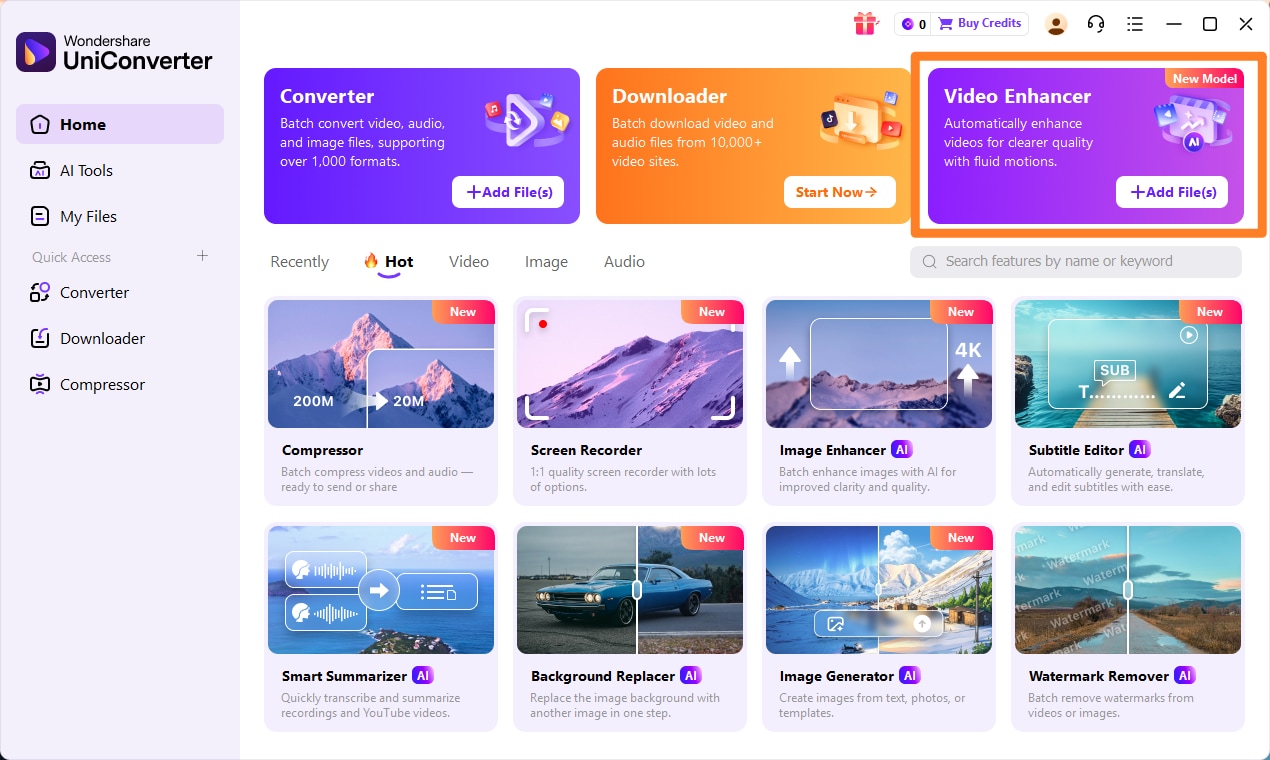
Step 1: Open UniConverter and Choose Video Enhancer
Launch UniConverter on your computer. From the main interface, navigate to the "Toolbox" section and select the Video Enhancer feature. This dedicated module provides all the necessary tools for improving your video's quality.
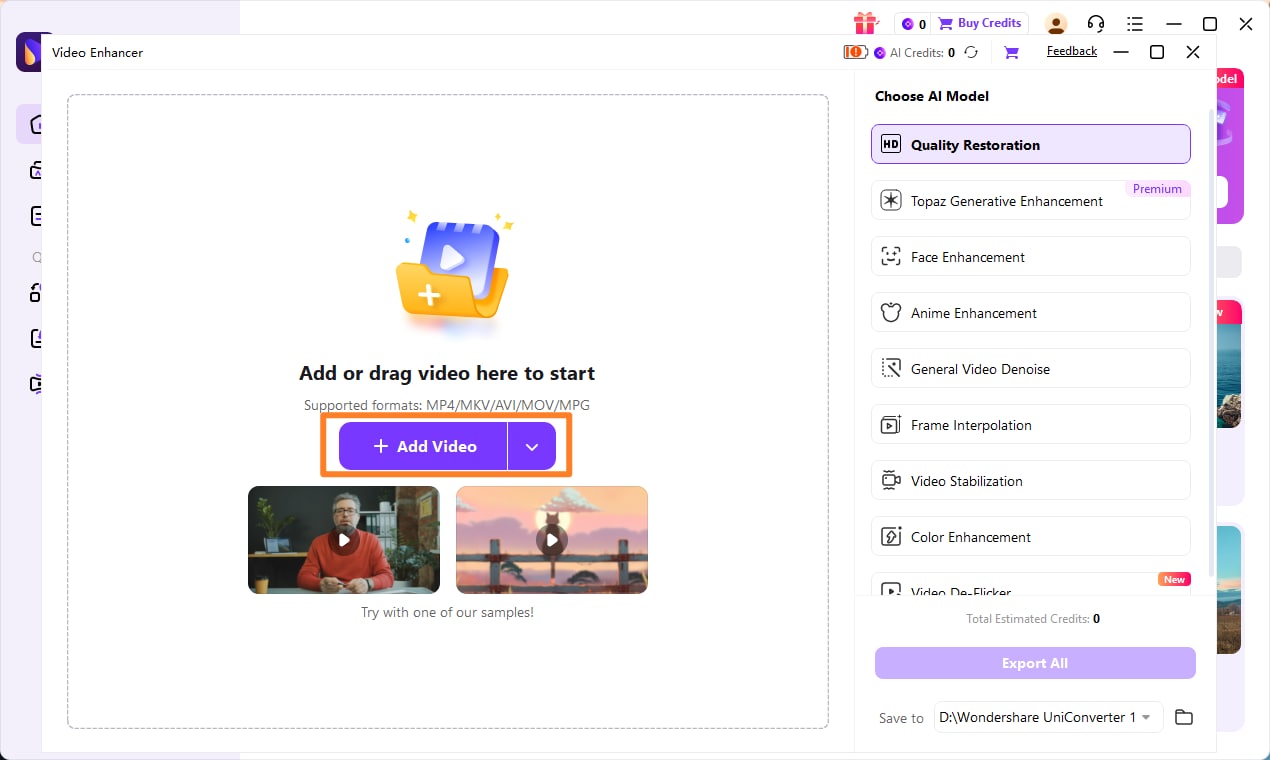
Step 2: Upload the Videos
Click the "Add Files" button or simply drag and drop the video files you wish to enhance into the UniConverter interface. You can add multiple videos for batch processing, saving significant time.
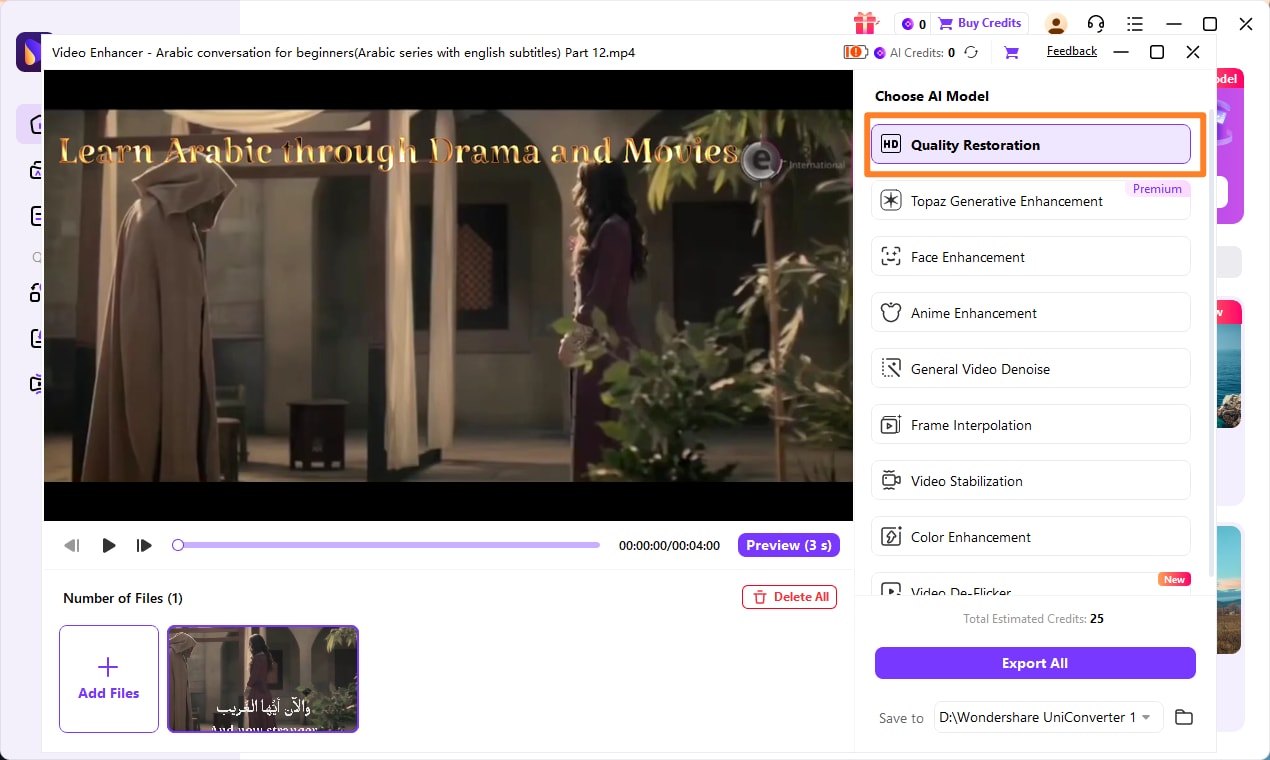
Step 3: Choose Enhancement Model
UniConverter offers various enhancement options. You can choose to optimize brightness and contrast, de-shake footage, remove video noise, or upscale resolution. Select the specific enhancement models that best suit your video's needs. You can also preview the changes before applying them.
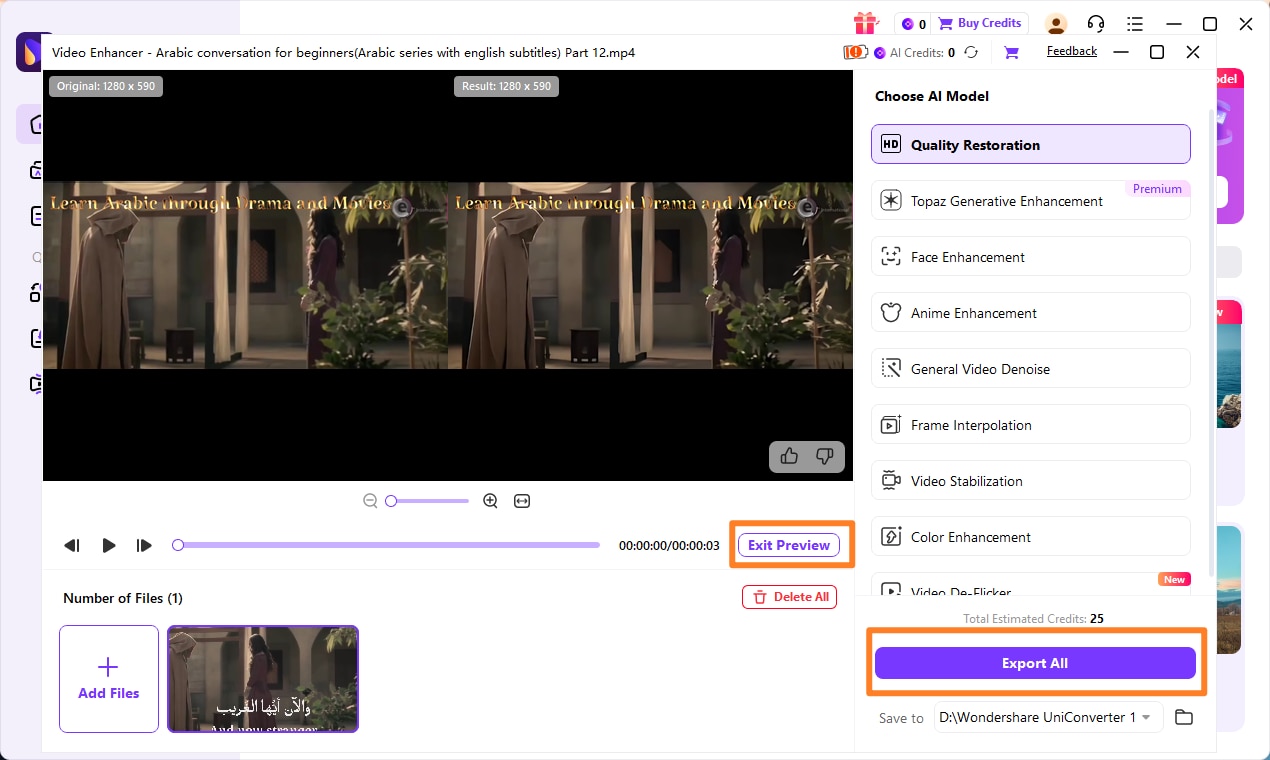
Step 4: Preview and Save the Enhanced Video
After selecting your desired enhancements, click "Preview" to see the results. Once satisfied, choose your desired output format and destination folder, then click "Enhance" to process and save your improved video.

Seeking a Powerful Clideo Video Enhancer Alternative?
Part 7: Final Verdict and Recommendations
The Clideo Video Enhancer review reveals a tool perfectly positioned for quick, casual video improvements. Its browser-based nature and intuitive interface make it incredibly accessible for beginners and those needing rapid edits. However, its limitations in advanced features, reliance on internet connectivity, and potential for watermarks on free outputs mean it's not a one-size-fits-all solution. For users seeking more control, higher output quality, or offline capabilities, desktop alternatives are essential.
For Casual Users and Beginners
Clideo Video Enhancer is an excellent choice. Its ease of use and immediate accessibility make it perfect for making simple adjustments to videos before sharing them on social media or with friends and family.
For Content Creators on a Budget
The free tier of Clideo can be useful for occasional, non-critical enhancements, but be prepared for watermarks. For more consistent, watermark-free content, a paid subscription to Clideo or a more robust freemium desktop tool like UniConverter would be more beneficial.
For Users Needing Offline Capabilities
Clideo is not suitable. Its online-only nature means you'll need a stable internet connection. For offline work, a desktop application like UniConverter is indispensable, offering uninterrupted workflow regardless of connectivity.
For Professionals Seeking Advanced Control
Clideo Video Enhancer falls short. Professionals require granular control over every aspect of video enhancement, which only dedicated software like Adobe Premiere Pro or DaVinci Resolve can provide. UniConverter offers a good middle ground for advanced amateurs or small businesses needing more than basic but less than professional-grade tools.
Part 8: Frequently Asked Questions (FAQs)
-
1. Is Clideo Video Enhancer completely free to use?
Clideo offers a free tier with limitations, such as watermarks on output videos and restrictions on file size and processing time. To remove watermarks and access full features, a paid subscription is required.
-
2. Can Clideo Video Enhancer improve 4K video quality?
While it can apply basic enhancements like brightness, contrast, and color adjustments to 4K videos, its ability to significantly improve true 4K quality, especially in terms of detail recovery or advanced noise reduction, is limited compared to professional desktop software.
-
3. Is my data safe when uploading videos to Clideo?
Clideo states they prioritize user data security and use encryption for data transfer. However, as with any online service, it's always wise to review their privacy policy for detailed information on how your data is handled and stored. For highly sensitive content, local processing tools are generally more secure.
-
4. What are the main advantages of using a desktop alternative like UniConverter?
Desktop alternatives like UniConverter often offer more advanced features, offline access, better performance for large files (especially with GPU acceleration), higher output quality without watermarks, and enhanced data security as files are processed locally. They also typically provide a more stable and uninterrupted editing experience.
-
5. How long does it take to enhance a video with Clideo?
Processing time depends heavily on several factors: the length and resolution of your video, its file size, the complexity of the enhancements applied, and crucially, the speed and stability of your internet connection. Shorter videos with basic enhancements usually process relatively quickly, but large files can take a significant amount of time.
