
- Claid.ai Value: Offers advanced AI for realistic detail restoration and efficient batch processing, ideal for e-commerce.
- Limitations: Subscription model and limited free trial can be barriers; less suited for artistic stylization.
- Comparison: Claid.ai excels in AI accuracy and scalability, especially for cloud-based batch processing and API integration.
- Alternatives Insight: UniConverter provides a robust, local, one-time purchase alternative, balancing quality, privacy, and convenience.
- Decision Factors: Consider data privacy, potential over-processing, subscription cost vs. usage, and internet dependency for optimal tool choice.
In this article
- Part 1: What is Claid.ai Image Enhancer?
- Part 2: Claid.ai Image Enhancer: Core Features, Pros, and Cons
- Part 3: Claid.ai Image Enhancer: Ideal Users and Use Cases
- Part 4: Claid.ai and Alternatives Comparison
- Part 5: Risks and Pitfalls to Consider
- Part 6: How to Use UniConverter for Efficient Image Enhancement
- Part 7: Conclusion
- Part 8: FAQs
In today's visually-driven world, the demand for high-quality images is soaring, whether for e-commerce, social media, or personal archives. This has led to a proliferation of AI-powered image enhancement tools promising to transform mediocre photos into stunning visuals. Among these, Claid.ai has emerged as a prominent player, leveraging artificial intelligence to upscale, denoise, and refine images with remarkable precision. This Claid.ai image enhancer review will dive deep into its capabilities, compare it with leading alternatives, and help you determine if it's the right tool for your specific needs. We'll explore its features, ideal use cases, potential pitfalls, and even suggest a robust alternative for comprehensive image processing.
Part 1: What is Claid.ai Image Enhancer?
Claid.ai is an AI-driven platform designed to automatically enhance and optimize images for various applications. It's built on advanced machine learning algorithms that understand image content and apply intelligent adjustments, aiming to deliver professional-grade results without manual editing. When I first encountered Claid.ai, I was intrigued by its promise of effortless enhancement, especially given the tedious nature of traditional image editing. This review aims to clarify whether it truly lives up to that promise and addresses common pain points in image processing.
The Rise of AI Image Enhancement Tools
The explosion of digital content has created a significant need for efficient image optimization.
* Time-consuming manual editing: Traditional photo editing software requires considerable skill and time.
* Inconsistent quality: Achieving uniform quality across a large batch of images is a challenge.
* Accessibility for non-professionals: Many users lack the expertise to use complex editing tools effectively.
Part 2: Claid.ai Image Enhancer: Core Features, Pros, and Cons
Claid.ai positions itself as a comprehensive solution for image enhancement, offering a suite of features powered by its AI engine. From my experience, its core strength lies in its ability to intelligently analyze and improve image quality. It can upscale low-resolution images, remove noise, sharpen details, and even correct colors, all with minimal user input. The platform also boasts features like background removal and image compression, making it a versatile tool for various image-related tasks.
Pros:
* Advanced AI for realistic detail restoration: I've been genuinely impressed by how well it can recover lost details and make images look sharper and more natural.
* Batch processing capabilities for efficiency: This is a huge time-saver for me, especially when dealing with large volumes of product photos.
* API integration for developers: For those looking to integrate enhancement into their own workflows, the API is incredibly useful.
Cons:
* Subscription-based pricing model: While powerful, the recurring cost can be a barrier for casual users or small businesses with limited budgets.
* Limited free trial features: I found the free trial to be quite restrictive, making it hard to fully assess its capabilities before committing.
Part 3: Claid.ai Image Enhancer: Ideal Users and Use Cases
From my perspective, Claid.ai shines brightest for users who need consistent, high-quality image enhancements at scale. If you're constantly dealing with a large volume of images that need a quick, professional touch, this tool is definitely worth considering. However, it's not a one-size-fits-all solution, and its strengths and weaknesses become apparent in different scenarios.
Best Use Case: E-commerce Product Photography Enhancement
For e-commerce businesses, Claid.ai is a game-changer. I've used it to enhance product shots, and the results are consistently impressive. It sharpens details, brightens colors, and makes products look more appealing, directly impacting conversion rates. The batch processing feature is invaluable here, allowing me to process hundreds of images in minutes, which would take hours with manual editing.
Limited Use Case: Artistic Image Stylization
If you're an artist or photographer looking for creative stylization or highly nuanced artistic effects, Claid.ai might not be your primary tool. While it enhances, it doesn't offer the granular control or artistic filters that dedicated photo manipulation software provides. I tried using it for some artistic projects, and while it improved the base image, it couldn't achieve the specific stylistic vision I had in mind. For that, I still turn to more traditional editing suites.
Part 4: Claid.ai and Alternatives Comparison
When evaluating image enhancement tools, it's crucial to see how they stack up against the competition. I've had the chance to experiment with several, and here's how Claid.ai compares to some notable alternatives, including UniConverter, Topaz Labs Gigapixel AI, and Luminar Neo.
| Feature/Scenario | Claid.ai | UniConverter | Topaz Labs Gigapixel AI | Luminar Neo |
| E-commerce Product Shots | Excellent | Good | Fair | Good |
| Old Photo Restoration | Good | Excellent | Excellent | Good |
| Batch Processing | High | High | Medium | Medium |
| API Integration | Yes | No | No | No |
| Pricing Model | Subscription | One-time purchase | One-time purchase | Subscription/One-time |
| Processing Speed | Fast (Cloud) | Fast (Local, GPU) | Very Fast (Local, GPU) | Moderate (Local) |
| Output Quality | Very High | High | Excellent | High |
| Ease of Use | Very Easy | Easy | Moderate | Moderate |
| Customer Support | Good | Excellent | Good | Good |
| Security | Cloud-based | Local processing | Local processing | Local processing |
Key Differentiators: AI Accuracy and Scalability
Claid.ai's strength lies in its highly accurate AI and its scalability, especially for cloud-based batch processing and API integration. While Topaz Labs Gigapixel AI often delivers slightly superior results for pure upscaling and old photo restoration, Claid.ai offers a more integrated solution for businesses needing automated enhancement across various image types. UniConverter stands out for its all-in-one approach and local processing, offering a great balance of quality and convenience without recurring fees. Luminar Neo, while powerful for creative editing, is less focused on pure AI enhancement at scale.
Part 5: Risks and Pitfalls to Consider
While Claid.ai offers undeniable advantages, it's important to be aware of potential risks and drawbacks before fully committing. I've learned through experience that even the most advanced tools have their limitations and hidden costs.
Data Privacy Concerns
As a cloud-based service, Claid.ai requires you to upload your images to their servers. For sensitive or proprietary images, this raises legitimate data privacy concerns. While they likely have robust security measures, it's always a good practice to review their privacy policy carefully. I always think twice before uploading confidential client work to any cloud service.
Potential for Over-Processing and Unnatural Results
The AI, while smart, isn't infallible. There have been instances where Claid.ai over-processed an image, leading to an artificial or "plastic" look, especially with faces or fine textures. It's crucial to review the enhanced images and sometimes dial back the intensity or choose a different enhancement model. I've found that a light touch often yields more natural results.
Subscription Cost vs. Usage Frequency
The subscription model can be a pitfall if your usage isn't consistent. If you only need to enhance images occasionally, the monthly or annual fee might not be cost-effective. I initially thought I'd use it constantly, but my workflow sometimes has lulls, making me question the ongoing expense. For infrequent use, a pay-per-image model or a one-time purchase alternative might be more economical.
Internet Dependency for Optimal Performance
Since Claid.ai is a cloud-based service, a stable and fast internet connection is essential for optimal performance. If your internet is spotty, uploading large batches of images can be slow and frustrating. I've experienced this firsthand when working from locations with unreliable Wi-Fi, which significantly hampered my productivity. Local processing solutions don't have this limitation.
Part 6: How to Use UniConverter for Efficient Image Enhancement
Sometimes, despite the allure of cloud-based AI, you might find yourself needing a more robust, offline, and versatile solution, especially when other tools fall short on batch processing, stability, or overall enhancement quality. This is where UniConverter truly shines as a comprehensive alternative. It offers a powerful AI Image Enhancer that works locally, ensuring privacy and consistent performance, free from internet dependency. It's an all-in-one toolkit that goes beyond just enhancement, providing a stable, ad-free, and high-quality experience for all your media needs, leveraging GPU acceleration for speed and maintaining original quality. For instance, you can easily upscale images to 4K or perform other advanced image enhancement tasks.
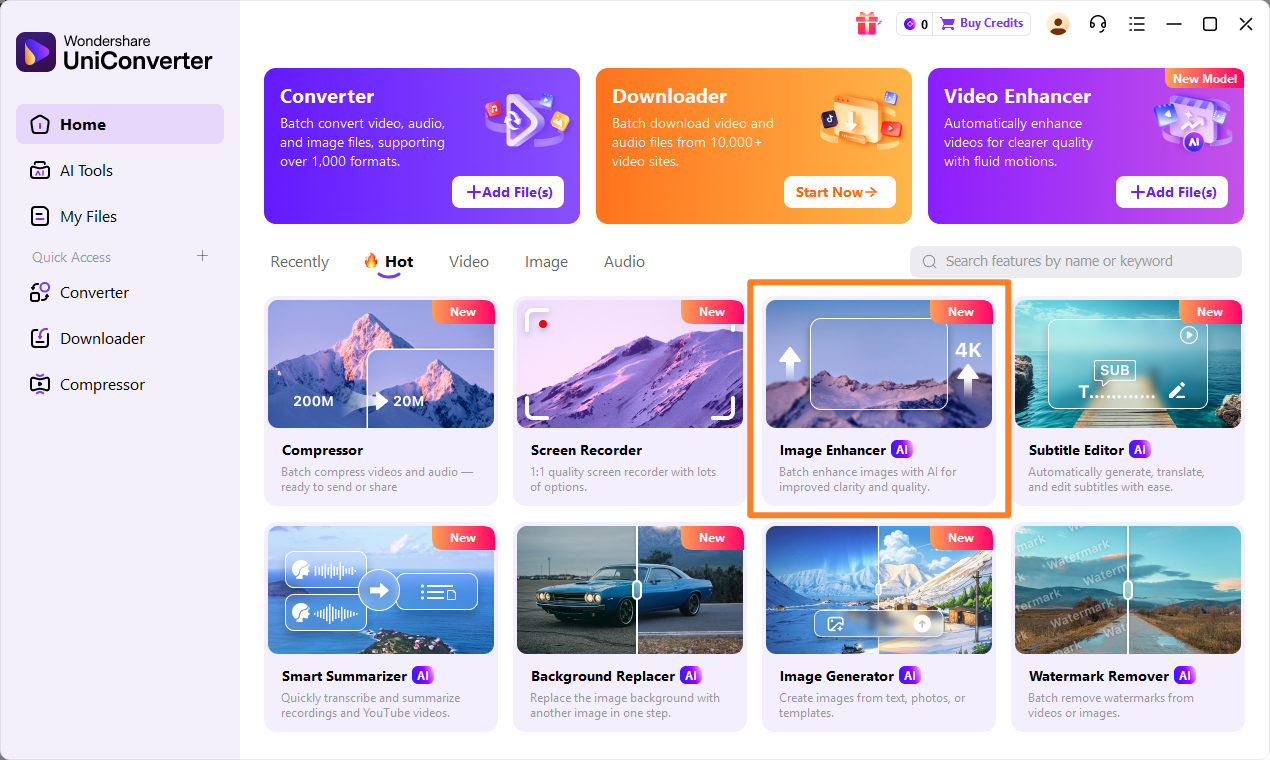
Step 1: Open UniConverter and Choose Image Enhancer
First, launch UniConverter on your computer. On the main interface, navigate to the "AI Lab" section from the left sidebar. Within AI Lab, you'll find the "AI Image Enhancer" feature. Click on it to proceed.
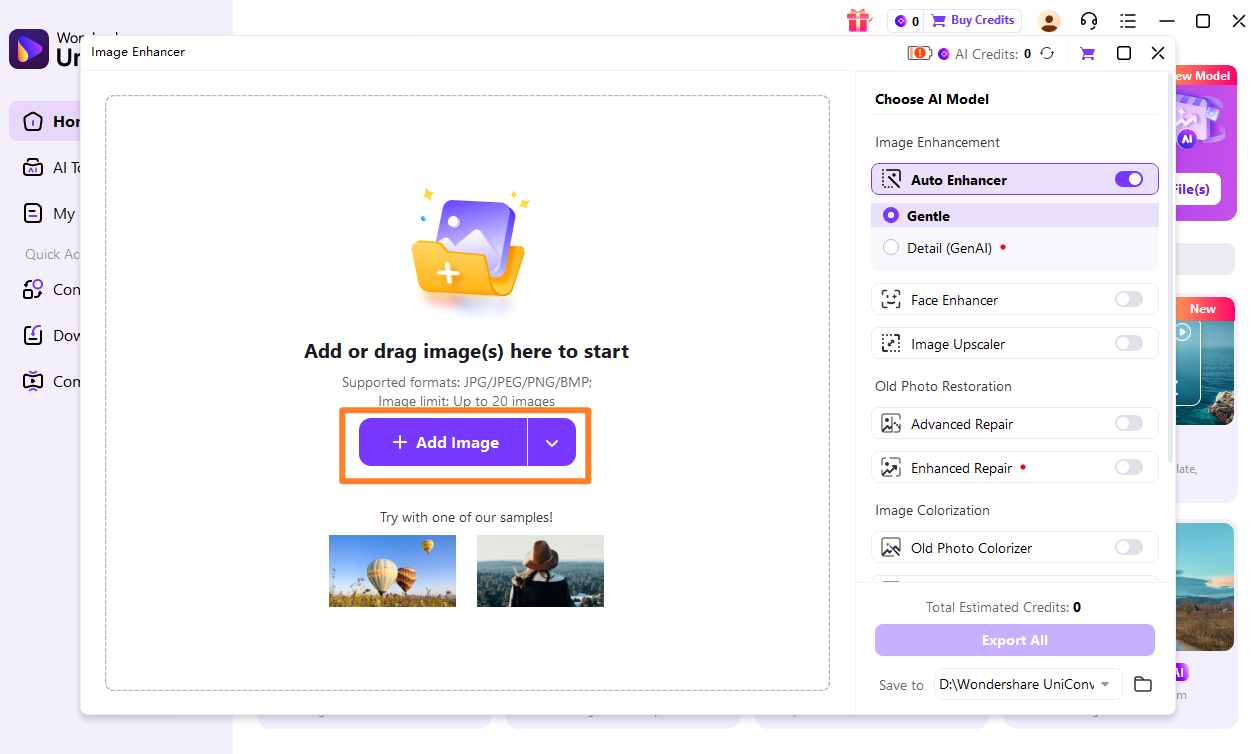
Step 2: Upload the Images
Now, you need to import the images you wish to enhance. You can either drag and drop your image files directly into the designated area or click the "Add Files" button to browse and select them from your local storage. UniConverter supports various image formats.
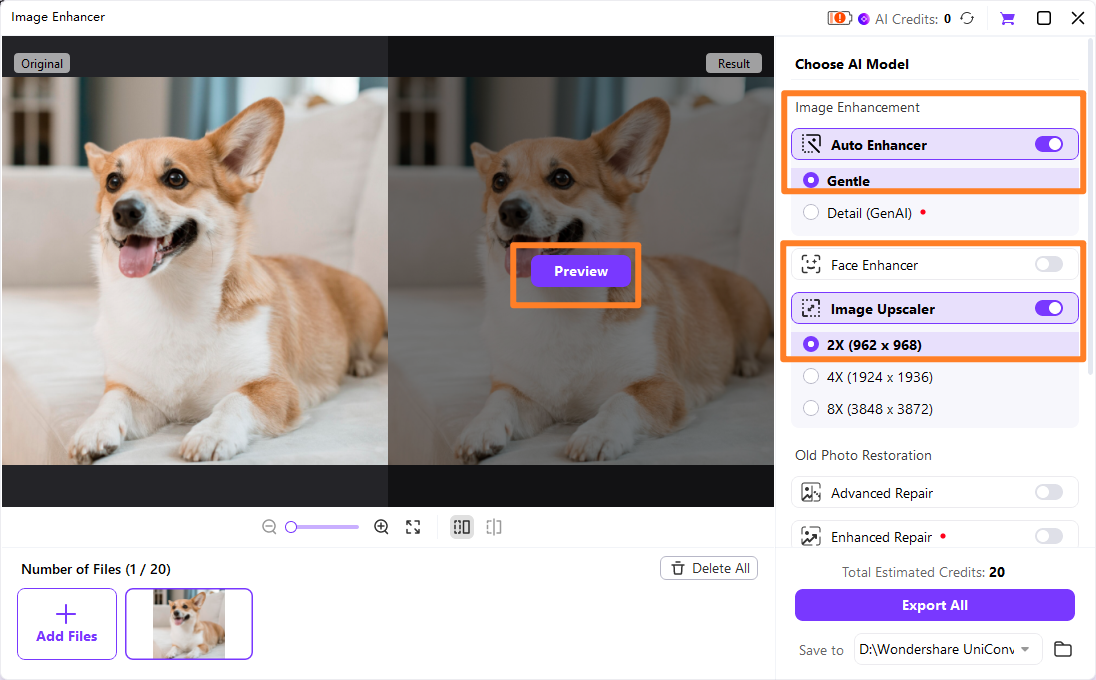
Step 3: Choose Enhancement Model
Once your images are loaded, UniConverter will present you with different enhancement models. You can select the one that best suits your needs, such as "AI Upscale" for resolution improvement, "Denoise" for removing grain, or "Sharpen" for clearer details. You can also adjust the enhancement intensity.
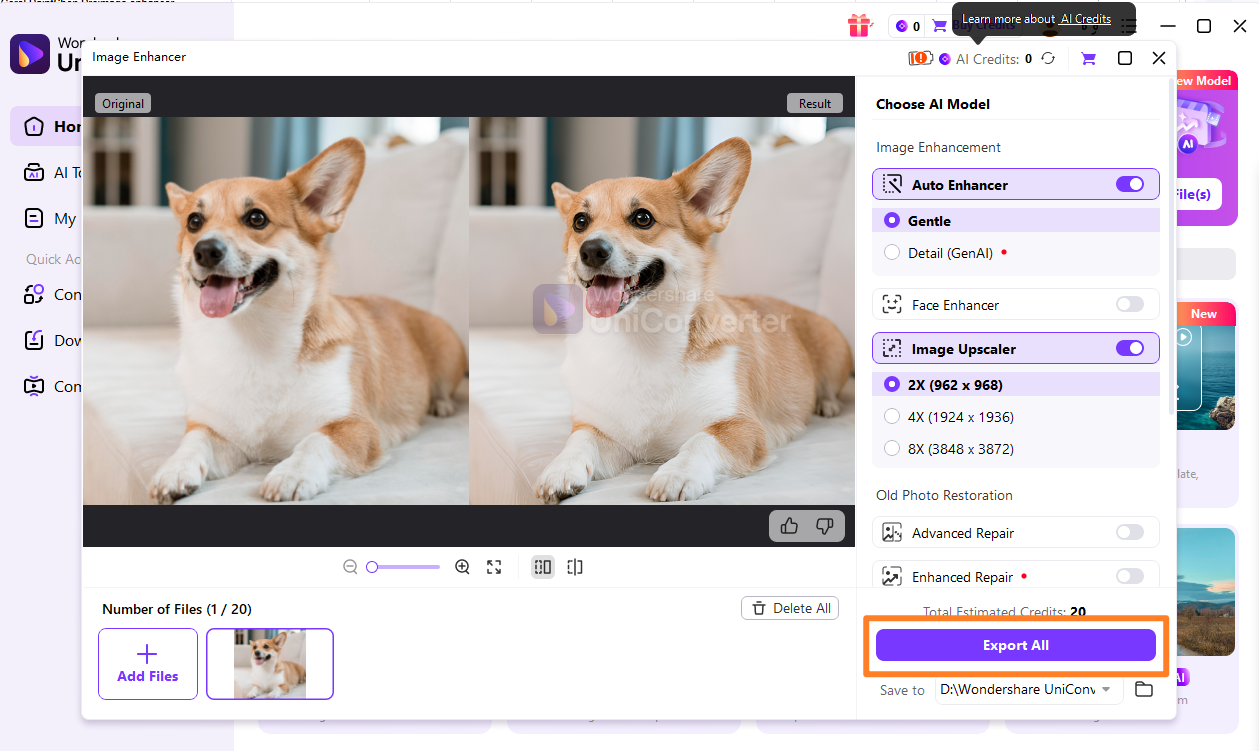
Step 4: Preview and Save the Enhanced Images
After selecting your desired enhancement settings, UniConverter will process the images. You can preview the enhanced results alongside the original to compare. Once satisfied, click the "Export" or "Save" button to save your high-quality, enhanced images to your chosen destination folder.

Claid.ai Alternative for Image Enhancement?
Part 7: Conclusion
After extensively using and comparing various image enhancement tools, including Claid.ai image enhancer review, I've come to a clear understanding of their strengths and weaknesses. Claid.ai is an excellent choice for businesses and professionals who require automated, large-scale image enhancement, particularly for e-commerce product photography, thanks to its advanced AI and API integration. Its ability to restore details and process batches efficiently is a significant time-saver. However, its subscription model and cloud-based nature might not suit everyone. For casual users, hobbyists, or those with privacy concerns, the recurring cost and reliance on internet connectivity could be drawbacks. If your needs are more sporadic, or if you prioritize local processing, a one-time purchase solution like UniConverter offers a compelling alternative, providing robust enhancement capabilities alongside a suite of other media tools without ongoing fees. Ultimately, the best tool balances cost, performance, and your specific workflow requirements.
Part 8: FAQs
-
1. What types of images does Claid.ai enhance best?
Claid.ai excels at enhancing product photography, real estate images, and general photos that require upscaling, denoising, and sharpening for a clean, professional look. It's particularly good for improving image quality for web and digital display.
-
2. Is Claid.ai suitable for large-scale image processing?
Absolutely. Claid.ai is designed with batch processing and API integration in mind, making it highly suitable for businesses and workflows that need to process hundreds or thousands of images efficiently.
-
3. How does Claid.ai compare to Photoshop's enhancement tools?
Claid.ai offers automated, AI-driven enhancement, which is faster for batch processing and requires less manual skill than Photoshop. Photoshop provides much more granular control and a wider range of creative editing tools, making it better for highly customized, artistic enhancements. Claid.ai is for efficiency; Photoshop is for ultimate control.
-
4. Are there any free alternatives to Claid.ai?
While there aren't many free tools that offer the same level of AI sophistication and batch processing as Claid.ai, some online tools provide basic image upscaling or enhancement for free, often with limitations on file size, resolution, or daily usage. GIMP is a free, open-source alternative for manual editing, but it lacks AI automation.
-
5. What are the privacy implications of using AI image enhancers?
Using cloud-based AI image enhancers means uploading your images to external servers, which can raise privacy concerns, especially for sensitive content. It's crucial to review the service provider's privacy policy to understand how your data is handled, stored, and used. Local processing tools like UniConverter offer better privacy as your images never leave your computer.
