
- Chainner Overview: Open-source, node-based AI video enhancer for deep customization.
- Core Features: Advanced AI for upscaling, denoising; modular workflow; community models.
- Pros & Cons: Free, flexible, high quality; steep learning curve, resource-intensive.
- Target Users: Tech-savvy professionals for restoration; not for quick social media edits.
- Comparison: Chainner offers high AI customization, low ease of use, free.
- UniConverter Value: User-friendly, fast, efficient alternative for reliable enhancement.
- Risks: Privacy with unverified models, AI artifacts, high hardware demands, no dedicated support.
- Decision Factor: Choose Chainner for control and expertise; UniConverter for ease and speed.
In this article
- Part 1: What is Chainner AI Video Enhancer?
- Part 2: Chainner AI Video Enhancer: Core Features, Pros, and Cons
- Part 3: Target Users and Use Cases
- Part 4: Chainner AI Video Enhancer and Alternatives Comparison
- Part 5: Risks and Pitfalls of Using Chainner AI Video Enhancer
- Part 6: How to Use UniConverter for Efficient Video and Image Enhancement
- Part 7: Conclusion
- Part 8: FAQs
Chainner AI Video Enhancer: A Comprehensive Review and Comparison
The landscape of video production and archiving is rapidly evolving, driven by advancements in Artificial Intelligence. AI video enhancement tools have emerged as game-changers, offering the ability to breathe new life into old footage, upscale low-resolution content, and remove imperfections with unprecedented precision. This Chainner AI Video Enhancer review delves into one such powerful, open-source solution, examining its core functionalities, ideal use cases, and comparing it against established commercial alternatives. We will explore how Chainner stands out in a crowded market, particularly for users seeking deep customization and control, while also highlighting its limitations and potential pitfalls. This comprehensive analysis aims to equip professionals and enthusiasts alike with the insights needed to make informed decisions about their video enhancement workflows.
Part 1: What is Chainner AI Video Enhancer?
Chainner AI Video Enhancer is an open-source, node-based image and video processing tool that leverages advanced AI models for tasks such as upscaling, denoising, deinterlacing, and general quality improvement. Unlike many commercial solutions that offer a black-box approach, Chainner provides users with granular control over the entire enhancement pipeline, allowing for the integration of various AI models and custom workflows. This flexibility stems from its community-driven development, fostering an environment where users can contribute and share their own models and configurations. The tool is designed for users who require precise control over their video enhancement processes, often dealing with challenging source material that demands tailored solutions.
Market Background and User Pain Points:
* Legacy Footage Restoration: Many archives and content creators possess vast libraries of low-resolution, degraded footage that needs to be brought up to modern standards.
* Quality Discrepancies: Users often face inconsistencies in video quality across different sources, requiring a robust tool to unify and enhance their content.
* Cost of Commercial Solutions: High-end commercial video enhancement software can be prohibitively expensive, pushing users towards more accessible, yet powerful, alternatives.
* Lack of Customization: Generic enhancement tools often lack the specific controls needed to address unique video artifacts or achieve desired aesthetic outcomes.
Part 2: Chainner AI Video Enhancer: Core Features, Pros, and Cons
Chainner AI Video Enhancer is built around a modular, node-based interface, allowing users to construct complex processing chains. Its core capabilities revolve around leveraging state-of-the-art AI models for various video enhancement tasks. This includes advanced super-resolution for upscaling videos to higher resolutions, sophisticated noise reduction algorithms to clean up grainy footage, and deinterlacing to convert interlaced video into progressive scan. The platform also supports a wide array of image and video formats, ensuring broad compatibility for diverse projects. Furthermore, its open-source nature means it continuously benefits from community contributions, leading to a growing library of specialized models and features.
* Advanced AI algorithms for superior upscaling and noise reduction.
* Highly customizable enhancement parameters for professional users.
* Node-based workflow for building complex processing pipelines.
* Support for a wide range of AI models, including community-contributed ones.
* Open-source and community-driven development for continuous improvement.
* Pros:
* Unparalleled flexibility and customization through its node-based system and open-source models.
* Potentially superior quality for specific, challenging enhancement tasks due to fine-grained control.
* Completely free to use, making it accessible to a wider audience.
* Cons:
* Steep learning curve for beginners due to its technical nature and lack of a simplified interface.
* Requires significant computational resources, particularly a powerful GPU, for efficient processing.
Part 3: Target Users and Use Cases
Chainner AI Video Enhancer is primarily designed for tech-savvy professionals, researchers, and enthusiasts who demand granular control over their video enhancement workflows. Its complexity and powerful customization options make it less suitable for casual users seeking quick, automated solutions.
* Best Use Case: Professional Video Restoration and Archiving
* Scenario: A film archivist needs to restore old, low-resolution footage with significant grain and artifacts to modern standards for digital preservation and re-release. Chainner's granular control over AI models and parameters allows for precise restoration, targeting specific types of degradation. The archivist can experiment with different denoising models, upscaling algorithms, and even custom-trained models to achieve the best possible outcome for historically significant content, ensuring the preservation of detail while removing imperfections.
* Limited Use Case: Quick Social Media Video Enhancement
* Scenario: A social media content creator wants to quickly improve the quality of a short, low-resolution clip captured on a phone before posting. Chainner's complex interface and time-consuming processing make it less ideal for rapid, on-the-go enhancements where speed and simplicity are prioritized over absolute quality. The overhead of setting up a node graph and waiting for processing would be inefficient for a creator who needs to post content frequently and quickly. Simpler, automated tools are far more appropriate here.
Part 4: Chainner AI Video Enhancer and Alternatives Comparison
| Feature/Competitor | Chainner AI Video Enhancer | UniConverter | Topaz Video AI | DaVinci Resolve (Studio) |
| AI Model Customization | High (open-source, community models) | Low (pre-set models) | Medium (proprietary models) | Low (integrated AI features) |
| Ease of Use | Low (technical interface) | High (user-friendly GUI) | Medium (user-friendly GUI) | Medium (professional NLE) |
| Processing Speed | Varies (GPU dependent, can be slow) | Fast (optimized for GPU acceleration) | Fast (optimized for modern GPUs) | Fast (optimized for professional hardware) |
| Output Quality | Excellent (with expertise) | Good to Excellent | Excellent | Excellent (with expertise) |
| Cost | Free (open-source) | Paid (subscription/lifetime) | Paid (one-time license) | Free (basic), Paid (Studio) |
| Target Audience | Tech-savvy professionals, researchers | Casual users, content creators | Professional videographers, enthusiasts | Video editors, colorists |
Key Differentiators: Open-Source Flexibility vs. Commercial Polish
Chainner AI Video Enhancer stands out with its open-source flexibility, offering unmatched customization for users willing to invest time in learning its intricacies. This allows for highly specialized enhancement workflows that might not be possible with off-the-shelf solutions. UniConverter, on the other hand, excels in user-friendliness and speed for general enhancement tasks, making it ideal for casual users and content creators needing quick, reliable results without deep technical knowledge. Topaz Video AI provides a balance, offering powerful proprietary AI models with a more accessible interface than Chainner, catering to professionals who value efficiency and high-quality output. DaVinci Resolve's Studio version integrates AI features within a comprehensive video editing suite, best suited for editors who need enhancement as part of a larger post-production workflow.
Part 5: Risks and Pitfalls of Using Chainner AI Video Enhancer
While Chainner offers powerful capabilities, its open-source nature and technical demands come with several potential risks and pitfalls that users should be aware of before committing to the platform.
Privacy Concerns with Community Models
As Chainner supports community-contributed AI models, there's a potential risk associated with using models from unverified sources. These models could theoretically contain malicious code or be designed to collect data, posing a privacy and security risk, especially when processing sensitive footage. Users must exercise caution and ideally stick to well-vetted models from trusted contributors.
Potential for "AI Artifacts" and Unnatural Results
Despite advanced algorithms, AI video enhancement is not perfect. Chainner, like other AI tools, can sometimes introduce "AI artifacts" – unnatural textures, distortions, or overly smooth areas – if parameters are not tuned correctly or if the source material is severely degraded. Achieving a natural-looking enhancement requires expertise and careful adjustment, which can be time-consuming.
Hardware Requirements and Performance Bottlenecks
Chainner is resource-intensive, particularly requiring a powerful GPU with substantial VRAM for efficient processing. Without adequate hardware, enhancement tasks can be extremely slow, rendering the tool impractical for large projects or users with older systems. This can be a significant barrier to entry for many potential users.
Lack of Dedicated Customer Support
Being an open-source project, Chainner does not offer dedicated customer support. Users must rely on community forums, documentation, and their own problem-solving skills to troubleshoot issues. This can be a major drawback for professionals who require timely assistance for mission-critical projects.
Compatibility Issues with Different Operating Systems
While Chainner aims for broad compatibility, open-source projects can sometimes encounter more frequent or complex compatibility issues across different operating systems or hardware configurations. Users might need to spend time resolving dependencies or compiling the software, which adds to the technical overhead.
Part 6: How to Use UniConverter for Efficient Video and Image Enhancement
When other tools fall short, offering unstable enhancements, weak effects, or lacking batch processing capabilities, UniConverter emerges as a robust and user-friendly alternative. It provides a streamlined experience for enhancing videos and images without the complexities of open-source tools or the limitations of basic software. UniConverter boasts a clean interface, supports a vast array of formats, leverages GPU acceleration for fast processing, and ensures stable, lossless quality improvements. It's an all-in-one solution for those seeking reliable and efficient media enhancement. For instance, its capabilities extend to advanced features like a background replacer for videos, allowing users to easily change video backgrounds or even remove backgrounds without losing quality.
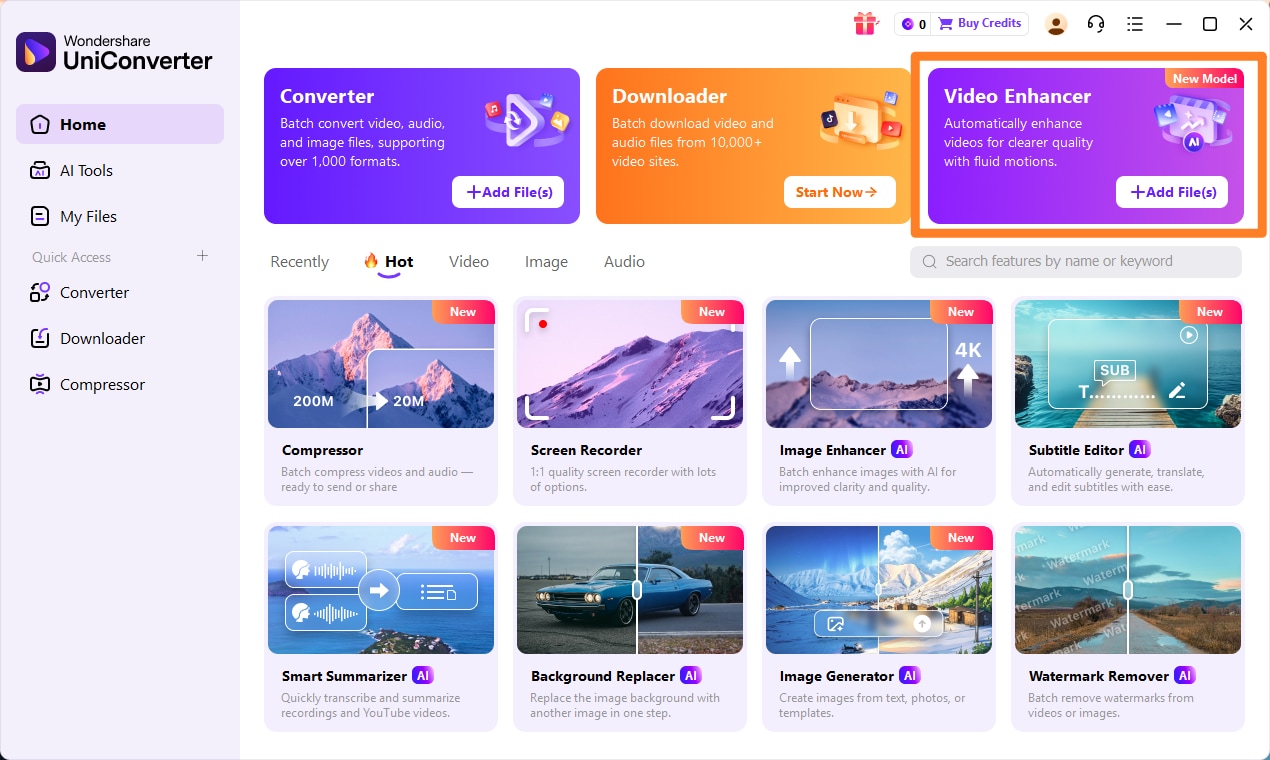
Step 1: Open UniConverter and Choose Video Enhancer
Launch UniConverter on your computer. From the main interface, navigate to the "Toolbox" section and select the "Video Enhancer" feature.
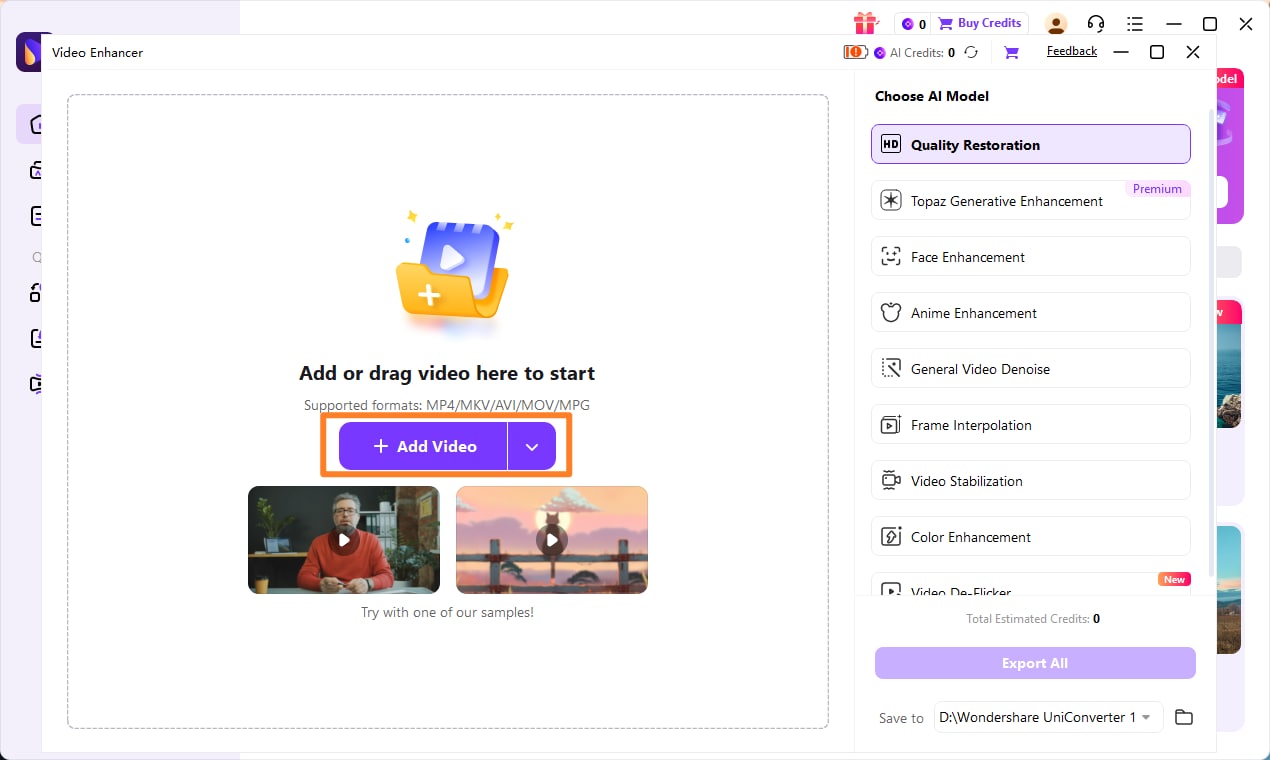
Step 2: Upload the Videos
Click on the "Add Files" button or drag and drop the video files you wish to enhance into the UniConverter window. You can add multiple videos for batch processing.
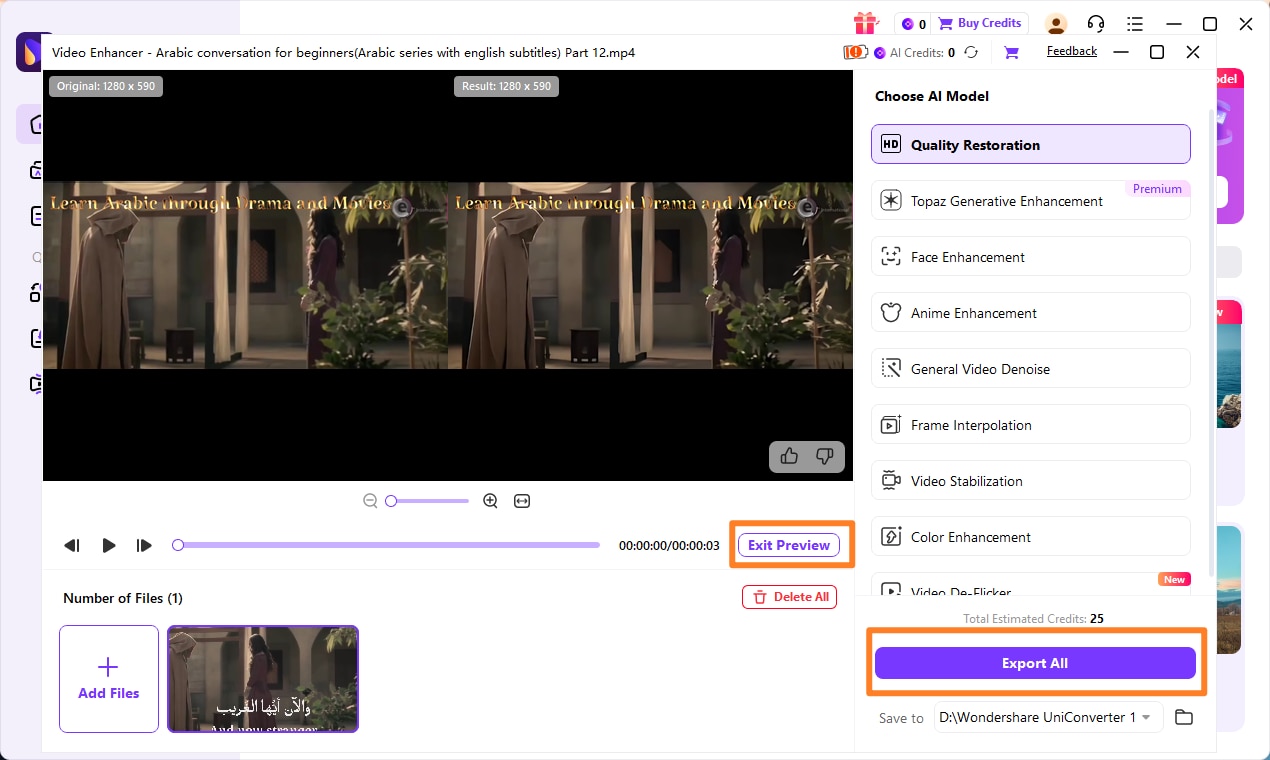
Step 3: Choose Enhancement Model
Once your videos are loaded, UniConverter will present various enhancement options. Select the desired AI model or enhancement features such as "Upscale," "Denoise," "Stabilize," or "Optimize Brightness and Contrast." Adjust any specific parameters as needed.

Step 4: Preview and Save the Enhanced Video
After selecting your enhancement options, click "Preview" to see the potential results. If satisfied, choose your desired output format and destination folder, then click "Enhance" to start the process and save your improved video.

Chainner AI Video Enhancer Alternative?
Part 7: Conclusion
This Chainner AI Video Enhancer review highlights its position as a powerful, open-source tool offering unparalleled customization for video enhancement. Its node-based workflow and access to a vast array of AI models make it an ideal choice for tech-savvy professionals and researchers tackling complex restoration or upscaling projects. However, its steep learning curve, significant hardware demands, and lack of dedicated support mean it's not for everyone. For users prioritizing ease of use, speed, and reliable, high-quality results without the technical overhead, commercial alternatives like UniConverter or Topaz Video AI offer compelling solutions. UniConverter, in particular, stands out for its user-friendly interface and efficient batch processing, catering to a broader audience from casual users to content creators. The future of AI video enhancement will likely see a continued blend of open-source innovation and polished commercial offerings, each serving distinct user needs and technical proficiencies.
Part 8: FAQs
-
1. Is Chainner AI Video Enhancer completely free to use?
Yes, Chainner is an open-source project and is free to download and use.
-
2. What kind of hardware do I need to run Chainner effectively?
A powerful GPU (NVIDIA or AMD) with ample VRAM (at least 8GB, preferably more) is highly recommended for efficient processing, especially for 4K video.
-
3. Can Chainner improve the quality of highly compressed videos?
While Chainner can help, heavily compressed videos with significant data loss may still show limitations in quality improvement. AI can't invent information that isn't there.
-
4. How does Chainner compare to Topaz Video AI in terms of output quality?
Both can achieve excellent results. Chainner offers more granular control over AI models and parameters, potentially leading to more tailored and sometimes superior results for specific, challenging scenarios if the user has the expertise. Topaz Video AI is generally more user-friendly and optimized for a wider range of common enhancement tasks.
-
5. Is there a mobile version of Chainner AI Video Enhancer?
No, Chainner is primarily a desktop application and requires significant computational power, making a mobile version impractical.
