
- Canva Enhancer: Great for quick, basic edits within Canva for casual users.
- Limitations: Lacks advanced customization, professional features, and requires a Pro subscription.
- Ideal Use: Perfect for social media posts and simple content creation, prioritizing speed and ease.
- Alternatives: UniConverter offers robust, stable enhancement, batch processing, and offline capabilities.
- Decision: Choose Canva for convenience; UniConverter for comprehensive, high-quality image enhancement.
In this article
- Part 1: What is Canva Photo Enhancer?
- Part 2: Canva Photo Enhancer: Core Features, Pros, and Cons
- Part 3: Who is Canva Photo Enhancer For? Ideal Scenarios and Limitations
- Part 4: Canva Photo Enhancer and Alternatives Comparison
- Part 5: Risks and Pitfalls to Consider
- Part 6: How to Use UniConverter for Comprehensive Image Enhancement
- Part 7: Conclusion
- Part 8: FAQs
Canva has become a household name for graphic design, and their Canva Photo Enhancer review delves into a crucial aspect for many content creators: making images pop. In a world saturated with visuals, a well-enhanced photo can be the difference between a scroll and a stop. This review will explore Canva's offering, comparing it to other tools in the market, and help you understand if it's the right fit for your image enhancement needs. We'll cover its features, ideal use cases, potential pitfalls, and even suggest a robust alternative for more demanding tasks.
Part 1: What is Canva Photo Enhancer?
Canva Photo Enhancer is Canva's integrated tool designed to improve the quality and appearance of your images directly within their design platform. For me, it felt like a natural extension of their existing ecosystem, making it incredibly convenient if you're already a Canva user. My initial thought was, "Great, one less tool to open!" It aims to simplify the often complex process of photo editing, making it accessible to anyone, regardless of their prior experience with image manipulation. This review will address the core question: how effective is it for enhancing photos, especially when stacked against dedicated image enhancement software?
The Growing Need for Accessible Image Enhancement
The demand for quick and effective image enhancement tools has surged, driven by several factors:
* Social Media's Visual Dominance: Platforms like Instagram and TikTok thrive on high-quality visuals, pushing users to present their best images.
* Content Creation Boom: Bloggers, small businesses, and marketers constantly need engaging visuals for their content.
* Smartphone Photography: With everyone carrying a powerful camera in their pocket, the sheer volume of photos being taken necessitates easy enhancement options.
Part 2: Canva Photo Enhancer: Core Features, Pros, and Cons
From my experience, Canva Photo Enhancer offers a straightforward approach to improving images. Its core capabilities revolve around basic adjustments and AI-driven enhancements. I found it particularly useful for quick fixes when I didn't want to dive into more complex software.
Here are some of its core capabilities:
* Brightness and Contrast Adjustment: Basic controls to lighten or darken images and adjust the difference between light and dark areas.
* Saturation and Tint Control: Allows you to make colors more vibrant or muted, and adjust the overall color cast.
* Sharpening: A simple slider to make details in your image appear crisper.
* Vignette Effect: Adds a darkening or lightening effect around the edges of your photo.
* AI-Powered Auto Enhance: A one-click solution that attempts to automatically improve your image's overall appearance.
Pros:
* Intuitive User Interface for Quick Edits: I loved how easy it was to navigate. Everything felt self-explanatory, which is a huge plus when you're in a hurry.
* Seamless Integration within the Canva Ecosystem: Being able to enhance an image and then immediately drop it into a design without exporting and re-importing is a massive time-saver for me.
* AI-Powered Enhancements for Common Photo Issues: The "Auto Enhance" button often gave decent results for minor adjustments, saving me from fiddling with multiple sliders.
Cons:
* Limited Advanced Customization Options: If you're looking for granular control over specific colors or advanced retouching, you'll quickly hit a wall. I often wished for more precise control.
* Subscription Required for Premium Features: While there's a free tier, many of the more impactful enhancement tools are locked behind a Canva Pro subscription, which can be a bit frustrating.
Part 3: Who is Canva Photo Enhancer For? Ideal Scenarios and Limitations
Based on my usage, Canva Photo Enhancer is definitely geared towards a specific audience. If you're like me and need quick, decent results without a steep learning curve, it's a solid choice.
Best Use Case: Quick Social Media Post Preparation
For me, this is where Canva Photo Enhancer shines. When I'm preparing a social media post and just need to brighten an image, boost its colors slightly, or add a quick filter, Canva is my go-to. It's perfect for content creators, small business owners, or anyone who needs to make their photos look presentable for online sharing without spending a lot of time. The speed and convenience are unmatched in this scenario.
Limited Use Case: Professional Photography Retouching
However, if you're a professional photographer or someone who needs high-end retouching, Canva Photo Enhancer simply won't cut it. I tried using it for more complex tasks like skin retouching or detailed color grading, and it quickly became apparent that it lacks the precision and advanced tools required. For those kinds of jobs, you'll need dedicated photo editing software. It's not designed for pixel-level adjustments or intricate manipulations.
Part 4: Canva Photo Enhancer and Alternatives Comparison
When I started looking into image enhancers, I realized there's a whole spectrum of tools out there. Here's how Canva Photo Enhancer stacks up against some popular alternatives, including UniConverter, which I've found to be incredibly versatile.
| Feature/Tool | Canva Photo Enhancer | UniConverter | Adobe Lightroom | Fotor |
| Ease of Use | High | High | Medium | High |
| AI Enhancement | Basic | Advanced (upscaling, denoising) | Advanced (auto adjustments, content-aware fill) | Basic |
| Customization | Limited | Moderate (batch processing, format conversion) | Extensive (manual controls, presets) | Moderate |
| Price | Freemium | One-time purchase/Subscription | Subscription | Freemium |
| Processing Speed | Fast | Very Fast (GPU acceleration) | Moderate | Fast |
| Output Quality | Good | Excellent (lossless options) | Excellent | Good |
| Customer Support | Email/Help Center | 24/7 Live Chat/Email | Extensive Community/Support | Email/Help Center |
| Security | Cloud-based | Local processing option | Cloud-based | Cloud-based |
Key Differentiators: User-Friendliness vs. Advanced Control
From my perspective, the biggest takeaway here is the trade-off between user-friendliness and advanced control. Canva Photo Enhancer is incredibly easy to pick up and use, making it ideal for quick, basic enhancements. However, if you need more sophisticated AI capabilities like intelligent upscaling or denoising, or if you require extensive manual control over every aspect of your image, tools like UniConverter or Adobe Lightroom are far superior. Fotor sits somewhere in the middle, offering a bit more than Canva but still not reaching the professional-grade capabilities of Lightroom. For me, UniConverter stands out for its balance of ease of use and powerful, stable enhancement features, especially when I need to process multiple images without compromising quality.
Part 5: Risks and Pitfalls to Consider
While Canva Photo Enhancer is convenient, I've learned that it's important to be aware of some potential downsides, especially when relying on cloud-based tools. It's not always as straightforward as it seems.
Data Privacy Concerns with Cloud-Based Editing
One of my primary concerns, and something I always think about with cloud services, is data privacy. When I upload my photos to Canva, they're stored on their servers. While Canva states they have security measures, I always wonder: who has access to my images? How long are they stored? For sensitive or personal photos, this is a significant consideration. It's a trade-off for the convenience of cloud editing.
Upselling and Subscription Pressure
I've noticed that while Canva offers a free tier, many of the truly useful or "better" enhancement features are often locked behind their Pro subscription. It can feel like a constant push to upgrade, which can be annoying if you're trying to stick to a budget. I often found myself wishing a certain filter or tool was available in the free version, only to be met with a "Pro" badge.
Potential for Over-Processed or Unnatural Results
The AI-powered enhancements, while convenient, can sometimes be a double-edged sword. I've experienced instances where the "Auto Enhance" feature made my photos look a bit too artificial or over-processed. Colors might become oversaturated, or details might look unnaturally sharp. It's a quick fix, but not always the most aesthetically pleasing one, and it often requires manual tweaking afterward.
Dependence on Internet Connectivity
This is a practical pitfall I've run into. Since Canva Photo Enhancer is entirely web-based, if my internet connection is slow or drops, I'm completely out of luck. There's no offline mode, which can be a real hindrance if I'm working remotely or in an area with unreliable Wi-Fi. It means I can't just quickly enhance a photo on the go without a stable connection.
Part 6: How to Use UniConverter for Comprehensive Image Enhancement
When I find myself needing more robust image enhancement, especially for tasks that Canva struggles with, I often turn to UniConverter. It's been a reliable alternative for me, particularly when I need consistent quality, batch processing, or when other tools just aren't cutting it. UniConverter avoids the common pitfalls of unstable enhancement, weak effects, and lack of batch processing that I've encountered with some online tools. It offers a comprehensive solution with no ads, extensive format support, GPU acceleration for speed, stable lossless image enhancement, and efficient batch processing. It's my go-to for an all-in-one solution to enhance images or even upscale video.
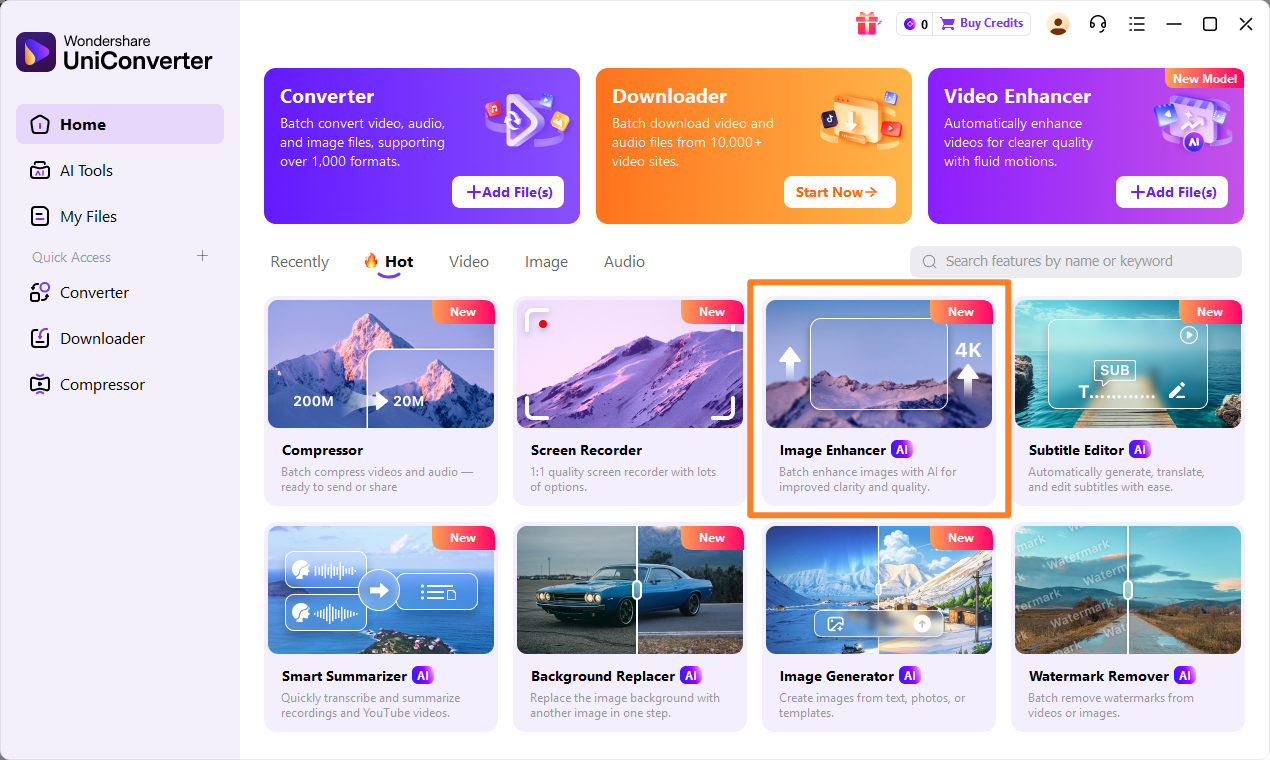
Step 1: Open UniConverter and Choose Image Enhancer
Launch Wondershare UniConverter on your computer. From the main interface, go to the Image section and select AI Image Enhancer.
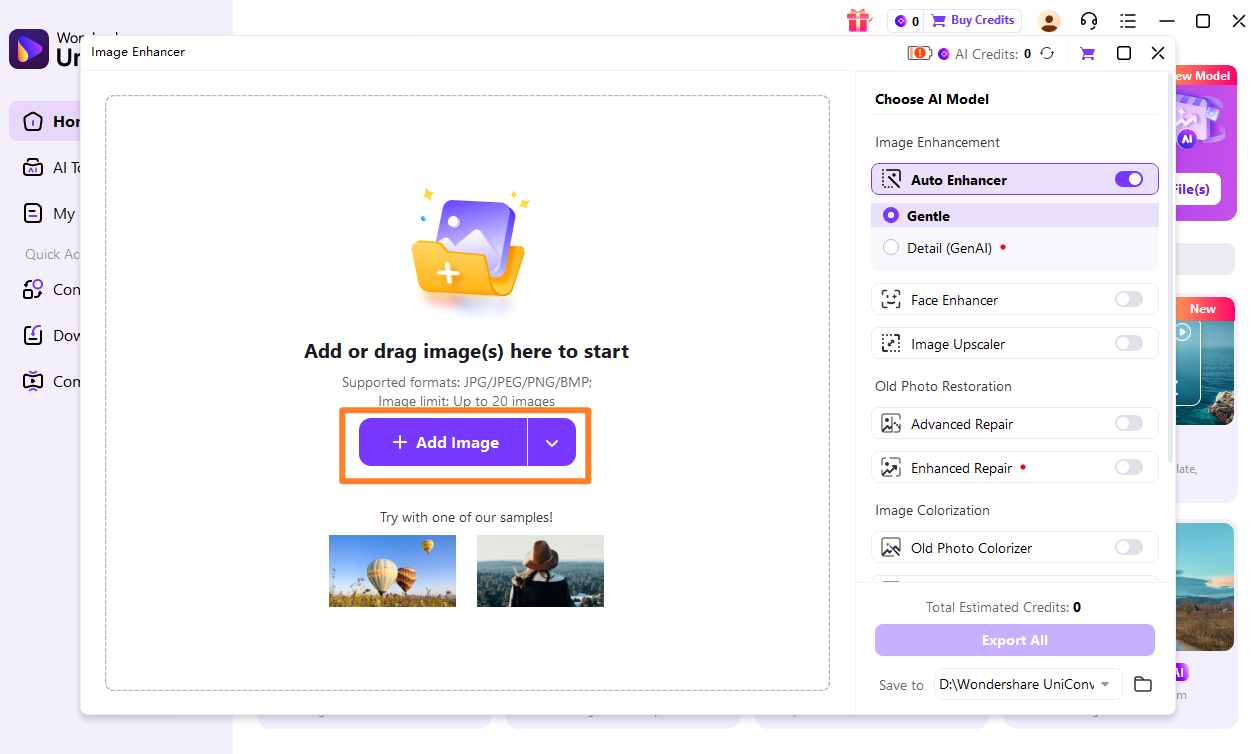
Step 2: Upload the Images
Click the “+ Add Files” button or drag and drop your images into the program. You can upload one or multiple images for batch processing.
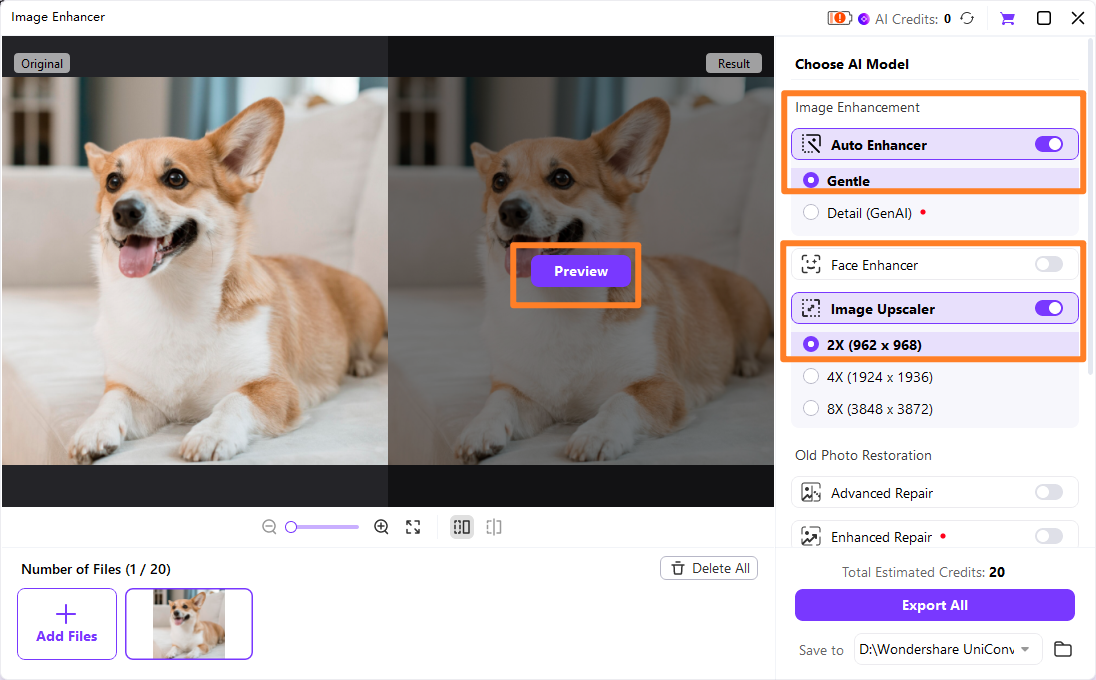
Step 3: Choose Enhancement Model
Select the most suitable AI enhancement model based on your needs, such as Image Upscaler, Portrait Enhancer, or Old Photo Restoration. Adjust settings if necessary.
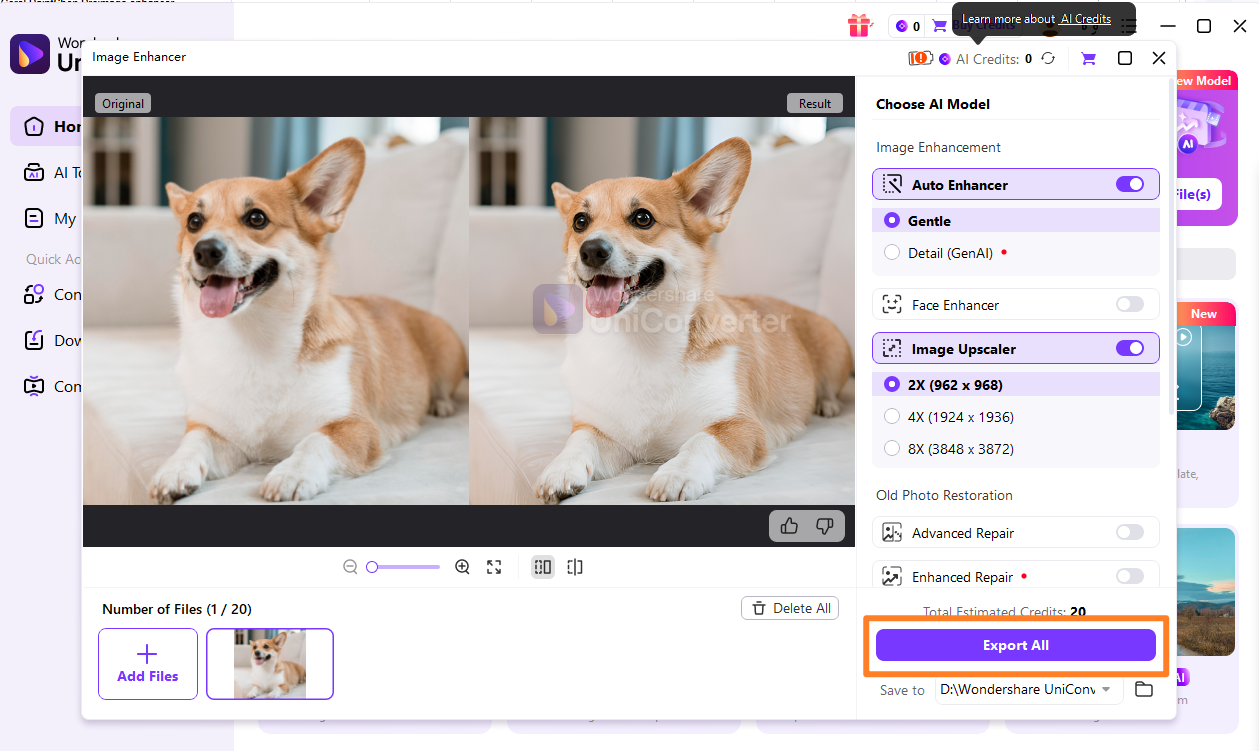
Step 4: Preview and Save the Enhanced Images
Click Preview to check the results. Once satisfied, choose the output location and click Export to save your enhanced images.

Seeking a Powerful Canva Photo Enhancer Alternative?
Part 7: Conclusion
In conclusion, my Canva Photo Enhancer review highlights its strengths as a user-friendly, integrated tool perfect for quick, basic image adjustments within the Canva ecosystem. It excels for casual users and social media enthusiasts who prioritize speed and simplicity for everyday content creation. For small businesses and content creators, it offers a convenient way to maintain a consistent visual brand without needing specialized photo editing skills. However, its limitations in advanced customization and the reliance on a subscription for premium features mean it falls short for professional photographers and graphic designers who require granular control, high-fidelity retouching, or robust batch processing capabilities. For those demanding more comprehensive and stable enhancement, especially with features like AI upscaling, denoising, and offline processing, dedicated software like UniConverter presents a more powerful and versatile alternative.
Part 8: FAQs
-
1. Is Canva Photo Enhancer truly free?
While Canva offers a free tier, many advanced photo enhancement features require a Canva Pro subscription.
-
2. Can Canva Photo Enhancer fix blurry photos?
It can improve slightly blurry photos, but it's not designed for severely out-of-focus images.
-
3. How does Canva Photo Enhancer compare to Photoshop?
Canva is much simpler and more user-friendly for basic enhancements, while Photoshop offers far more powerful and granular control for professional editing.
-
4. Is my data safe when using Canva Photo Enhancer?
Canva has security measures in place, but as with any cloud-based service, users should be aware of their privacy policy regarding uploaded content.
-
5. Can I use Canva Photo Enhancer offline?
No, Canva Photo Enhancer requires an active internet connection as it's a web-based tool.
