
- BasicVSR Value: Discover BasicVSR's cutting-edge open-source video super-resolution for legacy footage, ideal for researchers and advanced users.
- Feature Comparison: Understand BasicVSR's core features, including advanced super-resolution and customization, versus its steep learning curve and hardware demands.
- Target Audience: Learn when BasicVSR excels (archival restoration) and when it's unsuitable (real-time streaming) based on its complexity.
- Alternative Analysis: Compare BasicVSR's free, highly customizable nature against user-friendly commercial alternatives like Topaz Video AI and UniConverter.
- Risks & Pitfalls: Be aware of BasicVSR's challenges: data privacy, uncanny valley artifacts, time-consuming tuning, hardware costs, and lack of support.
- UniConverter Solution: Explore UniConverter as a user-friendly, efficient alternative for high-quality video enhancement without BasicVSR's technical hurdles.
In this article
- Part 1: What is BasicVSR Video Enhancer?
- Part 2: BasicVSR Video Enhancer: Core Features, Pros, and Cons
- Part 3: Target Users and Usage Scenarios
- Part 4: BasicVSR and Alternatives Comparison
- Part 5: Risks and Pitfalls When Using BasicVSR
- Part 6: How to Use UniConverter for User-Friendly Video Enhancement
- Part 7: Conclusion
- Part 8: FAQs
The BasicVSR Video Enhancer review delves into a cutting-edge open-source solution for video super-resolution, a critical tool in an era where legacy footage often falls short of modern display standards. This review will explore BasicVSR's technical underpinnings, evaluate its strengths and weaknesses, and compare it against leading commercial alternatives like Topaz Video AI, DaVinci Resolve, and Adobe Premiere Pro. We aim to provide a comprehensive, scenario-based analysis to help users, from researchers to everyday content creators, make informed decisions about their video enhancement needs. Understanding the nuances of each tool is crucial for achieving optimal results, especially when balancing quality, ease of use, and cost.
Part 1: What is BasicVSR Video Enhancer?
BasicVSR is an advanced open-source video super-resolution framework, primarily developed by researchers, that leverages deep learning to significantly enhance the quality of low-resolution video footage. It stands at the forefront of AI-driven video enhancement, offering state-of-the-art algorithms for tasks like upscaling, denoising, and deblurring. This BasicVSR Video Enhancer review aims to dissect its capabilities, identify its ideal applications, and benchmark its performance against established commercial solutions. The core problem it addresses is the ubiquitous challenge of transforming older, often pixelated or blurry videos into high-definition content suitable for contemporary viewing platforms.
The Evolving Landscape of AI Video Enhancement
* Demand for Legacy Content Restoration: A growing need to revitalize archival footage for documentaries, historical preservation, and personal memories.
* Bridging Resolution Gaps: The disparity between older video formats and modern 4K/8K displays necessitates powerful upscaling solutions.
* Accessibility of AI Tools: The proliferation of AI has made sophisticated enhancement techniques more accessible, yet often with a steep learning curve for advanced models.
* User Expectations for Quality: Viewers now expect pristine visual quality, pushing the boundaries of what video enhancement tools must deliver.
Part 2: BasicVSR Video Enhancer: Core Features, Pros, and Cons
BasicVSR Video Enhancer offers robust capabilities for transforming low-resolution videos into higher-quality outputs. Its core strength lies in its sophisticated AI models designed for super-resolution, motion compensation, and artifact reduction.
Core Features:
* Advanced Super-Resolution: Utilizes deep learning models to upscale video resolution with remarkable detail preservation.
* Temporal Information Utilization: Leverages information across multiple frames to ensure temporal consistency and reduce flickering.
* Customizable Model Architectures: Allows for modification of its underlying neural network for specific enhancement tasks.
* Support for Various Formats: Capable of processing a wide range of video input formats, though output often requires conversion.
* Research-Grade Performance: Often incorporates the latest advancements in AI video enhancement research.
Pros:
* State-of-the-art Super-Resolution for Legacy Footage: Delivers exceptional quality for upscaling old, low-resolution videos.
* Open-Source Flexibility for Research and Customization: Ideal for developers and researchers to adapt and integrate.
* High Potential for Quality Improvement in Specific Scenarios: Can achieve results comparable to or exceeding commercial tools in controlled environments.
Cons:
* Steep Learning Curve and Technical Requirements: Demands significant technical expertise for setup, configuration, and operation.
* Resource-Intensive Processing and Hardware Demands: Requires powerful GPUs and substantial VRAM for efficient processing, making it inaccessible for many users.
Part 3: Target Users and Usage Scenarios
BasicVSR is not a tool for the casual user; its complexity and resource demands narrow its target audience considerably. It primarily caters to those with a strong technical background and specific, high-stakes video enhancement needs.
Optimal Scenario: Restoring Archival Footage for Documentary Filmmaking
For documentary filmmakers, archivists, or historical preservationists dealing with valuable, low-resolution archival footage, BasicVSR shines. Imagine a scenario where a documentary needs to incorporate decades-old 480p footage into a modern 4K production. BasicVSR, with its cutting-edge super-resolution capabilities, can meticulously upscale this footage, recovering lost details and significantly improving overall clarity. The time and effort invested in mastering BasicVSR's parameters are justified by the invaluable historical and artistic impact of the enhanced material, making it a powerful tool for professional post-production studios willing to invest in the technical expertise.
Limited Scenario: Real-time Video Enhancement for Live Streaming
BasicVSR is entirely unsuitable for real-time applications such as live streaming. Its computational demands and offline processing nature mean it cannot enhance video streams on the fly. Attempting to use BasicVSR for live content would result in significant latency, dropped frames, and an unmanageable workflow. For live streaming, users require lightweight, optimized solutions that can perform basic enhancements with minimal delay, a domain where BasicVSR simply does not compete.
Part 4: BasicVSR and Alternatives Comparison
This section provides a comparative analysis of BasicVSR against leading commercial and professional video enhancement tools, highlighting their performance across key metrics.
| Feature/Scenario | BasicVSR | Topaz Video AI | DaVinci Resolve (with AI plugins) | Adobe Premiere Pro (with AI plugins) |
| Ease of Use | Very Low | High | Medium | Medium |
| Output Quality (Specific Scenarios) | Excellent (Archival) | Excellent (General) | Good (Integrated) | Good (Integrated) |
| Processing Speed | Slow (GPU-dependent) | Moderate to Fast | Moderate | Moderate |
| Cost/Licensing | Free (Open-Source) | $299 (One-time) | Free (Basic), $295 (Studio) | $22.99/month (Subscription) |
| Customization | Very High | Low | Medium | Medium |
BasicVSR excels in deep customization and research-grade output quality, especially for highly specific, challenging enhancement tasks like archival restoration, provided the user possesses significant technical expertise. Topaz Video AI offers a highly user-friendly experience with excellent general-purpose enhancement, making it ideal for professionals seeking efficiency without deep technical dives. DaVinci Resolve and Adobe Premiere Pro, with their integrated AI plugins, provide convenient enhancement within existing professional editing workflows, though their dedicated enhancement capabilities might not match BasicVSR's specialized focus or Topaz's dedicated algorithms.
Part 5: Risks and Pitfalls When Using BasicVSR
Using BasicVSR, despite its powerful capabilities, comes with a unique set of challenges and potential pitfalls that users, especially those less technically inclined, should be aware of.
Data Privacy Concerns with Cloud-Based Implementations
While BasicVSR itself is a local, open-source tool, users might be tempted to run it on cloud-based GPU instances for faster processing. This introduces significant data privacy risks. Uploading sensitive or proprietary video footage to third-party cloud servers means relinquishing direct control over that data, potentially exposing it to unauthorized access or breaches. Users must carefully vet cloud providers and understand their data handling policies before processing any confidential material.
Potential for "Uncanny Valley" Artifacts in Enhanced Footage
AI-driven enhancement, particularly super-resolution, can sometimes introduce artifacts that make the enhanced footage look artificial or unsettling – a phenomenon often referred to as the "uncanny valley." While BasicVSR is state-of-the-art, aggressive upscaling or incorrect parameter tuning can lead to overly smooth skin textures, distorted facial features, or a plastic-like appearance that detracts from the natural look of the original video. Achieving a natural-looking enhancement requires careful balancing and often subjective judgment.
Significant Time Investment for Optimal Parameter Tuning
BasicVSR is not a plug-and-play solution. Achieving optimal results often requires extensive experimentation with various parameters, models, and configurations. This tuning process can be incredibly time-consuming, demanding a deep understanding of the underlying AI models and image processing concepts. Users must be prepared to dedicate significant hours to trial-and-error, rendering it impractical for projects with tight deadlines or for users seeking quick, automated results.
Hardware Upgrade Costs for Efficient Processing
The computational demands of BasicVSR are substantial. To run it efficiently and achieve reasonable processing times, users typically need high-end GPUs with ample VRAM (e.g., NVIDIA RTX 3080/4090 or equivalent). For many users, this necessitates a significant hardware upgrade, adding a considerable hidden cost to the "free" open-source solution. Without adequate hardware, processing even short video clips can take an unacceptably long time, negating the benefits of its advanced algorithms.
Lack of Dedicated Customer Support for Open-Source Projects
As an open-source project, BasicVSR lacks the dedicated customer support, official documentation, and user-friendly interfaces found in commercial software. Users encountering issues or seeking guidance must rely on community forums, GitHub issues, or their own problem-solving skills. This can be a major hurdle for individuals or small teams without in-house technical experts, leading to frustration and stalled projects.
Part 6: How to Use UniConverter for User-Friendly Video Enhancement
While BasicVSR offers unparalleled customization for advanced users, its complexity can be a significant barrier for many. For those seeking a more straightforward, efficient, and reliable solution for video enhancement, UniConverter stands out. It bypasses the steep learning curve and hardware demands of open-source tools, offering a user-friendly interface combined with powerful AI capabilities. UniConverter provides a stable, lossless, and batch-processing solution with GPU acceleration, supporting a vast array of formats without any ads or hidden costs, making it an all-in-one ultimate solution for everyday video enhancement needs. Users can easily fix pixelated videos or even upscale video to 4K with its intuitive features.
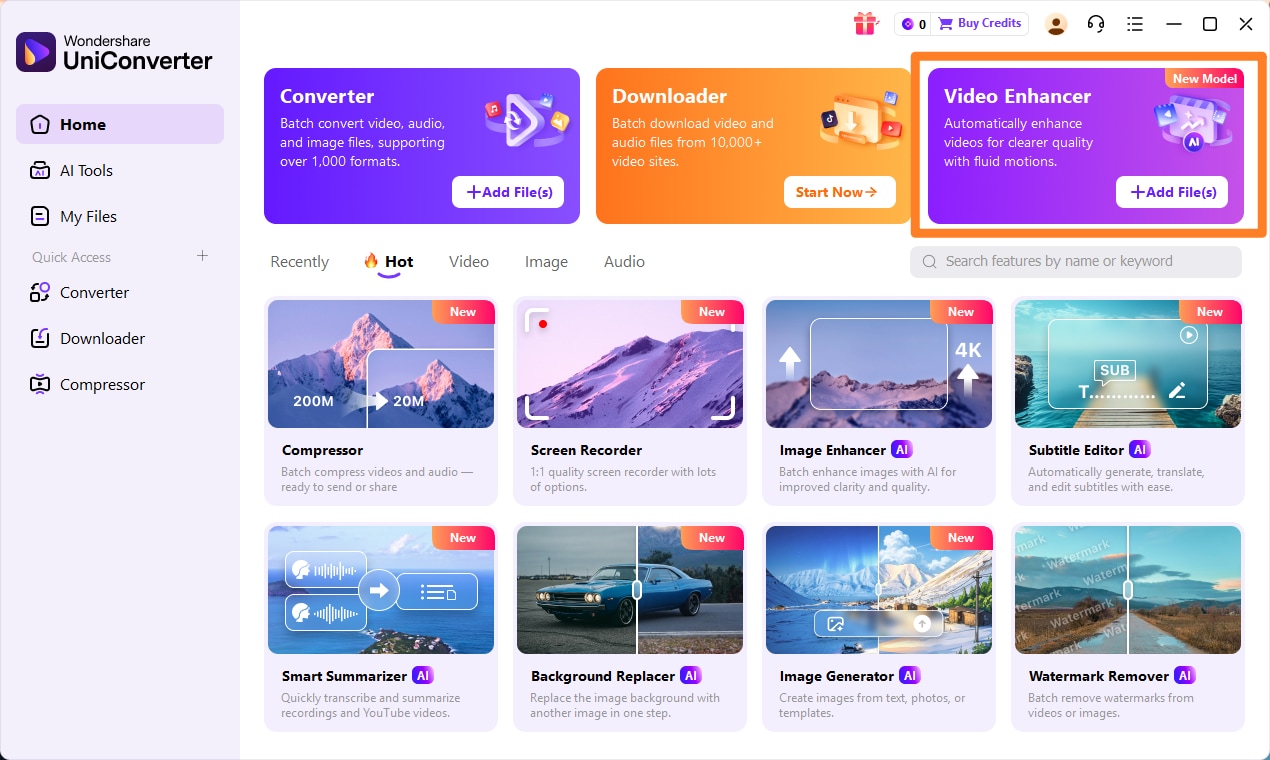
Step 1: Open UniConverter and Choose Video Enhancer
Launch UniConverter on your desktop. On the main interface, navigate to the "AI Lab" section and select the "Video Enhancer" tool. This will open the dedicated enhancement module.
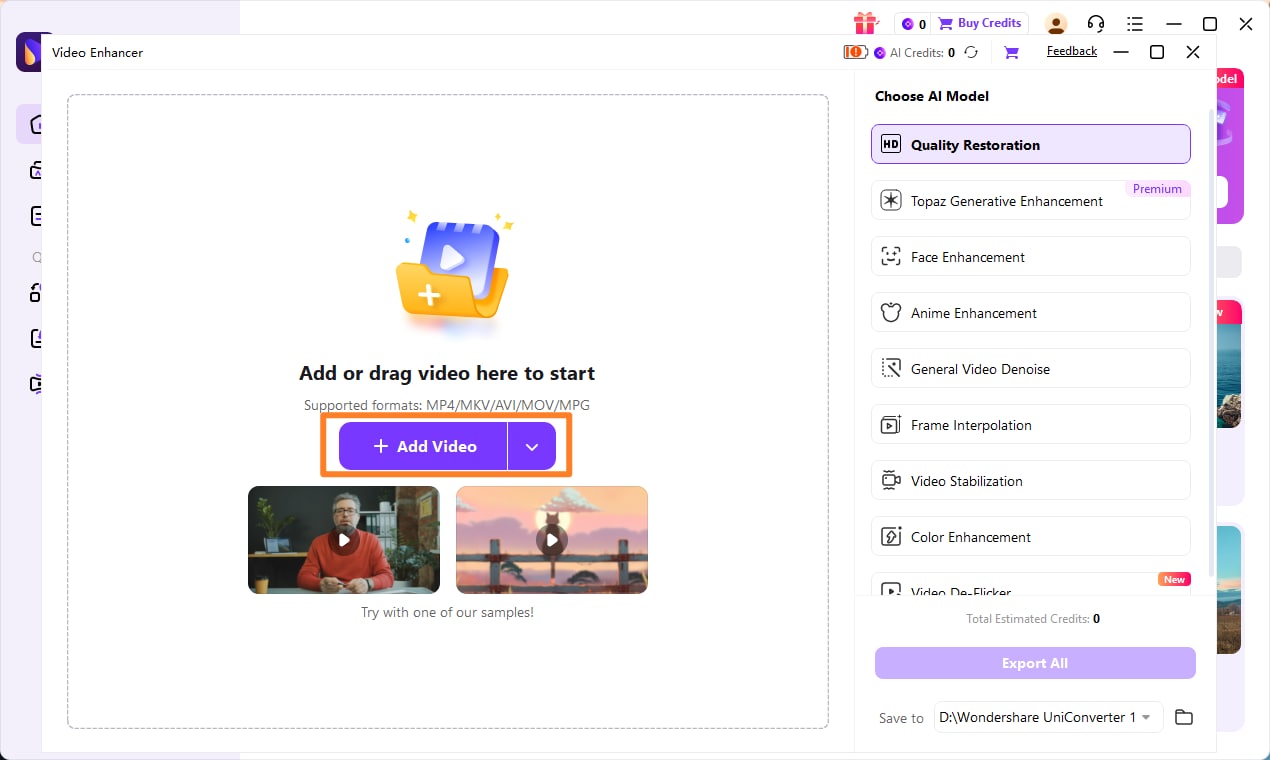
Step 2: Upload the Videos
Click on the "Add Files" button or simply drag and drop your low-resolution videos into the UniConverter interface. You can add multiple videos for batch processing.
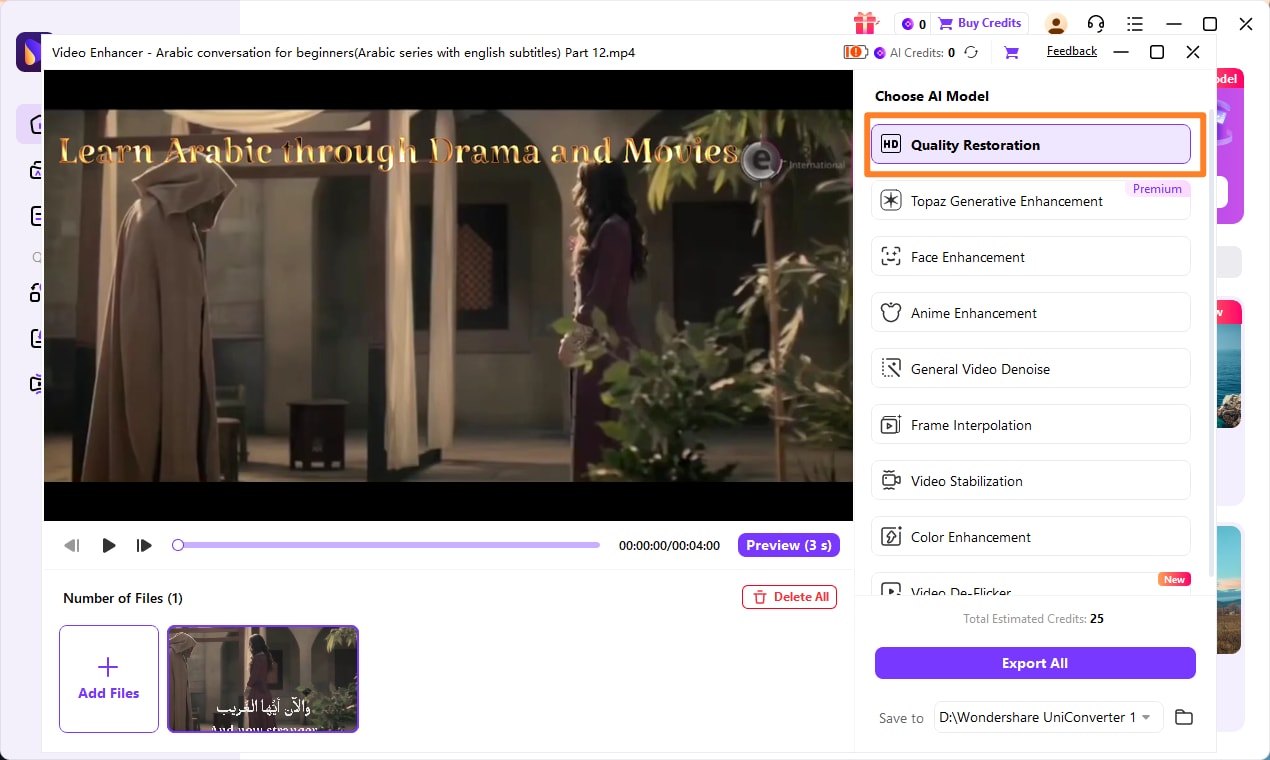
Step 3: Choose Enhancement Model and Adjust Parameters
UniConverter offers various AI enhancement models (e.g., General Denoise, Anime, Face, Interpolation). Select the model best suited for your video content. You can also adjust parameters like resolution, brightness, contrast, and saturation.
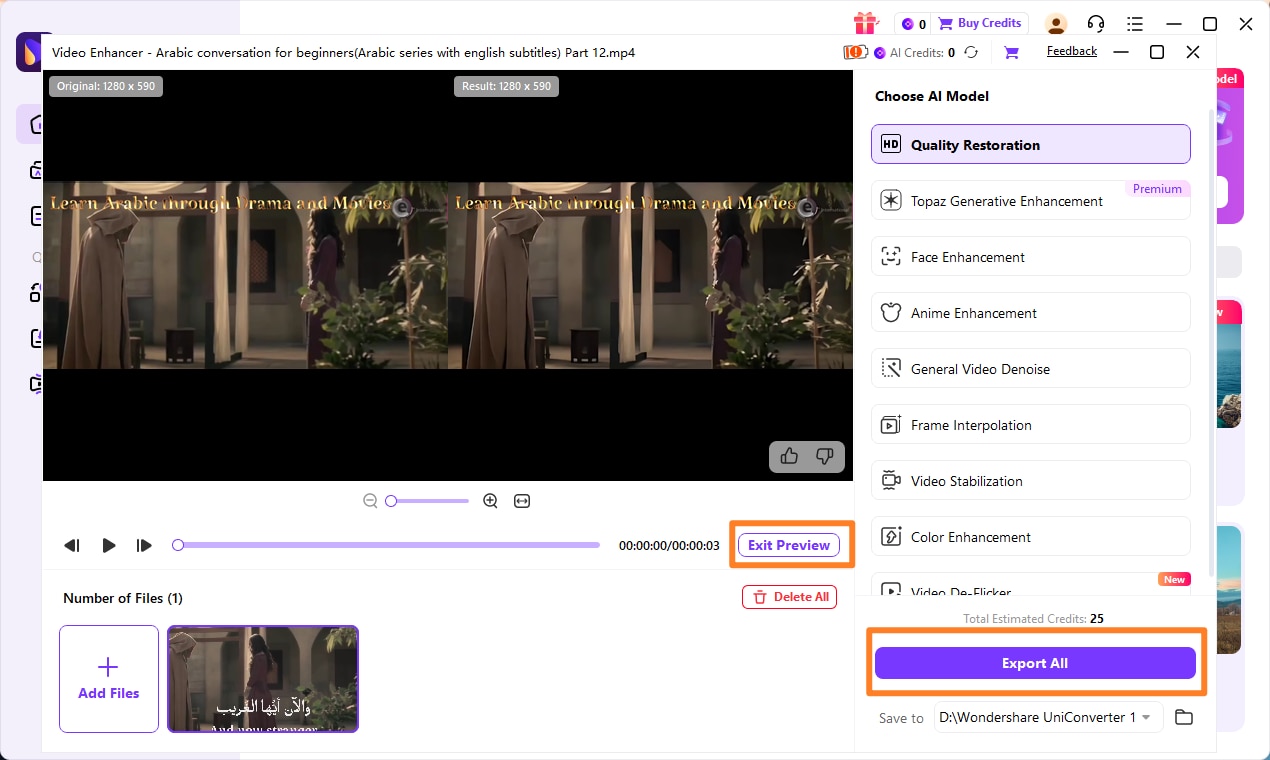
Step 4: Preview and Save the Enhanced Video
After selecting your desired settings, click "Preview" to see a short clip of the enhanced video. Once satisfied, choose your output format and destination folder, then click "Export" to save your high-quality enhanced video.

Enhance Videos Beyond BasicVSR with Ease
Part 7: Conclusion
The BasicVSR Video Enhancer review reveals a powerful, cutting-edge open-source tool best suited for researchers, developers, and advanced users with specific, high-stakes video enhancement projects, particularly in archival restoration. Its unparalleled customization and state-of-the-art algorithms come at the cost of a steep learning curve, significant hardware demands, and a lack of dedicated support. For the vast majority of users, including professionals and beginners seeking efficiency, ease of use, and reliable results without deep technical dives, commercial alternatives like Topaz Video AI or integrated solutions within DaVinci Resolve or Adobe Premiere Pro offer a more practical approach. UniConverter, in particular, stands out as an excellent all-in-one solution for everyday users, balancing quality, usability, and cost-effectiveness, making sophisticated video enhancement accessible to a broader audience. The choice ultimately depends on the user's technical proficiency, budget, and the specific requirements of their video enhancement tasks.
Part 8: FAQs
-
1. Is BasicVSR free to use?
Yes, BasicVSR is an open-source project, making it free to use. However, it requires technical expertise for setup and operation.
-
2. What kind of hardware do I need for BasicVSR?
BasicVSR is resource-intensive and benefits greatly from powerful GPUs (e.g., NVIDIA RTX series) with ample VRAM for efficient processing.
-
3. Can BasicVSR enhance old family videos?
Absolutely, BasicVSR can significantly improve the quality of old, low-resolution family videos, but it requires a hands-on approach.
-
4. How does BasicVSR compare to commercial video enhancers like Topaz Video AI?
BasicVSR offers cutting-edge research-grade enhancement with high customization, while commercial tools like Topaz Video AI prioritize user-friendliness and streamlined workflows.
-
5. Is BasicVSR suitable for real-time video enhancement?
Generally no. BasicVSR is designed for offline processing and is not optimized for real-time video enhancement due to its computational demands.
