
- AviSynth Unpacked: Discover AviSynth's script-based power for advanced video enhancement, perfect for technical users seeking ultimate control.
- Pros & Cons: Weigh AviSynth's unparalleled customization and open-source benefits against its steep learning curve and lack of GUI.
- Who Benefits Most: Learn if AviSynth suits your needs, from professional archiving to specific restoration, or if a simpler tool is better.
- Compare & Decide: See how AviSynth stacks against DaVinci Resolve, Premiere Pro, and Topaz Video AI for features, ease, and cost.
- Avoid Pitfalls: Understand the risks of scripting errors, compatibility issues, and time-consuming workflows with AviSynth.
- UniConverter Alternative: Explore UniConverter for an intuitive, AI-powered solution for efficient video enhancement without complex scripting.
In this article
- Part 1: What is AviSynth Video Enhancer?
- Part 2: AviSynth Video Enhancer: Core Features, Pros, and Cons
- Part 3: Who Should Use AviSynth Video Enhancer? (Use Cases & Scenarios)
- Part 4: AviSynth Video Enhancer and Alternatives Comparison
- Part 5: Risks and Pitfalls When Using AviSynth Video Enhancer
- Part 6: How to Use UniConverter for Efficient Video Enhancement
- Part 7: Conclusion
- Part 8: FAQs
This AviSynth Video Enhancer review delves into the intricate world of video quality improvement, offering a comprehensive analysis of its capabilities, ideal use cases, and comparisons against leading competitors. As digital content creation and consumption surge, the demand for tools that can elevate video fidelity, from restoring vintage footage to refining modern productions, has never been higher. This review aims to equip users with the knowledge to make informed decisions, dissecting AviSynth's unique, script-based approach while evaluating its position within a market dominated by user-friendly graphical interfaces and AI-driven solutions.
Part 1: What is AviSynth Video Enhancer?
AviSynth Video Enhancer is not a standalone video editor in the traditional sense, but rather a powerful, script-based frame server that allows for advanced non-linear video editing and post-production. It acts as an intermediary, feeding processed video frames to other applications like encoders or players. Its core strength lies in its ability to apply a vast array of filters and operations to video streams through a simple scripting language, offering unparalleled control over every pixel. This review will dissect its core functionalities, compare it with contemporary alternatives, and identify the specific scenarios where its unique architecture shines brightest.
The Landscape of Video Enhancement Tools
The current market for video enhancement tools is diverse, catering to a wide spectrum of users from casual enthusiasts to seasoned professionals. Key challenges and user pain points include:
* Balancing Quality and Ease of Use: Many users seek high-quality enhancements without a steep learning curve.
* Cost-Effectiveness: Free and open-source solutions are often preferred, but sometimes lack advanced features or support.
* Specific Enhancement Needs: Different projects require specialized tools, from deinterlacing old footage to AI-powered upscaling.
* Performance and Compatibility: Tools must perform efficiently across various hardware configurations and support diverse video formats.
Part 2: AviSynth Video Enhancer: Core Features, Pros, and Cons
AviSynth Video Enhancer's core capability revolves around its script-based processing, enabling users to chain together numerous filters for complex video manipulation. It supports a wide range of video operations, including deinterlacing, denoising, sharpening, color correction, resizing, and frame rate conversion. Its modular design allows for the integration of countless third-party plugins, extending its functionality almost infinitely.
Pros:
* Unparalleled Customization and Scripting Flexibility for Advanced Users: AviSynth offers granular control over every aspect of video processing through its scripting language, allowing for highly specific and complex enhancement workflows not possible with GUI-based tools.
* Open-Source Nature and Extensive Community Support: Being open-source, AviSynth is free to use and benefits from a large, active community that develops plugins, shares scripts, and provides support, making it a continuously evolving platform.
* High-Quality, Lossless Processing Capabilities: When configured correctly, AviSynth can perform operations with minimal or no loss of quality, making it ideal for archival and professional-grade video restoration where fidelity is paramount.
Cons:
* Steep Learning Curve for Beginners: The absence of a graphical user interface and reliance on scripting can be daunting for new users, requiring a significant time investment to master.
* Lack of a Graphical User Interface (GUI): All operations are performed via text-based scripts, which can be less intuitive and more prone to errors compared to drag-and-drop interfaces.
Part 3: Who Should Use AviSynth Video Enhancer? (Use Cases & Scenarios)
AviSynth Video Enhancer is best suited for users with a strong technical inclination, who require precise control over their video processing workflows and are comfortable with scripting. It's a powerful tool for those who prioritize quality and customization over ease of use.
Best-Fit Scenario: Professional Archiving and Restoration of Vintage Footage
For archivists, film restorers, and video enthusiasts dealing with old, damaged, or low-quality footage (e.g., VHS tapes, old film reels), AviSynth is an invaluable asset. Its ability to apply highly specific deinterlacing (e.g., QTGMC), denoising, and stabilization filters through custom scripts allows for the meticulous restoration of historical content, preserving its integrity while significantly improving visual quality. The lossless processing capabilities ensure that every detail is retained during the enhancement process.
Limited Scenario: Quick Edits and Enhancements for Social Media Content
For users needing to quickly enhance videos for social media platforms or casual sharing, AviSynth is a poor choice. Its script-based workflow and lack of a GUI make it impractical for rapid edits, simple color corrections, or applying trendy filters. The time investment required to write and debug scripts for minor enhancements far outweighs the benefits for such use cases, where speed and ease of use are paramount.
Part 4: AviSynth Video Enhancer and Alternatives Comparison
| Feature/Scenario | AviSynth Video Enhancer | DaVinci Resolve | Adobe Premiere Pro | Topaz Video AI |
| Ease of Use | Difficult (Scripting) | Moderate | Moderate | Easy (GUI) |
| Customization | Extremely High | High | High | Moderate |
| AI Enhancement | Via Plugins | Yes | Yes | Dedicated AI |
| Cost | Free | Free (Lite), Paid (Studio) | Subscription | One-time Purchase |
| Target User | Advanced/Tech-Savvy | Professionals | Professionals | Enthusiasts/Professionals |
| Processing Speed | Varies (CPU/GPU dependent) | Fast (GPU Accelerated) | Fast (GPU Accelerated) | Very Fast (GPU Accelerated) |
| Output Quality | Excellent (Lossless potential) | Excellent | Excellent | Excellent (AI-driven) |
| Customer Support | Community Forums | Official/Paid | Official/Paid | Official/Paid |
| Security | Open-source (Auditable) | High | High | High |
Key Differentiators: Scripting Power vs. User-Friendly GUIs
AviSynth stands out with its unparalleled scripting power, offering a level of control that GUI-based editors simply cannot match. For complex, custom workflows, it's the clear winner. However, for ease of use and integrated AI enhancements, Topaz Video AI is superior, providing dedicated AI models for upscaling, denoising, and deinterlacing with a simple interface. DaVinci Resolve and Adobe Premiere Pro offer a balance of powerful editing features, moderate ease of use, and integrated AI, catering to professional editors who need comprehensive suites.
Part 5: Risks and Pitfalls When Using AviSynth Video Enhancer
Using AviSynth, while powerful, comes with its own set of challenges and potential pitfalls, especially for those new to its script-based environment. Understanding these risks is crucial for a smooth and effective workflow.
Potential for Scripting Errors and Crashes
The script-based nature of AviSynth means that even a minor syntax error can lead to the script failing to load or causing the application it's feeding to crash. Debugging these scripts can be time-consuming and frustrating, requiring a deep understanding of the scripting language and filter parameters. This can significantly slow down the enhancement process, especially for complex tasks.
Compatibility Issues with Newer Codecs and Hardware
As an open-source project, AviSynth's development can sometimes lag behind the rapid advancements in video codecs and hardware. Users might encounter compatibility issues with very new video formats (e.g., AV1, newer HEVC profiles) or struggle to fully leverage modern GPU acceleration without specific plugins or workarounds. This can limit its utility for cutting-edge video projects.
Time-Consuming Workflow for Complex Tasks
While powerful, the manual, script-driven workflow for complex tasks can be incredibly time-consuming. Crafting intricate scripts for multi-stage enhancements, testing different filter combinations, and rendering the output can take significantly longer than performing similar tasks in a GUI-based editor that offers visual feedback and presets. This makes it less suitable for projects with tight deadlines.
Lack of Dedicated Customer Support
As an open-source tool, AviSynth does not offer official customer support. Users must rely on community forums, wikis, and online tutorials for troubleshooting and guidance. While the community is active and helpful, getting immediate, personalized assistance for specific, complex issues can be challenging, potentially leaving users stuck with problems for extended periods.
Steep Learning Curve for Non-Technical Users
The most significant pitfall for many is the steep learning curve. Users without prior scripting experience or a strong technical background will find AviSynth challenging to learn and master. The absence of a visual interface means all operations are abstractly defined in code, which can be a major barrier to entry and lead to frustration for those accustomed to intuitive graphical tools.
Part 6: How to Use UniConverter for Efficient Video Enhancement
When other tools fall short in batch processing, stable enhancement, or delivering noticeable improvements, UniConverter emerges as a robust alternative. It provides a user-friendly interface combined with powerful features, ensuring consistent and high-quality video enhancements without the complexities of scripting or the instability of less refined tools. UniConverter offers a comprehensive solution for all your video needs, including lossless enhancement, broad format support, and GPU acceleration for faster processing. For instance, you can easily fix pixelated videos or even upscale video to 4K.
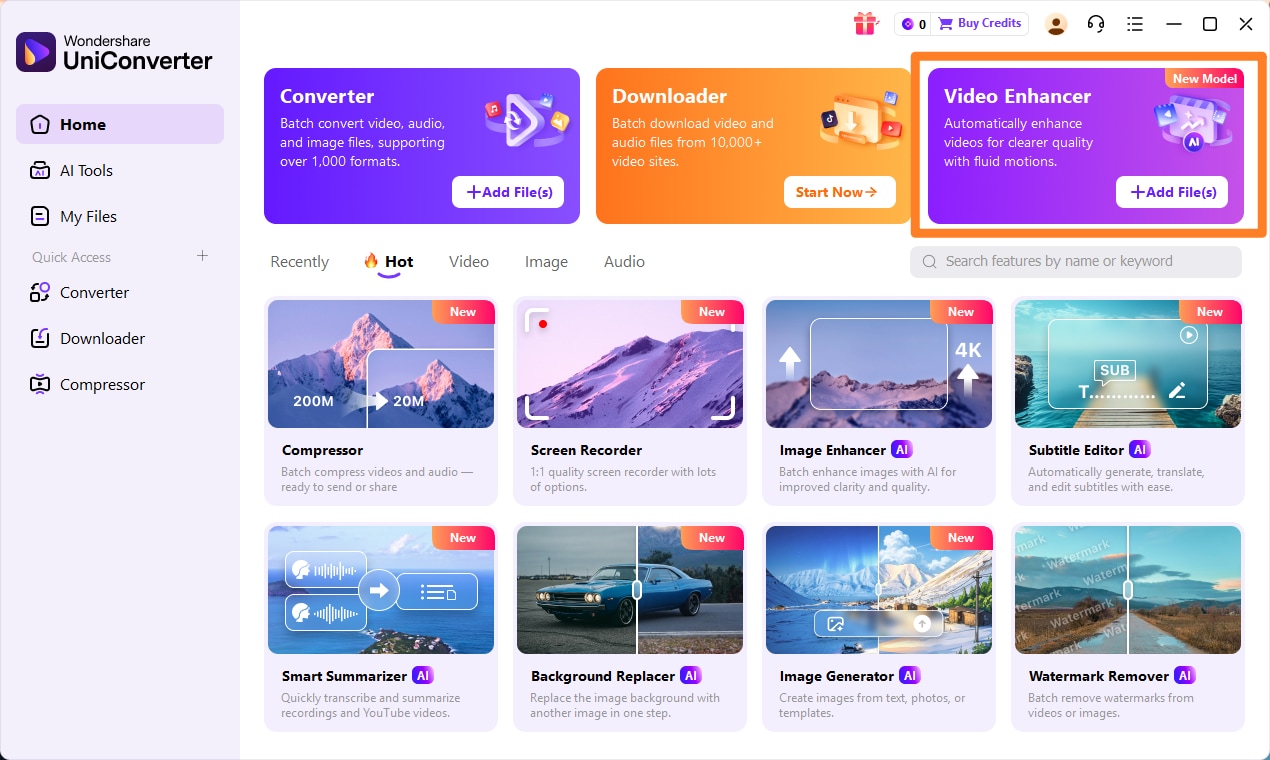
### Step 1: Open UniConverter and Choose Video Enhancer
Launch UniConverter on your computer. From the main interface, navigate to the "AI Lab" section and select the "Video Enhancer" tool.
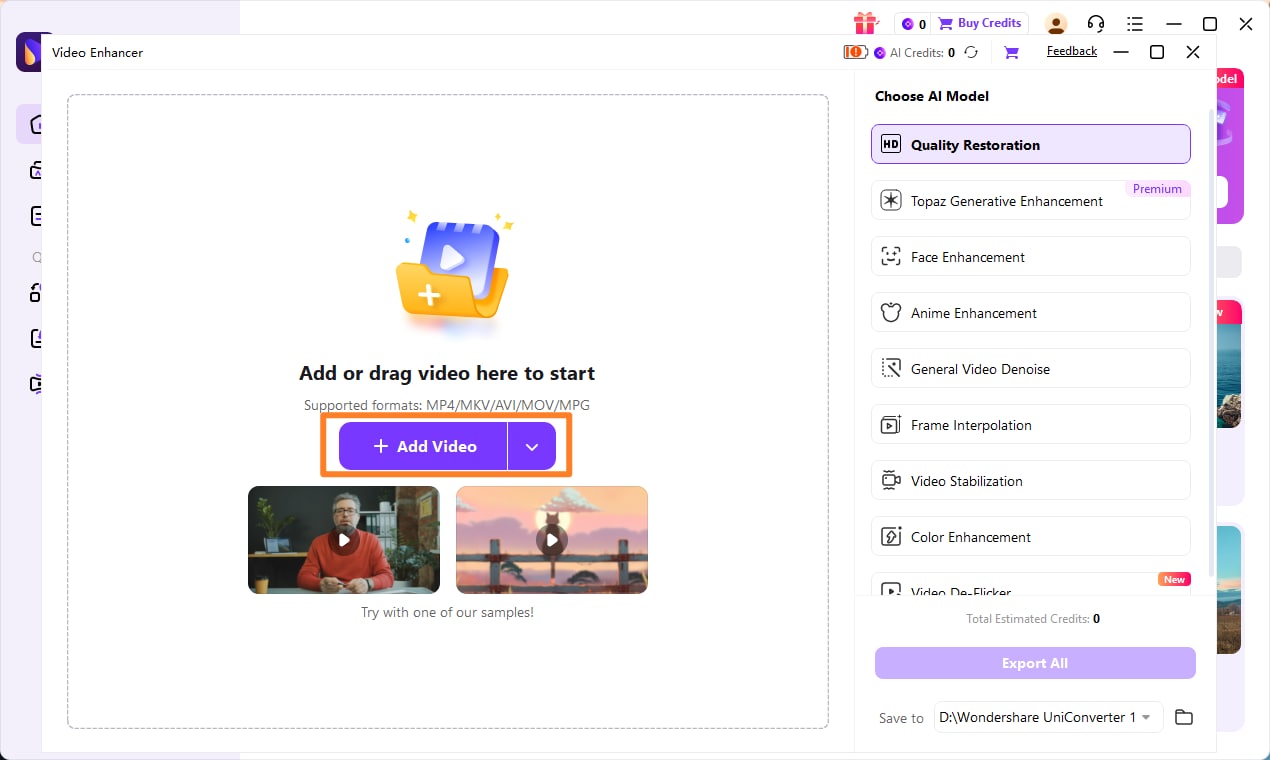
### Step 2: Upload the Videos
Click on the "Add Files" button or simply drag and drop the video files you wish to enhance into the UniConverter interface. You can add multiple videos for batch processing.
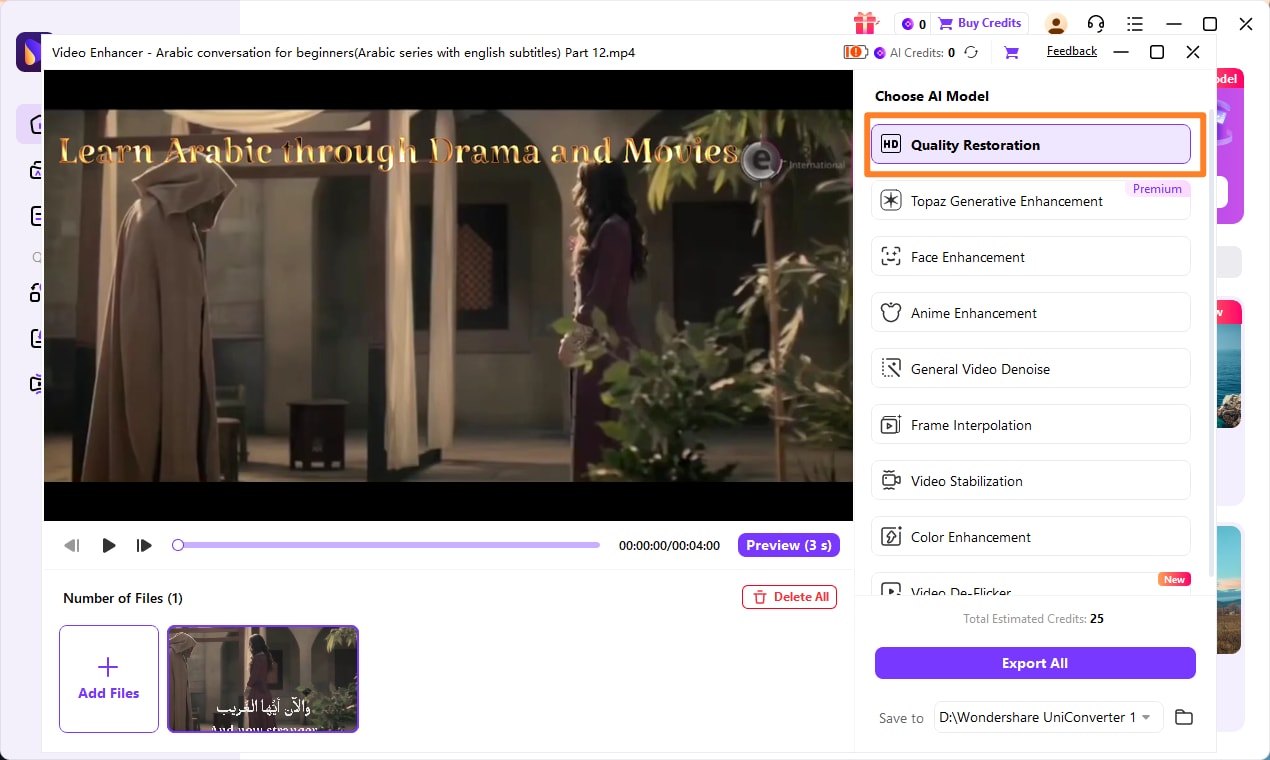
### Step 3: Choose Enhancement Model
Once your videos are loaded, UniConverter will present various enhancement models. Select the model that best suits your needs, such as "AI Upscale" for resolution improvement, "Denoise" for removing grain, or "Stabilization" for shaky footage. Adjust any additional settings like output format or resolution. If you're looking to unblur a video, UniConverter has the right tools for that too.
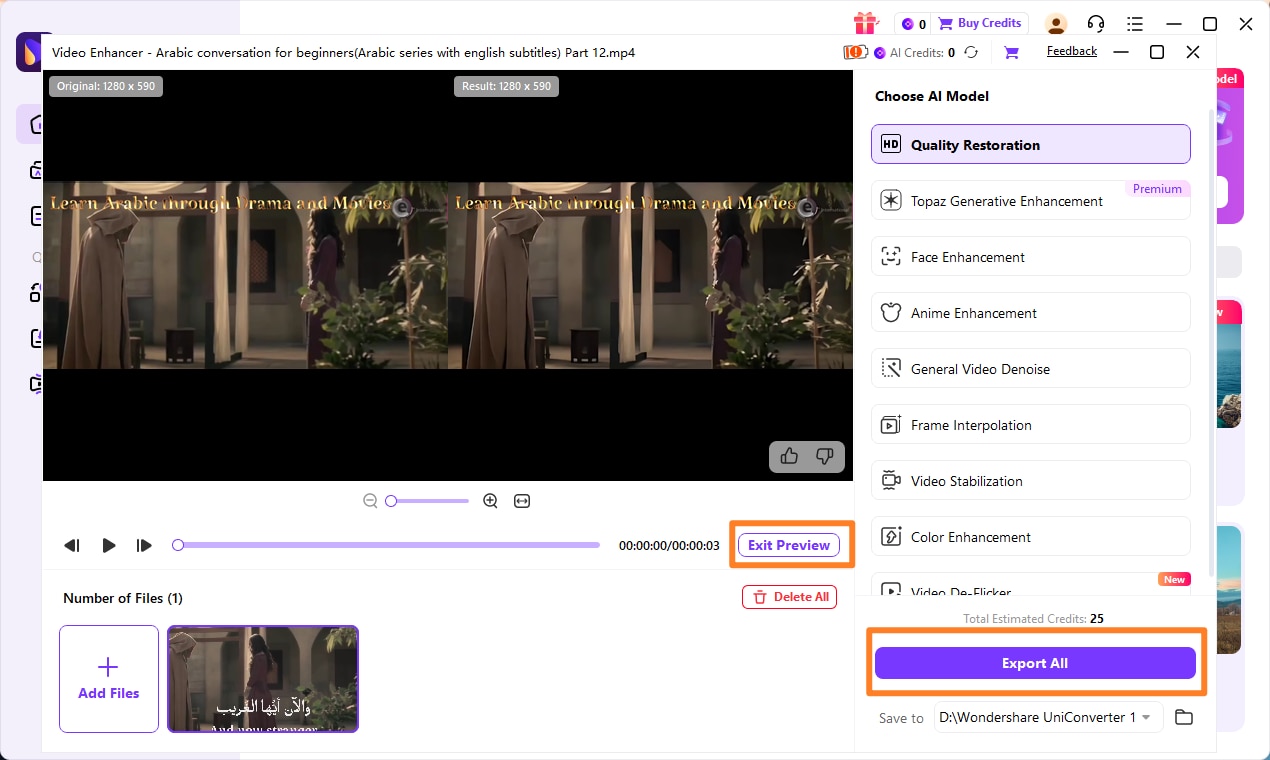
### Step 4: Preview and Save the Enhanced Video
After selecting your desired enhancements, click "Preview" to see the effect before processing. Once satisfied, click the "Export" button to save your enhanced video to your chosen destination.

Seeking an Easier AviSynth Video Enhancer Alternative?
Part 7: Conclusion
The AviSynth Video Enhancer review reveals it as a uniquely powerful tool, particularly for advanced users and professionals engaged in meticulous video restoration and archiving. Its script-based architecture offers unparalleled customization and lossless processing, making it ideal for tasks requiring granular control over every pixel. However, its steep learning curve and lack of a GUI make it unsuitable for beginners or those needing quick, casual enhancements. For users prioritizing ease of use, integrated AI capabilities, and faster workflows, alternatives like DaVinci Resolve, Adobe Premiere Pro, or Topaz Video AI, and especially UniConverter, offer more accessible and often equally effective solutions. The choice ultimately hinges on the user's technical proficiency, specific project requirements, and willingness to invest time in mastering a complex, yet incredibly rewarding, platform.
Part 8: FAQs
-
1. Is AviSynth Video Enhancer free to use?
Yes, AviSynth is open-source and completely free.
-
2. Can AviSynth enhance video resolution?
While AviSynth can improve perceived quality, true resolution upscaling often requires AI-based tools.
-
3. Is AviSynth compatible with Mac or Linux?
AviSynth is primarily Windows-based, though some workarounds or virtual machines might exist.
-
4. How difficult is it to learn AviSynth?
It has a steep learning curve due to its script-based nature, requiring knowledge of scripting syntax.
-
5. What are the best plugins for AviSynth video enhancement?
Popular plugins include MVTools for motion compensation, QTGMC for deinterlacing, and various denoisers.
