
- XMedia Recode: Powerful, free transcoder for Windows, offering extensive format support and customizable settings.
- Ideal Users: Best for advanced users needing granular control over video conversions, not for casual users.
- Pros: Extensive format support, highly customizable settings, batch processing. Cons: Outdated UI, potential stability issues.
- Comparison: XMedia Recode offers more control than HandBrake, less complex than FFmpeg, but less user-friendly than UniConverter.
- Risks: Potential for malware from unofficial downloads, steep learning curve, occasional codec issues, no dedicated support.
- UniConverter: User-friendly alternative for efficient, high-quality audio/video conversion with GPU acceleration and broad format support.
In this article
- Part 1: What is XMedia Recode
- Part 2: XMedia Recode Core Features, Pros, and Cons
- Part 3: XMedia Recode: Ideal Users and Use Cases
- Part 4: XMedia Recode and Alternatives Comparison
- Part 5: Risks and Pitfalls to Consider
- Part 6: How to Use UniConverter for Efficient Audio and Video Conversion
- Part 7: Conclusion
- Part 8: FAQs
In the vast digital landscape, video content reigns supreme, driving the constant need for efficient and reliable video transcoding solutions. Among the myriad options, XMedia Recode review emerges as a powerful, albeit somewhat niche, contender. This comprehensive review aims to dissect XMedia Recode's capabilities, weigh its advantages and disadvantages, and ultimately guide users in making informed decisions about their video conversion needs. We will delve into its core features, identify its ideal user base, and critically compare it against prominent alternatives, providing a holistic perspective on its place in the competitive video transcoding market.
Part 1: What is XMedia Recode
XMedia Recode is a free, portable video and audio transcoder for Windows, developed by Sebastian Dörfler. It has gained a reputation for its extensive format support and highly customizable encoding settings, making it a go-to tool for users who require precise control over their media conversions. Unlike many commercial solutions, XMedia Recode offers a no-cost entry point to advanced video processing, appealing to a segment of users who prioritize functionality and flexibility over a polished user interface. This review will address the core question: Is XMedia Recode still a viable and competitive option in today's rapidly evolving video transcoding landscape, especially when compared to more modern and user-friendly alternatives?
The Landscape of Video Transcoding Software
* Growing demand for diverse format compatibility: Users frequently encounter various video and audio formats from different devices and platforms, necessitating tools that can handle a wide array of inputs and outputs.
* Balancing quality and file size: The need to optimize video files for different playback environments (e.g., mobile, web, high-definition displays) often involves complex trade-offs between visual quality and file size.
* User expectation for efficiency and ease of use: While advanced control is valued by some, a significant portion of users seeks straightforward solutions for quick and hassle-free conversions.
* The rise of cloud-based and integrated solutions: The market is increasingly seeing solutions that offer not just conversion but also editing, downloading, and sharing capabilities, pushing standalone transcoders to innovate.
Part 2: XMedia Recode Core Features, Pros, and Cons
XMedia Recode stands out for its robust set of features tailored for comprehensive media conversion. Its primary strength lies in its ability to handle an impressive range of video and audio formats, allowing users to convert almost any media file to another. Beyond basic format conversion, it offers an unparalleled level of control over encoding parameters, including codecs, bitrates, frame rates, resolutions, and aspect ratios, catering to users who demand precise customization. The software also supports batch processing, enabling users to queue multiple conversion tasks, which significantly streamlines workflows for large projects. Furthermore, XMedia Recode includes basic editing functionalities such as cropping, padding, and color correction, adding a layer of utility beyond simple transcoding. Its ability to extract audio from video files and convert between various audio formats further enhances its versatility.
- Pros:
- Extensive format support for diverse media files.
- Highly customizable encoding settings for advanced users.
- Batch processing capabilities for efficient workflow.
- Cons:
- Outdated user interface can be challenging for beginners.
- Potential for stability issues or crashes with certain files.
Part 3: XMedia Recode: Ideal Users and Use Cases
XMedia Recode is particularly well-suited for a specific demographic of users who possess a certain level of technical proficiency and a need for granular control over their video conversions. It caters to individuals who are not intimidated by a complex interface and are willing to invest time in understanding various encoding parameters to achieve precise results. This often includes professionals or hobbyists in video production, multimedia editing, or archiving who require specific output specifications that simpler tools cannot provide.
- Best Use Case: Advanced Users Needing Granular Control Over Video Conversions
- Scenario: A videographer needs to convert high-bitrate 4K footage to a specific codec and resolution for a client, requiring precise control over every encoding parameter, such as H.265 with a specific CRF value and a custom audio bitrate, to ensure compatibility and optimal quality for a professional delivery.
- Limited Use Case: Casual Users Seeking a Simple, Intuitive Conversion Tool
- Scenario: A grandparent wants to quickly convert a home video from their old camcorder (e.g., in an obscure MPEG-2 format) to a mobile-friendly MP4 format for sharing with family, without dealing with complex settings or technical jargon. The outdated UI and multitude of options in XMedia Recode would likely overwhelm them, leading to frustration.
Part 4: XMedia Recode and Alternatives Comparison
XMedia Recode, while powerful, operates in a competitive landscape. When stacked against other popular video converters, its strengths and weaknesses become more apparent. For instance, HandBrake offers a more modern interface and excellent presets, making it a strong contender for general-purpose conversions. FFmpeg, a command-line tool, provides ultimate flexibility for those comfortable with scripting, often surpassing XMedia Recode in raw power and automation. UniConverter, on the other hand, aims for an all-in-one solution with a user-friendly GUI, integrating conversion with editing, downloading, and burning features. XMedia Recode excels in offering a comprehensive set of advanced settings within a GUI, a middle ground between HandBrake's user-friendliness and FFmpeg's command-line complexity, though its UI can be a barrier for some.
| Feature/Software | XMedia Recode | HandBrake | FFmpeg | UniConverter |
| Ease of Use | Moderate | Moderate | High (CLI) | High |
| Format Support | Excellent | Very Good | Excellent | Excellent |
| Advanced Settings | Excellent | Good | Excellent | Good |
| Batch Processing | Yes | Yes | Yes | Yes |
| User Interface | Outdated | Modern | Command Line | Modern |
| Stability | Good | Very Good | Excellent | Excellent |
Key Differentiators: Control vs. Simplicity
XMedia Recode differentiates itself by offering an extensive array of granular controls over encoding parameters, making it a favorite among power users who need to fine-tune every aspect of their video conversions. This contrasts with tools like UniConverter, which prioritize ease of use and a streamlined experience for general users. HandBrake strikes a balance, offering both presets and some advanced options, while FFmpeg provides the ultimate command-line control for those who prefer scripting.
Part 5: Risks and Pitfalls to Consider
When considering XMedia Recode, especially as a free software, users should be aware of several potential risks and pitfalls that can impact their experience and system security.
Potential for Malware or Adware Bundling with Downloads
While XMedia Recode itself is legitimate freeware, downloading it from unofficial sources or third-party download sites significantly increases the risk of encountering bundled adware, spyware, or even more malicious software. These unwanted programs can slow down your computer, display intrusive advertisements, or compromise your privacy by collecting data without your consent. Always ensure you download XMedia Recode directly from its official website to mitigate this risk.
Steep Learning Curve for Novice Users
The software's strength in offering extensive customization options also presents a significant hurdle for beginners. The user interface, while functional, is not intuitive and can appear cluttered with numerous settings, tabs, and technical jargon. Novice users might find themselves overwhelmed, struggling to understand the purpose of various encoding parameters, leading to frustration or suboptimal conversion results.
Occasional Compatibility Issues with Newer Codecs
As video technology evolves rapidly, new codecs and container formats emerge. While XMedia Recode boasts broad format support, there can be occasional delays in updating the software to fully support the very latest codecs or specific implementations, potentially leading to conversion failures or unexpected output quality issues with cutting-edge media files.
Lack of Dedicated Customer Support
As a free, open-source-like project, XMedia Recode does not offer dedicated customer support. Users encountering issues or needing assistance must rely on community forums, online tutorials, or their own troubleshooting skills. This lack of official support can be a significant drawback for users who prefer guided assistance or quick resolutions to problems.
Output Quality Inconsistencies with Default Settings
While XMedia Recode allows for high-quality output with proper configuration, relying on default settings without understanding their implications can sometimes lead to suboptimal results. Users might experience unexpected quality degradation, increased file sizes, or other inconsistencies if they do not adjust the settings to match their specific source material and desired output.
Part 6: How to Use UniConverter for Efficient Audio and Video Conversion
When other tools struggle with batch processing, stability issues, or file quality degradation, UniConverter stands out as a robust and user-friendly alternative. It provides a comprehensive solution for all your video and audio conversion needs, ensuring high-quality output without the inconvenience of ads or complicated settings. With its GPU acceleration, UniConverter delivers fast and stable conversions, supporting a vast array of formats without compromising quality, making it an all-in-one ultimate solution. For instance, you can easily convert MOV to MP4 or convert MP3 to M4B with ease. It also functions as an excellent image converter.
Step 1: Open UniConverter and Choose Converter
Launch UniConverter on your computer. On the left sidebar, select the "Converter" tab to access the main conversion interface.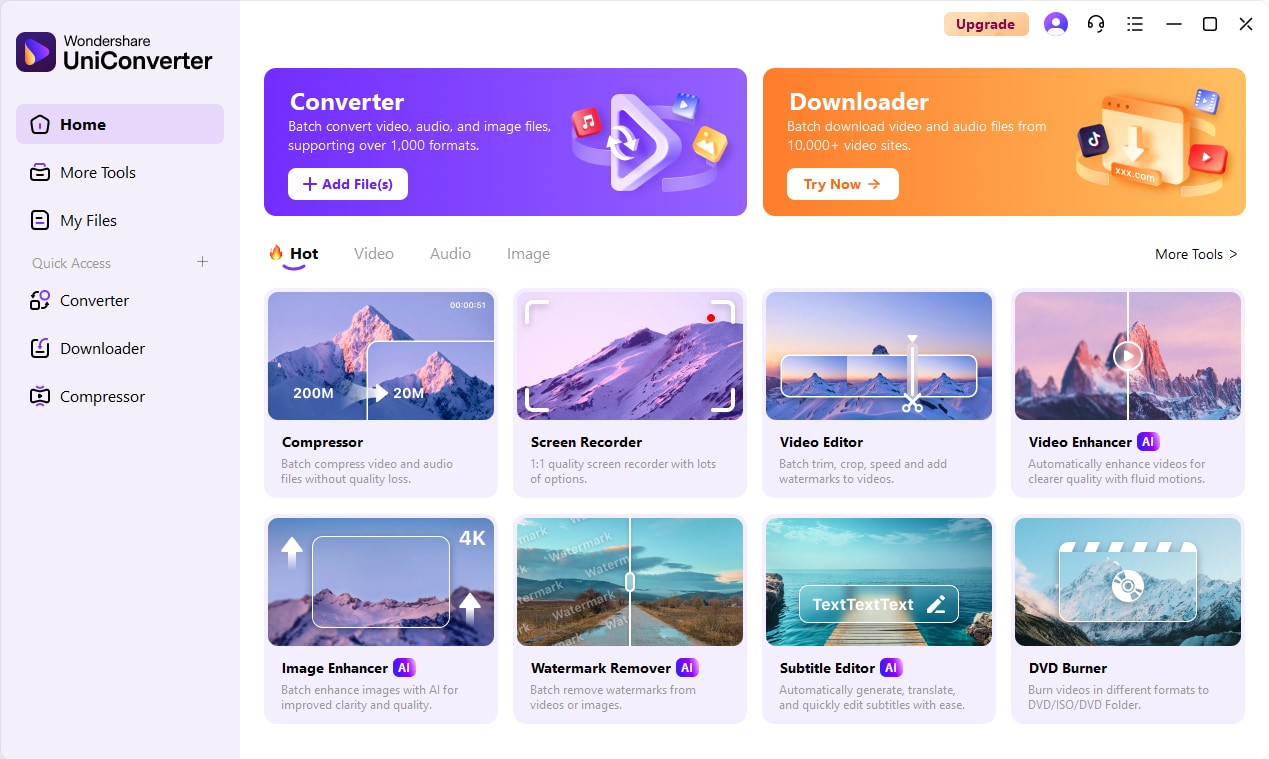
Step 2: Upload the Video, Audios or Images
Click on the "Add Files" button or simply drag and drop your video, audio, or image files into the program window. You can add multiple files for batch conversion.
Step 3: Choose Required Formats or Parameters
At the bottom of the window, click on the "Output Format" dropdown menu. Select your desired output format (e.g., MP4, MOV, MP3) and choose your preferred resolution or quality settings. You can also customize advanced parameters if needed.
Step 4: Save the Converted File
Once your settings are configured, click the "Convert" or "Start All" button. UniConverter will process your files efficiently. After conversion, you can find your converted files in the "Finished" tab or by clicking the folder icon next to the output path.

Unlock Your Video's Full Potential
Part 7: Conclusion
In conclusion, the XMedia Recode review reveals a powerful and highly customizable tool best suited for advanced users and specific niche conversions. Its extensive format support and granular control over encoding parameters make it an invaluable asset for videographers, multimedia professionals, and tech-savvy individuals who demand precise output specifications. However, its outdated user interface, steep learning curve, and potential for stability issues may deter casual users seeking a simple, intuitive conversion experience. For those prioritizing ease of use, a modern interface, and integrated functionalities, alternatives like UniConverter offer a more streamlined and reliable solution. Ultimately, the choice between XMedia Recode and its competitors hinges on your technical skill level, the specific requirements of your project, and your willingness to navigate a more complex interface versus opting for a more user-friendly, albeit potentially less customizable, option. Prioritizing software with regular updates and strong community support is always advisable for long-term usability and security.
Part 8: FAQs
1. Is XMedia Recode completely free to use?
Yes, XMedia Recode is freeware and does not require any payment.
2. Can XMedia Recode convert audio files as well?
Yes, XMedia Recode supports the conversion of various audio formats in addition to video.
3. Is XMedia Recode safe to download and install?
While the software itself is legitimate, users should download it from the official website to avoid bundled adware or malware from third-party sites.
4. How does XMedia Recode compare to HandBrake in terms of features?
Both offer extensive features, but XMedia Recode often provides more granular control over specific encoding parameters, while HandBrake has a more modern and user-friendly interface.
5. What are the common reasons for XMedia Recode crashes?
Crashes can occur due to corrupted source files, insufficient system resources, or compatibility issues with specific codecs or operating system versions.
