
- WinFF Overview: Free, open-source GUI for FFmpeg, simplifying video/audio conversion for basic tasks.
- Core Features: Supports extensive formats, batch conversion, preset profiles, basic customization, and subtitle support.
- Pros & Cons: Wide format support and ease of use for basic tasks vs. limited editing and outdated interface.
- Ideal Use: Best for converting large collections of home videos for diverse device playback.
- Limitations: Not suitable for professional editing, lacks advanced quality control, and limited support for new technologies.
- Comparison: WinFF offers simplicity; UniConverter provides speed, quality, and advanced editing; HandBrake offers advanced encoding control.
- Risks: Potential for outdated codecs, security vulnerabilities, and compatibility issues with newer OS.
- UniConverter Alternative: Offers superior speed, lossless conversion, comprehensive editing, and robust support for modern media workflows.
In this article
WinFF: A Comprehensive Review of the Free Video Converter
In the realm of digital media, the need for converting video files between various formats is a common challenge. Whether it's to ensure compatibility with different devices, reduce file sizes, or prepare content for specific platforms, a reliable video converter is an essential tool. This WinFF review delves into one such free and open-source solution, WinFF, examining its features, strengths, and weaknesses. We will explore its position in the competitive landscape of free video converters, identify its ideal use cases, and highlight potential pitfalls. This comprehensive analysis aims to provide users with the necessary insights to make an informed decision about whether WinFF meets their specific video conversion needs, ultimately guiding them toward the most suitable tool for their digital media workflows.
Part 1: What is WinFF?
WinFF is a free, open-source graphical user interface (GUI) for the command-line video converter FFmpeg. It was designed to simplify the complex process of video and audio conversion for everyday users, abstracting away the intricacies of FFmpeg's command-line syntax. Originating as a project to make FFmpeg more accessible on Windows and Linux, WinFF has become a go-to for many seeking a straightforward solution for basic media conversions. This review will critically assess WinFF's capabilities, its standing against contemporary alternatives, and its relevance in today's fast-evolving digital media environment.
The Landscape of Free Video Converters
The market for free video converters is vast and varied, catering to a wide spectrum of user needs.
* Accessibility and Cost-Effectiveness: Many users prioritize free solutions to avoid subscription fees or one-time purchase costs.
* Ease of Use: A significant portion of users seeks intuitive interfaces that don't require extensive technical knowledge.
* Format Compatibility: The ability to handle a broad range of input and output formats is crucial for diverse media libraries.
* Performance and Quality: While free, users still expect reasonable conversion speeds and acceptable output quality.
Part 2: WinFF: Core Features, Pros, and Cons
WinFF positions itself as a user-friendly front-end for FFmpeg, offering a streamlined approach to video and audio conversion. Its core capabilities revolve around format versatility and batch processing.
Core Features:
* Extensive Format Support: Converts between a vast array of video and audio formats (e.g., AVI, MP4, WMV, MOV, FLV, MP3, WAV).
* Batch Conversion: Allows users to add multiple files and convert them simultaneously, saving time.
* Preset Profiles: Includes pre-defined settings for common devices and platforms (e.g., DVD, YouTube, various mobile devices).
* Basic Output Customization: Offers options to adjust video bitrate, frame rate, and resolution, as well as audio bitrate and sample rate.
* Subtitle Support: Can embed or extract subtitles during the conversion process.
Pros
* Wide range of supported formats for input and output: Handles almost any video or audio file you throw at it.
* Batch conversion capabilities for multiple files: Efficiently processes large collections of media.
* User-friendly interface, especially for basic tasks: Simple drag-and-drop functionality for quick conversions.
Cons
* Limited advanced editing features: Lacks tools for trimming, cropping, merging, or adding effects.
* Outdated interface and infrequent updates: The visual design feels dated, and development has slowed considerably.
Part 3: WinFF: Ideal Users and Usage Scenarios
WinFF caters primarily to users who require straightforward video and audio conversions without the need for complex editing or advanced features. Its simplicity and broad format support make it suitable for specific, less demanding tasks.
Best Use Case: Converting a Large Collection of Home Videos for Playback on Various Devices
Imagine you have a vast archive of old home videos in various legacy formats (e.g., AVI, WMV from old camcorders) that you want to make compatible with modern smart TVs, tablets, or smartphones. WinFF excels here. You can easily add hundreds of files to its batch converter, select a common output format like MP4, and let it process them in one go. The pre-defined profiles simplify choosing the right settings for different devices, ensuring your memories are accessible across your entire digital ecosystem without manual tweaking for each file.
Limited Use Case: Professional Video Editing and High-Quality Output for Commercial Projects
For professional videographers, content creators, or anyone needing precise control over video encoding, color profiles, or advanced editing, WinFF falls short. It lacks the granular control over codecs, bitrates, and quality settings required for broadcast-quality output or specific commercial deliverables. Furthermore, its absence of editing tools means any pre-processing like cutting unwanted segments or adding watermarks would need to be done in a separate, more robust video editor, making the workflow inefficient for professional use.
Part 4: WinFF and Alternatives Comparison
To provide a comprehensive perspective, let's compare WinFF with some prominent alternatives in the video conversion space, including UniConverter, HandBrake, and Freemake Video Converter.
| Feature/Software | WinFF | UniConverter | HandBrake | Freemake Video Converter |
| Processing Speed | Medium | Very High (GPU acceleration) | High | Medium |
| Output Quality | Basic | Excellent (Lossless conversion options) | High (Advanced controls) | Medium (Potential watermarks) |
| Ease of Use | High | High | Medium | High |
| Customer Support | Community | Dedicated 24/7 | Community | Email/Limited |
| Security | Open-source (potential for outdated codecs) | High (Regular updates) | High (Open-source) | Medium (Adware concerns) |
| Batch Conversion | Yes | Yes | Yes | Yes |
| Advanced Editing | No | Yes (Trim, Crop, Effects, Subtitles) | Limited (Filters, Chapters) | Limited (Basic cut) |
| Platform Compatibility | Windows, Linux | Windows, macOS | Windows, macOS, Linux | Windows |
| Cost | Free | Paid (Free trial) | Free | Free (with limitations/ads) |
Key Differentiators:
- WinFF excels in simplicity and broad format support for basic conversions, making it a quick solution for simple tasks. - UniConverter offers a premium experience with superior processing speed, lossless output quality, and a comprehensive suite of editing tools, making it ideal for users demanding high performance and versatility. - HandBrake provides more advanced control over encoding parameters, ideal for specific output requirements and users who understand video codecs. - Freemake provides a more modern UI but often includes watermarks or ads in its free version, which can be a deterrent for some users.
Part 5: Risks and Pitfalls When Using WinFF
While WinFF offers a free solution for video conversion, users should be aware of several potential risks and limitations, especially given its open-source nature and less frequent updates.
Potential for Outdated Codecs and Security Vulnerabilities
As an open-source project with infrequent updates, WinFF might rely on older versions of FFmpeg or other libraries. This can lead to the use of outdated codecs, which may not be as efficient or secure as their modern counterparts. Outdated software can also harbor unpatched security vulnerabilities, potentially exposing your system to risks if you process files from untrusted sources.
Lack of Advanced Quality Control for Specific Output Needs
WinFF's interface simplifies FFmpeg, but this simplification comes at the cost of granular control. Users cannot fine-tune encoding parameters like specific codec profiles, levels, or advanced bitrate control methods. This limitation means achieving very specific output quality or file size targets for professional or niche applications can be challenging, often resulting in suboptimal results.
Limited Support for Newer Video Technologies (e.g., 4K, HEVC)
Given its slower development cycle, WinFF may not fully support the latest video technologies. Converting 4K or 8K content, or efficiently handling newer codecs like HEVC (H.265) with hardware acceleration, might be less optimized or even unsupported. This can lead to extremely long conversion times or poor quality output for modern high-resolution media.
Absence of Built-in Video Editing Tools
WinFF is purely a converter. It lacks any built-in tools for basic video editing such as trimming, cropping, merging multiple clips, or applying simple effects. If your workflow requires any form of pre-conversion editing, you will need to use a separate video editor, adding an extra step and potentially more software to your system.
Risk of Compatibility Issues with Newer Operating Systems
As operating systems evolve, software needs to be updated to maintain compatibility. With WinFF's infrequent updates, there's a risk that it may not function optimally or even run at all on newer versions of Windows or Linux, leading to instability, crashes, or unexpected behavior.
Part 6: How to Use UniConverter for Efficient Video Conversion
When other tools fall short with batch processing, stability issues, or quality loss, UniConverter emerges as a robust alternative. It provides a seamless, ad-free experience with extensive format support, GPU acceleration, stable lossless conversion, and efficient batch processing, positioning itself as an all-in-one media solution.
Step 1: Open UniConverter and Choose Converter
Launch UniConverter on your computer. From the main interface, navigate to the "Converter" tab, which is typically the default view or easily accessible from the left-hand menu.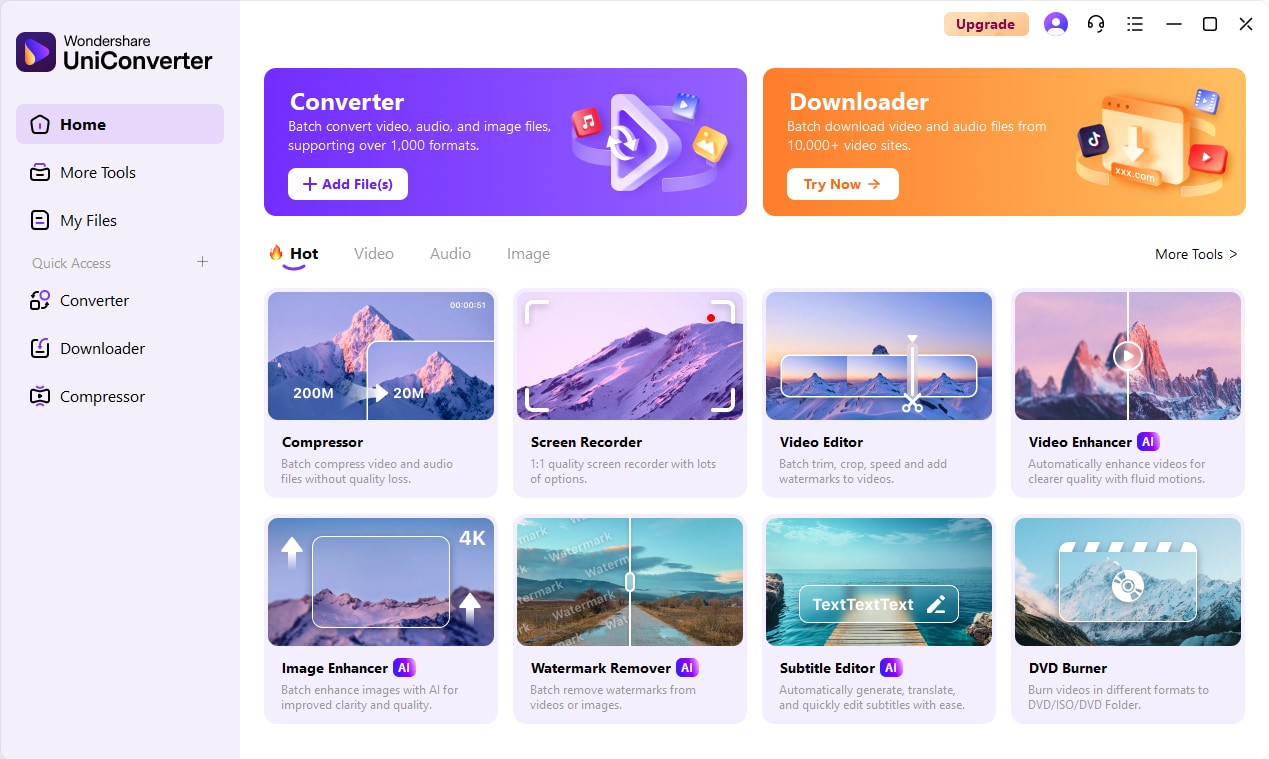
Step 2: Upload the Video, Audios or Images
Drag and drop your desired video, audio, or image files directly into the UniConverter window. Alternatively, click the "Add Files" button to browse and select files from your local storage.
Step 3: Choose Required Formats or Parameters
At the bottom of the window, click on the "Output Format" dropdown menu. Select your desired output format (e.g., MP4, MOV, MP3) and choose a resolution or quality preset. You can also customize advanced parameters like codec, bitrate, and frame rate. For example, you can convert MOV to MP4 or convert MP4 to MP3 with ease. If you need to convert images, UniConverter handles various image formats as well.
Step 4: Save the Converted File
Click the "Convert" button next to each file, or "Start All" for batch conversion. Once the conversion is complete, navigate to the "Finished" tab to locate your converted files. You can also set a custom output folder before conversion.

Efficient Video Conversion & Editing
Part 7: Conclusion
In conclusion, this WinFF review highlights its enduring value as a free, open-source solution for basic video and audio conversion. Its strength lies in its simplicity and broad format compatibility, making it an excellent choice for users who need to quickly convert a large volume of files for general playback on various devices, such as archiving home videos. However, its limitations, including an outdated interface, infrequent updates, lack of advanced editing features, and potential compatibility issues with newer technologies, position it as less suitable for professional use or for users requiring precise control over output quality. For those seeking a more comprehensive, feature-rich, and regularly updated solution that offers advanced editing, superior performance, and robust support for modern video technologies, premium alternatives like UniConverter are highly recommended. Ultimately, the choice between WinFF and its competitors depends on individual user needs, balancing the desire for a free, simple tool against the demand for advanced features, reliability, and ongoing support.
Part 8: FAQs
1. Is WinFF still being updated?
WinFF's development has slowed significantly, with updates being infrequent. The last stable release was several years ago, meaning it may not fully support the latest codecs or operating system features.
2. Can WinFF convert videos for mobile devices?
Yes, WinFF includes several pre-defined profiles for common mobile devices and platforms, allowing users to convert videos into formats compatible with smartphones and tablets.
3. Does WinFF support 4K video conversion?
While WinFF, through FFmpeg, can technically process 4K video, its performance and optimization for such high-resolution content might be limited due to its age and lack of hardware acceleration support compared to modern converters.
4. Are there any hidden costs or ads in WinFF?
No, WinFF is completely free and open-source. It does not contain any hidden costs, advertisements, or bundled adware.
5. How does WinFF compare to online video converters?
WinFF is a desktop application, offering more privacy and often faster conversion speeds for large files as it doesn't rely on internet upload/download. Online converters are convenient for small, occasional conversions but often have file size limits and privacy concerns.
