
- Tipard Overview: Understand Tipard Video Converter's core features, pros, and cons for informed decisions.
- Target Audience: Identify if Tipard suits your needs, from casual home video conversion to specific professional limitations.
- Comparative Analysis: See how Tipard stacks against UniConverter, HandBrake, and FFmpeg in features and value.
- Potential Risks: Be aware of data privacy, bundled software, quality degradation, and support issues.
- UniConverter Alternative: Discover UniConverter for superior speed, quality, and comprehensive features for diverse needs.
In this article
- Part 1: What is Tipard Video Converter?
- Part 2: Tipard Video Converter: Core Features, Pros, and Cons
- Part 3: Target Users and Usage Scenarios
- Part 4: Tipard Video Converter and Alternatives Comparison
- Part 5: Risks and Pitfalls to Consider
- Part 6: How to Use UniConverter for Efficient Video Conversion
- Part 7: Conclusion
- Part 8: FAQs
This Tipard Video Converter review delves into its capabilities, comparing it against leading alternatives to help you make an informed decision. In a market saturated with video conversion tools, understanding the nuances of each offering is crucial. This article aims to provide a comprehensive analysis of Tipard Video Converter, examining its core features, strengths, and weaknesses. We will explore its suitability for various user scenarios, highlight potential risks, and ultimately guide you toward the best video conversion solution for your specific needs.
Part 1: What is Tipard Video Converter?
Tipard Video Converter is a multimedia software designed to convert video and audio files between various formats. Developed by Tipard Studio, it aims to provide users with a straightforward solution for format compatibility issues, device playback, and basic video editing needs. The software boasts a user-friendly interface, making it accessible to both beginners and those with some technical expertise. This review will critically assess its performance, feature set, and overall value proposition in the competitive landscape of video conversion tools.
The Video Converter Market Landscape
The video converter market is characterized by:
* Diverse User Needs: From casual users converting home videos to professionals requiring high-fidelity output for complex projects.
* Rapid Technological Advancements: Constant evolution in video codecs, resolutions (4K, 8K), and device-specific formats.
* A Spectrum of Solutions: Ranging from free, open-source tools to premium, feature-rich software, each with varying levels of performance and reliability.
* Growing Demand for Efficiency: Users increasingly seek fast conversion speeds, intuitive interfaces, and robust format support.
Part 2: Tipard Video Converter: Core Features, Pros, and Cons
Tipard Video Converter offers a suite of functionalities aimed at simplifying video conversion. Its core capabilities include high-speed conversion, extensive format support, and basic editing tools. The software prides itself on maintaining output quality while providing a user-friendly experience.
Core Features:
* High-Speed Conversion: Leverages hardware acceleration for faster processing.
* Extensive Format Support: Converts to and from a wide array of video and audio formats.
* Basic Editing Tools: Includes trimming, cropping, merging, and adding watermarks.
* Batch Conversion: Allows multiple files to be converted simultaneously.
* Output Profile Customization: Users can adjust resolution, bitrate, frame rate, and other parameters.
Pros
* High-Quality Video Conversion for Professional Projects: Delivers impressive output quality, preserving much of the original video's detail and clarity, suitable for projects where visual fidelity is paramount.
* Extensive Format Support for Diverse Device Compatibility: Boasts a comprehensive list of supported input and output formats, ensuring compatibility with virtually any device or platform.
* Intuitive Interface for Quick and Easy Video Editing Tasks: The clean and well-organized interface makes navigation and basic editing operations straightforward, even for novice users.
Cons
* Limited Advanced Editing Capabilities for Complex Post-Production: While it offers basic editing, it lacks the sophisticated tools required for professional-grade color grading, multi-track editing, or advanced effects.
* Occasional Performance Lags with Large 4K Files: When handling extremely large 4K or higher-resolution files, the software can sometimes experience noticeable slowdowns, impacting conversion efficiency.
Part 3: Target Users and Usage Scenarios
Tipard Video Converter is best suited for users who require a reliable and easy-to-use tool for general video conversion tasks, without the need for highly specialized editing features. Its simplicity and broad format support make it ideal for everyday multimedia management.
Best Scenario: Converting Home Videos for Family Sharing
A family user wants to convert old camcorder footage or smartphone videos into a universally playable format (like MP4) for sharing with relatives who use various devices (smart TVs, tablets, older computers). Tipard Video Converter's extensive format support and straightforward interface allow them to quickly process multiple videos, ensuring everyone can watch them without compatibility issues, and the quality preservation maintains sentimental value.
Limited Scenario: Professional Filmmakers Requiring Advanced Color Grading
A professional filmmaker is working on a documentary and needs to convert RAW camera footage into an editable proxy format, while also performing precise color grading, noise reduction, and complex visual effects. Tipard Video Converter, with its basic editing suite, would fall short. It lacks the advanced color correction tools, LUT support, and multi-layer editing capabilities essential for professional post-production workflows. For such tasks, dedicated video editing software is indispensable.
Part 4: Tipard Video Converter and Alternatives Comparison
Understanding how Tipard Video Converter stacks up against its rivals is crucial for making an informed decision. Here's a comparison with some prominent alternatives:
| Feature/Scenario | Tipard Video Converter | UniConverter | HandBrake | FFmpeg |
| Batch Conversion Speed (Large Files) | Good | Excellent | Good | Excellent (CLI) |
| Output Quality (Lossless) | Very Good | Excellent | Very Good | Excellent (Expert) |
| User Interface Simplicity | Excellent | Excellent | Moderate | Very Poor (CLI) |
| Advanced Editing Tools | Basic | Moderate | Basic | None (CLI) |
| Price Point | Mid-Range | Mid-Range | Free | Free |
| Customer Support | Email/Online | 24/7 Live Chat/Email | Community Forum | Community Forum |
| Security | Good | Excellent | Good | Excellent |
Tipard Video Converter excels in user interface simplicity and offers very good output quality, making it a solid choice for general users. However, UniConverter stands out with its superior batch conversion speed, excellent lossless output, and more robust advanced editing tools, coupled with dedicated customer support. HandBrake is a powerful free option, particularly for its encoding capabilities, but its UI can be less intuitive for beginners. FFmpeg, while incredibly powerful and free, is a command-line tool, making it suitable only for highly technical users. For most users seeking a balance of features, ease of use, and performance, UniConverter often presents a more comprehensive solution.
Part 5: Risks and Pitfalls to Consider
While Tipard Video Converter offers a convenient solution for video conversion, users should be aware of several potential risks and pitfalls that can impact their experience and data security.
Potential for Data Privacy Concerns
Like many third-party software, there's always a potential, albeit often low, risk regarding data privacy. Users should review Tipard's privacy policy to understand how their data is collected, stored, and used. Unverified software sources can sometimes bundle spyware or adware, making it crucial to download from the official website.
Unwanted Software Bundles During Installation
During the installation process, some software, including certain versions or installers of Tipard Video Converter, might attempt to bundle additional, often unwanted, programs or browser extensions. Users must pay close attention to custom installation options and uncheck any pre-selected offers to avoid installing bloatware.
Output Quality Degradation with Aggressive Compression Settings
While Tipard Video Converter aims for high-quality output, aggressive compression settings chosen by the user can lead to noticeable degradation in video and audio quality. Reducing bitrate or resolution too much to achieve smaller file sizes can result in pixelation, artifacts, and muffled audio, especially with complex scenes or high-motion footage.
Limited Customer Support Responsiveness
Some users have reported that customer support responsiveness for Tipard products can be inconsistent. If you encounter technical issues or require assistance, a slow or unhelpful support channel can be frustrating, potentially leading to prolonged downtime or unresolved problems.
Inconsistent Performance on Older Hardware
While modern software often leverages hardware acceleration, older computer systems with less powerful CPUs or integrated graphics cards might experience inconsistent performance. This can manifest as slower conversion times, software crashes, or general instability, particularly when processing high-resolution videos or multiple files simultaneously.
Part 6: How to Use UniConverter for Efficient Video Conversion
When other tools fall short with batch processing, stability, or quality retention, UniConverter emerges as a robust alternative. It addresses common pain points like unwanted ads, limited format support, and slow conversion speeds by offering a comprehensive, ad-free experience with GPU acceleration, lossless conversion, and efficient batch processing. UniConverter is an all-in-one solution for all your video and audio conversion needs.
Step 1: Open UniConverter and Choose Converter
Launch UniConverter on your computer. From the main interface, select the "Converter" tab on the left sidebar.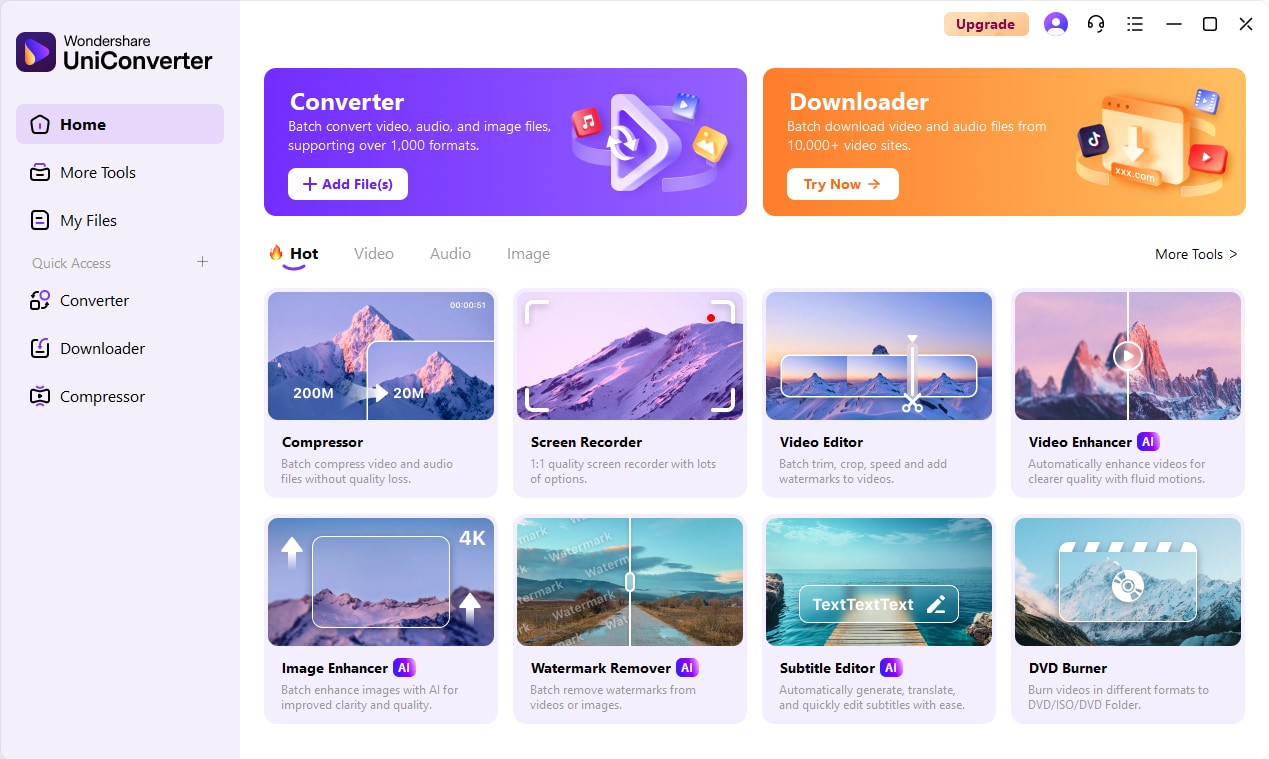
Step 2: Upload the Video, Audios or Images
Click the "Add Files" button or drag and drop your video, audio, or image files directly into the program window.
Step 3: Choose Required Formats or Parameters
Select your desired output format from the "Output Format" menu at the bottom. You can also customize parameters like resolution, bitrate, and frame rate. For instance, you might want to convert MOV to MP4 or convert HEIC to JPG.
Step 4: Save the Converted File
Choose your output folder, then click the "Convert" or "Start All" button to begin the conversion process.

Effortless Video Conversion and Editing
Part 7: Conclusion
This Tipard Video Converter review has highlighted its strengths in user-friendliness and broad format support, making it a suitable choice for basic video conversion tasks and casual users. However, its limitations in advanced editing and occasional performance lags with large files suggest it might not be the ideal solution for professionals or those with demanding post-production needs. For casual users and beginners, Tipard offers a straightforward path to converting home videos and ensuring device compatibility. Content creators on a budget might find its features sufficient for simple projects, but should be aware of its editing constraints. For professionals needing advanced features, or users prioritizing speed, lossless quality, and comprehensive tools, alternatives like UniConverter present a more compelling and versatile option, offering a superior balance of performance, features, and reliability. Ultimately, the best choice depends on individual requirements, budget, and technical proficiency.
Part 8: FAQs
1. Is Tipard Video Converter safe to download and use?
Yes, generally Tipard Video Converter is safe to download from its official website. However, users should be cautious during installation to avoid bundled software and always download from trusted sources.
2. Can Tipard Video Converter convert videos without losing quality?
Tipard Video Converter aims to preserve high quality during conversion. While it can achieve near-lossless quality, some degree of quality degradation can occur, especially if aggressive compression settings are chosen to reduce file size.
3. What are the main differences between Tipard Video Converter and HandBrake?
Tipard Video Converter offers a more intuitive graphical user interface and broader format support, making it easier for beginners. HandBrake, while free and powerful, is primarily an open-source transcoder with a steeper learning curve and focuses more on specific video encoding tasks rather than a wide range of format conversions.
4. Does Tipard Video Converter support 4K and 8K video conversion?
Yes, Tipard Video Converter generally supports the conversion of 4K and 8K videos. However, performance can vary, and converting very large, high-resolution files may be slower and more resource-intensive, potentially leading to occasional lags on less powerful systems.
5. How does Tipard Video Converter handle DRM-protected videos?
Like most legitimate video converters, Tipard Video Converter cannot legally convert DRM-protected videos (e.g., from streaming services like Netflix, Hulu, or iTunes purchases). Its functionality is limited to converting unprotected personal video files.
