
- TheFileConverter Value: Offers accessible, web-based file conversion for diverse formats, ideal for quick, everyday tasks.
- TheFileConverter Limitations: Lacks advanced editing, slower with large files, and potential privacy/ad concerns compared to desktop tools.
- UniConverter Comparison: Provides superior speed (GPU), output quality, extensive features, and offline use for professional needs.
- Decision Factor: Choose TheFileConverter for simplicity and casual use; UniConverter for performance, advanced features, and critical projects.
In this article
- Part 1: What is TheFileConverter?
- Part 2: TheFileConverter: Core Features, Pros, and Cons
- Part 3: Who Benefits from TheFileConverter? Use Cases Explored
- Part 4: TheFileConverter and Alternatives Comparison
- Part 5: Potential Pitfalls and Considerations When Using TheFileConverter
- Part 6: How to Use UniConverter for Efficient Audio and Video Conversion
- Part 7: Final Verdict and Recommendations
In today's digital age, file conversion is an indispensable task, whether for personal use or professional endeavors. From converting documents for compatibility to optimizing media files for different platforms, the need for reliable and efficient conversion tools is ever-present. This TheFileConverter review delves into one such popular online tool, examining its features, performance, and overall utility. We will explore its strengths and weaknesses, compare it against leading competitors, and ultimately help you determine if it's the right solution for your specific file conversion needs.
Part 1: What is TheFileConverter?
TheFileConverter is a web-based platform designed to facilitate the conversion of various file types, including documents, images, audio, and video, from one format to another. It operates entirely online, eliminating the need for software installations and making it accessible from any device with an internet connection. The service aims to provide a straightforward and efficient solution for users who frequently encounter file compatibility issues or require quick format changes. Its primary appeal lies in its simplicity and broad format support, catering to a wide audience from casual users to those with more specific, though not overly complex, conversion requirements. This review seeks to provide a comprehensive understanding of its capabilities and limitations within the broader file conversion landscape.
The File Conversion Landscape
* Ubiquitous Need: The proliferation of diverse file formats across different operating systems and applications necessitates frequent conversions for interoperability.
* Accessibility Demands: Users increasingly require conversion tools that are accessible from anywhere, without being tied to a specific device or software.
* Balancing Simplicity and Power: The market is segmented between tools offering quick, simple conversions for everyday tasks and more robust software for professional, high-fidelity output.
* Security and Privacy Concerns: As more data is processed online, users are increasingly concerned about the security and privacy implications of using web-based conversion services.
Part 2: TheFileConverter: Core Features, Pros, and Cons
TheFileConverter positions itself as a versatile online tool, offering a range of functionalities to address common file conversion needs. Its core capabilities revolve around supporting a multitude of formats and providing a user-friendly experience.
* Extensive Format Support: Converts between a vast array of document, image, audio, and video formats.
* Batch Conversion: Allows for the processing of multiple files simultaneously, enhancing efficiency.
* Cloud-Based Operation: No software installation required, accessible via web browser.
* Basic Customization Options: Offers fundamental settings adjustments for output quality and parameters.
* Drag-and-Drop Interface: Simplifies the file upload process for quick initiation of conversions.
Pros
* Wide Range of Supported Formats for Diverse Needs: The platform boasts an impressive list of supported file types, making it a go-to for various conversion tasks without needing multiple specialized tools.
* Intuitive User Interface for Quick Conversions: Its clean and straightforward design ensures that even novice users can navigate the site and initiate conversions with minimal effort.
* Cloud-Based Accessibility for On-the-Go Use: Being entirely online, users can access TheFileConverter from any device, anywhere, as long as they have an internet connection, offering significant flexibility.
Cons
* Limited Advanced Editing Capabilities: For users requiring more than basic format conversion, such as video trimming, audio merging, or image manipulation, TheFileConverter falls short.
* Potential for Slower Conversion Speeds with Large Files: While adequate for smaller files, converting large video or audio files can be time-consuming, impacting productivity.
Part 3: Who Benefits from TheFileConverter? Use Cases Explored
TheFileConverter's design and feature set make it particularly suitable for certain user profiles and scenarios, while proving less ideal for others. Understanding these distinctions is crucial for making an informed decision.
Best Use Case: Quick, Everyday File Conversions for Casual Users
TheFileConverter excels as a tool for individuals who frequently need to convert common file types without requiring specialized software or advanced features. This includes students converting PDFs to Word documents, office workers changing image formats for presentations, or general users adapting media files for different devices. Its ease of use and web-based nature mean that a quick conversion is just a few clicks away, making it perfect for those one-off or infrequent tasks where speed and simplicity are prioritized over professional-grade output or intricate controls. For instance, a student needing to convert a research paper from DOCX to PDF for submission, or a small business owner resizing product images for their website, would find TheFileConverter highly efficient and convenient.
Limited Use Case: Professional Media Production Requiring High-Fidelity Output
Conversely, TheFileConverter is not designed for professionals in fields like video editing, graphic design, or audio engineering. These users often require precise control over conversion parameters, lossless quality preservation, advanced editing functionalities (e.g., color correction, audio mixing, complex video compression), and the ability to handle extremely large files efficiently. The potential for quality degradation, limited codec options, and slower processing times for substantial media files make TheFileConverter unsuitable for professional media production workflows where fidelity, speed, and comprehensive control are paramount. For example, a videographer needing to transcode 4K footage for editing or a musician mastering tracks would find TheFileConverter's capabilities severely lacking.
Part 4: TheFileConverter and Alternatives Comparison
To provide a comprehensive perspective, let's compare TheFileConverter with some of its prominent competitors, highlighting their strengths and weaknesses across key performance indicators.
| Feature / Product | TheFileConverter | UniConverter | HandBrake | CloudConvert |
| Processing Speed | Moderate | Very Fast (GPU) | Moderate | Moderate |
| Output Quality | Good | Excellent | Excellent | Good |
| Ease of Use | Very High | High | Moderate | High |
| Customer Support | Basic (FAQ) | Comprehensive | Community Forum | Email/FAQ |
| Security | Standard | High (Desktop) | High (Offline) | Standard |
| Format Support | Extensive | Very Extensive | Video/Audio | Very Extensive |
| Advanced Features | Limited | Extensive | Extensive (Video) | Moderate |
| Pricing Model | Freemium | Premium | Free (Open Source) | Freemium |
TheFileConverter offers a highly accessible and user-friendly experience, making it ideal for quick, simple conversions. However, for users prioritizing speed, output quality, and a broader suite of advanced features, UniConverter stands out with its GPU acceleration and comprehensive toolkit. HandBrake, while free and powerful for video and audio, has a steeper learning curve. CloudConvert provides a similar web-based experience to TheFileConverter but often offers more advanced options within its freemium model. Ultimately, the choice depends on whether simplicity and basic functionality suffice or if professional-grade performance and extensive features are required.
Part 5: Potential Pitfalls and Considerations When Using TheFileConverter
While TheFileConverter offers convenience, users should be aware of several potential drawbacks and considerations, especially concerning free online services. These factors can impact data security, user experience, and the quality of the converted output.
Data Privacy and Security Concerns
As an online service, TheFileConverter requires users to upload their files to its servers. This raises legitimate concerns about data privacy and security. Users should be cautious about uploading sensitive or confidential documents, as there's always a risk, however small, of data breaches or unauthorized access. While most reputable services claim to delete files after a certain period, the initial transmission and storage on third-party servers inherently carry a risk. It's crucial to review their privacy policy to understand how your data is handled, stored, and eventually purged.
Impact of Advertisements on User Experience
Many free online conversion tools, including TheFileConverter, rely on advertisements for revenue. These ads can range from unobtrusive banners to more disruptive pop-ups or interstitial ads that interrupt the conversion workflow. While a necessary evil for free services, excessive or intrusive advertising can significantly degrade the user experience, making the process frustrating and less efficient. Users might find themselves spending more time closing ads than actually performing conversions.
Output Quality Limitations for Specific Formats
While TheFileConverter supports a wide array of formats, the quality of the output, especially for complex media files like high-resolution videos or professional audio, might not always meet professional standards. Free online converters often employ aggressive compression algorithms to save server resources, which can lead to a noticeable loss in quality, such as pixelation in images, artifacts in videos, or reduced audio fidelity. For critical projects where output quality is paramount, these limitations can be a significant drawback.
Dependency on Internet Connectivity
Being a cloud-based service, TheFileConverter is entirely dependent on a stable internet connection. Any interruption in connectivity will halt the conversion process, potentially leading to lost progress or requiring users to restart the conversion. This dependency can be a major inconvenience in areas with unreliable internet access or for users who need to perform conversions offline. Desktop applications, in contrast, offer the flexibility of offline operation.
Hidden Costs or Subscription Models
While TheFileConverter might offer a free tier, many online services often have limitations on file size, daily conversions, or access to certain premium features. To unlock these, users might be prompted to subscribe to a paid plan. These "hidden costs" can sometimes be a surprise for users expecting a completely free service, and the subscription fees might not always be competitive compared to feature-rich desktop software. It's important to understand the full scope of their pricing model before committing to frequent use.
Part 6: How to Use UniConverter for Efficient Audio and Video Conversion
When other tools struggle with batch processing, stability issues, or quality degradation, UniConverter stands out as a powerful solution. It delivers a smooth, ad-free experience with broad format compatibility, GPU acceleration for enhanced speed, lossless conversion, and robust batch processing features, positioning it as a comprehensive media toolkit.
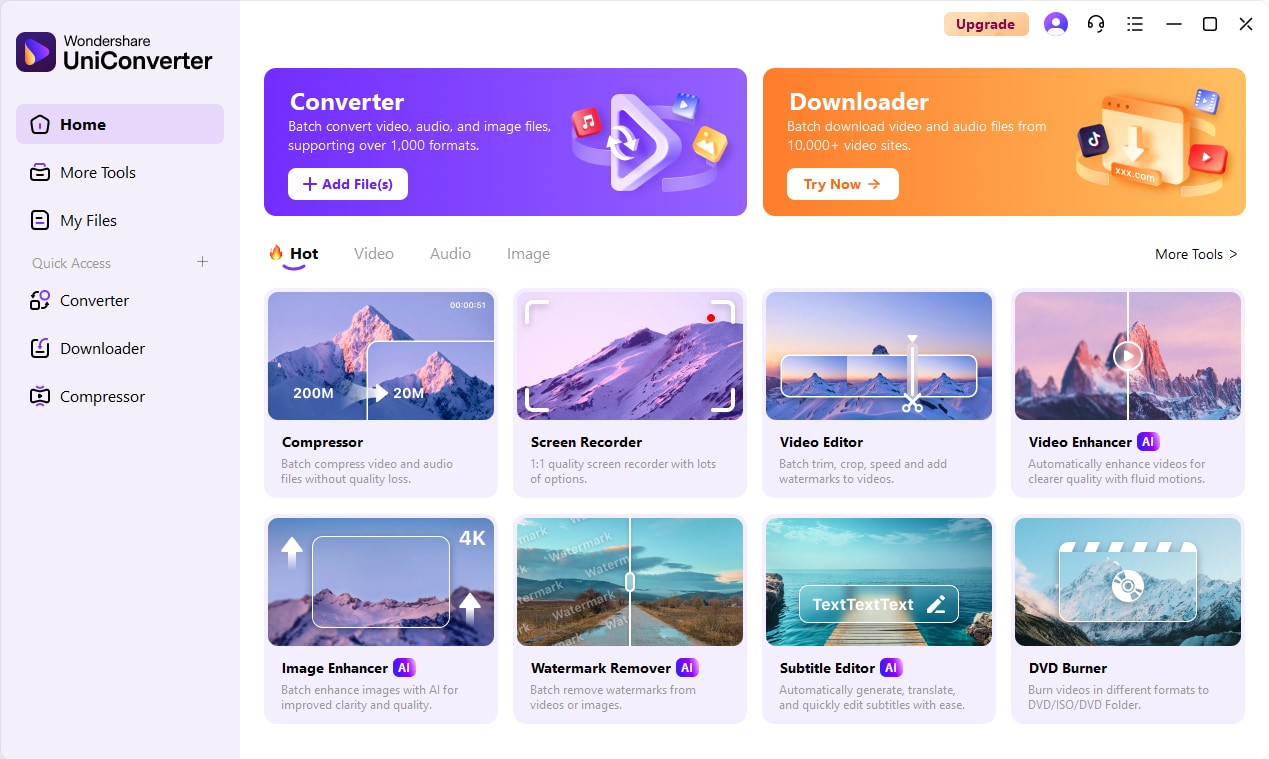
Step 1: Open UniConverter and Choose Converter
Launch UniConverter on your computer. From the main interface, select the "Converter" tab, which is typically the default or prominently displayed option.
Step 2: Upload the Video, Audios or Images
Drag and drop your desired video, audio, or image files directly into the UniConverter window. Alternatively, click the "Add Files" button to browse and select files from your local storage.

Step 3: Choose Required Formats or Parameters
At the bottom of the interface, click on the "Output Format" dropdown menu. Select your desired output format (e.g., MP4, MOV, MP3) and adjust any necessary parameters such as resolution, bitrate, or quality settings. For instance, you can easily convert MOV to MP4 or convert MP4 to MP3 with precise control over the output. If you need to convert HEIC to JPG, this is where you'd select the JPG format.

Step 4: Initiate Conversion and Enjoy Advanced Features
Once your files are loaded and output settings configured, click the "Convert" or "Start All" button. UniConverter will then process your files efficiently, leveraging GPU acceleration for faster conversions.


High Efficient Tool to Batch Convert Media
Part 7: Final Verdict and Recommendations
The TheFileConverter review reveals a tool that excels in simplicity and accessibility, making it an excellent choice for individuals seeking quick, no-frills file conversions. Its web-based nature and broad format support cater well to casual users who occasionally need to change file types without the hassle of software installations. However, for professionals or users with more demanding requirements, such as high-fidelity output, advanced editing capabilities, or the need to process large files efficiently, TheFileConverter's limitations become apparent. In such scenarios, desktop applications like UniConverter offer a superior experience with their robust feature sets, faster processing speeds, and enhanced control over conversion parameters. The decision ultimately hinges on balancing convenience against performance and features. For everyday, non-critical conversions, TheFileConverter is a perfectly adequate and cost-effective solution. For those whose work depends on consistent quality, speed, and comprehensive media management, investing in a more powerful tool like UniConverter will prove to be a more beneficial and future-proof choice, ensuring optimal results and a smoother workflow.
Part 8: FAQs
-
1. Is TheFileConverter free to use?
Yes, TheFileConverter offers a free tier that allows users to perform basic file conversions. However, there might be limitations on file size, the number of daily conversions, or access to certain premium features, which may require a paid subscription to unlock. -
2. What file types does TheFileConverter support?
TheFileConverter supports a wide array of file types across various categories, including documents (PDF, DOCX, XLSX), images (JPG, PNG, GIF), audio (MP3, WAV, AAC), and video (MP4, AVI, MOV). Its extensive format support is one of its primary advantages. -
3. How does TheFileConverter handle large files?
While TheFileConverter can process large files, conversion speeds may be slower compared to desktop applications, especially for very large video or audio files. There might also be file size limits on the free tier, requiring a premium subscription for larger files. -
4. Is my data safe when using TheFileConverter?
TheFileConverter, like most online services, states that it takes measures to protect user data. However, uploading sensitive or confidential information to any cloud-based service always carries an inherent risk. It's advisable to review their privacy policy to understand their data handling and deletion practices. -
5. What are the main advantages of UniConverter over TheFileConverter?
UniConverter offers several key advantages, including significantly faster conversion speeds (due to GPU acceleration), superior output quality, a much broader suite of advanced editing tools (e.g., video editing, DVD burning, screen recording), batch processing without limitations, and an ad-free, offline user experience. It's designed for more professional and demanding use cases.
