
- Shutter Encoder Value: Free, powerful, open-source transcoder for diverse video formats, ideal for professionals.
- Feature Comparison: Offers extensive format support, advanced settings, and batch processing; excels where HandBrake is basic.
- Ideal User: Best for video editors and post-production needing precise control over complex transcoding tasks.
- Performance & Pitfalls: Resource-intensive, steep learning curve, and lacks dedicated support; not for casual users.
- UniConverter Alternative: Provides user-friendly interface, GPU acceleration, and stable conversions for streamlined workflows.
- Decision Point: Choose Shutter Encoder for advanced, free control; UniConverter for ease, speed, and reliability.
In this article
- Part 1: What is Shutter Encoder?
- Part 2: Shutter Encoder: Core Features, Pros, and Cons
- Part 3: Shutter Encoder: Ideal Users and Use Cases
- Part 4: Shutter Encoder and Alternatives Comparison
- Part 5: Risks and Pitfalls to Consider
- Part 6: How to Use UniConverter for Efficient Video Conversion
- Part 7: Conclusion
- Part 8: FAQs
Shutter Encoder review delves into a powerful, free video transcoder that has become a staple for many video professionals. This review will provide an in-depth analysis of its features, compare it against leading alternatives, and guide users through its optimal use cases and potential pitfalls. In an era where diverse video formats and demanding delivery specifications are the norm, understanding the capabilities of transcoding tools is paramount. This article aims to equip users with the knowledge to make informed decisions about their video workflow.
Part 1: What is Shutter Encoder?
Shutter Encoder is a free, open-source video and audio transcoder developed by Aurélien Depetris. Built on FFmpeg, it offers a robust and versatile solution for converting media files between a vast array of formats. Its primary purpose is to simplify complex transcoding tasks, providing a graphical user interface (GUI) that makes the power of FFmpeg accessible to a wider audience, from hobbyists to seasoned professionals. This review aims to dissect its core functionalities, evaluate its performance against competitors, and identify its ideal user base.
The Landscape of Video Transcoding Tools
The video production industry constantly evolves, presenting unique challenges for media management.
* Diverse Camera Formats: Modern cameras record in a multitude of codecs (e.g., ProRes, DNxHD, H.264, H.265, RAW), often requiring conversion for editing or delivery.
* Platform-Specific Requirements: Different platforms (web, broadcast, social media) have specific technical specifications for video and audio, necessitating precise transcoding.
* Workflow Efficiency: Professionals need tools that can handle large volumes of media quickly and reliably without compromising quality.
* Cost-Effectiveness: Free and open-source solutions like Shutter Encoder offer significant advantages in budget-conscious environments.
Part 2: Shutter Encoder: Core Features, Pros, and Cons
Shutter Encoder stands out with its comprehensive feature set designed to meet the rigorous demands of video production. It supports an impressive range of input and output formats, including professional codecs like ProRes, DNxHD, and XDCAM, alongside consumer formats such as MP4, MOV, and MKV. Users gain granular control over encoding parameters, including bitrate, resolution, frame rate, and color space, enabling precise customization for specific project requirements. Its batch processing capabilities are a significant time-saver, allowing users to queue multiple conversions and process them efficiently.
* Extensive format support: Handles virtually any video or audio format.
* Advanced customization options: Fine-tune encoding parameters for quality and file size.
* Batch processing capabilities: Efficiently convert multiple files simultaneously.
* Built-in editing tools: Basic cutting, cropping, and audio adjustments.
* Image sequence support: Convert video to image sequences and vice versa.
- Pros:
- Extensive format support for diverse media types.
- Advanced customization options for encoding parameters.
- Batch processing capabilities for efficient workflows.
- Cons:
- Steep learning curve for beginners due to complex interface.
- Resource-intensive for high-resolution or large file conversions.
Part 3: Shutter Encoder: Ideal Users and Use Cases
Shutter Encoder caters primarily to users who require precise control over their video and audio conversions and regularly deal with a variety of professional media formats. Its advanced settings and comprehensive format support make it an indispensable tool for video editors, colorists, and post-production supervisors. These users often need to transcode footage for proxy workflows, conform media to specific broadcast standards, or prepare deliverables for various platforms with exact specifications.
- Best Use Case: Professional Video Production Workflows
- Scenario: A video editor needs to transcode various camera footage (e.g., ProRes, DNxHD, H.264) into a consistent editing codec for a large project, requiring precise control over bitrates and color spaces. This ensures smooth playback during editing and adherence to project standards.
- Limited Use Case: Quick, Simple Conversions for Casual Users
- Scenario: A casual user wants to quickly convert a single video file from MP4 to MOV for social media sharing, without needing advanced settings or batch processing. For such simple tasks, Shutter Encoder's extensive options might be overwhelming, and a simpler tool might be more appropriate.
Part 4: Shutter Encoder and Alternatives Comparison
| Feature/Aspect | Shutter Encoder | HandBrake | FFmpeg (CLI) | DaVinci Resolve (Free) | UniConverter |
| Ease of Use | Moderate | High | Low | Moderate | High |
| Format Support | Excellent | Good | Excellent | Good | Excellent |
| Advanced Settings | Extensive | Moderate | Extensive | Moderate | Moderate |
| Batch Processing | Yes | Yes | Yes | Yes | Yes |
| Performance | Good | Good | Excellent | Good | Excellent |
| Cost | Free | Free | Free | Free (Paid Studio Version) | Paid (Free Trial) |
Shutter Encoder offers a GUI with a balance of extensive features and user-friendliness compared to the command-line interface of FFmpeg, which, while powerful, requires significant technical knowledge. HandBrake excels in simplicity for common conversions but lacks the depth of control found in Shutter Encoder for professional workflows. DaVinci Resolve, while a full NLE, offers robust export options but might be overkill for simple transcoding tasks and can be resource-intensive. UniConverter provides a user-friendly experience with excellent performance and broad format support, making it a strong contender for users seeking a more streamlined, yet powerful, solution.
Part 5: Risks and Pitfalls to Consider
While Shutter Encoder is a powerful tool, users should be aware of potential risks and pitfalls, especially when dealing with complex transcoding tasks or limited hardware. Understanding these can help mitigate issues and ensure a smoother workflow.
Potential for Overwhelm with Advanced Settings
For users new to video transcoding, the sheer number of options and parameters in Shutter Encoder can be daunting. Incorrect settings can lead to poor quality output, excessively large files, or even corrupted files, requiring a deeper understanding of video codecs and encoding principles.
Performance Bottlenecks on Older Hardware
Transcoding high-resolution video (4K, 8K) or using complex codecs (e.g., ProRes 4444) is computationally intensive. On older or underpowered hardware, Shutter Encoder can become very slow, leading to long conversion times and potentially system instability or crashes.
Lack of Dedicated Customer Support
As a free, open-source project, Shutter Encoder does not offer dedicated customer support. Users must rely on community forums, online documentation, or self-troubleshooting, which can be challenging when encountering obscure errors or complex technical issues.
Steep Learning Curve for Non-Technical Users
While it provides a GUI, Shutter Encoder still requires a certain level of technical understanding, especially when delving into advanced settings. Non-technical users might struggle to achieve desired results without investing time in learning the intricacies of video encoding.
Part 6: How to Use UniConverter for Efficient Video Conversion
When other tools fall short in batch processing, stability, or maintaining file quality, UniConverter emerges as a reliable alternative. It provides a user-friendly interface, extensive format support, GPU acceleration, and stable, lossless conversions, positioning itself as an all-in-one solution for various media needs, free from ads and pop-ups.
Step 1: Open UniConverter and Choose Converter
Launch UniConverter and navigate to the "Converter" tab from the left sidebar. This is your starting point for all video and audio conversions.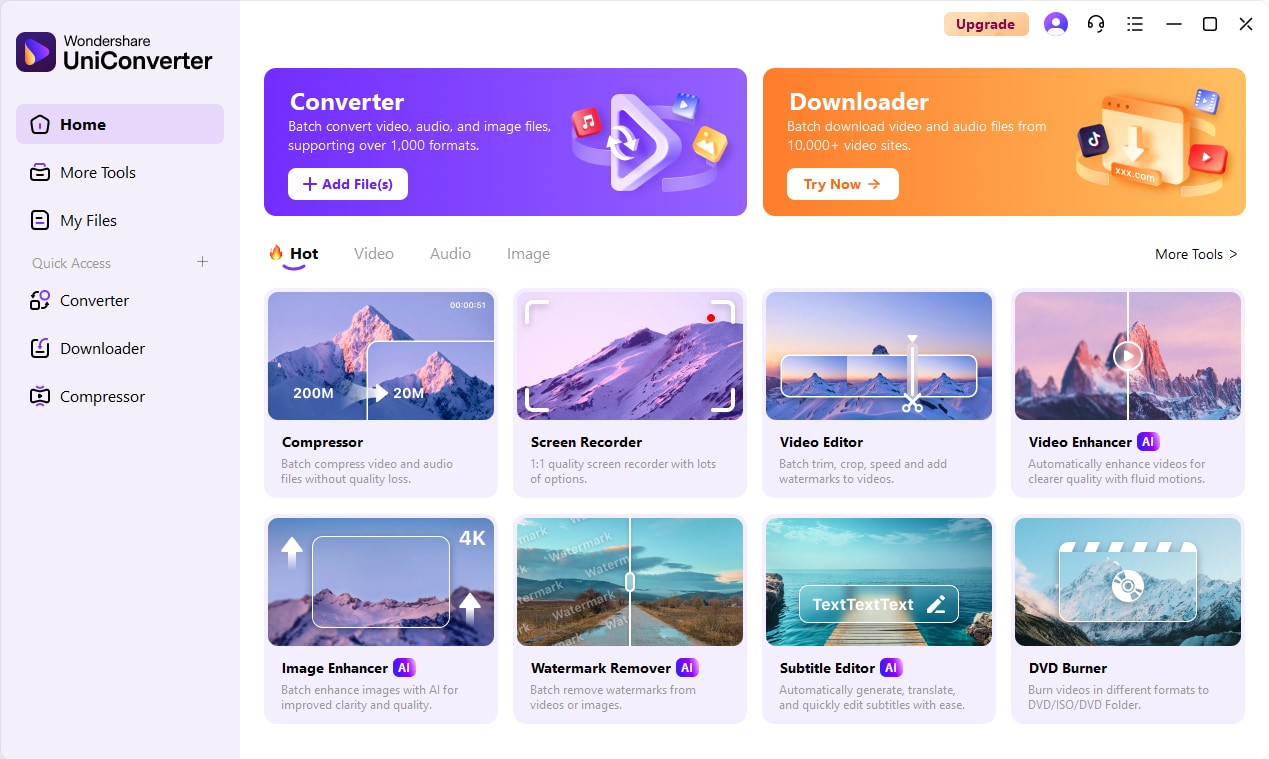
Step 2: Upload the Video, Audios or Images
Drag and drop your video, audio, or image files directly into the UniConverter interface, or click "Add Files" to browse and select them from your computer.
Step 3: Choose Required Formats or Parameters
Select your desired output format from the "Output Format" menu. You can also customize parameters like resolution, bitrate, and encoder settings for optimal results. For instance, you can easily convert MOV to MP4 or convert HEIC to JPG with precise control.
Step 4: Save the Converted File
Click the "Convert" or "Start All" button to begin the conversion process. Once completed, your converted files will be saved to the specified output folder.

Unlock Your Video's Full Potential
Part 7: Conclusion
The Shutter Encoder review highlights its position as a robust and versatile free transcoding tool, particularly valuable for video professionals and power users. Its extensive format support, granular control over encoding parameters, and batch processing capabilities make it an indispensable asset in complex video production workflows. However, its steep learning curve and resource demands on older hardware mean it may not be the ideal choice for casual users or those seeking a quick, simple conversion. While it excels in advanced scenarios, simpler alternatives like HandBrake might be more appropriate for basic tasks. For users prioritizing a streamlined experience with comprehensive features and reliable performance, UniConverter presents a compelling paid alternative. Ultimately, the best tool depends on the user's technical proficiency, specific project requirements, and hardware capabilities.
Part 8: FAQs
1. Is Shutter Encoder completely free to use?
Yes, Shutter Encoder is open-source and completely free to download and use.
2. Can Shutter Encoder handle 4K and 8K video conversions?
Yes, Shutter Encoder supports 4K and 8K video, but performance will depend on your hardware.
3. Is Shutter Encoder safe to download and install?
Yes, Shutter Encoder is generally considered safe and is widely used by professionals. Always download from the official website.
4. Does Shutter Encoder offer video editing capabilities?
While it has some basic cutting features, Shutter Encoder is primarily a transcoding tool, not a full-fledged video editor.
5. How does Shutter Encoder compare to HandBrake for general video conversion?
Shutter Encoder offers more advanced features and format support, while HandBrake is simpler for common conversions.
