
- OnlineConverter Value: Offers broad format support and user-friendly interface for quick, casual conversions.
- OnlineConverter Limitations: Requires internet, has file size limits, and features ads; less ideal for sensitive or large files.
- OnlineConverter vs. Competitors: Balances format variety and ease of use, but trails in speed, privacy, and file size vs. desktop tools.
- UniConverter Advantage: Desktop solution provides faster, private, high-quality conversions without internet or file size limits.
In this article
- Part 1: What is OnlineConverter?
- Part 2: OnlineConverter: Core Features, Pros, and Cons
- Part 3: Who is OnlineConverter For? Ideal Scenarios and Limitations
- Part 4: OnlineConverter vs. Competitors: A Comparative Look
- Part 5: Potential Pitfalls and Considerations When Using OnlineConverter
- Part 6: How to Use UniConverter to Convert Efficiently
- Part 7: Conclusion
- Part 8: FAQs
This OnlineConverter review delves into a popular online tool designed for quick and easy file conversions across various formats. In an increasingly digital world, the need to transform documents, images, audio, and video files from one format to another is ubiquitous. This review aims to provide a comprehensive analysis of OnlineConverter's features, performance, and user experience, comparing it against its competitors to help users make informed decisions. We will explore its strengths, weaknesses, ideal use cases, and potential pitfalls, ultimately guiding you on whether OnlineConverter is the right solution for your specific conversion needs.
Part 1: What is OnlineConverter?
OnlineConverter is a web-based platform that offers a wide array of file conversion services, allowing users to transform various media types without the need for software installation. From documents and images to audio and video files, it provides a convenient, browser-accessible solution for common conversion tasks. This OnlineConverter review will examine its capabilities and limitations in detail. The platform positions itself as a quick and accessible tool for anyone needing to change file formats on the fly, emphasizing ease of use and broad format support. Our review will address the core question: Does OnlineConverter truly deliver on its promise of being a reliable and efficient online conversion utility for the average user?
The Landscape of Online Conversion Tools
* Ubiquitous Need for Format Flexibility: In today's interconnected digital environment, users frequently encounter files in incompatible formats, necessitating conversion for viewing, editing, or sharing.
* Rise of Cloud-Based Solutions: The shift towards online tools offers convenience, eliminating software downloads and enabling access from any device with an internet connection.
* Balancing Convenience with Performance and Security: Users seek solutions that are not only easy to use but also reliable, fast, and secure, especially when dealing with sensitive data.
Part 2: OnlineConverter: Core Features, Pros, and Cons
OnlineConverter offers a comprehensive suite of conversion tools, supporting an impressive range of formats across different media categories. Its core strength lies in its accessibility and the sheer variety of conversions it facilitates, from basic image and document transformations to more specialized audio and video format changes. The platform prioritizes a straightforward user experience, making it approachable for individuals without technical expertise. However, its online-only nature and reliance on server processing introduce certain limitations that users should be aware of.
Pros
* Wide Range of Supported Formats for Various Media Types: OnlineConverter boasts an extensive list of supported formats, covering documents (PDF, DOCX, TXT), images (JPG, PNG, GIF), audio (MP3, WAV, FLAC), and video (MP4, AVI, MOV), making it a versatile tool for diverse conversion needs.
* User-Friendly Interface for Quick Conversions: The website's design is intuitive and uncluttered, allowing users to easily navigate, select their desired conversion type, upload files, and initiate the process with minimal clicks.
* No Software Installation Required, Browser-Based Access: As a purely online service, OnlineConverter eliminates the need for any software downloads or installations, offering instant access from any web browser on any operating system.
Cons
* Reliance on Internet Connection for All Operations: All conversion tasks require an active and stable internet connection, which can be a drawback in areas with poor connectivity or for users who prefer offline functionality.
* Potential Limitations on File Size and Conversion Speed: While generally efficient for smaller files, larger files may encounter limitations in terms of maximum upload size and can experience slower conversion times compared to dedicated desktop applications.
Part 3: Who is OnlineConverter For? Ideal Scenarios and Limitations
OnlineConverter is primarily designed for casual users who need quick, infrequent file conversions without the hassle of installing dedicated software. Its simplicity and broad format support make it an excellent choice for individuals who occasionally encounter incompatible file types and require a straightforward solution. However, its online nature and potential performance limitations mean it's less suited for professional use cases involving large volumes of data or sensitive information.
Best Use Case: Quick, One-Off File Conversions for Casual Users
Imagine a student needing to convert a PDF to a Word document for editing, or a social media manager resizing an image for a specific platform. OnlineConverter excels in these scenarios where speed and ease of access are paramount, and the files are typically small to moderate in size. It's perfect for those moments when you just need to get a conversion done without any fuss.
Limited Use Case: Batch Processing or Sensitive Data Handling
For professionals who regularly deal with large batches of files, such as video editors or graphic designers, OnlineConverter's file size limits and reliance on internet speed can be a significant bottleneck. Furthermore, for businesses handling confidential documents, the security implications of uploading sensitive data to a third-party online service might be a deterrent, making offline desktop solutions a more secure alternative.
Part 4: OnlineConverter vs. Competitors: A Comparative Look
When evaluating online conversion tools, it's crucial to compare OnlineConverter against other prominent players in the market. This comparison highlights its position in terms of features, performance, and user experience, helping users understand its unique value proposition and where it might fall short.
| Feature/Tool | OnlineConverter | CloudConvert | Zamzar | UniConverter |
| Supported Formats | Extensive | Extensive | Extensive | Extensive |
| File Size Limit | Moderate (up to 200MB) | High (up to 1GB free) | Moderate (up to 50MB free) | Very High (software-dependent) |
| Conversion Speed | Average | Fast | Average | Very Fast (GPU acceleration) |
| Privacy Policy | Standard | Enhanced (GDPR compliant) | Standard | Enhanced (local processing) |
| Ad Presence | Moderate | Low (paid tiers remove ads) | High | None (desktop software) |
Key Differentiators: What Sets OnlineConverter Apart (and Where It Falls Short)
OnlineConverter stands out for its sheer breadth of supported formats and its completely free-to-use model, making it highly accessible. However, its ad presence can be intrusive, and its file size limits are more restrictive than some competitors like CloudConvert, which offers a higher free tier limit. UniConverter, as a desktop application, surpasses all online tools in terms of conversion speed, file size handling, and privacy, as it processes files locally. While Zamzar also offers extensive format support, its free tier has a lower file size limit and often features more prominent ads. OnlineConverter strikes a balance between format variety and ease of use, but users prioritizing speed, large file handling, or privacy might find better alternatives.
Part 5: Potential Pitfalls and Considerations When Using OnlineConverter
While OnlineConverter offers convenience, users should be aware of several potential pitfalls and considerations, especially when dealing with sensitive data or expecting high-quality output. Understanding these limitations is crucial for making informed decisions about its suitability for specific tasks.
Data Privacy and Security Concerns
Uploading files to any online service, including OnlineConverter, inherently carries data privacy risks. Users should be cautious about converting sensitive or confidential documents, as the platform's data handling policies might not align with strict corporate or personal privacy requirements. While most reputable services claim to delete files after a certain period, the initial upload and processing expose data to third-party servers.
Impact of Advertisements on User Experience
OnlineConverter, being a free service, relies on advertisements for revenue. These ads can sometimes be intrusive, appearing as banners, pop-ups, or even video ads, which can disrupt the user experience and slow down navigation. For users who prefer an uninterrupted workflow, the presence of ads can be a significant annoyance.
Quality of Output for Specific File Types
While OnlineConverter generally provides acceptable conversion quality for common file types, the output quality for more complex or specialized formats, such as high-resolution images or professional video codecs, might not always meet professional standards. There can be instances of compression artifacts, loss of detail, or slight discrepancies in formatting, especially with intricate document layouts.
File Size Restrictions and Conversion Time
Free online converters often impose limitations on the maximum file size that can be uploaded for conversion. Exceeding these limits typically requires a paid subscription or prevents the conversion altogether. Additionally, conversion times can vary significantly based on file size, server load, and internet speed, potentially leading to long waits for larger files.
Lack of Advanced Editing Features
OnlineConverter is purely a conversion tool and does not offer any advanced editing capabilities. Users needing to crop, trim, merge, or apply effects to their media files before or after conversion will need to use separate software. This lack of integrated editing can lead to a fragmented workflow for tasks requiring more than just a format change.
Part 6: How to Use UniConverter to Convert Efficiently
When online tools prove insufficient due to limitations in batch processing, unstable conversions, or quality degradation, UniConverter stands out as a powerful desktop alternative. It overcomes the typical shortcomings of online converters by providing a stable, high-speed, and high-quality conversion experience. UniConverter supports a vast array of formats, utilizes GPU acceleration for swift processing, guarantees lossless conversion, and enables efficient batch operations, positioning it as a comprehensive all-in-one solution for diverse media conversion needs.
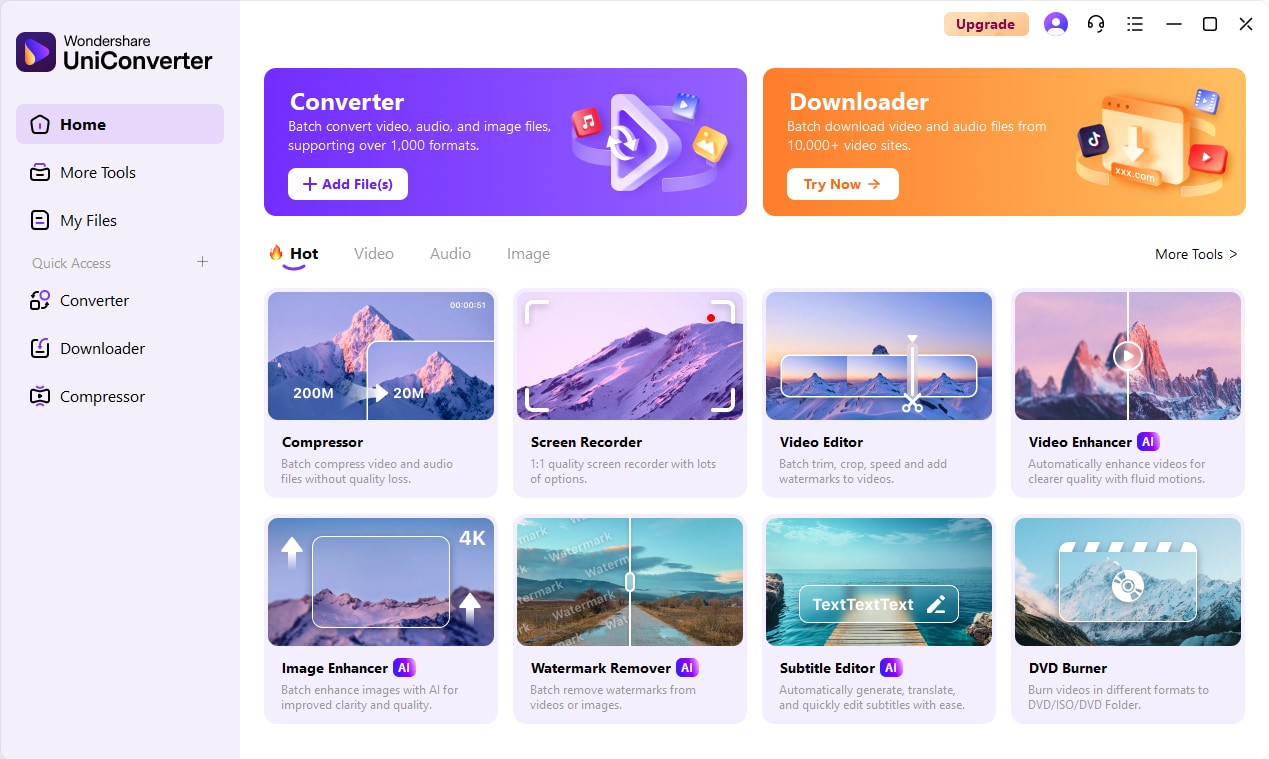
Step 1: Open UniConverter and Choose Converter
Download UniConverter from its official website and follow the on-screen instructions to install it on your computer. Launch UniConverter. From the main interface, select the 'Converter' tab to access the core conversion functionalities.
Step 2: Upload the Video, Audios or Images
Drag and drop your desired video, audio, or image files into the UniConverter interface. You can add multiple files for batch conversion.

Step 3: Choose Required Formats or Parameters
Select your desired output format from the extensive list. You can also customize parameters like resolution, bitrate, and quality settings. For instance, you can easily convert video to 360 VR or convert images to various formats.

Step 4: Start the Conversion and Save Your Output
Click the 'Convert' or 'Start All' button to begin the conversion process. Once completed, your converted files will be saved to the specified output folder.


Seeking a Powerful OnlineConverter Alternative?
Part 7: Conclusion
This OnlineConverter review has thoroughly examined the capabilities and limitations of OnlineConverter, positioning it as a highly accessible and convenient tool for casual, one-off file conversions. Its broad format support and user-friendly interface make it an excellent choice for individuals seeking quick solutions without software installation. However, its reliance on an internet connection, potential file size limits, and the presence of advertisements can detract from the user experience, especially for larger files or sensitive data. For professionals or users with frequent, high-volume, or sensitive conversion needs, desktop alternatives like UniConverter offer superior performance, enhanced privacy, and a more robust feature set, including batch processing and advanced editing capabilities, without the drawbacks of online services. Ultimately, the best choice depends on individual requirements: OnlineConverter for simplicity and occasional use, and UniConverter for power, privacy, and comprehensive media management.
Part 8: FAQs
-
1. Is OnlineConverter safe to use for sensitive files?
OnlineConverter, like most online services, involves uploading your files to their servers. While they typically state that files are deleted after a certain period, for highly sensitive or confidential files, it's generally safer to use offline desktop software like UniConverter that processes files locally, minimizing exposure risks.
-
2. Are there any file size limitations with OnlineConverter?
Yes, OnlineConverter usually imposes file size limits for free users, which can vary but are typically around 200MB. Larger files may require a premium subscription or cannot be converted. Desktop converters generally do not have such restrictions.
-
3. How does OnlineConverter handle data privacy?
OnlineConverter's privacy policy generally outlines that uploaded files are processed and then deleted from their servers after a set time. However, users should always review the specific terms of service for the most current information and consider the inherent risks of uploading data to any third-party online platform.
-
4. Can I convert multiple files at once using OnlineConverter?
Some sections of OnlineConverter may support limited batch processing, but it's often less efficient and more restrictive compared to dedicated desktop applications. For extensive batch conversions, a tool like UniConverter offers a much smoother and faster experience.
-
5. What are the main advantages of using a desktop converter like UniConverter over OnlineConverter?
Desktop converters like UniConverter offer several advantages: no internet dependency, higher conversion speeds (often with GPU acceleration), no file size limits, enhanced privacy (files are processed locally), no intrusive ads, and often include advanced editing features not found in online tools.
