
- Value: Miro Video Converter offers free, simple video conversion for casual users, prioritizing ease over advanced features.
- Comparison: It excels in simplicity but lacks advanced features, batch processing, and frequent updates compared to alternatives.
- Decision: Ideal for basic, occasional conversions; insufficient for professional use or demanding tasks requiring precision and speed.
- Risk: Free converters like Miro can have outdated code, security vulnerabilities, and limited control over output quality.
- Solution: UniConverter provides efficient, high-quality audio/video conversion with advanced features, speed, and reliability.
In this article
- Part 1: What is Miro Video Converter?
- Part 2: Miro Video Converter: Core Features, Pros, and Cons
- Part 3: Miro Video Converter: Target Audience and Use Cases
- Part 4: Miro Video Converter and Alternatives: A Comparative Analysis
- Part 5: Risks and Pitfalls When Using Free Video Converters
- Part 6: How to Use UniConverter for Efficient Audio and Video Conversion
- Part 7: Final Verdict and Recommendations
- Part 8: FAQs
Welcome to our in-depth Miro Video Converter review and comparison. In an era where digital content reigns supreme, the ability to effortlessly convert video formats is no longer a luxury but a necessity. Whether you're a casual user looking to play a downloaded video on your smartphone or a content creator preparing footage for various platforms, a reliable video converter is an indispensable tool. This review aims to dissect Miro Video Converter, a popular free and open-source option, by examining its features, performance, and overall value. We will also pit it against its notable competitors to help you make an informed decision about which tool best suits your video conversion needs.
Part 1: What is Miro Video Converter?
Miro Video Converter is a free, open-source video conversion tool developed by the Participatory Culture Foundation. It's designed with simplicity in mind, offering a straightforward approach to converting various video formats into more universally compatible ones, particularly for mobile devices and web platforms. Its primary goal is to make video conversion accessible to everyone, regardless of their technical expertise. This Miro Video Converter review will delve into its capabilities, limitations, and how it stacks up against other solutions in the market.
The Landscape of Free Video Converters
The market for free video converters is vast and varied, catering to a wide spectrum of user needs. However, this abundance also presents challenges:
* Overwhelming Choices: Users often struggle to differentiate between reliable, safe, and effective free tools.
* Hidden Costs and Ads: Many "free" converters come with intrusive advertisements, bundled software, or limitations that push users towards paid upgrades.
* Security Concerns: Some free software can pose security risks, including malware or outdated code vulnerabilities.
* Varying Quality and Features: The quality of conversion, speed, and range of supported formats can differ significantly across free options.
Part 2: Miro Video Converter: Core Features, Pros, and Cons
Miro Video Converter is renowned for its user-friendly interface and commitment to being a completely free and open-source solution. Its core capabilities revolve around simplifying the video conversion process for everyday users.
Core Features:
* Drag-and-Drop Interface: Effortlessly add files for conversion.
* Preset Profiles: Optimized settings for popular devices like Android phones, iPhones, and game consoles.
* Common Format Support: Converts to and from widely used formats such as MP4, WebM, Ogg, and FLV.
* Resolution Control: Basic options for output resolution.
* Open-Source Nature: Community-driven development and transparency.
Pros:
* Simple and intuitive user interface, ideal for beginners.
* Supports a wide range of common video formats for conversion.
* Completely free and open-source, with no hidden costs or ads.
Cons:
* Limited advanced features and customization options.
* Infrequent updates and potential compatibility issues with newer operating systems.
Part 3: Miro Video Converter: Target Audience and Use Cases
Miro Video Converter is primarily designed for individuals who need a quick and uncomplicated way to convert video files without delving into complex settings or spending money. Its minimalist design and straightforward functionality make it an excellent choice for casual users.
Best Use Case: Quick and Easy Format Conversion for Casual Users
Imagine a scenario where you've downloaded a video, but your smart TV or old tablet can't play it. You don't want to spend hours learning a new software or dealing with confusing codecs. This is where Miro Video Converter shines. You simply drag your video file into the application, select your target device (e.g., "Android Phone"), and click convert. The software handles the technical details, providing you with a playable file in minutes. It's perfect for students, casual viewers, or anyone who needs to quickly adapt a video for a specific playback device without fuss.
Limited Use Case: Professional Video Editing Workflows or Batch Processing
However, Miro Video Converter falls short for more demanding tasks. For a professional video editor who needs precise control over bitrates, codecs, frame rates, and advanced editing features like trimming, merging, or adding effects, Miro Video Converter is inadequate. Similarly, if you need to convert dozens or hundreds of files regularly (batch processing), its lack of robust batch conversion capabilities and slower processing speeds compared to more advanced tools would be a significant bottleneck. It's not built for high-volume, high-precision, or complex video manipulation.
Part 4: Miro Video Converter and Alternatives: A Comparative Analysis
When evaluating video converters, it's crucial to consider their performance across various metrics. Here's a comparison of Miro Video Converter against some prominent alternatives: HandBrake, Freemake Video Converter, and Any Video Converter Free.
| Feature/Product | Miro Video Converter | HandBrake | Freemake Video Converter | Any Video Converter Free |
| Ease of Use | Very High | Moderate | High | Moderate |
| Supported Formats | Good | Excellent | Good | Excellent |
| Advanced Features | Low | High | Moderate | Moderate |
| Output Quality Control | Basic | Advanced | Basic | Moderate |
| Batch Processing | No | Yes | Yes | Yes |
| Cost | Free | Free | Freemium | Freemium |
| Conversion Speed | Moderate | Fast (GPU) | Moderate | Fast (GPU) |
| Customer Support | Community | Community | Limited (Paid) | Limited (Paid) |
| Security | Good (Open-source) | Excellent (Open-source) | Variable (Ads) | Variable (Ads) |
Key Differentiators: Simplicity vs. Feature Richness
Miro Video Converter's strength lies in its unparalleled simplicity, making it the go-to for users who prioritize ease of use above all else. HandBrake, while also free and open-source, offers a significantly richer set of advanced features and output controls, making it ideal for users comfortable with more technical settings. Freemake Video Converter and Any Video Converter Free sit in the middle, offering a balance of ease of use and more features than Miro, but often come with freemium models that push for paid upgrades or include ads. For quick, no-frills conversions, Miro is hard to beat. For power users, HandBrake provides robust control, while the freemium options offer a broader feature set with some caveats.
Part 5: Risks and Pitfalls When Using Free Video Converters
While free video converters like Miro Video Converter offer undeniable appeal, it's crucial to be aware of the potential risks and drawbacks, especially when considering less reputable free options. These issues can range from minor annoyances to significant security threats.
Potential for Outdated Code and Security Vulnerabilities
Many free video converters, particularly those that are no longer actively maintained (like Miro Video Converter with its infrequent updates), can harbor outdated code. This can lead to security vulnerabilities that hackers might exploit. Using such software could expose your system to malware, viruses, or other malicious attacks, compromising your data and system integrity. Always ensure that any software you download is from a trusted source and ideally, regularly updated.
Lack of Dedicated Customer Support
Free software typically comes with little to no dedicated customer support. If you encounter bugs, conversion errors, or compatibility issues, you're often left to troubleshoot on your own, relying on community forums or outdated FAQs. This can be a significant time sink and frustration, especially for users who are not tech-savvy. Paid alternatives, in contrast, usually offer professional support channels.
Limited Control Over Output Quality and File Size
Free converters often provide only basic options for output quality and file size. This means you might end up with a converted video that is either excessively large (wasting storage) or significantly compressed, leading to a noticeable drop in visual and audio quality. For specific projects or professional use, this lack of granular control can be a major limitation, as you cannot fine-tune parameters like bitrate, resolution, or codec settings.
Absence of Advanced Editing or Enhancement Tools
Beyond simple format conversion, most free tools lack any advanced editing capabilities. Features like trimming, cropping, merging multiple clips, adding subtitles, applying filters, or enhancing video quality are typically absent. This forces users to either use multiple separate tools for different tasks or upgrade to a more comprehensive, often paid, solution if they require more than just basic conversion.
Part 6: How to Use UniConverter for Efficient Audio and Video Conversion
When other tools fall short with batch processing, unstable conversions, or quality loss, UniConverter emerges as a powerful and reliable alternative. It offers a comprehensive solution for all your video conversion needs, boasting a wide array of supported formats, GPU acceleration for faster speeds, lossless quality, and robust batch conversion capabilities, all without ads. UniConverter is designed to be an all-in-one ultimate solution for video processing.
Step 1: Open UniConverter and Choose Converter
Launch UniConverter on your computer. From the main interface, select the "Converter" tab.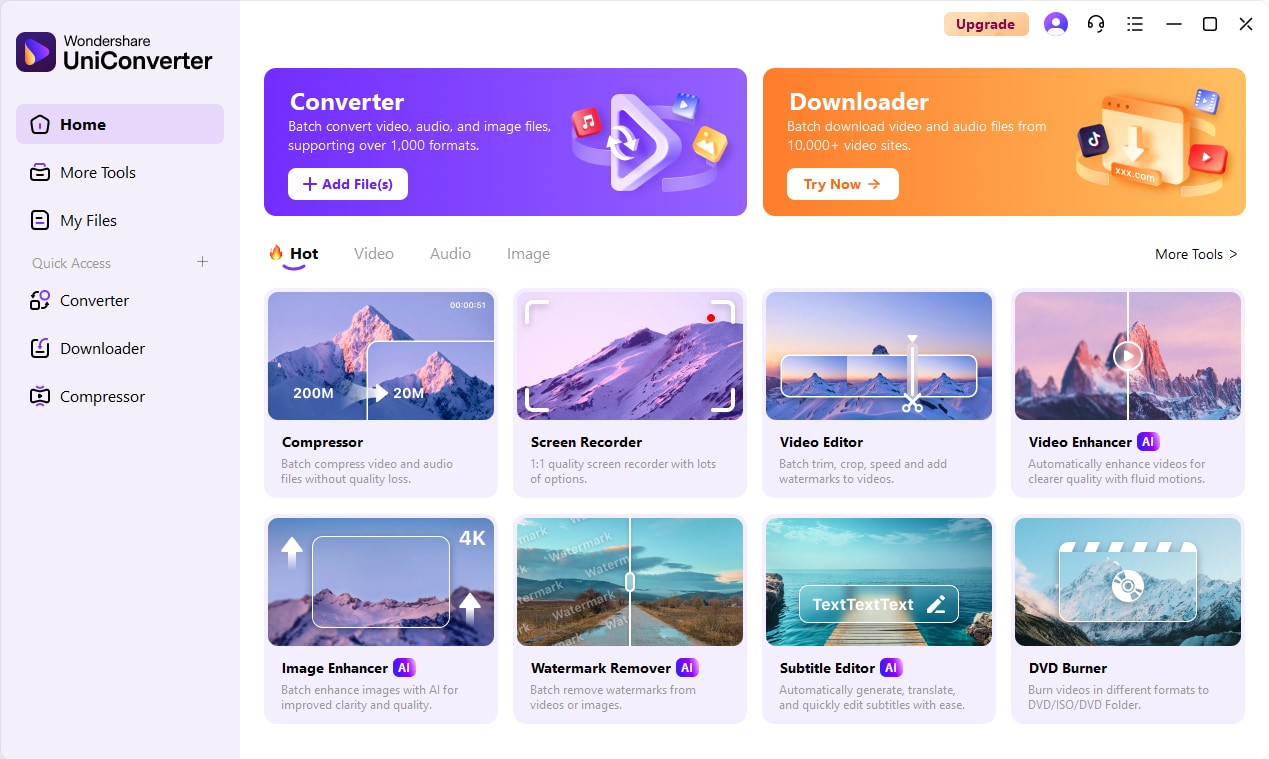
Step 2: Upload the Video, Audios or Images
Click on the "Add Files" button or simply drag and drop your video, audio, or image files into the program window. You can add multiple files for batch conversion.
Step 3: Choose Required Formats or Parameters
At the bottom of the window, click on the "Output Format" dropdown menu. Select your desired output format (e.g., MP4, MOV, MP3) and choose your preferred resolution or quality settings. You can also customize advanced parameters if needed. For instance, you can easily convert MOV to MP4 or convert MP4 to MP3 with just a few clicks.
Step 4: Save the Converted File
Once your settings are configured, click the "Convert" or "Start All" button. UniConverter will process your files efficiently. After conversion, you can find your converted files in the "Finished" tab or by clicking the "Open" button next to the file.

Efficient Video Conversion & Editing
Part 7: Final Verdict and Recommendations
This Miro Video Converter review has highlighted its strengths as a simple, free, and open-source tool for basic video conversion. For users who prioritize ease of use and zero cost for occasional, straightforward format changes, Miro Video Converter remains a viable option. Its intuitive interface makes it perfect for beginners who want to convert a video for a specific device without navigating complex settings. However, its limitations in advanced features, infrequent updates, and lack of dedicated support make it unsuitable for more demanding users. Those requiring precise control over output quality, batch processing, or additional editing capabilities will find Miro Video Converter insufficient. For frequent video conversion needs, especially in professional or semi-professional contexts, investing in a more robust solution like UniConverter, which offers comprehensive features, reliability, and dedicated support, is highly recommended. Ultimately, the best choice depends on your specific requirements, balancing simplicity and cost against advanced functionality and reliability.
Part 8: FAQs
Is Miro Video Converter safe to use?
Miro Video Converter is generally considered safe as it is open-source, meaning its code is transparent. However, its infrequent updates mean it might not address newer security vulnerabilities, which could pose a risk over time.
Does Miro Video Converter support 4K video conversion?
Miro Video Converter has basic resolution options but is not optimized for 4K video conversion. It may struggle with large 4K files or not offer the necessary codecs and settings for high-quality 4K output.
Can I convert audio files with Miro Video Converter?
No, Miro Video Converter is specifically designed for video conversion. It does not offer functionality to convert audio-only files.
Are there any hidden ads or malware in Miro Video Converter?
As an open-source project, Miro Video Converter is free from hidden ads or bundled malware. It adheres to a clean, straightforward user experience without commercial interruptions.
What are the main advantages of using a paid video converter over a free one?
Paid video converters typically offer more advanced features (e.g., 4K support, advanced editing, GPU acceleration), faster conversion speeds, higher output quality control, dedicated customer support, and regular updates for security and compatibility.
