
- HandBrake Value: Free, open-source, and powerful for advanced video transcoding and archiving.
- HandBrake Limitations: Steep learning curve, minimal editing, not ideal for quick, simple tasks.
- UniConverter Comparison: Offers intuitive interface, broad format support, GPU acceleration, and comprehensive editing tools.
- Decision Factor: Choose HandBrake for deep customization and no cost; UniConverter for ease of use, speed, and integrated features.
In this article
- Part 1: What is HandBrake?
- Part 2: HandBrake's Core Strengths and Weaknesses
- Part 3: Who is HandBrake For? Understanding Usage Scenarios
- Part 4: HandBrake vs. Its Competitors: A Comparative Look
- Part 5: Potential Pitfalls and Considerations
- Part 6: How to Use UniConverter for Efficient Video Conversion
- Part 7: Conclusion
- Part 8: FAQs
HandBrake: Your Go-To Video Transcoder?
HandBrake review: In the ever-evolving digital landscape, managing and optimizing video files is a common necessity, whether for archiving, playback on diverse devices, or sharing online. HandBrake has long stood as a prominent, open-source solution in this domain, offering powerful video transcoding capabilities. This review delves into its core functionalities, contrasting it with key competitors to provide a comprehensive understanding of its strengths and limitations. We will explore who benefits most from HandBrake's robust feature set, identify potential pitfalls, and ultimately guide users in making informed decisions about their video conversion needs. Our aim is to deliver a detailed, scenario-based analysis to help you navigate the complex world of video transcoding.
Part 1: What is HandBrake?
HandBrake review: HandBrake is a free and open-source video transcoder, originally developed in 2003, designed to convert video from nearly any format to a selection of modern, widely supported codecs. Its primary function is to convert video files into formats that are more compatible with various devices, reduce file sizes for storage, or prepare them for streaming. This review aims to dissect HandBrake's capabilities, positioning it against its contemporaries to help users understand its value proposition in a crowded market. We will address the core question: Is HandBrake still the optimal choice for your video conversion tasks, or have newer, more streamlined solutions surpassed it?
The Open-Source Video Conversion Landscape
* The Need for Format Flexibility: Users frequently encounter videos in formats incompatible with their preferred devices or platforms.
* Storage and Bandwidth Optimization: Large video files consume significant storage and bandwidth, necessitating efficient compression.
* Accessibility and Cost-Effectiveness: The demand for powerful, yet free, video conversion tools remains high.
Part 2: HandBrake's Core Strengths and Weaknesses
HandBrake's core performance lies in its robust transcoding engine, capable of handling a vast array of video and audio formats. It excels at converting media for specific devices, optimizing for web streaming, and archiving large video libraries. Its strength also lies in the granular control it offers over encoding parameters, allowing experienced users to fine-tune output quality and file size. However, this level of control can be a double-edged sword for novices.
Pros
* Wide Range of Supported Formats and Codecs: Converts almost any video format to MP4, MKV, and WebM.
* Advanced Customization for Video Encoding: Offers extensive control over bitrate, resolution, frame rate, and audio settings.
* Completely Free and Open-Source: No cost involved, backed by a community of developers.
* Cross-Platform Availability: Works on Windows, macOS, and Linux.
* Batch Processing: Efficiently converts multiple video files in one go.
Cons
* Steep Learning Curve for Beginners: The interface can be intimidating due to numerous advanced options.
* Limited Editing Capabilities: Primarily a transcoder, not a video editor.
Part 3: Who is HandBrake For? Understanding Usage Scenarios
HandBrake caters primarily to users who require precise control over their video conversions and are comfortable navigating complex technical settings. It's an invaluable tool for those with extensive media libraries or specific playback requirements across various devices. Its open-source nature also appeals to tech-savvy individuals and developers who appreciate transparency and customizability.
Best Use Case: Batch Converting Media Libraries for Archiving or Playback on Specific Devices
Imagine you have a vast collection of old DVDs or Blu-rays, and you want to digitize them for easier access on your smart TV, tablet, or smartphone. HandBrake shines here, allowing you to rip and convert these physical media into digital files (e.g., MP4) with optimized settings for each target device. You can set up a queue of files, apply consistent presets, and let HandBrake process them efficiently, significantly reducing file sizes while maintaining acceptable quality for archival or casual viewing.
Limited Use Case: Quick Edits and Conversions for Social Media Sharing
If your goal is to quickly trim a video clip, add a simple effect, and convert it for immediate sharing on platforms like Instagram or TikTok, HandBrake is not the ideal tool. Its focus on detailed encoding rather than quick edits means that even simple tasks can become cumbersome. Users looking for a swift, all-in-one solution for social media content creation would find HandBrake's workflow too slow and lacking in essential editing features.
Part 4: HandBrake vs. Its Competitors: A Comparative Look
When evaluating video transcoding tools, HandBrake stands out for its open-source nature and powerful customization. However, it faces strong competition from commercial alternatives that prioritize ease of use and integrated features.
| Feature/Product | HandBrake | UniConverter | FFmpeg | Shutter Encoder |
| Ease of Use | Moderate (Steep for beginners) | Very High | Very Low (Command-line) | High |
| Output Quality | Excellent (Highly customizable) | Excellent (AI enhancement) | Excellent (Highly customizable) | Excellent |
| Editing Features | Minimal (Cropping, scaling) | Comprehensive (Trim, merge, effects, subtitle) | Minimal (Via command line) | Basic (Cut, merge) |
| Price | Free | Paid (Subscription/Lifetime) | Free | Free |
| Supported Formats | Wide (MP4, MKV, WebM) | Extremely Wide (1000+ formats) | Extremely Wide (Via command line) | Wide |
| Processing Speed | Good (Hardware dependent) | Excellent (GPU acceleration) | Excellent (Highly optimized) | Good |
| Customer Support | Community Forums | Dedicated Support | Community Forums | Community Forums |
| Security | Open-source (Transparent) | High (Reputable company) | Open-source (Transparent) | Open-source (Transparent) |
Key Differentiators: Where HandBrake Stands Out (and Falls Short)
HandBrake excels in providing granular control over encoding parameters, making it a favorite for advanced users who need to fine-tune every aspect of their video output. Its open-source nature guarantees transparency and continuous community development. However, its user interface can be daunting for beginners, and it lacks integrated editing functionalities.
UniConverter emerges as a strong contender for users seeking an all-in-one solution. It boasts an intuitive interface, supports an incredibly wide array of formats, and integrates powerful editing tools, DVD burning, and even AI-powered enhancements. Its GPU acceleration often leads to faster processing times compared to HandBrake, making it ideal for users who value speed and convenience. The trade-off is its paid model.
FFmpeg is the underlying engine for many video tools, including parts of HandBrake. It offers unparalleled flexibility and power but requires command-line proficiency, making it unsuitable for most casual users. Its strength lies in its raw capability for complex, automated video processing tasks.
Shutter Encoder strikes a balance between HandBrake's customization and UniConverter's ease of use. It's free, offers a clean interface, and supports a good range of formats and codecs, including professional ones. While it doesn't have the extensive editing suite of UniConverter, it's a solid choice for users who want more control than basic converters but less complexity than HandBrake.
In essence, HandBrake is best for those who prioritize deep customization and cost-free operation, while UniConverter caters to users who value a comprehensive, user-friendly experience with advanced features. FFmpeg is for the command-line expert, and Shutter Encoder offers a good middle ground.
Part 5: Potential Pitfalls and Considerations
Using video transcoding software, especially free and open-source options like HandBrake, comes with its own set of challenges and considerations. While powerful, users need to be aware of potential pitfalls to achieve optimal results and avoid frustration.
Understanding Encoding Presets and Their Impact on Quality
HandBrake offers numerous presets, from "Fast 1080p30" to "Very Slow 4K." Choosing the wrong preset can drastically affect output quality and file size. A "fast" preset might result in a smaller file but with noticeable compression artifacts, especially in fast-moving scenes. Conversely, a "very slow" preset will yield higher quality but take significantly longer to process. Beginners often struggle to balance these trade-offs, leading to either unnecessarily large files or compromised visual fidelity.
The Importance of Source File Quality
HandBrake cannot magically improve the quality of a poor source file. If your input video is low resolution, heavily compressed, or contains artifacts, the output will reflect these limitations, regardless of your encoding settings. Attempting to upscale a low-quality video often results in a blurry or pixelated output rather than a sharper image. Users must manage expectations based on their original media.
Performance Differences Across Hardware
The speed and efficiency of HandBrake conversions are highly dependent on your computer's hardware, particularly its CPU and, to a lesser extent, its GPU (for specific codecs). Older processors will take significantly longer to encode videos, especially high-resolution or high-bitrate files. Lack of dedicated GPU acceleration for certain codecs can also slow down the process considerably, leading to long wait times for complex tasks.
Navigating Complex Settings for Optimal Results
HandBrake's strength in customization is also its biggest hurdle for new users. The myriad of options for video codecs, frame rates, bitrates, audio tracks, subtitles, and filters can be overwhelming. Incorrectly configured settings can lead to unexpected results, such as out-of-sync audio, distorted video, or files that won't play on the target device. Achieving optimal results often requires experimentation and a solid understanding of video encoding principles.
Part 6: How to Use UniConverter for Efficient Video Conversion
When other tools fall short with batch processing, stability issues, or quality loss during conversion, UniConverter stands out as a robust and user-friendly alternative. It offers a seamless experience, free from ads, with extensive format support, GPU acceleration for speed, lossless conversion, and efficient batch processing. UniConverter is positioned as an all-in-one solution for all your video and audio needs.
Step 1: Open UniConverter and Choose Converter
Launch UniConverter on your computer. From the main interface, select the "Converter" tab. This is where you'll initiate your video and audio conversion tasks.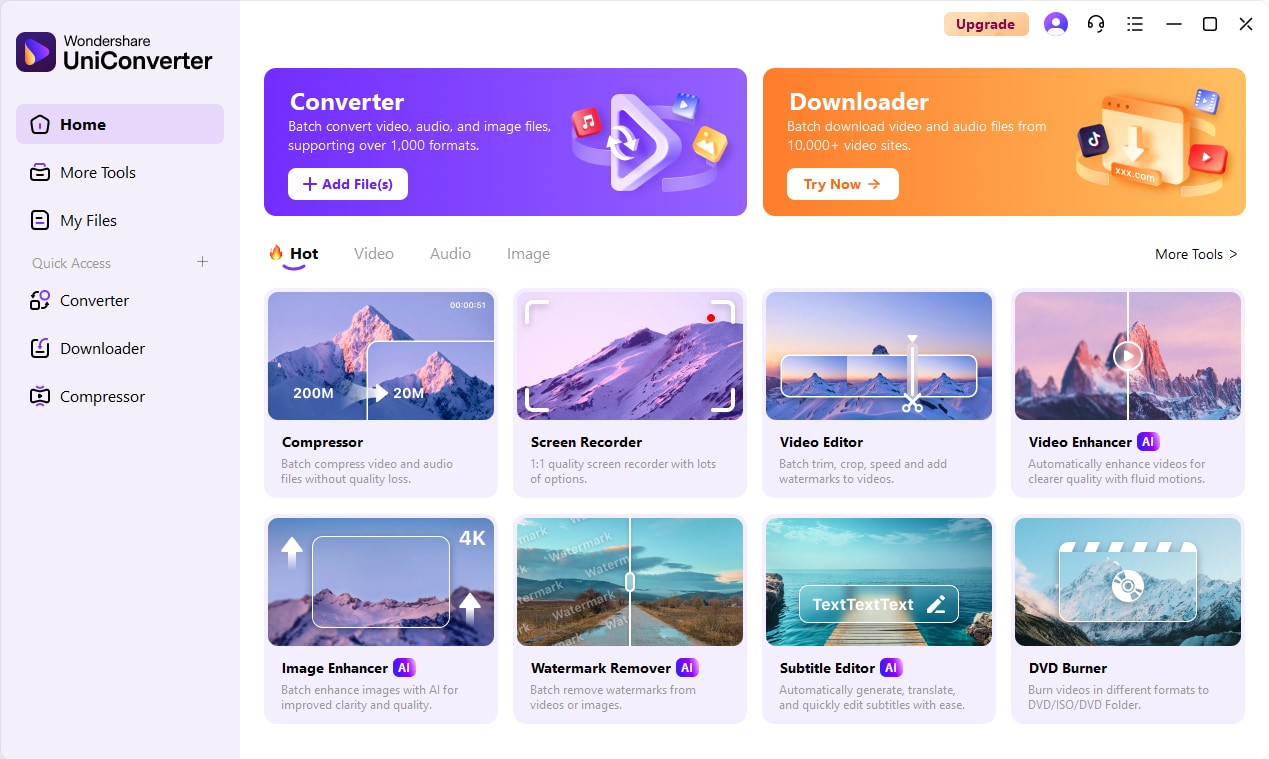
Step 2: Upload the Video, Audios or Images
Click on the "Add Files" button or simply drag and drop your video, audio, or image files into the program window. You can add multiple files for batch conversion.
Step 3: Choose Required Formats or Parameters
At the bottom of the window, click on the "Output Format" dropdown menu. Select your desired output format (e.g., MP4, MOV, AVI) and choose your preferred resolution or device preset. You can also customize advanced parameters like bitrate and codec. For instance, you might want to convert MOV to MP4 for broader compatibility. If you're working with images, you can also convert TIFF to JPG or other formats.
Step 4: Save the Converted File
Once all settings are configured, click the "Convert" or "Start All" button. UniConverter will process your files efficiently. For example, you can easily convert MP4 to MP3 or convert WAV to MP3. After conversion, you can find your converted files in the "Finished" tab or the specified output folder.

Enhance Your Video Editing Workflow
Part 7: Conclusion
The HandBrake review reveals it as a powerful, free, and open-source video transcoder, ideally suited for tech-savvy users and archivists who require extensive control over video encoding parameters. Its ability to convert a vast array of formats with high customization makes it invaluable for digitizing media libraries and optimizing content for specific devices. However, its steep learning curve and limited editing capabilities make it less suitable for beginners or those needing quick, simple edits for social media. For casual users and content creators prioritizing ease of use, speed, and integrated features, paid alternatives like UniConverter offer a more streamlined and comprehensive solution. UniConverter excels with its intuitive interface, broad format support, GPU acceleration, and robust editing tools, making it a strong contender for an all-in-one video management experience. Ultimately, the choice between HandBrake and its competitors hinges on individual technical proficiency, specific use cases, and budget considerations.
Part 8: FAQs
1. Is HandBrake truly free?
Yes, HandBrake is completely free and open-source software, available for download without any cost.
2. Can HandBrake convert 4K videos?
Yes, HandBrake can convert 4K videos, but the processing time can be significant depending on your computer's hardware and the chosen encoding settings.
3. Does HandBrake support GPU acceleration?
HandBrake has limited GPU acceleration support, primarily for specific codecs like Intel Quick Sync Video and NVIDIA NVENC, which can speed up encoding for compatible hardware.
4. What's the best HandBrake preset for web streaming?
The "Web" presets (e.g., "Web Optimized") are a good starting point for web streaming. However, you may need to adjust resolution and bitrate manually to achieve optimal results for your specific platform and audience.
5. Why is my HandBrake conversion taking so long?
Conversion time depends on several factors, including the video's length, resolution, the complexity of the chosen preset (e.g., higher quality settings take longer), and your computer's processing power (CPU and GPU).
