
- FFQueue Value: Automates complex video encoding, ideal for large batches and precise control via FFmpeg scripting.
- User Profile: Best for technical users, system administrators, and media professionals needing deep customization and automation.
- Ease of Use: Steep learning curve due to command-line interface; not suitable for casual users seeking simple conversions.
- Comparison: Offers unparalleled scripting over HandBrake/Shutter Encoder, but lacks UniConverter's intuitive GUI and dedicated support.
- Risks: Prone to configuration errors, relies on FFmpeg updates, lacks dedicated support, and can be resource-intensive.
- UniConverter Alternative: Provides an intuitive GUI, GPU acceleration, and dedicated support for efficient, high-quality conversions.
In this article
This FFQueue review delves into the capabilities of FFQueue, an open-source command-line tool designed for advanced video processing. In an era where video content dominates digital landscapes, efficient and customizable video encoding solutions are paramount. This review aims to provide a comprehensive analysis of FFQueue, comparing it against popular alternatives like HandBrake and Shutter Encoder, to help users make informed decisions about their video workflow tools. We will explore its core features, ideal use cases, potential pitfalls, and offer recommendations for various user profiles.
Part 1: What is FFQueue?
FFQueue is a powerful, open-source command-line utility built on top of FFmpeg, designed to manage and automate complex video encoding and processing tasks. It acts as a queue manager for FFmpeg jobs, allowing users to process multiple video files sequentially or in parallel with highly customized settings. Its primary strength lies in its ability to handle large batches of video files, making it an indispensable tool for professionals and organizations dealing with extensive media libraries. This review will address the core challenge of finding an efficient, flexible, and scalable video processing solution that can meet diverse technical requirements without compromising quality or requiring constant manual intervention.
The Evolving Landscape of Video Processing Tools
* Increasing Demand for Automation: The sheer volume of video content necessitates automated solutions for encoding, transcoding, and archiving.
* Need for Customization: Generic converters often lack the granular control required for specific output formats, codecs, and quality settings.
* Scalability for Large Archives: Managing and processing vast video libraries demands tools capable of handling high throughput and complex job queues.
* Integration with Existing Workflows: Professionals often require tools that can be easily integrated into existing scripting and automation pipelines.
Part 2: FFQueue: Core Features, Pros, and Cons
FFQueue's core strength lies in its ability to orchestrate FFmpeg commands, offering unparalleled control over video processing. It excels in managing encoding queues, enabling users to define intricate processing chains for various video and audio formats. Its capabilities extend to highly specific tasks like bitrate adjustments, resolution scaling, frame rate conversions, and complex filter applications. Users can leverage its robust scripting interface to automate virtually any FFmpeg operation, making it a versatile tool for both simple conversions and advanced video manipulations.
Pros:
* Efficient Batch Processing for Large Video Libraries: FFQueue's queue management system allows for seamless processing of hundreds or thousands of video files, ideal for media archives and large-scale projects.
* Highly Customizable Encoding Parameters for Niche Requirements: Users have direct access to FFmpeg's vast array of options, enabling precise control over every aspect of the encoding process, from codecs and bitrates to complex filters.
* Robust Error Handling and Logging for Unattended Operations: It provides detailed logs and mechanisms to handle encoding failures gracefully, ensuring that long-running tasks can proceed with minimal supervision.
Cons:
* Steep Learning Curve for Beginners and Non-Technical Users: Its reliance on the command line and deep understanding of FFmpeg parameters can be daunting for those without technical expertise.
* Limited Built-in GUI Functionality, Relying Heavily on Command Line: The absence of a comprehensive graphical user interface means users must be comfortable with text-based commands and scripting.
Part 3: FFQueue: Ideal Users and Use Cases
FFQueue is primarily designed for technical users, system administrators, media professionals, and developers who require powerful, automated, and highly customizable video processing capabilities. Its command-line interface and deep integration with FFmpeg make it unsuitable for casual users seeking a simple drag-and-drop solution. Instead, it thrives in environments where scripting, automation, and precise control over encoding parameters are paramount.
Best Use Case: Automated Video Transcoding for Media Archives
Imagine a large institution with petabytes of historical video footage in various legacy formats. FFQueue can be configured to automatically ingest new or existing files, transcode them into modern, standardized formats (e.g., H.264 or H.265), apply specific watermarks or metadata, and then move them to archival storage. This entire process can be scripted and run unattended, ensuring consistency and efficiency across the entire archive without manual intervention.
Limitation Scenario: Quick, One-Off Video Conversions for Casual Users
A casual user simply wants to convert a single MP4 file to an MOV file for a presentation. Using FFQueue would involve opening a command prompt, typing out a complex FFmpeg command with specific parameters, and understanding the output. This process is significantly more cumbersome and time-consuming than using a simple GUI-based converter like HandBrake, which offers a few clicks for the same task. For such quick, infrequent conversions, FFQueue's power becomes an unnecessary barrier.
Part 4: FFQueue and Alternatives Comparison
| Feature/Product | FFQueue | UniConverter | HandBrake | Shutter Encoder |
| Batch Processing | Excellent (script-driven) | Excellent (GUI-driven) | Good | Good |
| Customization | Excellent (FFmpeg direct) | Very Good (extensive presets) | Good (preset-based) | Very Good (advanced options) |
| Ease of Use | Poor (CLI) | Excellent (intuitive GUI) | Good (user-friendly GUI) | Good (balanced GUI) |
| Platform Support | Cross-platform | Cross-platform | Cross-platform | Cross-platform |
| Price | Free (open-source) | Paid (free trial) | Free (open-source) | Free (open-source) |
| Output Quality | User-defined (FFmpeg) | High (optimized presets) | High (optimized presets) | High (optimized presets) |
| Processing Speed | Hardware dependent | GPU accelerated | Hardware dependent | Hardware dependent |
| Customer Support | Community | Dedicated support | Community | Community |
FFQueue stands out for its unparalleled scripting capabilities, making it the go-to choice for highly automated, backend video processing workflows where direct FFmpeg command control is essential. UniConverter offers a premium, user-friendly experience with a comprehensive GUI, robust feature set, and dedicated customer support, ideal for users seeking a powerful yet accessible solution. HandBrake provides a solid, free, and user-friendly option for common transcoding tasks, while Shutter Encoder strikes a good balance between ease of use and advanced features, catering to users who need more control than HandBrake but prefer a GUI over CLI.
Part 5: Risks and Pitfalls to Consider
When leveraging powerful command-line tools like FFQueue, users must be aware of several potential risks and pitfalls that can impact workflow efficiency, output quality, and system stability. The inherent flexibility and low-level control, while advantageous for experts, can introduce complexities for less experienced users.
Potential for Configuration Errors Leading to Suboptimal Output
The vast number of FFmpeg parameters accessible through FFQueue means that incorrect syntax or parameter choices can easily lead to suboptimal video quality, incorrect aspect ratios, audio synchronization issues, or even corrupted files. Debugging these issues often requires a deep understanding of video codecs and FFmpeg's intricacies, which can be time-consuming and frustrating. A single misplaced comma or an incorrect bitrate value can significantly degrade the final output.
Dependency on FFmpeg for Core Functionality and Updates
FFQueue is essentially a wrapper around FFmpeg. This means its capabilities are directly tied to the version and features of FFmpeg installed on the system. Users must ensure they have a compatible and up-to-date FFmpeg installation. Issues or bugs within FFmpeg itself will directly affect FFQueue's performance and stability. Furthermore, new codec support or performance improvements often require manual FFmpeg updates, adding another layer of management.
Lack of Dedicated Customer Support for Troubleshooting
As an open-source project, FFQueue does not offer dedicated customer support. Users encountering problems must rely on community forums, documentation, or their own troubleshooting skills. While the FFmpeg community is extensive, finding specific solutions for FFQueue-related issues can be challenging, especially for unique or complex scenarios. This lack of direct support can significantly impact project timelines if critical issues arise.
Resource Intensive for Complex Tasks on Older Hardware
While FFQueue itself is lightweight, the underlying FFmpeg processes it orchestrates can be extremely resource-intensive, particularly for 4K video encoding, complex filtering, or high-bitrate conversions. Running multiple encoding jobs simultaneously or processing large files on older or underpowered hardware can lead to system slowdowns, crashes, or significantly extended processing times. Users need to ensure their hardware meets the demands of their intended video processing tasks.
Part 6: How to Use UniConverter for Efficient Video/Audio Conversion
When other tools fall short in batch processing, stability, or maintaining quality, UniConverter emerges as a robust alternative. It bypasses the complexities of command-line interfaces and offers a streamlined experience for high-quality, lossless conversions, even for large batches. UniConverter provides a comprehensive solution with no ads, extensive format support, GPU acceleration for speed, and guaranteed stability, making it an ultimate all-in-one tool for all your video and audio conversion needs.
Step 1: Open UniConverter and Choose Converter
Launch UniConverter on your computer. From the main interface, navigate to the "Converter" tab, which is typically the default selection or easily accessible from the left-hand menu.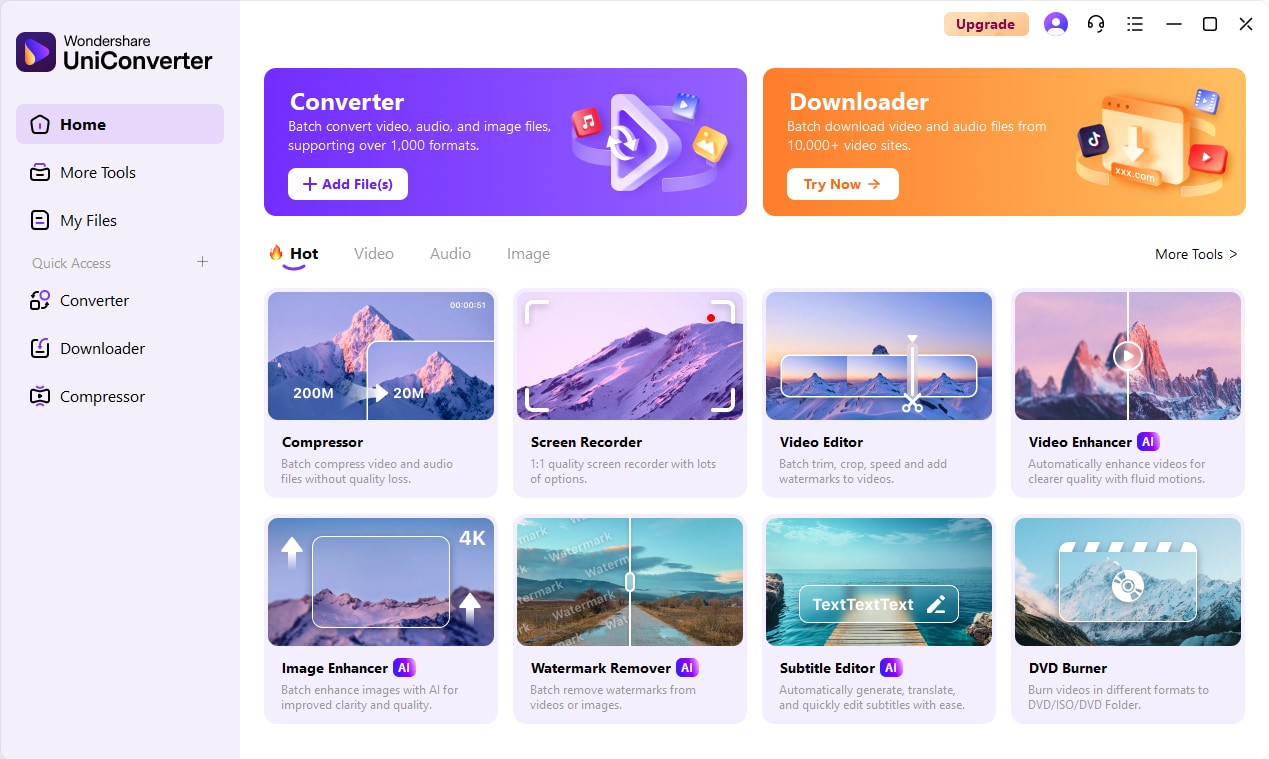
Step 2: Upload the Video, Audios or Images
Drag and drop your desired video, audio, or image files directly into the UniConverter window. Alternatively, click the "Add Files" button to browse and select files from your local storage.
Step 3: Choose Required Formats or Parameters
At the bottom of the window, select your desired output format from the "Output Format" menu. You can also customize advanced settings like resolution, bitrate, and encoder by clicking the "Settings" icon next to the format.
Step 4: Save the Converted File
Once all settings are configured, click the "Convert" or "Start All" button to begin the conversion process. After completion, the converted files will be saved to your specified output folder.

Enhance Your Video Editing Workflow
Part 7: Conclusion
This FFQueue review highlights its position as a highly specialized and powerful tool for automated video processing, particularly suited for those with technical expertise and a need for deep customization. While FFQueue excels in handling large-scale, script-driven encoding tasks for media archives and professional workflows, its command-line interface presents a significant barrier for casual users or those seeking a quick, one-off conversion. For advanced users and developers comfortable with FFmpeg, FFQueue remains an invaluable, free resource. However, for beginners and users prioritizing ease of use and a graphical interface, alternatives like UniConverter offer a more accessible and feature-rich experience. Shutter Encoder provides a balanced middle ground, catering to users who need more control than basic converters but prefer a GUI. Ultimately, the best tool depends on the user's technical proficiency, specific use case, and the desired level of control over the video processing workflow.
Part 8: FAQs
1. Is FFQueue free to use?
Yes, FFQueue is an open-source project and is completely free to download and use.
2. What operating systems does FFQueue support?
FFQueue is cross-platform and can be run on Windows, macOS, and Linux, provided FFmpeg is installed.
3. Can FFQueue handle 4K video encoding?
Yes, FFQueue can handle 4K video encoding, as its capabilities are derived from FFmpeg. Performance will largely depend on your system's hardware specifications.
4. Does FFQueue have a graphical user interface (GUI)?
FFQueue primarily operates via the command line. While there are some community-developed GUIs that interact with FFQueue, it does not have an official built-in graphical interface.
5. How does FFQueue compare to HandBrake for batch processing?
FFQueue offers more advanced and flexible scripting and automation capabilities for batch processing, allowing for highly customized and complex job queues. HandBrake's batch processing is more straightforward and GUI-driven, suitable for common transcoding tasks.
