
- Value: Convertio excels for quick, occasional conversions of smaller files, offering broad format support and ease of use.
- Comparison: Online tools like Convertio prioritize convenience, while desktop alternatives like UniConverter offer speed, security, and advanced features for large files and batch processing.
- Decision: Evaluate your needs: Convertio for light, non-sensitive tasks; UniConverter for professionals needing performance, security, and high-volume conversions.
- Considerations: Be aware of online converters' file size limits, potential data privacy risks, and reliance on internet connectivity.
In this article
- Part 1: What is Convertio?
- Part 2: Convertio's Core Features: Pros & Cons
- Part 3: Who is Convertio For? Ideal Use Cases & Limitations
- Part 4: Convertio and Alternatives: A Comparative Analysis
- Part 5: Risks & Considerations When Using Online Converters
- Part 6: How to Use UniConverter for Efficient Audio and Video Conversion
- Part 7: Final Verdict & Recommendations
- Part 8: FAQs
In today's digital landscape, the need for seamless file conversion is ubiquitous. From students needing to submit assignments in specific formats to professionals exchanging documents across diverse platforms, the ability to effortlessly transform files is no longer a luxury but a necessity. Online file converters have emerged as a popular solution, offering convenience and accessibility. Among these, Convertio stands out as a prominent player, promising a vast array of supported formats and a user-friendly experience. This Convertio review will delve into its core features, analyze its strengths and weaknesses, and compare it against leading competitors to help you determine if it's the right tool for your conversion needs. We'll explore its suitability for various use cases, highlight potential risks associated with online converters, and ultimately provide a comprehensive recommendation to guide your decision-making process.
Part 1: What is Convertio?
Convertio is a popular web-based file conversion service that allows users to transform various file types from one format to another directly through their web browser. Launched with the aim of simplifying the often complex process of file conversion, Convertio has positioned itself as an accessible and versatile tool for a wide range of users. Its core offering revolves around providing a cloud-based platform where files can be uploaded, converted, and then downloaded, eliminating the need for specialized software installations. This approach caters to the growing demand for flexible and on-the-go digital solutions, addressing common pain points in file management.
The Ever-Evolving Digital Format Landscape
The proliferation of digital devices and software has led to an explosion of file formats, often creating compatibility headaches for users.
The Need for Seamless Cross-Platform Compatibility
Users frequently encounter situations where a file created on one platform needs to be accessible or editable on another, necessitating conversion.
The Demand for Quick and Easy Solutions
Many users prioritize speed and simplicity when it comes to file conversion, preferring online tools over complex desktop applications.
Addressing User Pain Points with Accessibility
Convertio aims to alleviate these pain points by offering a straightforward, browser-based solution that requires no technical expertise.
Part 2: Convertio's Core Features: Pros & Cons
Convertio distinguishes itself with a robust set of features designed to make file conversion as effortless as possible. Its primary appeal lies in its extensive format support and cloud-based architecture, which together offer a highly convenient user experience. However, like any online service, it comes with certain limitations that users should be aware of.
Pros:
- Wide Range of Supported Formats: Convertio boasts an impressive library of over 3000 supported conversions, covering documents, images, audio, video, archives, spreadsheets, presentations, and more. This extensive compatibility ensures that most common, and even many niche, conversion needs can be met.
- Cloud-Based Convenience: As a purely online service, Convertio requires no software installation. Users can access it from any device with an internet connection, making it incredibly flexible for conversions on the go, without consuming local storage or processing power.
- User-Friendly Interface: The platform is designed with simplicity in mind. Its intuitive drag-and-drop functionality and clear step-by-step process make it accessible even for users with minimal technical expertise, ensuring a smooth conversion experience.
Cons:
- File Size Limitations for Free Users: The free tier of Convertio imposes significant restrictions on file size, typically limiting uploads to 100 MB or less. This can be a major drawback for users needing to convert larger media files or extensive documents.
- Potential for Slower Conversion Speeds with Large Files: While convenient, the cloud-based nature means conversion speeds can be influenced by internet connection quality and server load. Larger files, even for premium users, might experience noticeable delays compared to powerful desktop applications.
Part 3: Who is Convertio For? Ideal Use Cases & Limitations
Understanding who Convertio is designed for, and where its capabilities might fall short, is crucial for making an informed decision. Its strengths lie in its accessibility and broad format support, making it ideal for certain user profiles and scenarios. Conversely, its limitations become apparent in more demanding or professional contexts.
Best Use Case: Quick, On-the-Go Conversions for Everyday Users
Convertio shines brightest for individuals who need to perform occasional, straightforward file conversions without the hassle of installing dedicated software. This includes students converting PDFs to Word documents for editing, casual users resizing images for social media, or anyone needing to quickly change an audio or video format for playback on a different device. Its web-based nature means you can use it from a library computer, a friend's laptop, or your own device without leaving a trace, making it perfect for spontaneous conversion needs. For instance, if you receive a `.heic` image from an iPhone and need to convert it to `.jpg` for wider compatibility, Convertio offers an immediate and simple solution.
Limited Use Case: High-Volume, Batch Conversions for Professionals
While convenient for individual files, Convertio is less suited for professionals or businesses requiring high-volume, repetitive, or batch conversions. The free tier's file size and daily conversion limits quickly become restrictive, and even premium plans might struggle with the sheer scale and speed required for large-scale operations. For example, a graphic designer needing to convert hundreds of images to a specific web format, or a video editor processing multiple large video files, would find Convertio's cloud-based processing and potential speed limitations inefficient. In such scenarios, the lack of robust batch processing features and the dependency on internet speed make it a less optimal choice compared to dedicated desktop software designed for performance and efficiency.
Part 4: Convertio and Alternatives: A Comparative Analysis
When evaluating Convertio, it's essential to consider its position relative to other prominent file conversion tools in the market. This comparison highlights key differentiators and helps users understand which solution might best fit their specific requirements. We'll compare Convertio with UniConverter, CloudConvert, and Zamzar.
| Feature/Scenario | Convertio | UniConverter | CloudConvert | Zamzar |
| Supported Formats | Extensive (3000+) | Extensive (1000+) | Extensive (200+) | Extensive (1200+) |
| File Size Limit (Free) | Moderate (100 MB) | N/A (Desktop) | Moderate (1 GB/day, 25 conversions) | Low (50 MB) |
| Batch Conversion | Limited (Premium) | Yes | Yes (Premium) | Yes (Premium) |
| Offline Access | No | Yes | No | No |
| Pricing (Premium) | Subscription | One-time/Subscription | Subscription | Subscription |
| Processing Speed | Cloud-dependent | Fast (GPU acceleration) | Cloud-dependent | Cloud-dependent |
| Output Quality | High | Very High (Lossless) | High | Good |
| Security | Standard encryption | Local processing | Standard encryption | Standard encryption |
Key Differentiators: Cloud vs. Desktop, Free Tier Limitations, and Batch Processing
Convertio excels in its sheer breadth of format support and its user-friendly, entirely cloud-based approach. It's fantastic for quick, one-off conversions of smaller files. However, its free tier limitations on file size and the absence of robust batch processing make it less ideal for heavy users.
UniConverter stands out as a comprehensive desktop solution. Its key advantage is offline access, superior processing speed due to GPU acceleration, and truly unlimited batch conversion without file size restrictions. It offers a more controlled and secure environment as files are processed locally. For professionals dealing with large media files, UniConverter's lossless conversion and extensive editing capabilities make it a clear winner.
CloudConvert is another strong cloud-based contender, offering a good balance of supported formats and a slightly more generous free tier than Convertio in terms of daily conversions. It's known for maintaining high output quality. However, like Convertio, it's internet-dependent and has file size limitations for free users.
Zamzar is one of the older players in the online conversion space, offering a reliable service with a decent range of formats. Its main drawback is a more restrictive free tier, particularly with file size limits and the requirement to receive converted files via email for free users, which can be less convenient.
In summary, for maximum flexibility and occasional use, Convertio and CloudConvert are excellent. For power users, professionals, or anyone prioritizing speed, security, and large file handling, UniConverter's desktop-based solution offers a significantly more robust and efficient experience.
Part 5: Risks & Considerations When Using Online Converters
While online file converters like Convertio offer undeniable convenience, it's crucial to be aware of the potential risks and considerations, especially concerning data privacy, user experience, and output quality. The "free" aspect often comes with hidden trade-offs that users should understand before uploading sensitive or important files.
Data Privacy and Security Concerns
When you upload a file to an online converter, you are essentially entrusting your data to a third-party server. This raises questions about how your data is stored, processed, and eventually deleted. While reputable services claim to delete files after a certain period and use encryption, the risk of data breaches or unauthorized access always exists, especially for sensitive personal or corporate documents.
Impact of Advertisements on User Experience
Many free online converters rely on advertising revenue. This often translates to a cluttered interface filled with pop-up ads, banner ads, and sometimes even misleading download buttons. These advertisements can significantly detract from the user experience, slow down the conversion process, and in some cases, even lead to accidental clicks on malicious links.
Output Quality and Fidelity
The quality of the converted file can vary greatly among online converters. Some services might compromise on resolution, compression, or overall fidelity, especially for video, audio, or image conversions, to speed up the process or save server resources. This can result in pixelated images, degraded audio, or unreadable document formatting, which might be unacceptable for professional or archival purposes.
Internet Dependency and Accessibility
Online converters are inherently dependent on an active and stable internet connection. If your internet is slow, unreliable, or unavailable, you won't be able to convert your files. This limits accessibility in remote areas or during network outages, making them unsuitable for critical, time-sensitive conversions.
Hidden Costs and Subscription Models
While many online converters offer a free tier, these often come with severe limitations on file size, daily conversions, or features. To unlock full functionality, users are typically pushed towards subscription models. These recurring costs can add up, and users might find themselves paying for a service that still doesn't fully meet their needs compared to a one-time purchase of a robust desktop application.
Part 6: How to Use UniConverter for Efficient Audio and Video Conversion
When online tools prove insufficient due to batch processing limitations, conversion instability, or file quality degradation, UniConverter stands out as a powerful and dependable alternative. This comprehensive desktop solution is engineered to manage a wide range of multimedia tasks, guaranteeing stable, high-quality conversions free from ads, file size restrictions, or reliance on an internet connection. Leveraging GPU acceleration, it delivers exceptionally fast processing, making it the perfect choice for professionals and users who frequently convert large volumes of files. UniConverter serves as your ultimate all-in-one solution for video conversion, compression, editing, and much more.
Step 1: Open UniConverter and Choose Converter
Launch UniConverter on your computer. From the main interface, select the "Converter" tab on the left sidebar. This is where you'll initiate your file conversion process. 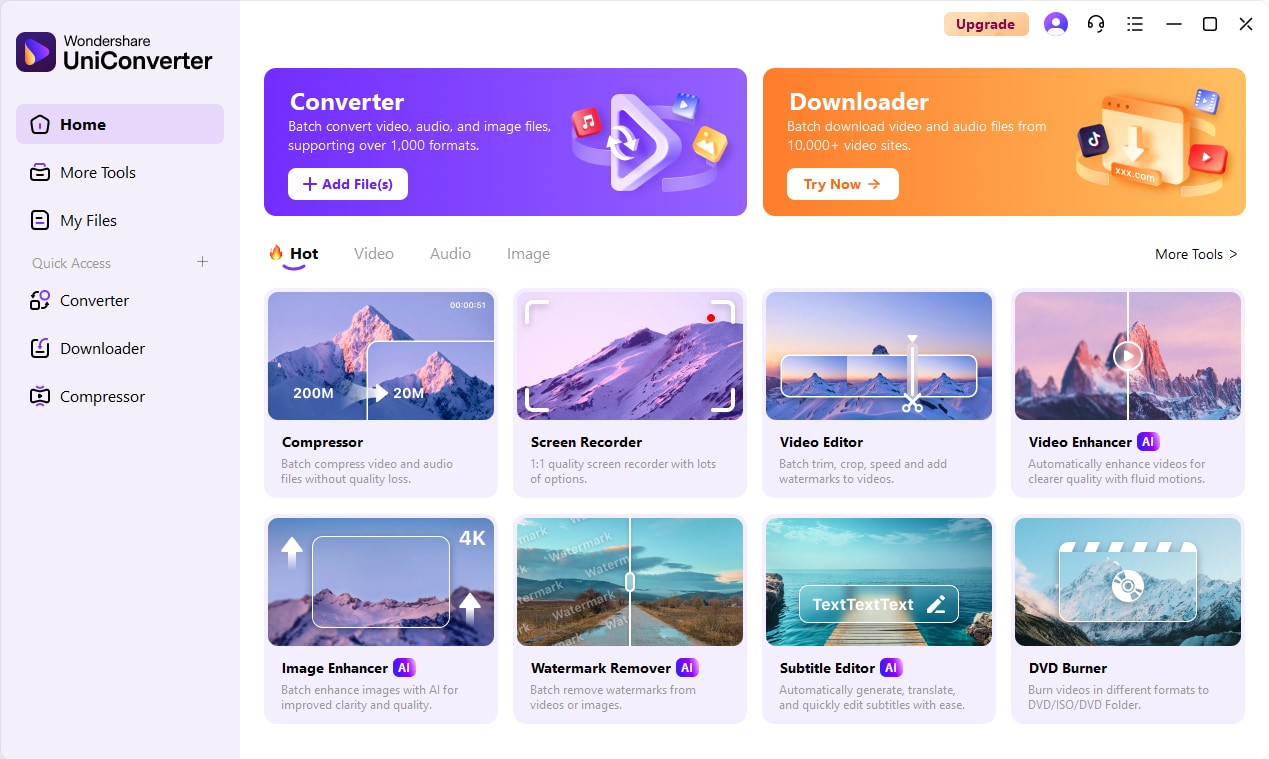
Step 2: Upload the Video, Audios or Images
Drag and drop your desired video, audio, or image files directly into the UniConverter window. You can also click the "Add Files" button to browse and select files from your local storage. UniConverter supports batch processing, allowing you to add multiple files at once, whether you need to convert HEIC to JPG or process numerous video clips. 
Step 3: Choose Required Formats or Parameters
At the bottom of the window, click on the "Output Format" dropdown menu. Here, you can select your desired output format (e.g., MP4, MOV, MP3, JPG) and choose specific quality presets or customize parameters like resolution, bitrate, and encoder for advanced control. For instance, you can easily convert MP4 to MP3 or adjust settings for other formats. 
Step 4: Save the Converted File
Once you've selected your output format and settings, click the "Convert" or "Start All" button. UniConverter will process your files efficiently. After conversion, you can find your converted files in the "Finished" tab or by clicking the folder icon next to the output path at the bottom. 

Unlock Your Video's Full Potential
Part 7: Final Verdict & Recommendations
Choosing the right file converter ultimately depends on your specific needs, usage patterns, and priorities. Both online and desktop solutions offer distinct advantages and disadvantages. This Convertio review aims to provide a balanced perspective to help you make an informed decision.
For Casual Users: Convertio's Strengths and Weaknesses
For individuals who require occasional, quick conversions of smaller files and prioritize convenience over advanced features or absolute privacy, Convertio is an excellent choice. Its vast format support and intuitive web interface make it incredibly accessible. However, be mindful of its file size limitations on the free tier and the potential for slower speeds with larger files. It's perfect for converting a single document or image on the fly but less so for daily, heavy-duty tasks.
For Professionals: When to Consider Desktop Alternatives
Professionals, content creators, or anyone dealing with large media files, sensitive data, or high-volume conversions should seriously consider desktop alternatives like UniConverter. The benefits of offline access, superior processing speed (especially with GPU acceleration), true batch processing, and enhanced data security (as files are processed locally) far outweigh the initial investment. Desktop software provides a more stable, efficient, and controlled environment, ensuring consistent quality and reliability for critical workflows.
Balancing Convenience and Security
The trade-off between convenience and security is a critical factor. Online converters offer unparalleled convenience but come with inherent data privacy risks. If your files contain sensitive personal, financial, or proprietary information, the added security of a desktop application that processes files locally is invaluable. Always weigh the ease of use against the potential exposure of your data.
Making an Informed Choice
Before committing to any solution, assess your typical conversion volume, file sizes, frequency of use, and the sensitivity of your data. For light, non-sensitive tasks, Convertio is a strong contender. For anything more demanding, where performance, security, and advanced features are paramount, a robust desktop converter like UniConverter will provide a more reliable and satisfying experience in the long run.
Part 8: FAQs
1. Is Convertio safe to use for sensitive files?
Convertio states it uses encryption and deletes files after a certain period. However, as an online service, there's always an inherent risk when uploading sensitive data to a third-party server. For highly sensitive files, a desktop converter that processes files locally is generally safer.
2. What are the main differences between Convertio's free and premium plans?
The free plan has significant limitations on file size (typically 100 MB or less) and the number of daily conversions. Premium plans remove these restrictions, offer faster conversion speeds, and provide priority support, allowing for larger files and unlimited conversions.
3. Can Convertio convert multiple files at once?
Yes, Convertio supports batch conversion, but the number of files you can convert simultaneously might be limited on the free plan. Premium users generally have more flexibility for converting multiple files concurrently.
4. How does Convertio handle large file conversions?
For free users, large files are often restricted by size limits. For premium users, Convertio can handle larger files, but conversion speeds can still be dependent on your internet connection and server load, potentially leading to longer processing times compared to desktop software.
5. Are there any offline alternatives to Convertio?
Yes, desktop software like UniConverter, HandBrake, and VLC Media Player offer offline file conversion capabilities. These tools process files locally on your computer, eliminating the need for an internet connection and often providing faster speeds and enhanced security.
