
- Online Converters: Convenient for quick, single-file conversions; often free and web-based.
- Limitations: Online tools face file size limits, privacy risks, ads, and potential quality loss.
- Desktop Software: UniConverter offers superior speed, quality, batch processing, and security for demanding tasks.
- Decision: Choose online for casual use; opt for desktop software like UniConverter for professional or high-volume needs.
In this article
- Part 1: What is Convert Audio Online?
- Part 2: Convert Audio Online: Core Features, Advantages, and Disadvantages
- Part 3: Target Users and Usage Scenarios
- Part 4: Convert Audio Online and Alternatives Comparison
- Part 5: Risks and Pitfalls of Using Online Audio Converters
- Part 6: How to Use UniConverter for Efficient Audio/Video Conversion
- Part 7: Conclusion
- Part 8: FAQs
Convert Audio Online: Your Ultimate Guide to Free and Paid Solutions
The digital age has made audio content ubiquitous, from podcasts and music to voice notes and lectures. However, the myriad of audio formats often presents a challenge: how to ensure compatibility across different devices and platforms. This is where online audio converters become indispensable tools. This Convert Audio Online review delves into the landscape of these services, examining their features, limitations, and the scenarios where they shine or fall short. We'll explore the convenience of free web-based solutions, highlight potential pitfalls, and ultimately guide you toward making informed decisions for your audio conversion needs, whether you're a casual user or a professional seeking robust capabilities.
Part 1: What is Convert Audio Online?
"Convert Audio Online" broadly refers to web-based services that allow users to change the format of their audio files directly through a web browser, without the need for software installation. These platforms typically offer a user-friendly interface where individuals can upload an audio file, select a desired output format, and then download the converted file. Their primary appeal lies in their accessibility and ease of use, making them a go-to solution for quick, one-off conversions. This review aims to address the core question: how effective and reliable are these online tools, especially when compared to more comprehensive desktop alternatives?
The Rise of Online Audio Converters and User Pain Points
* Format Incompatibility: Users frequently encounter issues playing audio files across different devices or software due to unsupported formats.
* Software Installation Hassle: Many users prefer not to download and install dedicated software for occasional conversion tasks.
* Cost-Effectiveness: The appeal of free services for basic audio conversion is a significant draw for budget-conscious users.
* Immediate Need for Conversion: Quick and easy solutions are often sought for urgent audio format changes.
Part 2: Convert Audio Online: Core Features, Advantages, and Disadvantages
Online audio converters typically offer a streamlined set of functionalities designed for quick and efficient format changes. Their core capabilities revolve around supporting a range of common audio formats for both input and output, often including MP3, WAV, FLAC, AAC, and OGG. Many provide basic settings for output quality, such as bitrate adjustments, and some even allow for simple trimming or merging of audio segments. The emphasis is on simplicity and speed, making them highly accessible to users with varying technical proficiencies.
* Format Support: Convert between popular audio formats like MP3, WAV, FLAC, AAC, and OGG.
* Basic Quality Settings: Adjust bitrate and sample rate for output files.
* Simple Interface: Intuitive design for easy file uploads and conversion initiation.
* No Software Installation: Operates entirely within a web browser.
* Direct Download: Converted files are typically available for immediate download.
Pros:
* Accessibility and Convenience: Convert from any device with internet access.
* Cost-Effectiveness: Many basic features are available for free.
* Simplicity: User-friendly interfaces for quick conversions.
Cons:
* Internet Dependency: Requires a stable connection for operation.
* Limited Advanced Features: Often lack professional editing tools.
Part 3: Target Users and Usage Scenarios
Online audio converters primarily cater to a broad audience of casual users who require straightforward audio format changes without delving into complex software. These tools are ideal for individuals who occasionally need to convert a song for a specific device, prepare an audio clip for social media, or simply ensure compatibility for playback. Their simplicity and zero-cost entry make them highly attractive for non-technical users seeking quick solutions.
Best Use Case: Quick, Single-File Conversions for Casual Users
Imagine a student needing to convert a lecture recording from M4A to MP3 for easier playback on an older MP3 player, or a social media enthusiast wanting to convert a voice note to a widely supported format for sharing. In these scenarios, an online audio converter provides an immediate, hassle-free solution. The user uploads the file, selects the desired output, and downloads the converted audio within minutes, without any commitment to software installation or subscription.
Limited Use Case: Batch Processing and High-Fidelity Audio Production
For professionals or users with more demanding needs, such as musicians, podcasters, or video editors, online audio converters present significant limitations. Tasks like converting large batches of files, maintaining pristine audio quality for production, or performing advanced editing operations (e.g., noise reduction, equalization, multi-track editing) are beyond the scope of most online tools. The lack of robust features, potential quality degradation, and file size limits make them unsuitable for high-fidelity audio production or extensive project workflows.
Part 4: Convert Audio Online and Alternatives Comparison
When considering "Convert Audio Online" solutions, it's crucial to compare them against dedicated desktop software and other online tools to understand their respective strengths and weaknesses.
| Feature/Tool | Convert Audio Online (Generic) | UniConverter | Online Audio Converter (e.g., 123apps) | CloudConvert |
| Processing Speed | Moderate | Very Fast (GPU Accelerated) | Moderate | Moderate |
| Output Quality | Good | Excellent (Lossless options) | Good | Excellent |
| Ease of Use | Very High | High | Very High | High |
| Customer Support | Limited/Community | Excellent (Dedicated Support) | Limited/FAQ | Good |
| Security | Varies (Check Policy) | High (Offline Processing) | Varies (Check Policy) | High |
| Batch Conversion | Limited/None | Yes (Robust) | Limited | Yes (Limited) |
| File Size Limit | Moderate | Very High/No Limit | Moderate | Moderate |
Generic online audio converters excel in ease of use and immediate accessibility for single, small files. However, UniConverter stands out for its superior processing speed, especially with GPU acceleration, and its commitment to maintaining excellent output quality, offering lossless conversion options. Online Audio Converter (123apps) provides a very user-friendly interface for quick tasks, similar to generic online tools. CloudConvert offers a good balance of features and quality for an online service, with broader format support. For users prioritizing speed, quality, and advanced features like batch processing without file size limitations, UniConverter is the stronger choice.
Part 5: Risks and Pitfalls of Using Online Audio Converters
While online audio converters offer convenience, they come with a set of risks and potential pitfalls that users should be aware of, especially when dealing with sensitive data or requiring high-quality output.
Data Privacy Concerns: Uploading Sensitive Audio Files
When you upload an audio file to an online converter, you are essentially entrusting your data to a third-party server. If the audio contains sensitive information, personal conversations, or proprietary content, there's a risk of data breaches or unauthorized access if the service's security protocols are weak. Many free services may also log or analyze your data for various purposes, which might not align with your privacy expectations.
Annoying Ads and Pop-ups: Impact on User Experience
A common trade-off for free online services is the presence of advertisements. Many online audio converters are heavily monetized through intrusive ads, pop-ups, and redirects. These not only degrade the user experience but can also lead to accidental clicks on malicious links, exposing users to malware or phishing attempts. The constant bombardment of ads can make a simple conversion task frustrating and time-consuming.
Output Quality Degradation: Loss of Fidelity in Conversion
While online converters promise format conversion, they often achieve this through re-encoding, which can lead to a loss of audio fidelity. This is particularly true for services that prioritize speed or use aggressive compression algorithms. If you're converting an audio file for professional use or where sound quality is paramount, you might notice a degradation in clarity, dynamic range, or the introduction of artifacts, making the converted file unsuitable for its intended purpose.
File Size Limitations: Hindrance for Larger Projects
Most free online audio converters impose strict file size limits. This can be a significant hurdle for users needing to convert longer audio tracks, podcasts, or high-quality uncompressed files. Encountering a file size limit means either having to split the audio (if the tool supports it, which is rare) or finding an alternative solution, disrupting the workflow and adding extra steps.
Security Vulnerabilities: Potential for Malware or Viruses
Some less reputable online converters might bundle unwanted software, redirect users to malicious websites, or even contain vulnerabilities that could be exploited by attackers. Uploading files to such sites or downloading converted files from them could inadvertently introduce malware or viruses to your system, compromising your computer's security and personal data.
Part 6: How to Use UniConverter for Efficient Audio/Video Conversion
When online tools fall short due to batch processing limitations, instability, or quality loss, UniConverter emerges as a robust desktop solution. It bypasses the common pitfalls of web-based converters by offering a stable, ad-free environment with extensive format support, GPU acceleration for rapid conversions, and lossless output options. UniConverter is designed for users who demand reliability, high fidelity, and the ability to handle large volumes of files efficiently, making it an ultimate all-in-one media conversion toolkit.
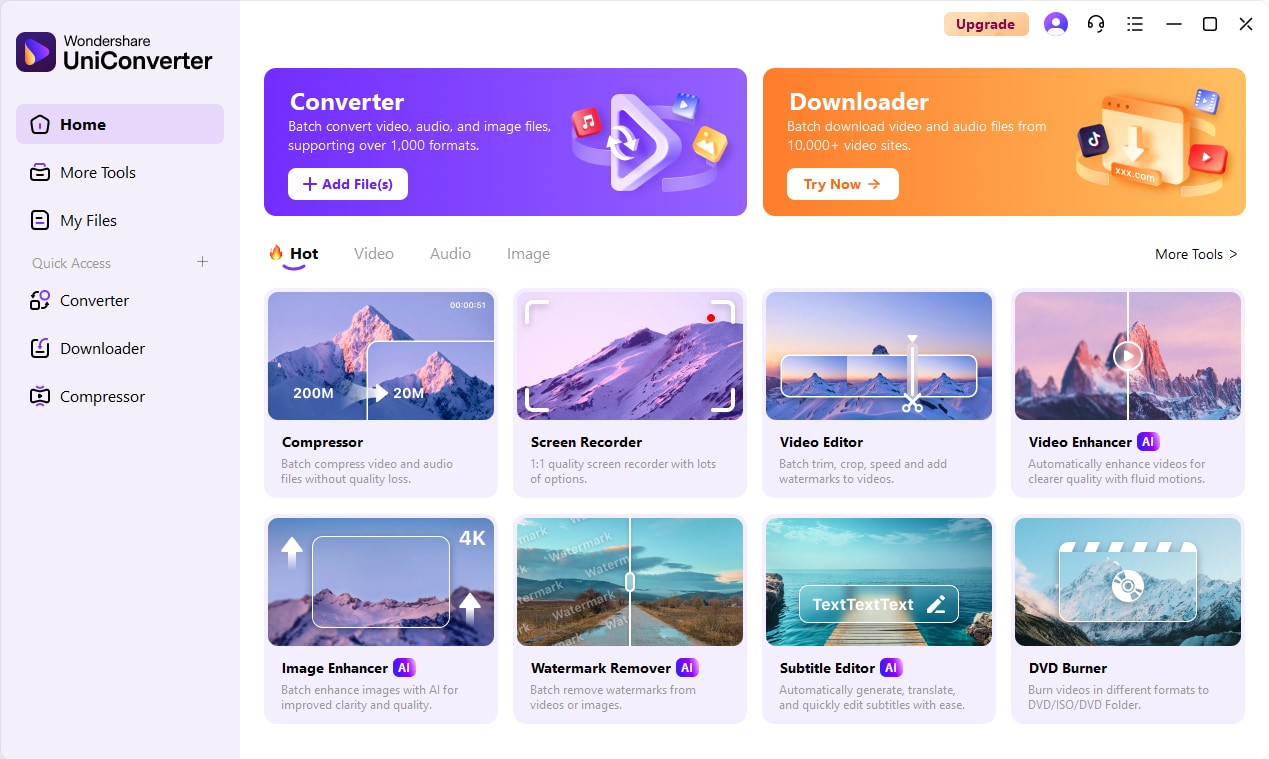
Step 1: Open UniConverter and Choose Converter
Launch UniConverter on your desktop. On the main interface, select the "Converter" tab from the left-hand menu. This is where you'll initiate all your audio and video conversion tasks.
Step 2: Upload the Video, Audios or Images
Click on the "Add Files" button or simply drag and drop your audio files directly into the UniConverter window. You can add multiple files for batch conversion.

Step 3: Choose Required Formats or Parameters
After importing, click on the "Output Format" dropdown menu. Navigate to the "Audio" tab and select your desired output format (e.g., MP3, WAV, FLAC). You can also customize settings like bitrate, sample rate, and channels for optimal quality.

Step 4: Save the Converted File
Choose your desired output folder at the bottom of the window. Finally, click the "Convert" or "Start All" button to begin the conversion process. Once completed, your converted audio files will be saved to the specified location.


Need a More Robust Audio Converter?
Part 7: Conclusion
The landscape of audio conversion offers a spectrum of tools, each with its own strengths and weaknesses. For users seeking quick, single-file conversions without the need for software installation, free online audio converters provide an accessible and convenient solution. They are ideal for casual tasks where the highest audio fidelity is not a critical concern. However, these web-based tools often come with limitations such as file size restrictions, potential privacy risks, intrusive advertisements, and a risk of quality degradation. For professionals, audiophiles, or anyone requiring batch processing, advanced editing features, and guaranteed high-quality output, dedicated desktop software like UniConverter is the superior choice. It offers a secure, stable, and feature-rich environment that ensures optimal results without the compromises inherent in many free online services. Ultimately, the best tool depends on individual needs, balancing the convenience of online options with the robustness and control offered by desktop applications. This Convert Audio Online review aims to equip you with the knowledge to make that informed decision.
Part 8: FAQs
-
1. Are online audio converters safe to use?
It depends on the specific service. Always check their privacy policy and user reviews. Reputable services are generally safer, but caution is advised, especially with sensitive files.
-
2. Can I convert multiple audio files at once online?
Some online converters offer batch conversion, but often with limitations on file size or the number of files. Desktop software like UniConverter usually provides more robust and efficient batch processing capabilities.
-
3. What's the best online audio converter for high-quality output?
While many claim high quality, dedicated desktop software generally offers superior results due to more advanced algorithms and fewer compression artifacts. For online options, services like CloudConvert are often cited for better quality among web-based tools.
-
4. Do online audio converters support all audio formats?
Most support common formats like MP3, WAV, and FLAC. Less common or proprietary formats might require specialized tools, often found in comprehensive desktop software.
-
5. Is there a free online audio converter without ads?
Finding a completely ad-free online converter can be challenging, as ads often support their free services. Some offer premium ad-free versions, or you might encounter fewer ads on services that have a paid tier.
