
- CloudConvert Value: Offers broad format support and advanced customization for diverse conversion needs.
- Free Tier Limitations: Be aware of CloudConvert's free tier restrictions on file size and conversion minutes.
- Online vs. Offline: CloudConvert requires internet; UniConverter provides secure, fast, offline processing.
- Security & Privacy: Online tools like CloudConvert involve temporary server uploads; UniConverter keeps files local.
- Decision Factor: Choose CloudConvert for convenience, UniConverter for speed, security, and large-scale tasks.
In this article
- Part 1: What is CloudConvert?
- Part 2: Core Features, Pros, and Cons
- Part 3: Ideal Users and Real-World Scenarios
- Part 4: CloudConvert vs. Competitors: A Comparative Analysis
- Part 5: Potential Risks and Pitfalls with CloudConvert
- Part 6: How to use UniConverter to convert efficiently
- Part 7: Conclusion
- Part 8: FAQs
In the digital age, file conversion is an indispensable task, whether for professional projects, academic submissions, or personal use. The myriad of file formats often necessitates a reliable tool to bridge compatibility gaps. This CloudConvert review delves into one of the most prominent online file converters, examining its features, performance, and overall utility. We will explore its strengths and weaknesses, compare it against key competitors, and identify the scenarios where it truly shines, as well as those where alternative solutions might be more appropriate. Our aim is to provide a comprehensive, scenario-based analysis to help users make informed decisions about their file conversion needs.
Part 1: What is CloudConvert?
CloudConvert is a popular online file conversion service that supports a vast array of file formats across various categories, including documents, images, audio, video, archives, and spreadsheets. Launched as a web-based platform, it eliminates the need for software installation, allowing users to convert files directly from their browsers. Its core appeal lies in its accessibility and broad format compatibility, aiming to be a one-stop solution for diverse conversion requirements. This review will critically assess CloudConvert's capabilities, focusing on its efficiency, output quality, and user experience, to determine its standing in a competitive market.
The File Conversion Landscape
The demand for efficient and reliable file conversion tools is driven by several factors:
* Interoperability Challenges: Different software and platforms often use proprietary file formats, leading to compatibility issues when sharing or processing files.
* Device and Platform Diversity: Users access content across various devices (desktops, mobiles, tablets) and operating systems, each with its own format preferences.
* Professional and Creative Needs: Professionals in design, media, and publishing frequently require conversions for specific project requirements, often involving niche or specialized formats.
* Archival and Accessibility: Converting older or less common formats to more universally accessible ones ensures long-term usability and preservation.
Part 2: Core Features, Pros, and Cons
CloudConvert offers a robust set of features designed to handle nearly any file conversion task. Its primary strength lies in its extensive format support and cloud-based processing.
Core Capabilities:
* Extensive Format Support: Converts over 200 different file formats.
* Cloud Integration: Connects with Google Drive, Dropbox, OneDrive, and URL for file input/output.
* Advanced Conversion Options: Allows users to adjust parameters like resolution, quality, codecs, and more.
* API for Developers: Provides a powerful API for integrating conversion capabilities into other applications.
* Batch Conversion: Supports converting multiple files simultaneously.
Pros:
* Extensive File Format Support for Diverse Needs: CloudConvert boasts an impressive list of supported formats, making it highly versatile for almost any conversion task, from obscure CAD files to common PDFs.
* High-Quality Conversions with Advanced Options: Users can fine-tune conversion settings, ensuring output quality meets specific requirements, which is crucial for professional applications.
* User-Friendly Interface and Cloud Integration: The platform is intuitive and easy to navigate, with seamless integration with popular cloud storage services for convenient file management.
Cons:
* Limited Free Tier for Frequent Users: The free tier has significant limitations on file size and conversion minutes, quickly becoming restrictive for regular or large-scale conversions.
* Dependency on Internet Connection for All Operations: As an online service, CloudConvert requires a stable internet connection for all conversions, making it unsuitable for offline work or areas with poor connectivity.
Part 3: Ideal Users and Real-World Scenarios
CloudConvert caters to a broad audience, but its strengths are particularly evident in specific use cases.
Best Use Case: Converting Niche Formats for Professional Projects
Consider a graphic designer who receives a legacy design file in an obscure format (e.g., .CDR from CorelDRAW) that their current software doesn't support. Instead of purchasing specialized software or asking the client for a different format, they can upload the .CDR file to CloudConvert and convert it to a more universally compatible format like .AI (Adobe Illustrator) or .SVG. The advanced options allow them to maintain vector quality and specific color profiles, ensuring the integrity of the design for further editing. This scenario highlights CloudConvert's utility for bridging format gaps in professional workflows without significant investment.
Limitation Scenario: Batch Processing Large Files on a Slow Connection
Imagine a videographer needing to convert 20 large 4K video files (each several GBs) from one format to another for a client. Attempting this with CloudConvert on a slow or unstable internet connection would be highly inefficient. Uploading and downloading such massive files would consume significant time and bandwidth, potentially leading to timeouts or failed conversions. Furthermore, the free tier's limitations would quickly be exhausted, necessitating a paid subscription for such a task. In this scenario, an offline, desktop-based converter with GPU acceleration would be far more practical and reliable.
Part 4: CloudConvert vs. Competitors: A Comparative Analysis
To understand CloudConvert's position, let's compare it with other popular online converters and a robust desktop solution.
| Feature / Product | CloudConvert | Zamzar | AnyConv | Online-Convert | UniConverter |
| Processing Speed | Moderate | Moderate | Moderate | Moderate | Very Fast (GPU Accelerated) |
| Output Quality | High (Customizable) | Good | Good | High (Customizable) | Excellent (Lossless) |
| Ease of Use | Excellent | Excellent | Excellent | Good | Excellent |
| Customer Support | 24/7 Live Chat & Email | ||||
| Security | Good (SSL, Data Deletion) | Good (SSL, Data Deletion) | Good (SSL, Data Deletion) | Good (SSL, Data Deletion) | Excellent (Offline Processing) |
| Offline Capability | No | No | No | No | Yes |
| Batch Processing | Yes (Paid) | Yes (Paid) | Limited | Yes (Paid) | Yes (Unlimited) |
| Advanced Features | Yes (API, Presets) | No | No | Yes (OCR, Presets) | Yes (Editor, Downloader, Burner) |
CloudConvert excels in its balance of ease of use and advanced customization options, making it a strong contender for users who need specific output settings. Zamzar and AnyConv offer simpler, more straightforward conversions, ideal for quick, no-frills tasks. Online-Convert provides a similar breadth of features to CloudConvert but with a slightly less refined interface. However, for speed, offline security, and comprehensive features, UniConverter stands out, especially for large-scale or sensitive conversions where internet dependency is a concern.
Part 5: Potential Risks and Pitfalls with CloudConvert
While CloudConvert is a powerful tool, users should be aware of potential risks and limitations, particularly concerning data handling and performance.
Data Privacy and Security Concerns
As an online service, CloudConvert requires users to upload their files to its servers. While they state strong security measures and data deletion policies, the inherent nature of cloud processing means sensitive or confidential documents are temporarily outside the user's direct control. For highly sensitive data, this can pose a privacy risk, especially in environments with strict data protection regulations. Users should always exercise caution when uploading proprietary or personal information.
Conversion Quality for Specific File Types
While CloudConvert generally delivers high-quality conversions, the outcome can vary significantly for highly complex or niche file types. For instance, converting intricate CAD drawings or highly compressed video formats might result in minor artifacts, loss of specific metadata, or subtle quality degradation that might not be immediately apparent but could impact professional workflows. Users should always verify the output quality for critical files.
Advertising and User Experience
For free-tier users, CloudConvert, like many online services, may display advertisements. While generally unobtrusive, these ads can sometimes interrupt the workflow or create a less polished user experience. Additionally, the free tier's limitations on file size and conversion minutes can lead to frequent interruptions, pushing users towards paid plans, which might not always be cost-effective for infrequent use.
Performance on Large or Complex Files
Converting very large files (e.g., multi-gigabyte video files) or highly complex documents (e.g., PDFs with numerous layers and embedded objects) can be time-consuming, even with a fast internet connection. The processing time depends on server load and file complexity, leading to unpredictable wait times. For mission-critical tasks requiring rapid turnaround, this dependency on server availability can be a significant bottleneck.
Part 6: How to use UniConverter to convert efficiently
When other tools fall short, struggling with batch processing, unstable conversions, or quality loss, UniConverter emerges as a robust desktop solution. It bypasses the limitations of online services, offering an ad-free, GPU-accelerated experience with extensive format support, ensuring stable, lossless conversions for all your media needs. UniConverter is an all-in-one toolkit for video, audio, and image processing.
Step 1: Open UniConverter and Choose Converter
Launch UniConverter on your computer. From the main interface, select the "Converter" tab to access the core conversion features.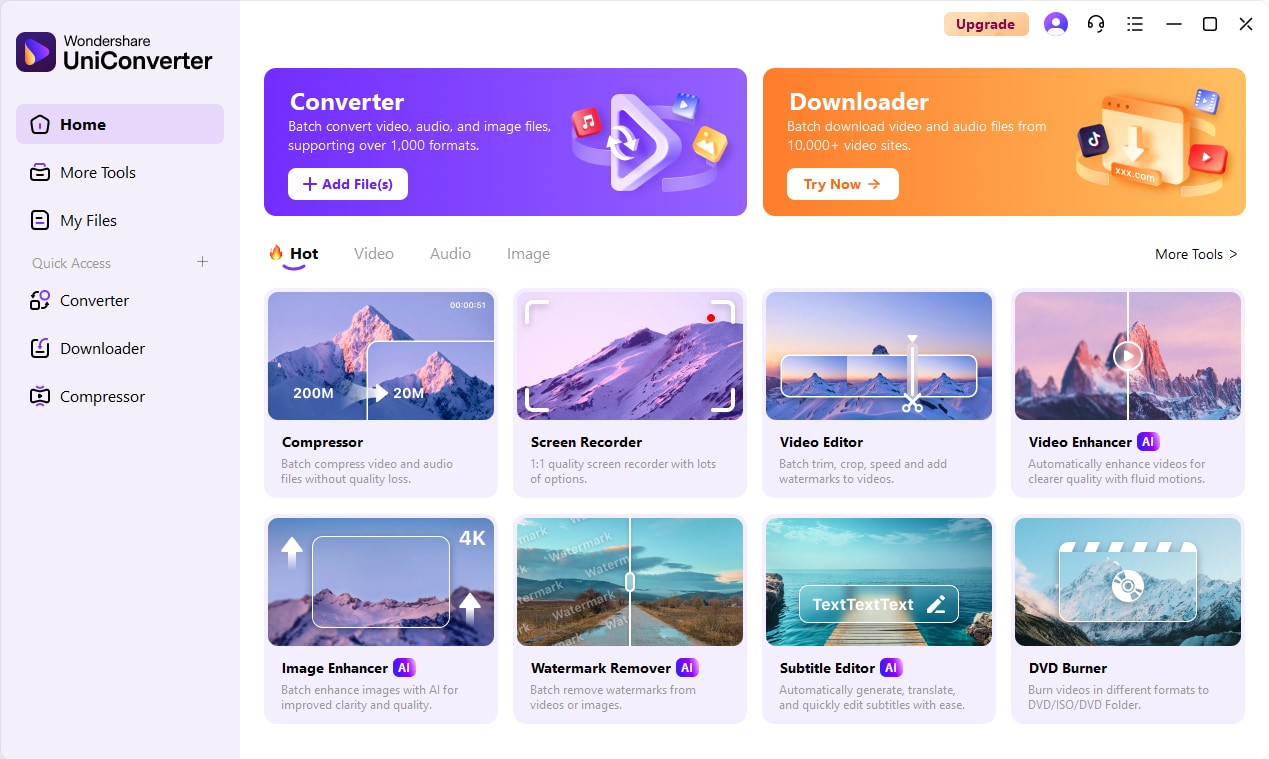
Step 2: Upload the Video, Audios or Images
Drag and drop your desired video, audio, or image files into the UniConverter window. You can also click "Add Files" to browse and select them.
Step 3: Choose Required Formats or Parameters
At the bottom of the window, click on "Output Format" to choose your desired output format and adjust specific parameters like resolution, quality, and codec. For instance, you can easily convert HEIC to JPG or convert MP4 to MP3.
Step 4: Save the Converted File
Click the "Convert" button next to each file or "Start All" for batch conversion. Once complete, find your converted files in the "Finished" tab or the designated output folder.

Enhance Your Video Conversion Workflow
Part 7: Conclusion
This CloudConvert review has highlighted its strengths as a versatile online file converter, particularly for users needing broad format support and advanced customization options without software installation. Its user-friendly interface and cloud integration make it convenient for casual and professional users alike. However, its limitations in the free tier, reliance on an internet connection, and potential privacy concerns for sensitive data necessitate careful consideration. For users with occasional, non-sensitive conversion needs, CloudConvert offers a compelling solution. Conversely, professionals or those dealing with large volumes of files, sensitive information, or requiring offline capabilities will find desktop alternatives like UniConverter to be a more powerful, secure, and efficient choice. The decision ultimately hinges on balancing convenience, cost, security, and the specific demands of the conversion task at hand. The future of file conversion will likely see a continued blend of cloud-based accessibility and robust offline processing, catering to an ever-evolving digital landscape.
Part 8: FAQs
1. Is CloudConvert safe to use for sensitive documents?
CloudConvert employs SSL encryption and states that uploaded files are deleted after a certain period. While generally secure, for highly sensitive or confidential documents, the inherent nature of cloud processing means data temporarily resides on their servers. For maximum security, offline converters are recommended for such files.
2. What are the main differences between CloudConvert's free and paid plans?
The free plan offers limited conversion minutes per day and restrictions on file size and concurrent conversions. Paid plans remove these limitations, providing more conversion minutes, larger file size support, faster processing, and access to the API, making them suitable for frequent or professional users.
3. Can CloudConvert convert video files without losing quality?
CloudConvert allows users to adjust video conversion parameters like resolution, bitrate, and codec, which can help maintain quality. However, some level of re-encoding always occurs, and for highly critical video projects, a dedicated desktop video converter with advanced lossless options might offer superior results.
4. How does CloudConvert handle large file conversions?
CloudConvert can handle large files, but the free tier has size limits. For very large files, a paid subscription is typically required. Conversion time will depend heavily on file size, complexity, and internet speed for both upload and download.
5. Are there any offline alternatives to CloudConvert?
Yes, several desktop applications offer offline file conversion, such as UniConverter, VLC Media Player (for media files), and dedicated PDF converters. These tools offer greater control, faster processing (especially with GPU acceleration), and enhanced security as files never leave your computer.
