
- Adobe Media Encoder (AME): Essential for professionals in Adobe Creative Cloud; excels in complex encoding and integration.
- Core Features: AME offers extensive format support, adaptive bitrate presets, watch folders, and GPU acceleration for efficiency.
- Pros & Cons: AME integrates seamlessly with Adobe CC, offers advanced presets, but is resource-intensive and subscription-based.
- Target Users: Ideal for professional video production; overkill for quick, casual conversions outside the Adobe ecosystem.
- Comparison: AME leads in Adobe integration. HandBrake is free and easy. DaVinci Resolve offers robust encoding. FFmpeg provides ultimate control.
- Risks: AME faces performance bottlenecks on older hardware, has a steep learning curve, and promotes vendor lock-in.
- UniConverter: A robust alternative for efficient, user-friendly video conversion, offering broad format support and GPU acceleration.
- Final Verdict: AME is indispensable for Adobe users. Alternatives like UniConverter suit those needing simpler, cost-effective solutions.
In this article
- Part 1: What is Adobe Media Encoder?
- Part 2: Adobe Media Encoder: Core Features, Pros, and Cons
- Part 3: Target Users and Usage Scenarios
- Part 4: Adobe Media Encoder and Alternatives Comparison
- Part 5: Risks and Pitfalls When Using Adobe Media Encoder
- Part 6: How to Use UniConverter for Efficient Video Conversion
- Part 7: Final Verdict and Recommendations
- Part 8: Frequently Asked Questions (FAQs)
Adobe Media Encoder: The Ultimate Comparison Guide
This Adobe Media Encoder review delves into one of the most ubiquitous tools in professional video production. As a cornerstone of the Adobe Creative Cloud ecosystem, Media Encoder is often the silent workhorse behind countless video projects, responsible for preparing media for various platforms and devices. This comprehensive review will dissect its core functionalities, evaluate its strengths and weaknesses, and critically compare it against key competitors like HandBrake, DaVinci Resolve, and FFmpeg. We aim to provide a clear, scenario-based analysis to help users, from seasoned professionals to independent creators, make informed decisions about their video encoding needs. Understanding its market position and the nuances of its performance is crucial in today's diverse media landscape.
Part 1: What is Adobe Media Encoder?
Adobe Media Encoder is a powerful, standalone application primarily designed for media processing and output. It serves as a dedicated encoding engine for Adobe Creative Cloud applications such as Premiere Pro, After Effects, and Audition, allowing users to export their projects into a vast array of formats and codecs. This review aims to address the critical question of whether Media Encoder remains the optimal choice for diverse video workflows in a market increasingly populated by robust, and often free, alternatives.
Market Position and Core Purpose
Adobe Media Encoder occupies a dominant position in the professional video editing and post-production landscape due to its deep integration within the Adobe Creative Cloud. Its core purpose is to streamline the export process, enabling users to render high-quality video and audio content for various distribution channels, from broadcast to web and mobile.
* Seamless Integration: It acts as the export hub for Adobe's professional video tools.
* Extensive Format Support: Offers a wide range of codecs and container formats.
* Batch Processing Efficiency: Manages multiple encoding jobs simultaneously.
* Professional Output Quality: Delivers high-fidelity video and audio exports.
Part 2: Adobe Media Encoder: Core Features, Pros, and Cons
Adobe Media Encoder excels in its ability to handle complex encoding tasks with precision and flexibility. Its core capabilities include comprehensive format support, advanced preset management, and robust queue handling.
Core Features:
* Extensive Codec and Format Support: Supports virtually all popular video and audio formats, including H.264, H.265 (HEVC), ProRes, DNxHD, MPEG-2, AAC, MP3, etc.
* Adaptive Bitrate Streaming Presets: Includes presets for platforms like YouTube, Vimeo, and social media, optimizing content for various viewing conditions.
* Watch Folders: Automates encoding by processing files dropped into designated folders.
* Timecode and Metadata Support: Preserves essential project information during export.
* GPU Acceleration: Leverages graphics card processing for faster encoding times.
Pros:
* Seamless Integration with Adobe Creative Cloud Ecosystem
* Advanced Encoding Presets and Customization Options
* Robust Batch Processing and Queue Management
Cons:
* Resource-Intensive and Demanding on Hardware
* Subscription-Based Model and Cost
Part 3: Target Users and Usage Scenarios
Adobe Media Encoder is meticulously crafted for professionals and teams deeply embedded in the Adobe Creative Cloud ecosystem, offering unparalleled integration and advanced features for complex media workflows.
Ideal Scenario: Professional Video Production Workflows
For professional video editors, motion graphics artists, and post-production houses, Media Encoder is indispensable. It allows them to queue multiple exports from Premiere Pro or After Effects, render in the background while continuing to edit, and ensure consistent output quality across various delivery specifications. For example, a production studio might use it to simultaneously export a master ProRes file, a H.264 version for web, and a specific broadcast-compliant format, all from a single project.
Limited Scenario: Quick, Casual Conversions for Non-Adobe Users
Conversely, for users who only need to perform quick, casual video conversions without any other Adobe software, Media Encoder is often overkill. Its subscription cost and resource demands make it an inefficient choice for simple tasks like converting a single video file for personal use or a quick format change for a non-professional project. A user simply looking to convert a downloaded video to an MP4 for their phone would find Media Encoder cumbersome and expensive compared to free, standalone alternatives.
Part 4: Adobe Media Encoder and Alternatives Comparison
When evaluating video encoding solutions, it's crucial to compare Adobe Media Encoder against its primary competitors to understand their respective strengths and weaknesses across key dimensions.
| Feature/Aspect | Adobe Media Encoder | HandBrake | DaVinci Resolve | FFmpeg |
| Integration | Excellent (Adobe CC) | None | Good (DaVinci Resolve) | Command Line |
| Presets | Extensive | Good | Good | Manual |
| Batch Processing | Excellent | Good | Good | Scripting |
| UI/UX | Professional | Functional | Professional | None (CLI) |
| Cost | Subscription | Free | Free (Studio Paid) | Free |
| Processing Speed | Fast (GPU accel.) | Moderate | Fast (GPU accel.) | Fast (CLI) |
| Output Quality | High | Good | High | High (with proper settings) |
| Ease of Use | Moderate | Easy | Moderate | Difficult (CLI) |
| Customer Support | Adobe Support | Community | Blackmagic Design | Community |
| Security | High (Adobe) | Open Source | High (Blackmagic) | Open Source |
Adobe Media Encoder shines in its integration with the Adobe Creative Cloud, offering a seamless workflow for professionals. HandBrake is a fantastic free option for basic conversions with good presets and ease of use. DaVinci Resolve, while a full NLE, offers robust encoding capabilities, especially in its Studio version, and is a strong contender for those seeking an all-in-one solution. FFmpeg, though command-line based, provides unparalleled control and flexibility for advanced users and developers.
Part 5: Risks and Pitfalls When Using Adobe Media Encoder
While Adobe Media Encoder is a powerful tool, users should be aware of potential risks and pitfalls, especially concerning performance, usability, and ecosystem dependency.
Performance Bottlenecks on Older Hardware
Adobe Media Encoder is a resource-intensive application. Running it on older or underpowered hardware can lead to significant performance bottlenecks, resulting in extremely slow encoding times, frequent crashes, or system instability. Users might experience their entire system becoming unresponsive during complex encoding tasks, hindering multitasking and overall productivity. This often necessitates substantial investment in high-end CPUs, GPUs, and ample RAM.
Steep Learning Curve for New Users
Despite its professional interface, Media Encoder can present a steep learning curve for users unfamiliar with video codecs, bitrates, and various export settings. The sheer number of options and presets can be overwhelming, leading to confusion and potentially suboptimal output quality if settings are not correctly understood and applied. New users might struggle to achieve desired results without a solid grasp of video encoding principles.
Vendor Lock-in within the Adobe Ecosystem
One of the most significant risks is vendor lock-in. Media Encoder's primary strength—its deep integration with other Adobe Creative Cloud applications—also becomes a weakness if a user decides to move away from the Adobe ecosystem. Projects created in Premiere Pro or After Effects are often best exported via Media Encoder, making it difficult to switch to alternative NLEs or encoding solutions without disrupting established workflows or losing certain functionalities.
Potential for Encoding Errors with Complex Settings
While offering extensive customization, this flexibility can also be a double-edged sword. Incorrectly configured complex settings, such as custom bitrate curves, advanced multiplexing options, or specific color space conversions, can lead to encoding errors, corrupted files, or unexpected visual artifacts in the final output. Troubleshooting these errors can be time-consuming and requires a deep understanding of video technical specifications.
Part 6: How to Use UniConverter for Efficient Video Conversion
When other tools fall short with batch processing, stability, or quality retention, UniConverter emerges as a robust solution. It offers a seamless, ad-free experience with extensive format support, GPU acceleration for speed, and lossless batch conversion, positioning itself as an ultimate all-in-one media solution.
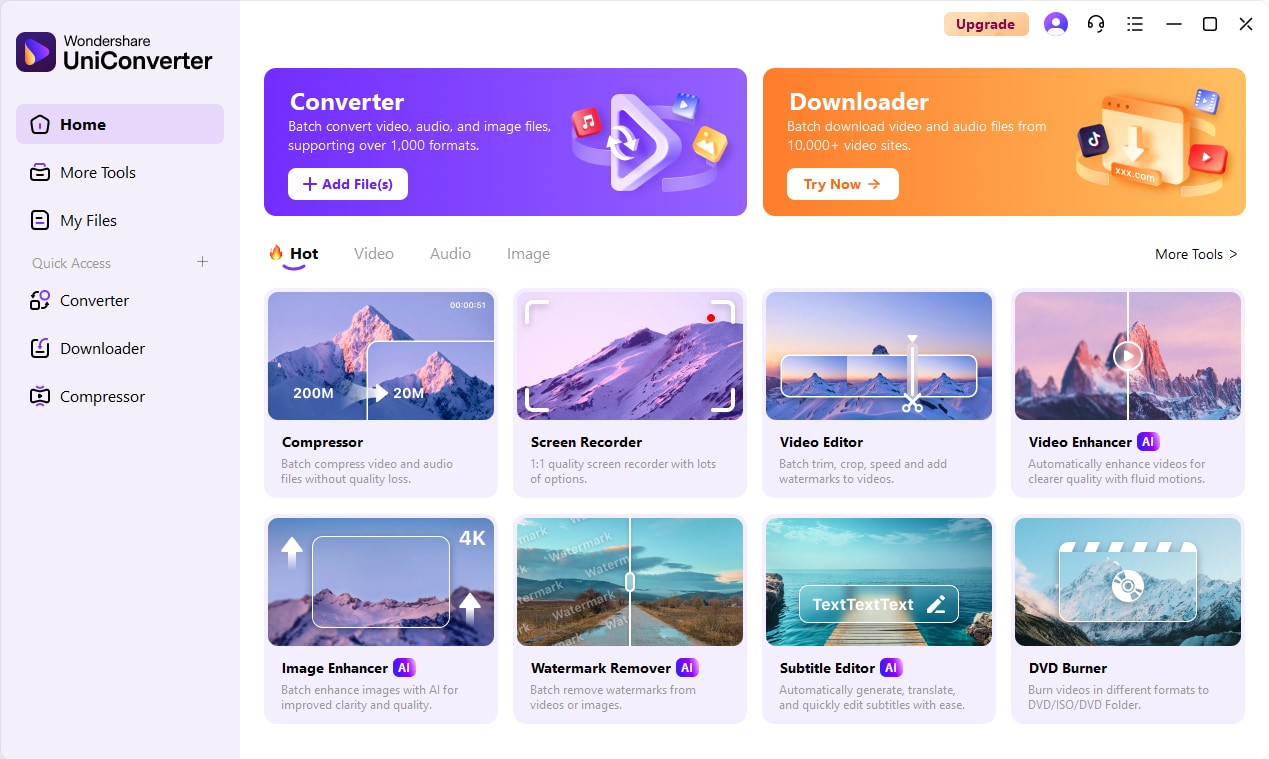
Step 1: Open UniConverter and Choose Converter
Launch UniConverter and navigate to the "Converter" tab from the main interface. This is your starting point for all video and audio conversion tasks.
Step 2: Upload the Video, Audios or Images
Drag and drop your video, audio, or image files directly into the UniConverter window. Alternatively, click the "Add Files" button to browse and select your media. UniConverter supports a wide range of formats, allowing you to convert anything to MP4 or other desired formats.

Step 3: Choose Required Formats or Parameters
Select your desired output format from the "Output Format" dropdown menu. You can also customize parameters like resolution, bitrate, and encoder settings for precise control, whether you need to convert MOV to MP4 or convert HEIC to JPG.

Step 4: Save the Converted File
Click the "Convert" or "Start All" button to begin the conversion process. Once completed, your converted files will be saved to the designated output folder.


Efficient Video Editing and Conversion Software
Part 7: Final Verdict and Recommendations
This Adobe Media Encoder review highlights its undeniable strength as an integral component of the Adobe Creative Cloud, offering unparalleled integration and advanced features for professional video production. For those deeply entrenched in the Adobe ecosystem, its ability to handle complex encoding tasks, manage queues, and provide extensive customization makes it an indispensable tool. However, its subscription model, resource demands, and steep learning curve for new users present significant barriers for others. Independent creators and small businesses might find the cost prohibitive and the feature set overkill for simpler tasks, potentially benefiting more from free or more affordable alternatives that offer a balance of functionality and ease of use. For users seeking a user-friendly, all-in-one solution that prioritizes efficiency, broad format support, and a straightforward experience without the Adobe ecosystem's complexities, dedicated conversion tools like UniConverter offer a compelling alternative, especially for quick, high-quality batch conversions. Ultimately, the best choice depends on individual workflow, budget, and technical proficiency.
Part 8: Frequently Asked Questions
1: Is Adobe Media Encoder free to use?
No, Adobe Media Encoder is part of the Adobe Creative Cloud subscription and is not available as a standalone free application.
2: Can Adobe Media Encoder convert videos to any format?
It supports a wide range of popular video and audio formats, but some niche formats might require third-party plugins or specific codecs to be installed.
3: How does Adobe Media Encoder handle 4K and 8K video?
It can handle high-resolution video, but performance heavily depends on your hardware specifications, particularly your CPU, GPU, and RAM.
4: Is there a standalone version of Adobe Media Encoder?
No, it's primarily designed to integrate with other Adobe Creative Cloud applications like Premiere Pro and After Effects, though it can be launched independently.
5: What are the best alternatives to Adobe Media Encoder for basic video conversion?
HandBrake, UniConverter, and DaVinci Resolve (for more advanced needs) are popular alternatives, with FFmpeg offering powerful command-line capabilities.
