
- VideoSmaller Overview: Free online tool for quick video compression, ideal for casual users and small files.
- Feature Limitations: Offers basic compression; lacks advanced controls for quality, bitrate, or batch processing.
- Best Use Case: Perfect for fast, simple video compression for social media or email sharing.
- Comparison Insight: UniConverter and HandBrake offer superior control, speed, and features for professional needs.
- Online Risks: Free online compressors pose data privacy risks, intrusive ads, and potential quality loss.
- UniConverter Value: Provides advanced, offline compression with high quality, speed, and robust features.
- Decision Guide: Choose VideoSmaller for quick, casual tasks; opt for UniConverter for quality, control, and security.
In this article
- Part 1: What is VideoSmaller Video Compressor?
- Part 2: VideoSmaller Video Compressor: Core Features, Pros, and Cons
- Part 3: VideoSmaller Video Compressor's Users and Use Cases
- Part 4: VideoSmaller Video Compressor vs. Competitors: A Comparative Analysis
- Part 5: Risks and Pitfalls When Using Free Online Compressors
- Part 6: How to Use UniConverter to Compress High-Quality Videos
- Part 7: Final Verdict and Recommendations
- Part 8: FAQs about Video Compression
Video compression has become an essential task in our digital lives, whether for sharing memories with friends, uploading content to social media, or optimizing storage. Online tools like VideoSmaller Video Compressor offer a quick and accessible solution for reducing file sizes without the need for complex software installations. This VideoSmaller Video Compressor review aims to provide a comprehensive analysis of its features, compare it with leading alternatives, and help you determine if it's the right tool for your video compression needs. I'll delve into its strengths and weaknesses, explore ideal use cases, and highlight potential risks associated with free online compressors, ultimately guiding you toward an informed decision.
Part 1: What is VideoSmaller Video Compressor?
VideoSmaller Video Compressor is a free online tool designed to reduce the file size of video clips. It operates directly within your web browser, eliminating the need for any software downloads or installations. My initial impression is that it targets users who need a quick, no-frills solution for common video compression tasks. This review will specifically address the core question: Does VideoSmaller effectively meet the demands of various video compression scenarios, from casual sharing to more professional applications, or are there better alternatives available?
The Landscape of Online Video Compression Tools
The demand for efficient video compression is driven by several key factors:
* Growing Video Content Creation: With smartphones and affordable cameras, everyone is a content creator, leading to an explosion of video files.
* Social Media Sharing Limitations: Platforms like WhatsApp, Instagram, and email often have strict file size limits, making compression a necessity.
* Storage and Bandwidth Constraints: Large video files consume significant storage space and can be slow to upload or download, impacting user experience.
* Need for Quick, Accessible Solutions: Many users prefer online tools for their convenience, avoiding the hassle of installing desktop software for occasional use.
Part 2: VideoSmaller Video Compressor: Core Features, Pros, and Cons
VideoSmaller Video Compressor focuses on delivering a straightforward video compression experience. Its core capabilities revolve around reducing video file size with minimal user input.
Key Features:
* Online Accessibility: Operates entirely in your web browser.
* Simple Interface: A clean, intuitive design for easy navigation.
* Basic Compression Options: Allows for some control over output quality (e.g., lower width).
* MP4 Format Support: Primarily handles MP4 files, a widely used video format.
* Email Notification: Option to receive an email when compression is complete.
Pros:
* Ease of Use for Quick Compressions: I found it incredibly simple to upload a video and initiate compression. The interface is self-explanatory, perfect for beginners.
* No Software Installation Required: This is a huge plus for me, as I often need to compress videos on different computers without administrative privileges.
* Free Access for Basic Needs: For occasional, small-scale compressions, the free access is a significant advantage.
Cons:
* Limited Advanced Features and Customization: I quickly realized that if I needed precise control over bitrate, resolution, or specific codecs, VideoSmaller fell short.
* Potential for Slower Processing on Large Files: When I tried compressing a larger video (close to its 500MB limit), the processing time was noticeably longer than with desktop software.
Part 3: VideoSmaller Video Compressor's Users and Use Cases
VideoSmaller Video Compressor is primarily designed for individuals who prioritize speed and simplicity over advanced features and high-fidelity output. It's a tool for the casual user, not the professional editor.
Best Use Case: Quick, On-the-Go Compression for Social Media Sharing
I've found VideoSmaller to be perfect for those moments when I've just recorded a short clip on my phone and need to quickly reduce its size to share on WhatsApp, Instagram Stories, or email to a friend. The process is fast, and the resulting file is usually small enough for these platforms without a drastic loss in perceived quality for casual viewing. It's my go-to for impromptu sharing when I'm away from my main editing setup.
Limited Use Case: Professional Video Editing Workflows Requiring High Fidelity
However, I would never use VideoSmaller for professional projects. If I'm working on a client video, a YouTube upload that needs to maintain specific quality standards, or anything requiring precise control over resolution, bitrate, or codec, VideoSmaller simply doesn't cut it. The lack of advanced settings means I can't guarantee the output quality, and the 500MB file size limit is often too restrictive for raw footage or high-resolution exports. For these scenarios, I need a more robust solution that offers granular control and preserves as much detail as possible.
Part 4: VideoSmaller Video Compressor vs. Competitors: A Comparative Analysis
When looking at online video compressors, VideoSmaller Video Compressor stands out for its simplicity, but it's crucial to see how it stacks up against other popular tools. I've compared it with some well-known alternatives to give you a clearer picture.
| Feature/Tool | VideoSmaller | UniConverter | HandBrake | Clideo |
| Max File Size | 500MB | Unlimited (desktop) | Unlimited (desktop) | 500MB (free) |
| Output Quality Control | Basic (lower width) | Advanced (bitrate, resolution, codec) | Advanced (bitrate, resolution, codec) | Basic (preset options) |
| Batch Processing | No | Yes | Yes | No (free) |
| Offline Use | No | Yes | Yes | No |
| Pricing Model | Free | Freemium (desktop) | Free (open-source) | Freemium |
| Processing Speed | Moderate | Fast (GPU acceleration) | Moderate | Moderate |
| Security | Standard online risks | High (local processing) | High (local processing) | Standard online risks |
Key Differentiators: Simplicity vs. Advanced Control
From my experience, VideoSmaller is the epitome of "set it and forget it" for small files. Its strength lies in its quick, free, and browser-based nature. However, when I need more control over the output quality, faster processing for larger files, or the ability to compress multiple videos at once, tools like UniConverter and HandBrake clearly outperform it. UniConverter, with its desktop application, offers a comprehensive suite of features including GPU acceleration for speed and extensive format support, making it ideal for users who frequently deal with video. HandBrake is another powerful free option for advanced users comfortable with more technical settings. Clideo offers a similar online experience to VideoSmaller but often has more ads and similar limitations on its free tier. If you're a casual user with small files, VideoSmaller is fine. But for anything beyond that, the alternatives offer significantly more power and flexibility.
Part 5: Risks and Pitfalls When Using Free Online Compressors
While free online compressors like VideoSmaller Video Compressor offer convenience, I've learned that they come with their own set of risks and potential pitfalls that users should be aware of. It's not just about the compression; it's about the entire experience and the security of your data.
Data Privacy Concerns with Uploaded Content
When I upload a video to an online compressor, I'm essentially entrusting my personal or potentially sensitive content to a third-party server. While many services claim to delete files after a certain period, there's always an inherent risk. I've often wondered about the security protocols in place and who might have access to my videos during the upload, processing, and storage phases. For anything remotely private, I'm extremely hesitant to use these services.
Intrusive Advertisements and Pop-ups
A common trade-off for "free" online tools is the bombardment of advertisements. I've encountered numerous pop-ups, banner ads, and even video ads on some free compressors. These can be incredibly disruptive to the workflow and, in some cases, can lead to accidental clicks on malicious links. It's a constant battle to navigate around them, which detracts from the supposed "ease of use."
Potential Loss of Video Quality
While the goal is to reduce file size, some free online compressors achieve this by aggressively compromising video quality. I've had instances where the compressed video looked pixelated, blurry, or had noticeable artifacts, especially in areas with a lot of motion or fine detail. The lack of granular control over compression settings means I often have to accept whatever quality the tool decides, which can be frustrating if the output isn't up to par.
Reliance on Internet Connectivity
Since these are online tools, a stable and fast internet connection is absolutely essential. I've experienced frustrating delays and even failed uploads when my internet was spotty. This reliance means I can't compress videos offline, which is a significant limitation if I'm traveling or in an area with poor connectivity. It ties me to a specific environment, unlike desktop software that works anywhere.
File Size and Format Limitations
Many free online compressors, including VideoSmaller, impose strict file size limits (e.g., 500MB). This means I can't use them for larger video files, which are increasingly common with higher resolution recordings. Furthermore, some tools only support a limited range of input and output formats, forcing me to convert files beforehand or look for another solution entirely.
Part 6: How to Use UniConverter to Compress High-Quality Videos
When online tools can’t keep up—especially with batch compression, inconsistent output, or noticeable quality loss—I usually rely on UniConverter as a more dependable desktop alternative. It avoids many of the common drawbacks of free web-based tools and delivers a smoother experience for anyone who needs a reliable video compressor. I also like that it supports a wide range of formats, uses GPU acceleration for faster processing, and can help compress videos without quality loss as much as possible. Combined with its stable batch processing and broader media management features, it works well as an all-in-one solution for video compression and file handling.
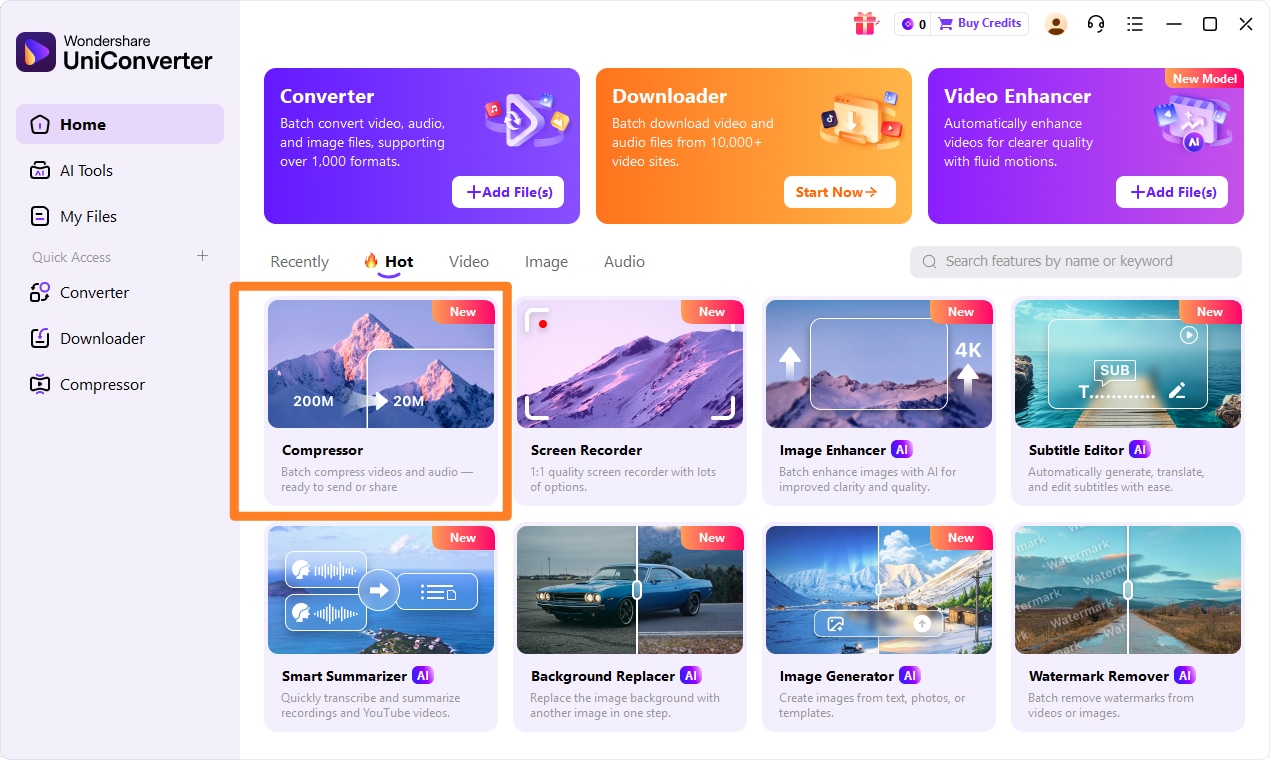
Step 1: Open UniConverter and Choose Compressor
First, I launch UniConverter on my desktop. From the main interface, I navigate to the "Compressor" tab on the left sidebar. This is where all the magic happens for reducing video file sizes.
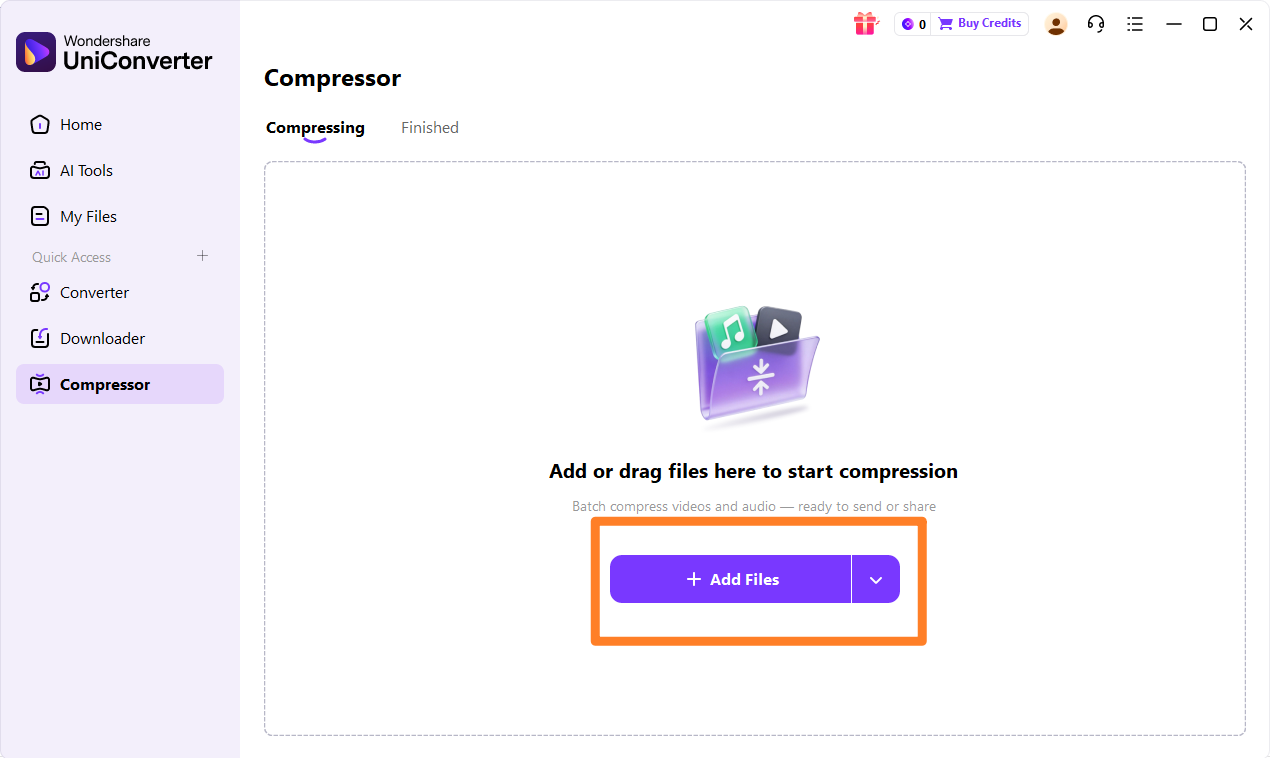
Step 2: Upload the Video, Audios or Images
Next, I click the "Add Files" button or simply drag and drop the video files I want to compress into the UniConverter window. I can add multiple videos at once for batch processing, which is a huge time-saver.
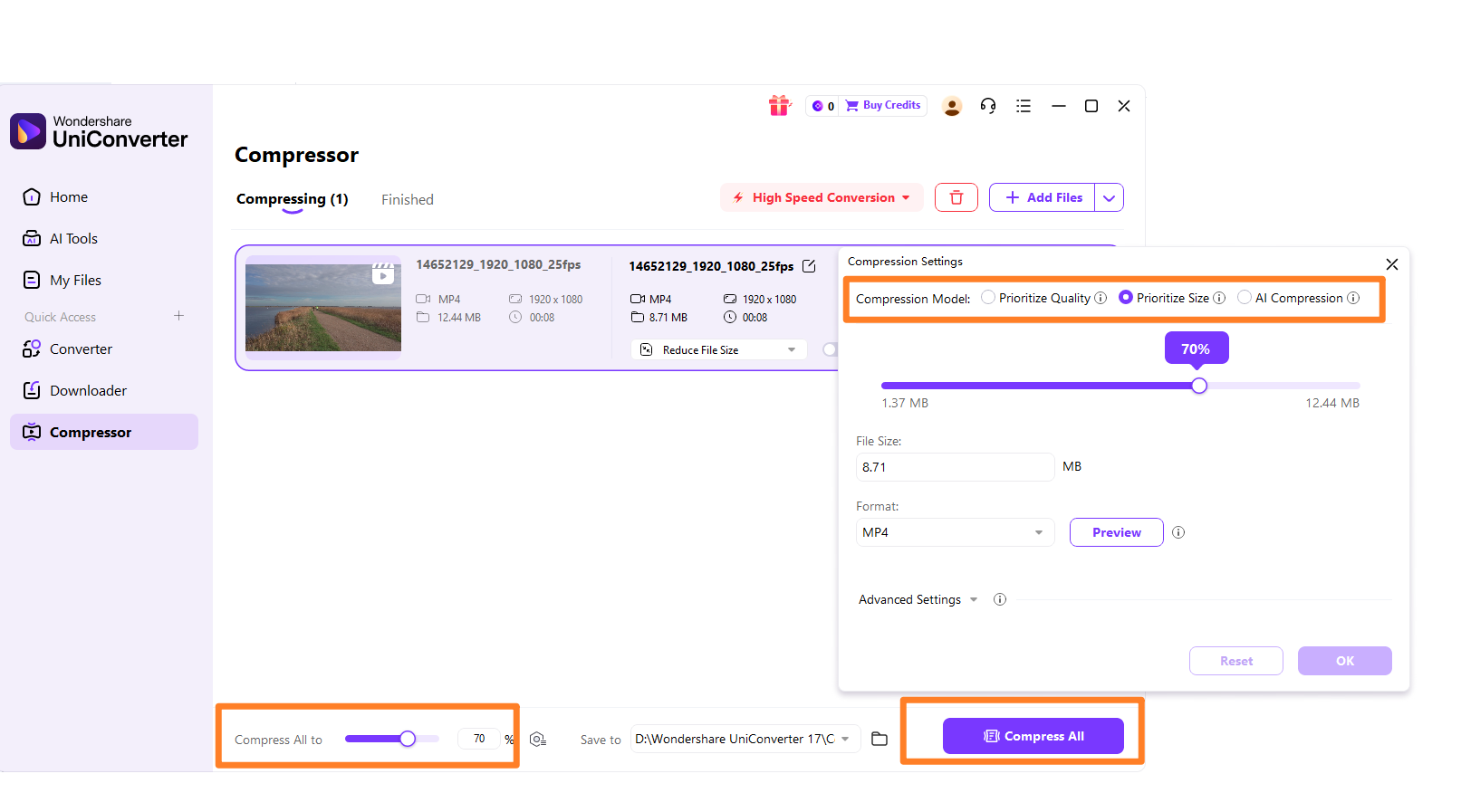
Step 3: Choose Required Parameters
Once my files are loaded, I can customize the compression settings. UniConverter allows me to adjust the file size, format, resolution, and bitrate. I can either use a preset or manually fine-tune the parameters to achieve the perfect balance between file size and quality.
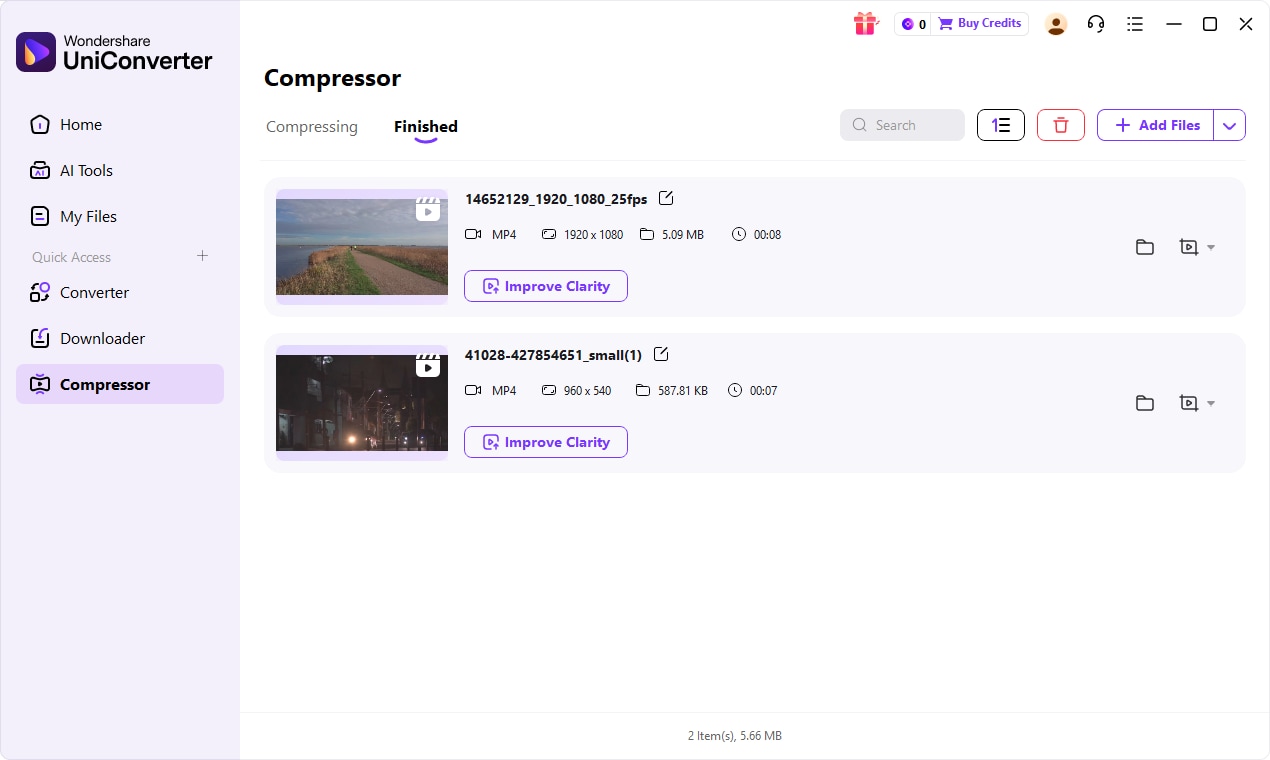
Step 4: Save the Compressed File
After setting my desired parameters, I choose an output folder for the compressed videos. Then, I click the "Compress" button. UniConverter quickly processes the files, and once complete, my compressed videos are ready in the specified location, maintaining excellent quality.

Need a Better VideoSmaller Alternative?
Part 7: Final Verdict and Recommendations
After thoroughly reviewing VideoSmaller Video Compressor and comparing it with its alternatives, my final verdict is clear: its utility largely depends on your specific needs and priorities.
For Casual Users Seeking Simplicity
If you're an occasional user who needs to quickly compress a small video (under 500MB) for social media sharing or emailing, and you don't mind basic quality control or potential ads, VideoSmaller is a perfectly acceptable, free, and convenient option. Its browser-based nature and straightforward interface make it ideal for quick, on-the-go tasks where speed and accessibility trump advanced features.
For Professionals Requiring Quality and Control
However, for anyone involved in professional video editing, content creation, or those who frequently handle large files and demand precise control over output quality, VideoSmaller Video Compressor falls short. In these scenarios, a desktop application like UniConverter or HandBrake is indispensable. These tools offer advanced settings, batch processing, faster speeds (especially with GPU acceleration), and the ability to work offline, ensuring consistent high-quality results without the limitations of online services.
For Users Prioritizing Data Security
Furthermore, if data privacy and security are paramount concerns for you, especially when dealing with sensitive or personal video content, I strongly recommend opting for a desktop-based compressor. Processing files locally with tools like UniConverter eliminates the risks associated with uploading your data to third-party servers, providing greater peace of mind.
Part 8: FAQs about Video Compression
-
1. Is VideoSmaller safe to use for my personal videos?
While VideoSmaller states it deletes files after a few hours, like any online service, there's an inherent risk when uploading personal content to a third-party server. For highly sensitive videos, I'd recommend using a desktop compressor like UniConverter that processes files locally.
-
2. How much quality will I lose when compressing a video with VideoSmaller?
The amount of quality loss with VideoSmaller can vary. Since it offers basic control, you might experience noticeable degradation, especially if you choose a very small output size or if the original video has complex details. It's generally suitable for casual viewing, but not for high-fidelity needs.
-
3. Can I compress multiple videos at once with VideoSmaller?
No, VideoSmaller does not support batch processing. You can only compress one video at a time, which can be time-consuming if you have several files to process. For batch compression, I rely on desktop software like UniConverter.
-
4. What are the main advantages of using a desktop compressor like UniConverter over online tools?
Desktop compressors like UniConverter offer several advantages: no file size limits, advanced control over compression settings (bitrate, resolution, codec), faster processing speeds (often with GPU acceleration), batch processing capabilities, offline use, and enhanced data privacy as files are processed locally.
-
5. Are there any file size limitations when using VideoSmaller?
Yes, VideoSmaller has a strict file size limit of 500MB per video. If your video exceeds this size, you won't be able to upload and compress it using their service.
