
- Online Tools Defined: Web-based audio converters change formats; compressors reduce file size, both for quick, browser-based tasks.
- Core Features: Online tools prioritize speed, simplicity, and accessibility for basic conversion and compression needs.
- Trade-offs: Enjoy convenience and cost-effectiveness, but expect internet dependency and limited advanced features.
- User Scenarios: Ideal for quick social media edits; unsuitable for professional production or large batch processing.
- Comparison: Online tools offer high accessibility and ease of use, but lack advanced features, offline capability, and robust privacy.
- Risks: Be aware of data privacy concerns, intrusive ads, potential quality degradation, and file size limitations.
- UniConverter Advantage: Offers a robust desktop solution for high-quality, fast, and secure audio/video compression and conversion.
- Decision Point: Choose online tools for casual, quick tasks; opt for UniConverter for professional results, security, and advanced features.
In this article
- Part 1: What are Online Audio Converters and Compressors?
- Part 2: Online Audio Converters & Compressors: Core Features and Trade-offs
- Part 3: The User and Usage Scenarios for Online Audio Converters & Compressors
- Part 4: Online Audio Converters & Compressors vs. Alternatives
- Part 5: Risks and Pitfalls of Using Online Audio Converters & Compressors
- Part 6: How to Use UniConverter to Efficiently Compress Audio and Video
- Part 7: Conclusion
- Part 8: FAQs
The digital age has made audio files ubiquitous, from podcasts and music to voice notes and online meetings. As a result, the need for efficient audio management tools has skyrocketed. This Online Audio Converter Audio Compressor review will delve into the world of online audio converters and compressors, exploring their functionalities, benefits, and limitations. We'll compare them against more robust desktop and cloud-based solutions, helping you understand when these convenient web-based tools are your best bet and when you might need something more powerful. My goal is to provide you with a comprehensive guide to make informed decisions about your audio processing needs.
Part 1: What are Online Audio Converters and Compressors?
Online audio converters and compressors are web-based tools designed to modify audio files directly within your browser. An audio converter changes an audio file from one format to another (e.g., MP3 to WAV, FLAC to OGG), while an audio compressor reduces the file size of an audio clip, often by lowering its bitrate or sampling rate, without significantly compromising perceived quality. These tools are typically free or freemium, offering a quick and accessible way to handle common audio tasks without needing to download or install any software. My aim in this review is to help you navigate the myriad of options available and understand their true value in various scenarios.
The Growing Demand for Online Audio Tools
The increasing demand for online audio tools stems from several key factors:
* Ubiquitous Content Creation: More people are creating audio content for social media, personal projects, and casual sharing.
* Device Versatility: The need to play audio across different devices and platforms necessitates format compatibility.
* Storage and Bandwidth Constraints: Smaller file sizes are crucial for faster uploads, downloads, and efficient storage, especially on mobile devices.
* Ease of Access: The desire for immediate solutions without software installation has driven users to web-based platforms.
Part 2: Online Audio Converters & Compressors: Core Features and Trade-offs
When I look at online audio converters and compressors, I see tools built for speed and simplicity. Their core capabilities revolve around basic format conversion and file size reduction. They typically support a decent range of common audio formats like MP3, WAV, AAC, and OGG. Many offer basic compression options, allowing you to adjust bitrate or quality settings to achieve a smaller file.
Pros:
* Accessibility and Convenience: I can convert and compress my audio files from any device with an internet connection, anywhere, anytime. This is incredibly useful when I'm on the go.
* Cost-Effectiveness: Most online tools are free to use, which saves me from purchasing expensive software for simple tasks.
* Simplicity: The interfaces are usually very straightforward, making it easy for me to get my tasks done quickly without a steep learning curve.
Cons:
* Internet Dependency: I've found that I absolutely need a stable internet connection for these tools to work, which can be a limitation in some situations.
* Limited Advanced Features: They often lack the professional-grade editing, batch processing, and fine-grained control that I might need for more complex audio projects.
Part 3: The User and Usage Scenarios for Online Audio Converters & Compressors
I've found that online audio converters and compressors are perfect for a specific type of user: someone who needs a quick, no-fuss solution for basic audio tasks. If you're not an audio professional and just need to get a file into a different format or make it a bit smaller, these tools are your go-to.
Best Use Case: Quick Edits for Social Media Sharing
For example, if I've recorded a short voice memo on my phone and want to share it on social media, but the platform requires a specific format or has a file size limit, an online converter/compressor is ideal. I can quickly upload the file, convert it to MP3, and compress it slightly, all within a few clicks, and then it's ready to share. It's perfect for those spontaneous moments where I need a fast turnaround.
Limited Use Case: Professional Audio Production and Large Batch Processing
However, I wouldn't rely on these tools for professional audio production. If I'm working on a podcast, a music track, or any project that requires precise editing, high-fidelity output, or processing a large number of files, online tools fall short. They typically lack advanced features like noise reduction, equalization, or multi-track editing, and their batch processing capabilities are often non-existent or very limited. For those scenarios, I definitely need more robust desktop software.
Part 4: Online Audio Converters & Compressors vs. Alternatives
When I compare online audio converters and compressors to their alternatives, I see a clear trade-off between convenience and control.
| Feature/Tool | Online Audio Converter/Compressor | Desktop Software (e.g., Audacity) | Cloud-Based Suites (e.g., Adobe Audition) | UniConverter |
| Accessibility | High (browser-based) | Medium (software installation) | High (browser/app) | High (software installation) |
| Ease of Use | Very High | Medium | Medium | High |
| Advanced Features | Low | Medium | High | Medium-High |
| Offline Capability | No | Yes | Limited | Yes |
| Privacy Concerns | Moderate | Low | Low | Low |
| Cost | Free/Freemium | Free/Paid | Subscription | Paid (one-time/subscription) |
| Processing Speed | Varies (internet dependent) | Fast (system dependent) | Fast (cloud processing) | Very Fast (GPU acceleration) |
| Output Quality | Good (basic tasks) | Excellent (fine control) | Excellent (professional) | Excellent (lossless options) |
| Customer Support | Minimal/Community | Community/Paid | Dedicated | Dedicated |
| Batch Processing | Limited/None | Yes | Yes | Yes |
From my experience, online tools like Online Audio Converter are fantastic for quick, one-off tasks where I prioritize speed and ease of use. They're free and accessible from anywhere. However, if I need more control over the output quality or advanced editing features, Audacity, a free desktop software, offers a much better balance. It's offline capable and provides more granular control over audio parameters. For professional-grade work, Adobe Audition, as part of a cloud-based suite, is unparalleled in its feature set and integration, though it comes with a subscription cost. UniConverter, on the other hand, stands out as a desktop solution that bridges the gap, offering high processing speed, excellent output quality, and robust batch processing capabilities, making it a strong contender for users who need more than basic online tools but aren't ready for a full professional suite.
Part 5: Risks and Pitfalls of Using Online Audio Converters & Compressors
While online audio converters and compressors offer undeniable convenience, I've learned that they come with their own set of risks and pitfalls that I need to be aware of. It's not always as straightforward as just uploading and downloading.
Data Privacy and Security Concerns
One of my biggest concerns when using free online tools is data privacy. When I upload my audio files, I'm essentially entrusting them to a third-party server. I often wonder: who has access to my data? How long is it stored? Is it being used for advertising or other purposes? Many free services have vague privacy policies, and I've heard stories of personal audio recordings being compromised.
Intrusive Advertisements and Pop-ups
I've frequently encountered online converters that are riddled with intrusive advertisements and pop-ups. These can range from annoying banner ads to misleading download buttons that try to trick me into installing unwanted software. It significantly degrades the user experience and can even pose a security risk if I accidentally click on a malicious ad.
Potential for Quality Degradation
While online compressors aim to reduce file size without significant quality loss, I've found that the results can be inconsistent. Especially with aggressive compression settings, I've noticed a noticeable drop in audio fidelity, with artifacts or a "muffled" sound. For anything beyond casual listening, this quality degradation can be a real problem.
File Size Limitations and Upload Speed Issues
Many free online tools impose strict file size limits, which can be frustrating if I'm trying to convert or compress a larger audio file. Additionally, the upload and download speeds are entirely dependent on my internet connection and the server's capacity. I've often experienced painfully slow transfers, turning a "quick" task into a time-consuming ordeal.
Lack of Customer Support
If I run into an issue or have a question while using an online converter, I've found that customer support is almost non-existent. There's usually no dedicated help desk or live chat, leaving me to troubleshoot problems on my own or search through community forums, which can be a significant drawback if I'm on a tight deadline.
Part 6: How to Use UniConverter to Efficiently Compress Audio and Video
Once online tools start showing their limitations—whether through missing batch compression, uneven results, or obvious quality loss—UniConverter becomes a much more dependable option. It offers a smoother experience for both audio compression and video compression, without the ads or privacy concerns that often come with browser-based services. I also like that GPU acceleration helps speed up processing, while features designed to compress videos without quality loss make it easier to reduce file size without sacrificing too much quality. With broad format support and more stable performance overall, it works well as a practical all-in-one tool for everyday media management.
Step 1: Open UniConverter and Choose Compressor
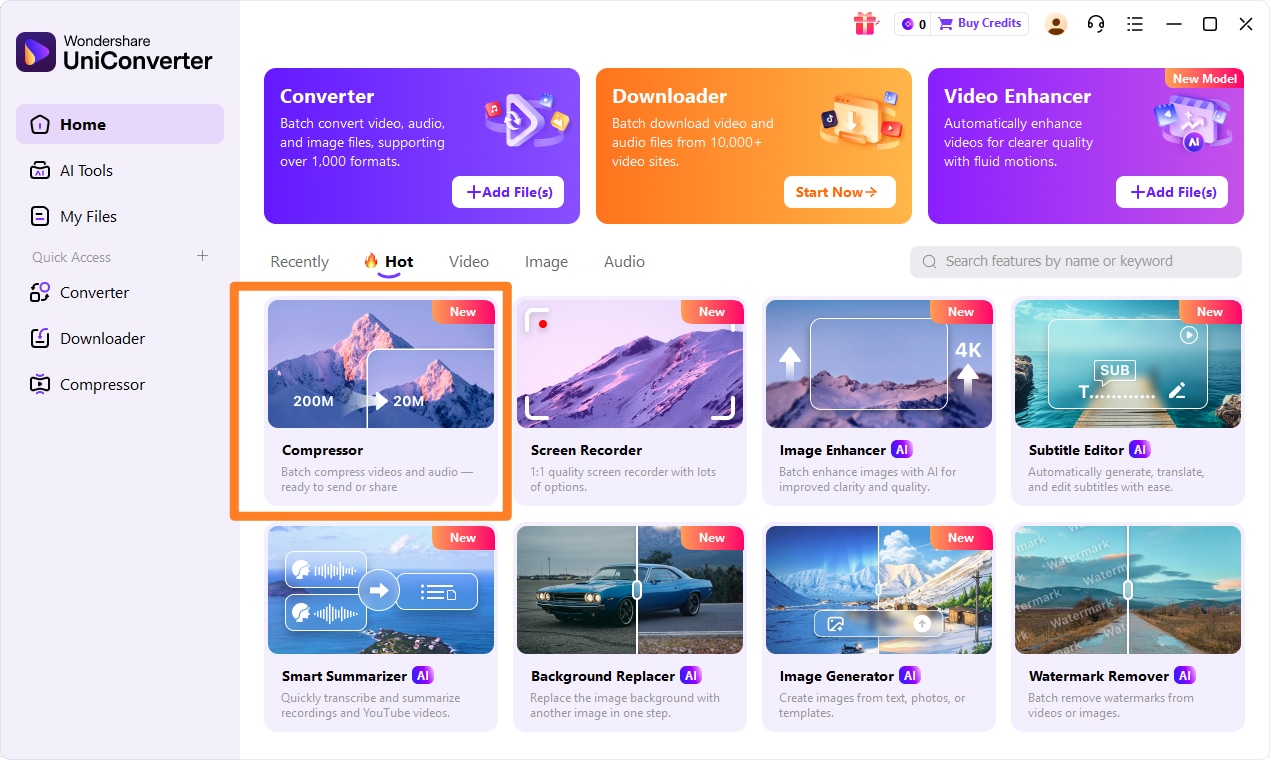
First, I launch UniConverter on my desktop. From the main interface, I navigate to the "Compressor" tab. This is where I'll manage all my compression tasks.
Step 2: Upload the Video, Audios or Images
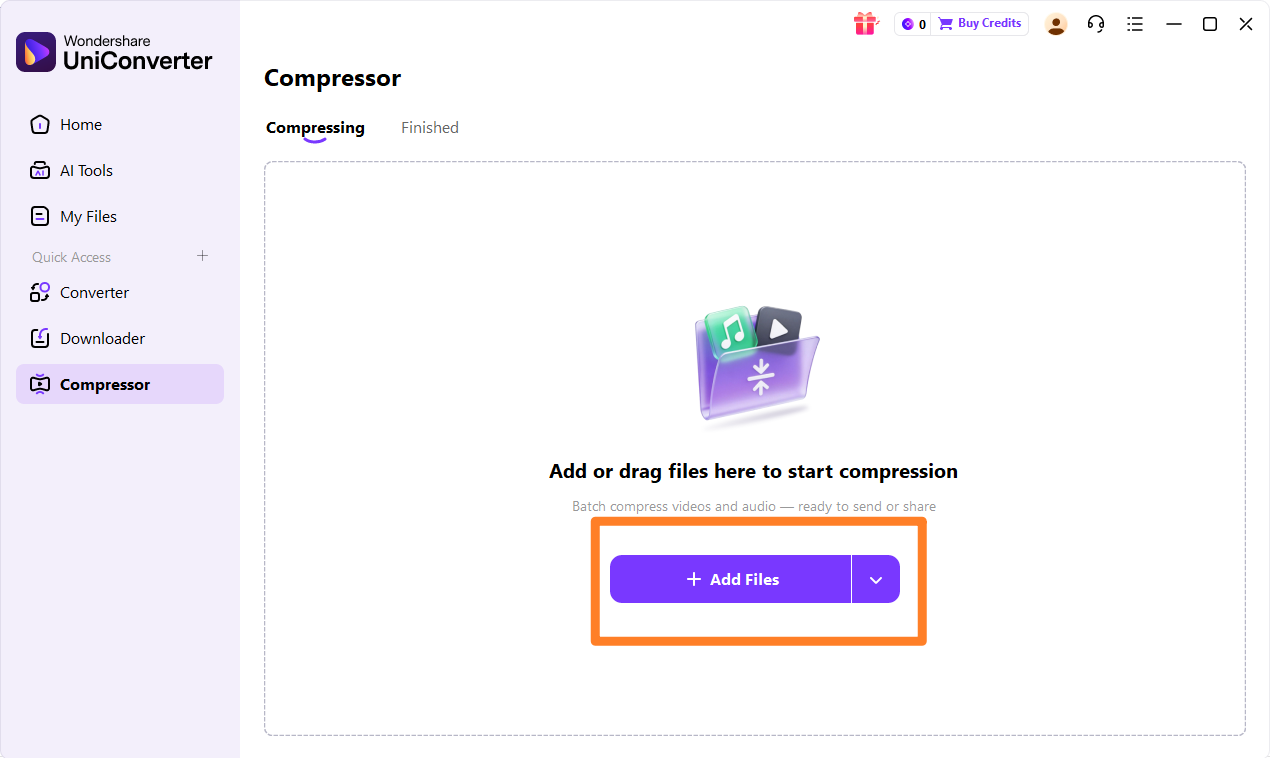
Next, I click on the "Add Files" button or simply drag and drop the audio, video, or image files I wish to compress into the UniConverter window. I can add multiple files for batch processing.
Step 3: Choose Required Parameters
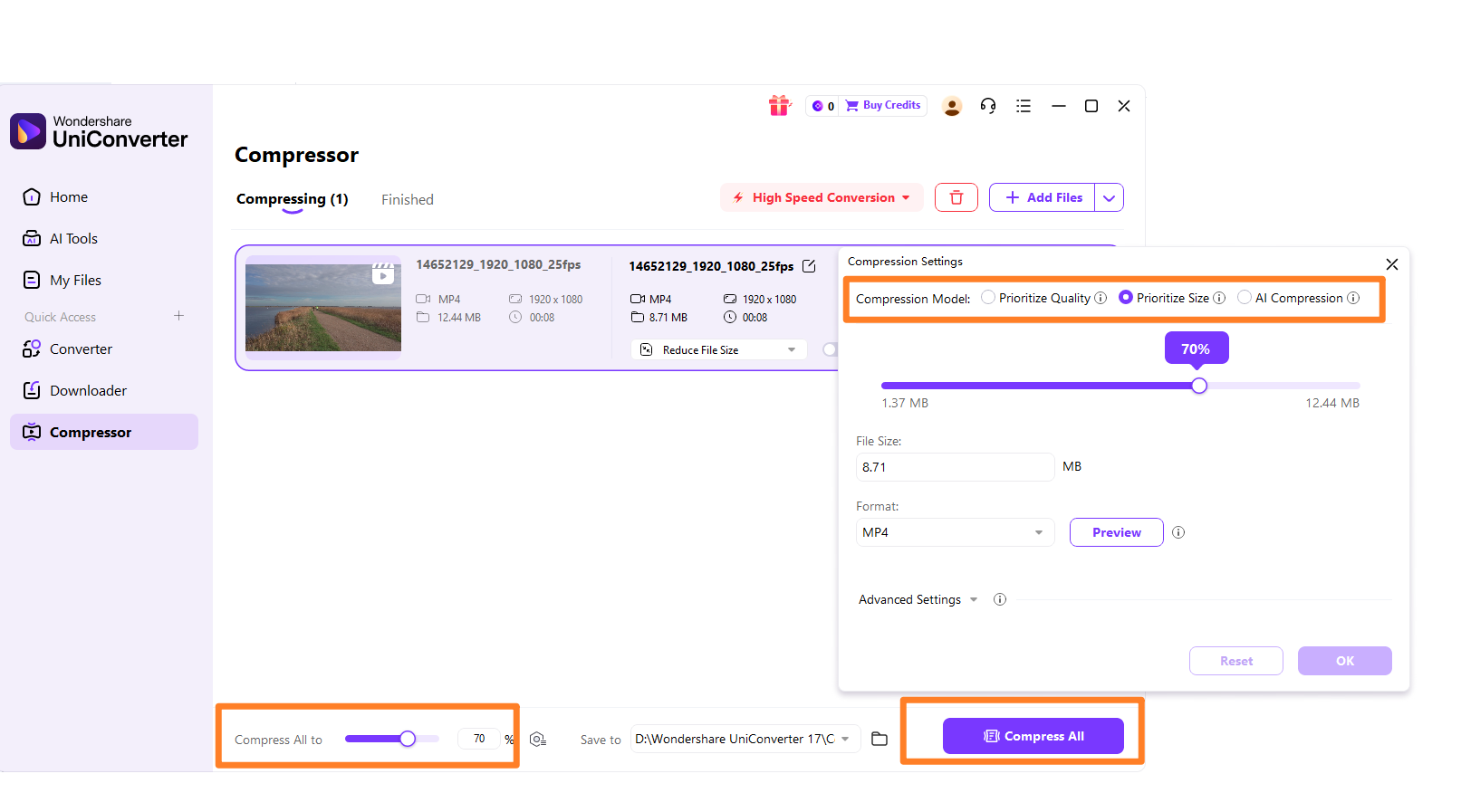
After uploading, I can select the output format, adjust the compression ratio, bitrate, and other parameters to achieve my desired file size and quality. UniConverter provides various presets and custom options.
Step 4: Save the Compressed File
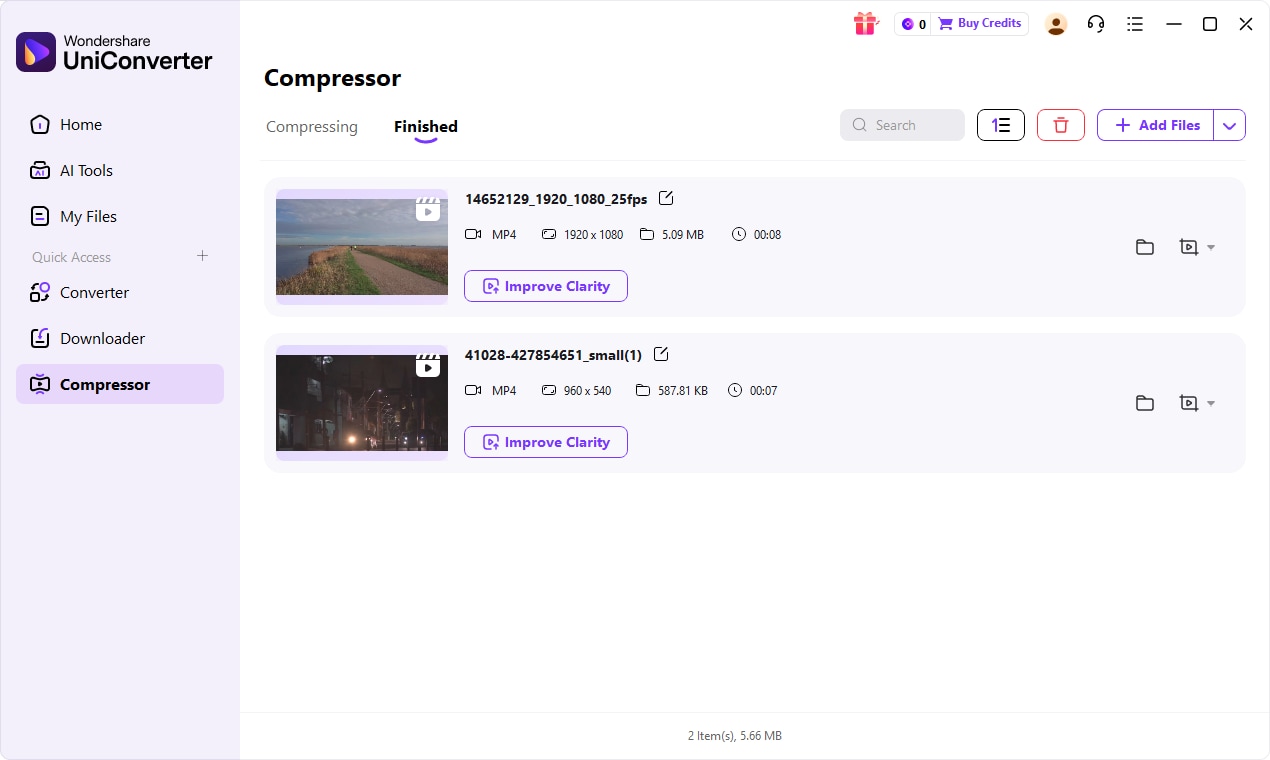
Once I'm satisfied with the settings, I click the "Compress" button. UniConverter will quickly process the files, and then I can choose the destination folder to save my optimized audio, video, or image files.

Need a Better Online Audio Converter Alternative?
Part 7: Conclusion
In conclusion, my Online Audio Converter Audio Compressor review reveals that these web-based tools are incredibly valuable for casual users and quick, one-off tasks. Their accessibility, cost-effectiveness, and simplicity make them ideal for scenarios like preparing a voice memo for social media or quickly converting a file for a specific device. However, for professionals or anyone requiring advanced features, batch processing, or guaranteed high-fidelity output, desktop software like Audacity or dedicated solutions like UniConverter offer far more control and reliability. The trade-off between convenience and security is a personal choice; while online tools are fast, they often come with privacy concerns, intrusive ads, and potential quality degradation. For those who prioritize data security, consistent quality, and a comprehensive feature set, investing in a dedicated tool like UniConverter provides a robust and efficient solution for all audio and video management needs.
Part 8: FAQs
-
1. Are online audio converters and compressors safe to use?
It depends on the specific tool. Many free online converters can pose privacy risks as your files are uploaded to their servers. Some may also contain intrusive ads or malware. It's crucial to use reputable sites and be cautious about sharing sensitive audio.
-
2. Can I convert multiple audio files at once using online tools?
Some online audio converters offer limited batch processing capabilities, allowing you to upload and convert a few files simultaneously. However, for large batches, desktop software or dedicated tools like UniConverter are generally more efficient and reliable.
-
3. What's the difference between audio conversion and audio compression?
Audio conversion changes the format of an audio file (e.g., MP3 to WAV) to ensure compatibility with different players or platforms. Audio compression reduces the file size of an audio clip, often by lowering its bitrate or sampling rate, to save storage space or facilitate faster sharing.
-
4. Do online audio tools support all audio formats?
Most online audio tools support common formats like MP3, WAV, AAC, and OGG. However, they may not support less common or proprietary formats. For comprehensive format support, I recommend using a versatile desktop application like UniConverter.
-
5. How do I choose the best online audio converter or compressor?
When choosing, consider factors like the range of supported formats, ease of use, file size limits, presence of ads, and privacy policy. For critical tasks or if you frequently process audio, I suggest opting for a dedicated desktop solution like UniConverter, which offers greater control, security, and advanced features.
