
- MozJPEG Value: Superior JPEG compression for web, optimizing performance and user experience.
- Core Features: Advanced algorithms like perceptual and trellis quantization for smaller files, better quality.
- Pros & Cons: Excellent JPEG compression, open-source; but JPEG-only, requires technical expertise.
- Ideal Users: Web developers and publishers needing maximum JPEG compression for fast-loading sites.
- Limitations: Not for multi-format compression or GUI-preferring users; command-line interface is a barrier.
- Comparison: Outperforms standard JPEGs, but less versatile than tools like UniConverter for diverse formats.
- Risks: Over-compression artifacts, complex integration, no visual preview, limited to JPEG.
- UniConverter Alternative: Offers comprehensive, user-friendly, multi-format compression with GPU acceleration.
- Decision Factor: Choose MozJPEG for deep JPEG optimization if technically proficient; UniConverter for versatility and ease.
In this article
- Part 1: What is MozJPEG Image Compressor?
- Part 2: MozJPEG Image Compressor: Core Features, Pros, and Cons
- Part 3: MozJPEG Image Compressor: Ideal Users and Use Cases
- Part 4: MozJPEG Image Compressor & Competitors: A Comparative Analysis
- Part 5: Risks and Pitfalls When Using MozJPEG
- Part 6: How to Use UniConverter for Comprehensive Image Compression
- Part 7: Conclusion
- Part 8: FAQs
MozJPEG Image Compressor: A Comprehensive Scenario-Based Review
In the ever-evolving landscape of web development, image optimization stands as a critical pillar for enhancing website performance and user experience. Large image files can significantly slow down page load times, leading to higher bounce rates and diminished engagement. This is where specialized compression tools like MozJPEG come into play. Developed by Mozilla, MozJPEG is an advanced JPEG encoder designed to achieve superior compression ratios without sacrificing visual quality, particularly for photographic content. This review will delve into MozJPEG's core functionalities, compare it with leading alternatives, and provide a scenario-based analysis to help you make informed decisions about your image optimization strategy. We'll explore its strengths, weaknesses, ideal use cases, and potential pitfalls, ensuring you gain a holistic understanding of its value in your workflow.
Part 1: What is MozJPEG Image Compressor?
MozJPEG Image Compressor is an open-source JPEG encoder developed by Mozilla that aims to significantly reduce the file size of JPEG images while maintaining high visual quality. Unlike standard JPEG encoders, MozJPEG employs advanced algorithms and perceptual optimizations to achieve better compression ratios, especially at lower quality settings. My experience with it has shown that it's particularly effective for web developers and content creators who need to deliver fast-loading websites without compromising the richness of their visual content. The core problem it addresses is the perennial struggle between image fidelity and web performance.
The Role of MozJPEG in Web Optimization
The digital world demands speed, and large image files are often the biggest culprits for slow loading times. This creates a significant challenge for anyone publishing content online.
* Impact on User Experience: Slow loading times frustrate users, leading to higher bounce rates and a negative perception of your website or application.
* SEO Implications: Search engines, like Google, prioritize fast-loading websites, meaning optimized images can directly contribute to better search rankings.
* Bandwidth Consumption: Smaller image files reduce bandwidth usage, which is beneficial for both website owners (lower hosting costs) and users (faster downloads, especially on mobile data).
* Storage Efficiency: Optimizing images can also lead to more efficient storage, particularly for websites with a vast amount of visual content.
Part 2: MozJPEG Image Compressor: Core Features, Pros, and Cons
MozJPEG is a powerful tool primarily focused on delivering highly optimized JPEG images for web use. Its core capability lies in its advanced compression algorithms that intelligently reduce file size while preserving perceived visual quality. I've found that it's not about simply shrinking pixels, but about smart, perceptual compression.
Core Features:
* Perceptual Quantization: MozJPEG uses advanced quantization tables that are optimized for how the human eye perceives images, leading to smaller files with less noticeable quality degradation.
* Trellis Quantization: This feature further refines the quantization process, making more intelligent decisions about which data to discard for optimal compression.
* Progressive JPEG Encoding: It supports progressive JPEGs, which allows images to load in a blurry state and gradually sharpen, improving the perceived loading experience.
* Chroma Subsampling Optimization: MozJPEG applies intelligent chroma subsampling to reduce color information in areas where it's less noticeable, further shrinking file size.
* JPEG-XT Support: It includes support for JPEG-XT, enabling features like HDR and alpha channel, though these are less commonly used for standard web optimization.
Pros:
* Superior Compression Efficiency for Web Images: I've consistently achieved significantly smaller file sizes with MozJPEG compared to standard encoders, often without any perceptible loss in quality.
* Optimized for Perceptual Quality: Its algorithms are designed to trick the human eye, making the compressed images look better than their file size would suggest.
* Open-Source and Widely Adopted: Being open-source means it's free to use and benefits from a large community of developers, ensuring continuous improvement and integration into various tools.
Cons:
* Limited to JPEG Format: This is its biggest drawback; if you need to compress PNGs, GIFs, or other formats, MozJPEG won't help you.
* Requires Technical Expertise for Optimal Use: It's primarily a command-line tool, which can be daunting for users without coding experience. Getting the best results often involves tweaking various parameters.
Part 3: MozJPEG Image Compressor: Ideal Users and Use Cases
From my perspective, MozJPEG is a highly specialized tool that shines in specific scenarios and for particular user groups. It's not a one-size-fits-all solution, but rather a powerful instrument for those who truly understand its capabilities and limitations.
Best Use Case: Web Developers and Publishers Seeking Maximum JPEG Compression
If you're a web developer, a large-scale content publisher, or anyone managing a website with a significant number of photographic images, MozJPEG is an invaluable asset. My team uses it extensively for client websites where every kilobyte counts. For instance, an e-commerce site with thousands of product images can see dramatic improvements in page load times and overall performance by processing all JPEGs through MozJPEG. It's perfect for scenarios where you need to squeeze every last bit of compression out of your JPEGs to ensure lightning-fast loading speeds, directly impacting SEO and user satisfaction. We often integrate it into our build pipelines or content management systems to automate the optimization process, ensuring that all uploaded images are automatically compressed to the highest standard.
Limited Use Case: Users Requiring Multi-Format Compression or GUI-Based Solutions
On the other hand, if you're a casual blogger, a small business owner without development resources, or someone who frequently works with a mix of image formats (PNGs for transparency, GIFs for animations), MozJPEG will feel restrictive. For example, if I'm designing a simple landing page and need to optimize a few JPEGs, a PNG logo, and a small GIF, I wouldn't reach for MozJPEG first. Its command-line interface and JPEG-only focus mean you'd need separate tools for other formats, adding complexity to your workflow. Users who prefer a visual interface, drag-and-drop functionality, and support for various image types will find MozJPEG's technical nature and format limitations cumbersome. It's not designed for quick, ad-hoc, multi-format optimization tasks.
Part 4: MozJPEG Image Compressor & Competitors: A Comparative Analysis
When it comes to image compression, MozJPEG stands out for its deep specialization in JPEG, but it's important to see how it stacks up against other popular tools. I've worked with all of these, and each has its place depending on your needs.
| Feature/Scenario | MozJPEG | TinyPNG | ImageOptim | UniConverter |
| Compression Algorithm | Perceptual JPEG | Smart Lossy (JPEG, PNG) | Multiple (JPEG, PNG, GIF) | Smart Lossy/Lossless (Multiple) |
| Ease of Use | Command-line | Web-based GUI | Desktop GUI | Desktop GUI |
| Output Quality | Excellent (JPEG) | Very Good | Excellent | Excellent |
| Supported Formats | JPEG Only | JPEG, PNG | JPEG, PNG, GIF | JPEG, PNG, GIF, WebP, BMP, TIFF |
| Batch Processing | Yes (via scripts) | Yes | Yes | Yes |
| Integration | Libraries/APIs | API | Desktop App | Desktop App, API |
| Speed | Fast (CLI) | Moderate (Web) | Fast (Desktop) | Very Fast (GPU Accelerated) |
| Customer Support | Community | Community | Dedicated Support | |
| Security | Local Processing | Cloud Processing | Local Processing | Local Processing |
Key Differentiators:
MozJPEG excels in raw JPEG compression for web, prioritizing file size over ease of use. If I need the absolute smallest JPEG and I'm comfortable with the command line, MozJPEG is my go-to. Competitors like TinyPNG offer broader format support (PNG) and a more user-friendly web interface, making it great for quick, online optimizations. ImageOptim provides a desktop GUI with multiple algorithms, offering a good balance for Mac users. UniConverter, on the other hand, offers a comprehensive desktop solution with broad format support, excellent quality, and GPU acceleration, making it incredibly fast and versatile for a wide range of image and video tasks. The choice depends on my technical skill, specific image optimization needs, and whether I prioritize a single format's deep optimization or a broader, more user-friendly tool.
Part 5: Risks and Pitfalls When Using MozJPEG
While MozJPEG is a powerful tool, my experience has taught me that it comes with its own set of challenges and potential risks, especially if you're not careful or lack technical expertise. It's not a magic bullet, and understanding these pitfalls is crucial for effective use.
Potential for Over-Compression and Artifacts
The primary goal of MozJPEG is to reduce file size, and if you push the compression settings too far, you will introduce noticeable artifacts. I've seen instances where developers, in their zeal to achieve the smallest file, ended up with blocky, desaturated, or blurry images. While MozJPEG is designed for perceptual quality, there's a limit. It's easy to overdo it, especially without a visual preview mechanism built into the command-line process. You need to experiment with quality settings and visually inspect the output to find the sweet spot.
Integration Challenges for Non-Technical Users
As a command-line tool, MozJPEG presents a steep learning curve for anyone unfamiliar with terminals, scripting, or programming. For a non-technical user, just installing it can be a hurdle, let alone understanding the various flags and parameters. I wouldn't recommend it to someone who just wants to drag and drop images for compression; they'd quickly get frustrated. Integrating it into a workflow often requires writing scripts, which is beyond the scope of many content creators or small business owners.
Lack of Support for Other Image Formats
This is a significant limitation. If your project involves a mix of JPEGs, PNGs (for transparency), GIFs (for animation), or WebP, MozJPEG only addresses one part of the puzzle. I've often had to use MozJPEG for JPEGs and then switch to another tool for PNGs, which adds an extra step and complexity to the overall image optimization workflow. This lack of versatility means you'll always need supplementary tools, increasing the management overhead.
Dependency on Command-Line Interface
The reliance on a command-line interface (CLI) means there's no visual feedback during the compression process. You input commands, and you get an output file. There's no progress bar, no real-time preview of quality, and no intuitive way to adjust settings on the fly. This can make iterative testing and fine-tuning a slow and cumbersome process, especially when dealing with a large batch of images with varying characteristics.
No Built-in Image Preview
Perhaps one of the most frustrating aspects for me is the absence of a built-in preview. After compressing an image, I have to manually open it in an image viewer to assess the quality. This constant switching between the terminal and an image viewer slows down the workflow considerably, making it harder to quickly compare different compression levels and decide on the optimal setting for a given image.
Part 6: How to Use UniConverter for Comprehensive Image Compression
Sometimes, when I'm dealing with a mix of image formats, or I need a more stable, user-friendly solution that guarantees quality and efficiency without the command-line hassle, I turn to UniConverter. It's a fantastic all-in-one tool that avoids the pitfalls of inconsistent results, quality loss, and lack of batch processing that I sometimes encounter with other free or specialized tools. UniConverter offers a robust, ad-free experience with extensive format support, efficient processing, and stable, high-quality compression across video, audio, and image files. It's my go-to for a truly comprehensive and hassle-free media compression solution.
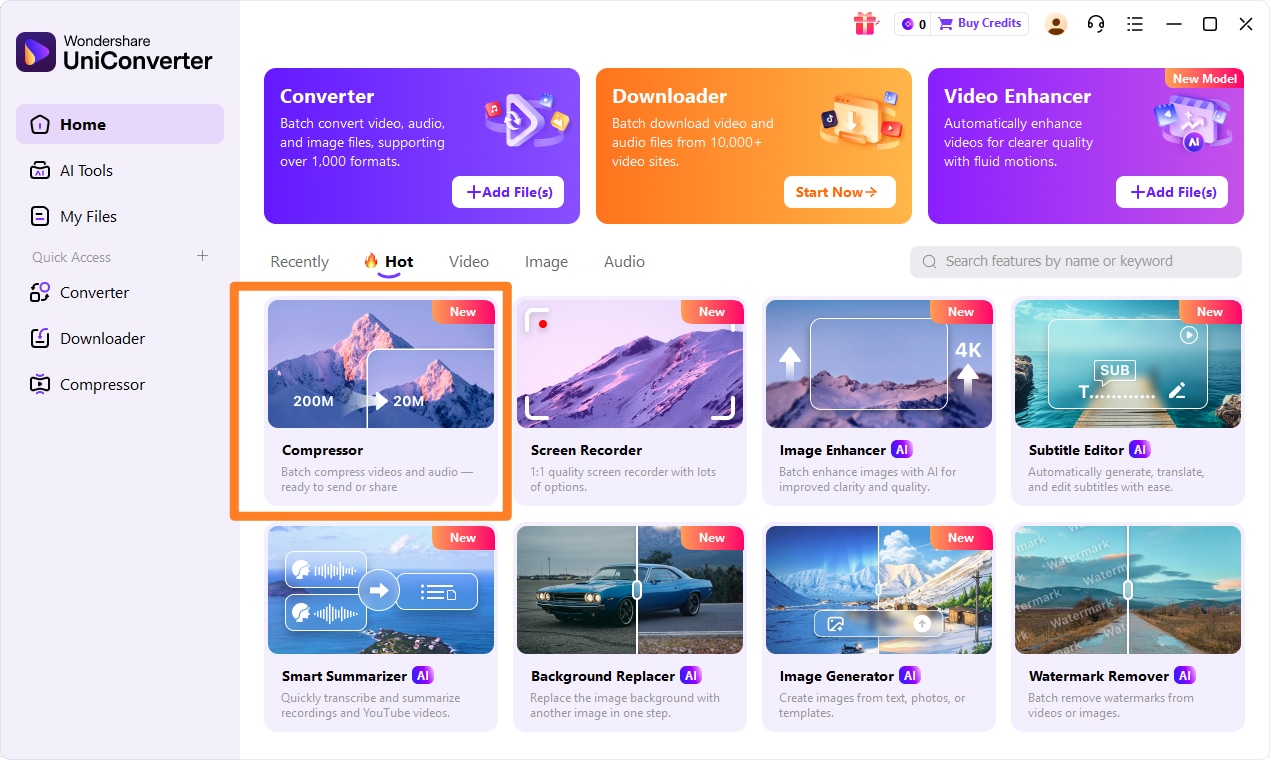
Step 1: Open UniConverter and Choose Compressor
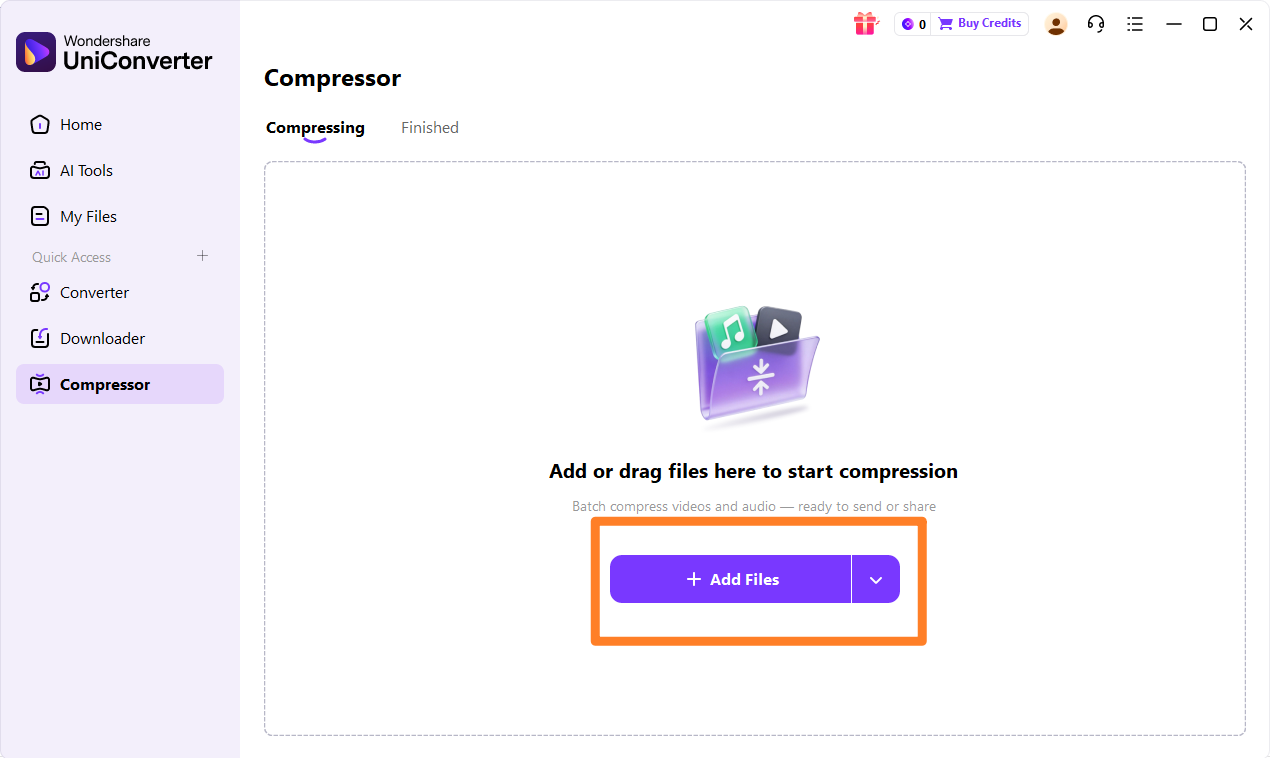
Step 2: Upload the Video, Audios or Images
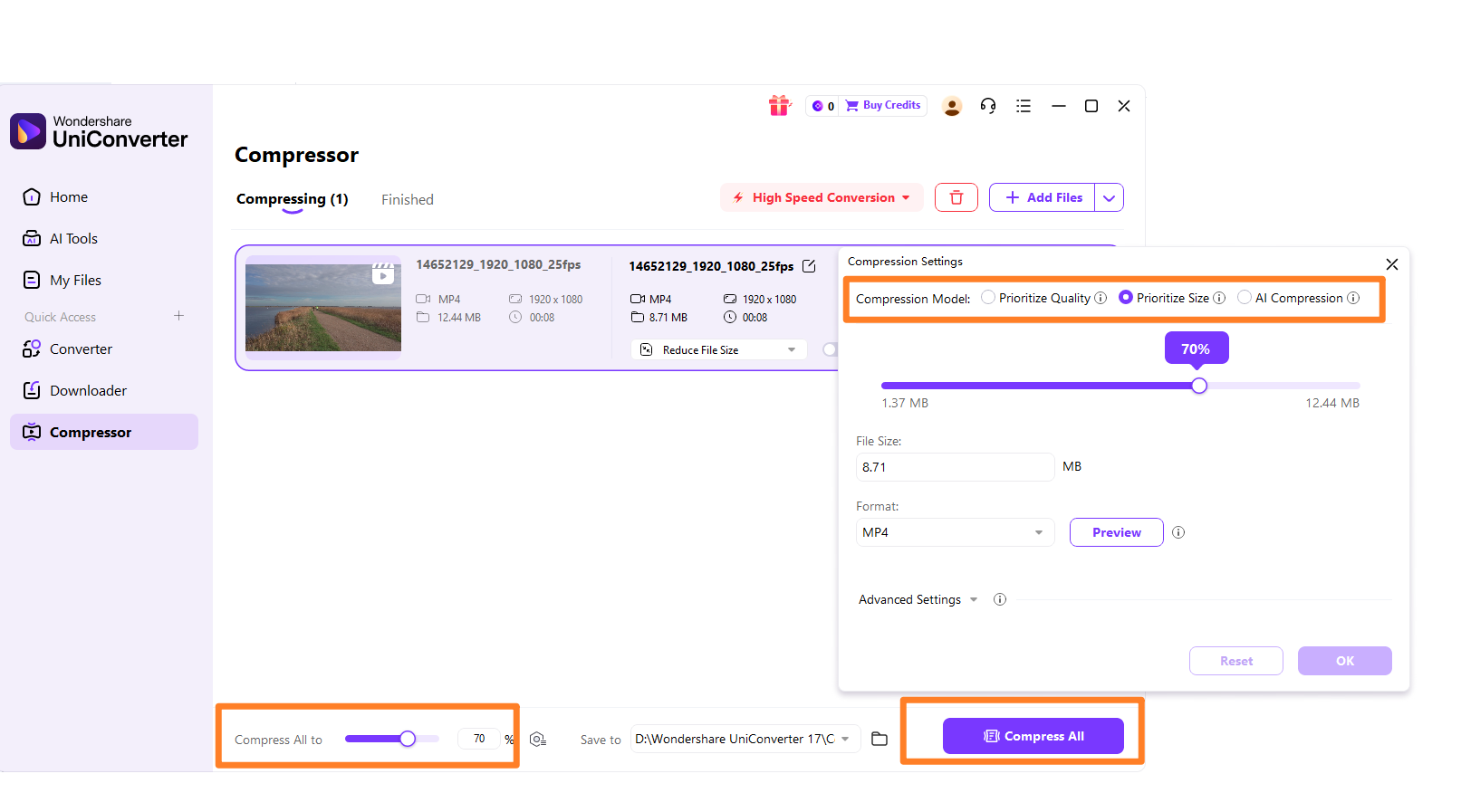
Step 3: Choose Required Parameters
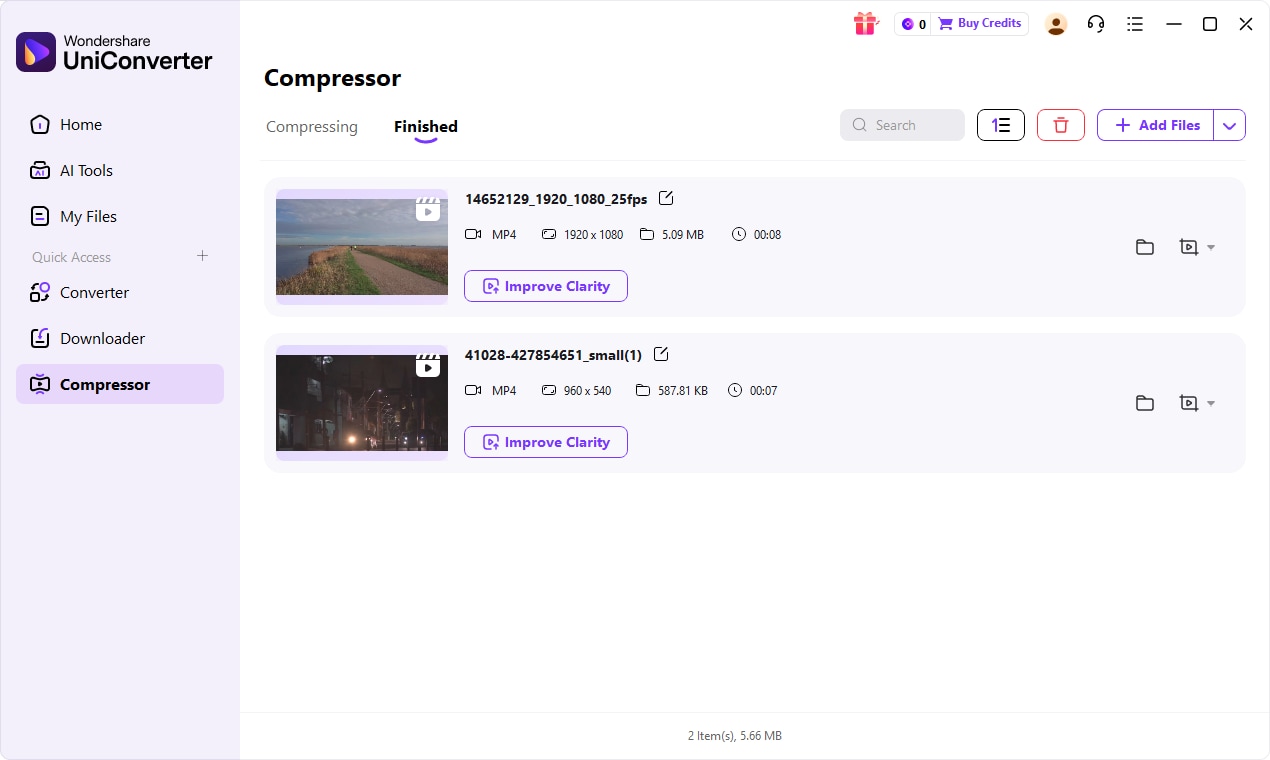
Step 4: Save the Compressed File

Optimize Images with a Powerful MozJPEG Alternative
Part 7: Conclusion
In conclusion, MozJPEG Image Compressor remains an unparalleled tool for web developers and publishers whose primary goal is to achieve the absolute smallest JPEG file sizes for web optimization. Its advanced perceptual algorithms deliver superior compression efficiency, making it a top choice for projects where every kilobyte counts. However, its command-line interface and exclusive focus on the JPEG format present significant limitations for users seeking a more versatile or user-friendly solution. For those without technical expertise or who require multi-format compression, the learning curve and need for supplementary tools can be prohibitive. While MozJPEG excels in its niche, users needing a comprehensive, GUI-based solution that handles various image formats, offers batch processing, and prioritizes ease of use and stability would be better served by alternatives like UniConverter. Ultimately, the best choice depends on your specific technical skills, the formats you work with, and your priority between raw compression power and overall workflow convenience.
Part 8: FAQs
-
1. What is MozJPEG and how does it differ from standard JPEG?
MozJPEG is an improved JPEG encoder that produces smaller files with better perceptual quality than traditional JPEG encoders, especially at lower quality settings. It uses advanced techniques like trellis quantization and perceptual optimization.
-
2. Is MozJPEG suitable for all types of images?
MozJPEG is specifically designed for photographic images. For graphics with sharp edges, text, or transparency, PNG or WebP might be more suitable. If you need to compress a variety of image types, UniConverter offers broad format support.
-
3. Can I use MozJPEG without command-line knowledge?
While MozJPEG itself is command-line based, many image optimization tools and plugins integrate MozJPEG, allowing you to benefit from it without direct command-line interaction. However, for direct use, command-line knowledge is essential.
-
4. Does MozJPEG reduce image quality significantly?
MozJPEG aims to reduce file size while preserving perceived image quality. At very high compression levels, some artifacts may become visible, but it generally outperforms standard JPEG in quality retention for a given file size. Careful testing of quality settings is recommended.
-
5. Are there any licensing restrictions for using MozJPEG?
MozJPEG is open-source and released under a BSD-style license, making it free to use for both personal and commercial projects. This open-source nature is a significant advantage for developers and businesses.
