
- Value: Movavi Video Compressor excels for quick, easy video compression for social media and casual users.
- Comparison: UniConverter offers superior advanced features, GPU acceleration, and stability for demanding tasks.
- Decision: Choose Movavi for simplicity; opt for UniConverter for professional control and comprehensive features.
- Pitfalls: Be aware of potential quality loss with aggressive compression and Movavi's limited advanced customization.
- Alternative: UniConverter provides an ad-free, robust solution with broad compatibility and near-lossless compression.
In this article
- Part 1: What is Movavi Video Compressor?
- Part 2: Movavi Video Compressor: Core Features, Pros & Cons
- Part 3: Movavi Video Compressor: User & Usage Scenarios
- Part 4: Movavi Video Compressor vs. Competitors: A Head-to-Head Comparison
- Part 5: Risks and Pitfalls to Consider
- Part 6: How to Use UniConverter to Compress High-Efficiency Audio and Video
- Part 7: Conclusion
- Part 8: FAQs
Movavi Video Compressor Review: Your Ultimate Guide to Efficient Video Compression
Welcome to my in-depth Movavi Video Compressor review. In today's digital age, video content is king, but large file sizes can be a real headache. Whether you're a casual user sharing clips with friends or a content creator uploading to YouTube, efficient video compression is essential. This review will delve into Movavi Video Compressor's features, weigh its pros and cons, compare it against competitors, and help you decide if it's the right tool for your needs. I'll also highlight potential pitfalls and offer a robust alternative for those seeking a more comprehensive solution.
Part 1: What is Movavi Video Compressor?
Movavi Video Compressor is a desktop application designed to reduce the file size of your video clips without significant loss of quality. In a world increasingly dominated by high-resolution video, from 4K smartphone recordings to professional camera footage, the need for effective compression has never been greater. I've personally struggled with slow upload times, limited storage space, and the frustration of incompatible file sizes when trying to share my work. This tool aims to address these common pain points, promising a straightforward solution for managing unwieldy video files. My goal with this review is to determine if Movavi Video Compressor truly delivers on its promise of efficient and user-friendly compression.
The Growing Need for Video Compression
* Storage Space Constraints: High-resolution videos quickly consume valuable disk space on devices and cloud storage.
* Faster Uploads and Downloads: Smaller file sizes mean quicker sharing on social media platforms and faster streaming for viewers.
* Compatibility Across Devices: Compressed videos are easier to play on various devices with differing specifications and network conditions.
* Website Performance: For web developers and content creators, optimized video files improve website loading speeds and user experience.
Part 2: Movavi Video Compressor: Core Features, Pros & Cons
Movavi Video Compressor positions itself as an accessible tool for video size reduction, focusing on ease of use and broad compatibility. Its core capabilities revolve around shrinking video files while attempting to maintain visual fidelity. I've found its primary strength lies in its ability to handle a wide array of video formats, making it a versatile choice for many users. The software also boasts a user-friendly interface that guides you through the compression process, even if you're new to video editing.
Pros:
* Intuitive User Interface for Quick Compression: I found the interface incredibly easy to navigate, allowing me to compress videos with just a few clicks.
* Wide Range of Supported Formats and Devices: It handles almost any video format I threw at it, from MP4 to AVI, and offers presets for various devices.
* Batch Processing for Multiple Files: Compressing several videos at once is a huge time-saver, and Movavi handles it efficiently.
Cons:
* Limited Advanced Customization Options: For more granular control over bitrate, resolution, or codecs, I often felt restricted by the available settings.
* Occasional Performance Issues with Very Large Files: While generally good, I noticed some slowdowns and occasional crashes when processing extremely large 4K video files.
Part 3: Movavi Video Compressor: User & Usage Scenarios
Movavi Video Compressor is primarily designed for individuals who need a quick and straightforward way to reduce video file sizes without delving into complex technical settings. It's perfect for casual users and small content creators who prioritize speed and simplicity over highly customized output. If you're constantly sharing videos on platforms like Instagram, TikTok, or WhatsApp, this tool can be a real time-saver.
Best Use Case: Quick Compression for Social Media Sharing
I frequently use Movavi Video Compressor when I need to quickly shrink a video from my phone or camera to upload to social media. The pre-configured profiles for platforms like YouTube or Instagram make it incredibly easy to get a file that's optimized for sharing without worrying about specific resolutions or bitrates. It’s a fantastic tool for getting content out fast.
Limited Scenario: Professional Video Editing Workflows
However, for my professional video editing projects, where precise control over every aspect of the video output is crucial, Movavi Video Compressor falls short. When I need to compress footage for a client project, I require advanced codec settings, specific bitrate controls, and often lossless compression options that Movavi simply doesn't offer. It's not built for the nuanced demands of a professional editing suite.
Part 4: Movavi Video Compressor vs. Competitors: A Head-to-Head Comparison
When I look at video compression tools, I'm always weighing ease of use against output quality and advanced features. Movavi Video Compressor is a strong contender in the user-friendly category, but it faces stiff competition from more feature-rich alternatives.
| Feature/Product | Movavi Video Compressor | UniConverter | HandBrake | FFmpeg |
| Ease of Use | Excellent | Excellent | Moderate | Difficult (CLI) |
| Compression Quality | Very Good | Excellent | Excellent | Excellent (highly customizable) |
| Batch Processing | Yes | Yes | Yes | Yes |
| Advanced Settings | Limited | Extensive | Extensive | Extensive |
| Price | Mid-range | Mid-range | Free | Free |
| Processing Speed | Good | Excellent (GPU acceleration) | Good | Good |
| Customer Support | Responsive | Excellent | Community | Community |
| Security | Good | Excellent | Good | Good |
Key Differentiators: Movavi's Strengths and Weaknesses Against Rivals
Movavi's strength lies in its unparalleled ease of use, making it ideal for beginners. While UniConverter offers similar ease of use, it significantly surpasses Movavi in terms of advanced features and processing speed, especially with its GPU acceleration. HandBrake and FFmpeg, though free and powerful, have steeper learning curves. HandBrake is great for quality but can be slow, and FFmpeg, being command-line based, is best for tech-savvy users. For me, Movavi is perfect for quick, everyday tasks, but when I need more control or faster processing for larger projects, UniConverter often becomes my go-to.
Part 5: Risks and Pitfalls to Consider
While Movavi Video Compressor offers a convenient solution for reducing video file sizes, it's important to be aware of certain risks and potential drawbacks that I've encountered or observed during my usage. No software is perfect, and understanding these limitations can help you make a more informed decision.
Potential Loss of Video Quality
One of the most significant risks with any compression software, including Movavi, is the potential for noticeable video quality degradation. While Movavi aims for minimal loss, aggressive compression settings can lead to pixelation, blurriness, or artifacting, especially in videos with complex scenes or fast motion. I've found that pushing the compression too far often results in a compromise I'm not willing to make for important videos.
Data Privacy Concerns
When using any software, especially those that process personal media, data privacy is a valid concern. While Movavi is a reputable company, it's always wise to review their privacy policy to understand how your data is handled. For desktop applications, the risk is generally lower than online tools, but it's still a consideration, especially if you're dealing with sensitive content.
In-App Advertisements and Upsells
Like many software products, Movavi often includes in-app advertisements or prompts for upgrades to their other products. While not a functional pitfall, these can be distracting and interrupt the workflow. I've sometimes found myself clicking through various offers before getting to the main task, which can be a minor annoyance.
Compatibility Issues with Specific Operating Systems
Although Movavi generally supports major operating systems, I've occasionally encountered minor compatibility glitches, especially after significant OS updates. While these are usually resolved with software updates, it's a potential pitfall to be aware of, particularly if you're running a less common or very new version of an OS.
Subscription Model vs. One-Time Purchase Value
Movavi offers both subscription and one-time purchase options. While the one-time purchase seems appealing, it often means you won't receive major version updates without an additional cost. The subscription model, on the other hand, ensures continuous updates but can be more expensive in the long run. It's a value proposition I always weigh carefully, considering my long-term usage needs.
Part 6: How to Use UniConverter to Compress High-Efficiency Audio and Video
Sometimes, when other tools struggle with batch compression, produce inconsistent results, or cause noticeable quality loss, I turn to UniConverter for a more reliable solution. It offers a smooth, ad-free experience and works well for both compressing video files and handling media more efficiently overall. What makes it especially useful is its wide format support, GPU acceleration for faster processing, and the ability to compress videos without quality loss as much as possible. It also supports audio compression, making it a practical all-in-one choice for media conversion and compression.
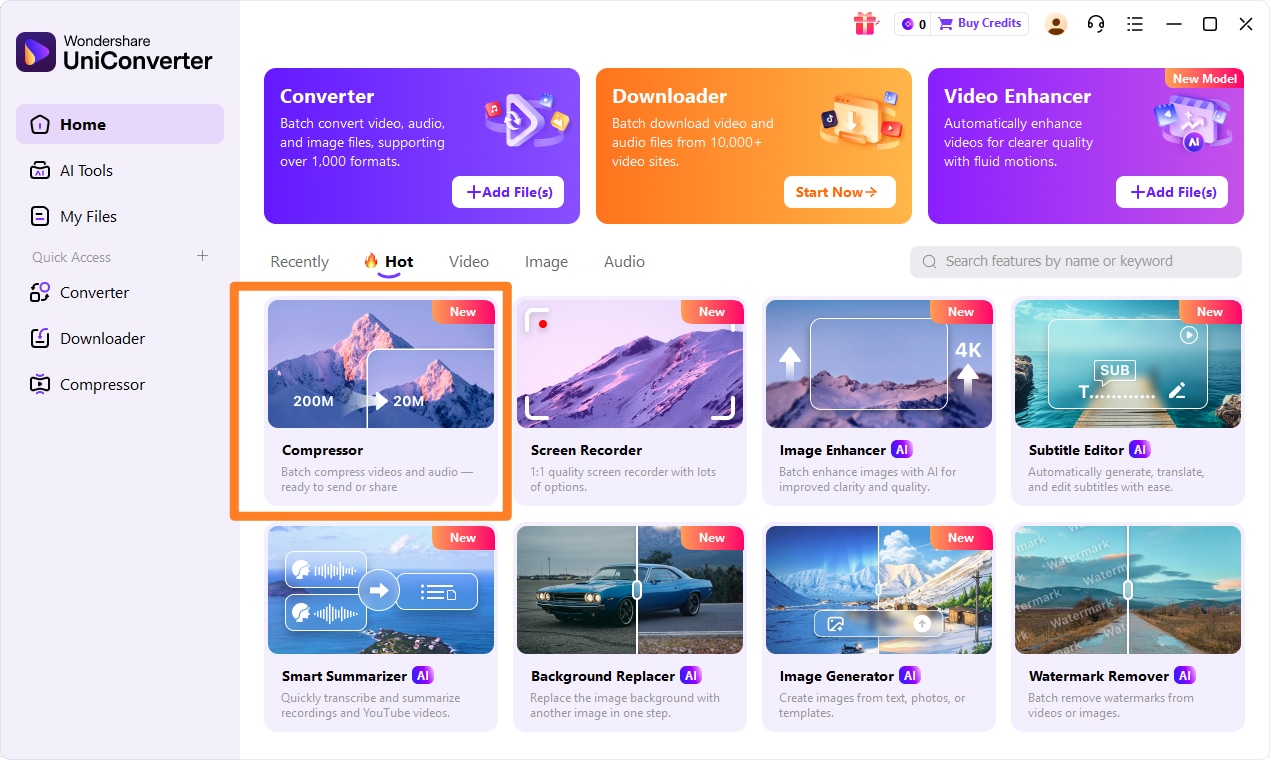
Step 1: Open UniConverter and Choose Compressor
Launch UniConverter on your computer. On the main interface, navigate to the "Compressor" tab.
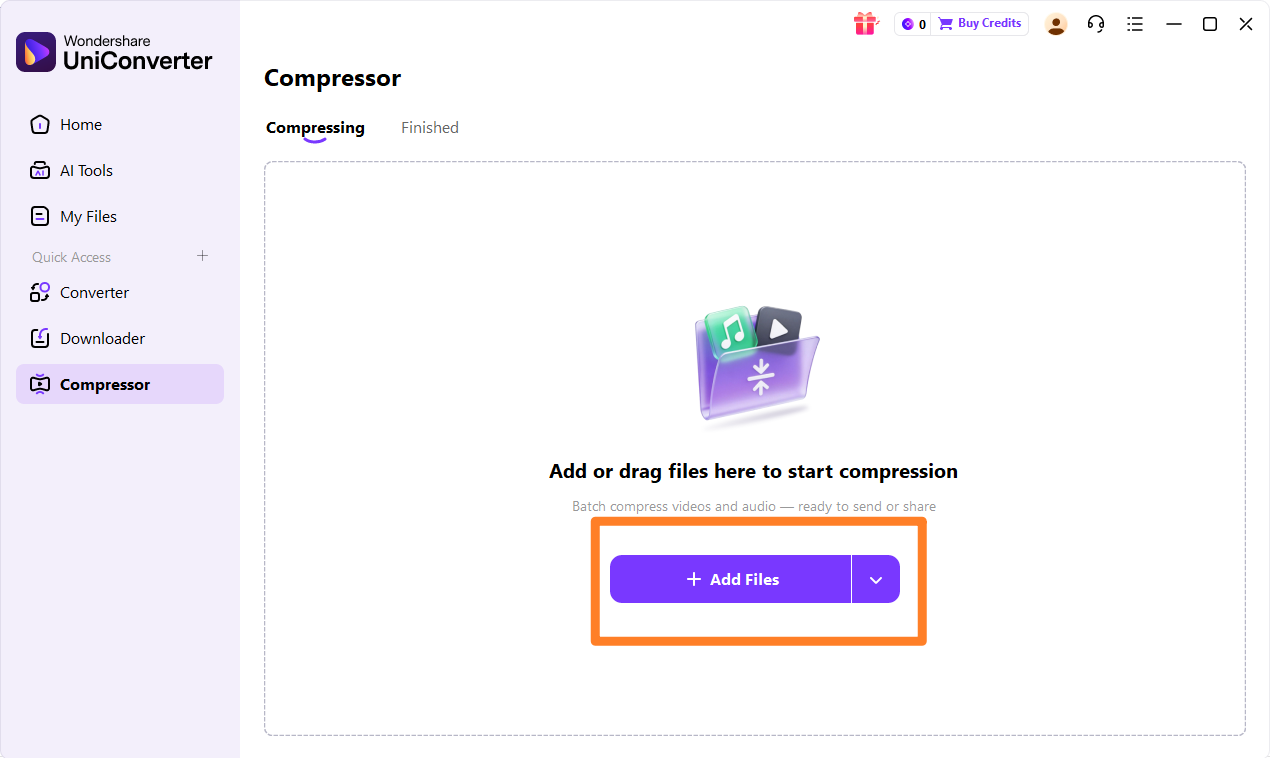
Step 2: Upload the Video, Audios or Images
Click on the "Add Files" button or simply drag and drop your video, audio, or image files into the UniConverter window.
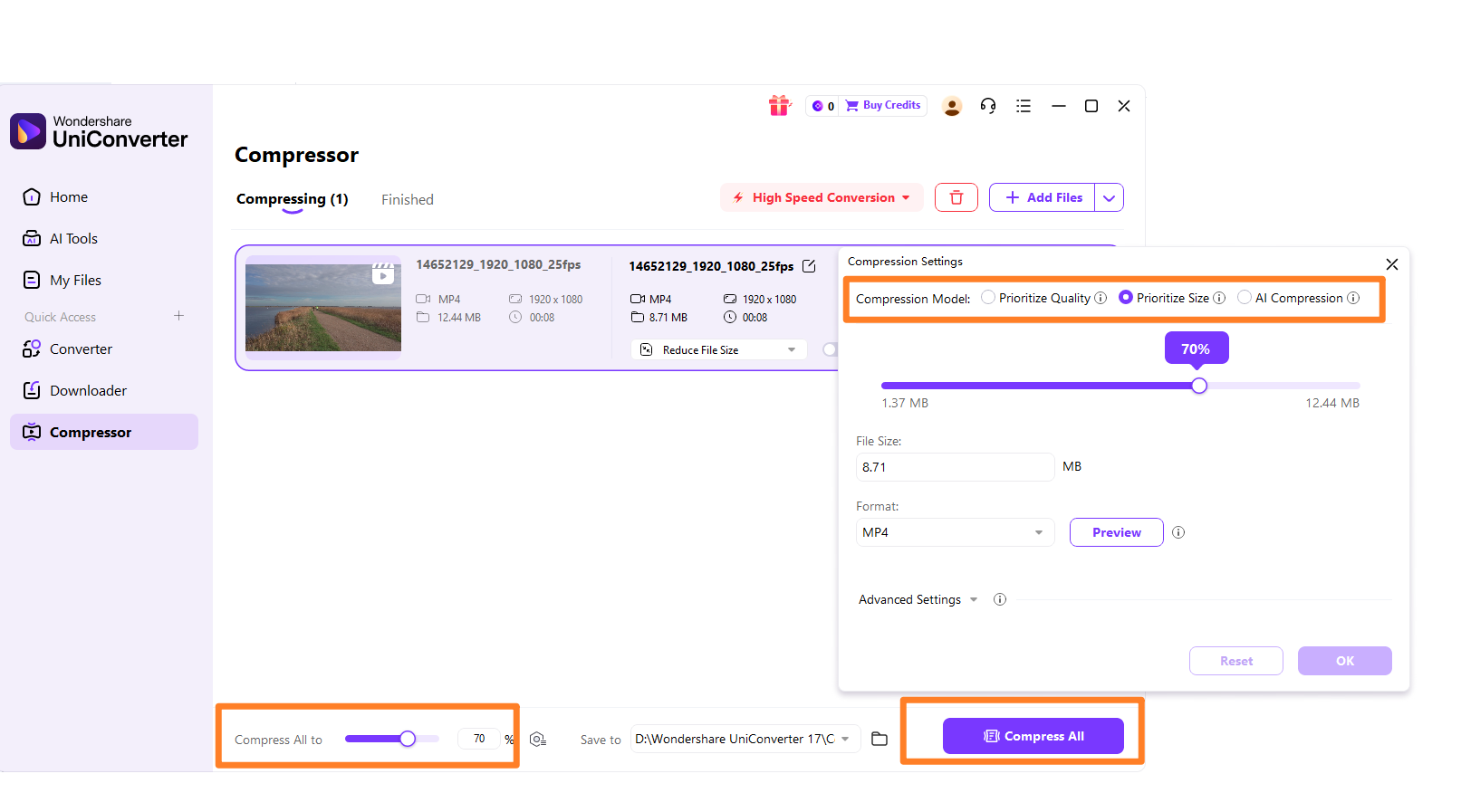
Step 3: Choose Required Parameters
Once your files are loaded, you can adjust the compression settings. UniConverter allows you to choose the output format, resolution, bitrate, and quality. You can also preview the compressed file size before processing.
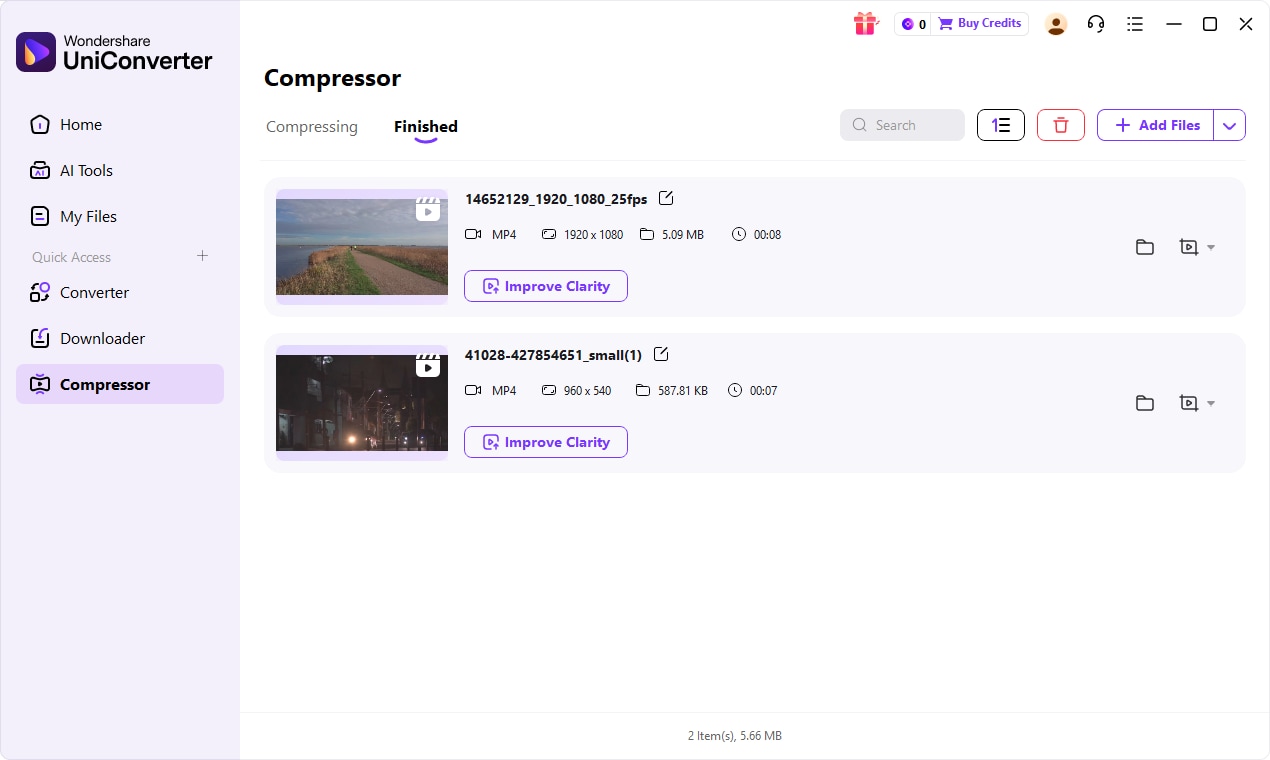
Step 4: Save the Compressed File
After setting your desired parameters, click the "Compress" button. UniConverter will process your files quickly. Once done, you can find your compressed files in the designated output folder.

Seeking a Movavi Video Compressor Alternative?
Part 7: Conclusion
After thoroughly exploring Movavi Video Compressor, I can confidently say it serves a specific niche very well. For casual users and beginners who need a straightforward, intuitive tool to quickly reduce video file sizes for sharing on social media or saving space, it's an excellent choice. Its ease of use and broad format support make it highly accessible. However, for content creators and small businesses requiring more advanced control over compression parameters, or for those dealing with extremely large files where performance and minimal quality loss are paramount, its limitations become apparent. While it offers good value for money in its mid-range price bracket, especially for a one-time purchase, the potential for quality degradation with aggressive settings and the lack of deep customization might push more demanding users towards alternatives. Ultimately, my Movavi Video Compressor review concludes that it's a solid tool for basic compression needs, but those seeking a comprehensive, high-performance solution with extensive features might find better value in a more robust option like UniConverter.
Part 8: FAQs
-
1. Does Movavi Video Compressor reduce video quality significantly?
Movavi Video Compressor aims to reduce file size with minimal quality loss. However, the extent of quality reduction depends on how aggressively you compress the video. If you choose very high compression ratios, you might notice some degradation, such as pixelation or blurriness. For optimal results, I recommend using moderate compression settings.
-
2. Is Movavi Video Compressor free to use?
Movavi Video Compressor is not entirely free. It typically offers a free trial period that allows you to test its features, but compressed videos often come with a watermark or have time limitations. To unlock full functionality and remove watermarks, you'll need to purchase a license or subscribe to their service.
-
3. Can Movavi Video Compressor compress 4K videos?
Yes, Movavi Video Compressor can compress 4K videos. It supports a wide range of resolutions, including 4K. However, compressing very large 4K files can be resource-intensive and might take longer, and you might experience some performance issues or a greater risk of noticeable quality loss if not handled carefully.
-
4. How does Movavi Video Compressor compare to online video compressors?
Movavi Video Compressor, being a desktop application, generally offers more stability, faster processing speeds (especially for large files), and better control over settings compared to most online video compressors. Online tools are convenient for small, occasional compressions but often have file size limits, slower upload/download times, and fewer customization options. For consistent or large-scale compression, a desktop solution like Movavi or UniConverter is usually superior.
-
5. What are the system requirements for Movavi Video Compressor?
Movavi Video Compressor typically requires a modern operating system (Windows 7/8/10/11 or macOS 10.13 or later), a decent processor (Intel, AMD, or compatible), at least 2 GB of RAM, and sufficient free hard disk space for installation and temporary files. For 4K video processing, I'd recommend a more powerful CPU and at least 8 GB of RAM for smoother performance.
