
- Value: Kapwing Audio Compressor offers quick, web-based audio compression for social media and casual content creators.
- Comparison: It excels in convenience but lacks advanced controls found in desktop alternatives like Audacity or UniConverter.
- Decision: Ideal for simple, fast tasks; not suitable for professional audio mastering or large-scale productions.
- Consideration: Online tools pose data privacy risks and depend on internet connectivity, unlike robust desktop software.
- Recommendation: For consistent, high-quality compression and advanced features, UniConverter is a superior, comprehensive alternative.
In this article
- Part 1: What is Kapwing Audio Compressor?
- Part 2: Kapwing Audio Compressor: Core Features, Pros, and Cons
- Part 3: Kapwing Audio Compressor: Ideal Use Cases and Limitations
- Part 4: Kapwing Audio Compressor vs. Competitors
- Part 5: Risks and Pitfalls to Consider
- Part 6: How to Use UniConverter for Efficient Audio and Video Compression
- Part 7: Final Verdict and Recommendations
- Part 8: FAQs
Kapwing Audio Compressor: A Comprehensive Review and Comparison
Welcome to my in-depth Kapwing Audio Compressor review! As a seasoned product reviewer specializing in industry analysis, I've seen countless tools emerge in the content creation space. Kapwing, a popular online video editing platform, has extended its capabilities to audio compression, aiming to simplify the lives of creators. This review will delve into its core features, weigh its pros and cons, and benchmark it against leading competitors. My goal is to provide you with a clear, scenario-based understanding of where Kapwing's audio compressor shines and where it might fall short, helping you make an informed decision for your audio compression needs.
Part 1: What is Kapwing Audio Compressor?
Kapwing Audio Compressor is a web-based tool designed to reduce the file size of audio tracks, making them easier to share, upload, and integrate into various projects. It's part of the broader Kapwing suite, known for its user-friendly online video editing capabilities. In today's fast-paced digital landscape, efficient audio compression is no longer a luxury but a necessity for content creators.
The core problem this tool addresses revolves around several key pain points for creators:
* Large File Sizes: Uncompressed audio can be massive, leading to slow uploads, high storage costs, and cumbersome sharing.
* Inconsistent Playback: Different platforms and devices have varying bandwidths and processing powers, requiring optimized audio for a consistent listening experience.
* Workflow Bottlenecks: Manual audio compression can be time-consuming, especially for creators juggling multiple tasks.
* Accessibility: Many professional audio tools are expensive and have steep learning curves, leaving casual creators in need of simpler solutions.
This review aims to determine if Kapwing Audio Compressor effectively alleviates these issues for its target audience.
Part 2: Kapwing Audio Compressor: Core Features, Pros, and Cons
Kapwing Audio Compressor offers a straightforward approach to reducing audio file sizes. Its primary function is to take an audio file and compress it, typically by adjusting its bit rate or sampling rate, to achieve a smaller footprint without significant perceived quality loss. It supports common audio formats like MP3, WAV, and AAC, making it versatile for most everyday needs. The interface is designed for quick, drag-and-drop operations, allowing me to compress files with just a few clicks.
Here are some of its core capabilities:
* File Size Reduction: Efficiently shrinks audio files for easier sharing and uploading.
* Format Support: Handles popular formats such as MP3, WAV, and AAC.
* Bitrate Adjustment: Allows for some control over the output quality and file size.
* Batch Processing (Limited): While not explicitly a batch compressor, I can process multiple files sequentially.
* Direct Integration: Works seamlessly within the Kapwing ecosystem for video projects.
Pros
* Intuitive Web-Based Interface for Quick Edits: I found it incredibly easy to navigate and use, even for someone new to audio compression.
* Seamless Integration with Kapwing's Video Editing Suite: If you're already using Kapwing for video, this tool fits right into your workflow.
* Free Tier Accessibility for Basic Compression Needs: It's a great starting point for casual users without any upfront cost.
Cons
* Limited Advanced Audio Control for Professional Users: I often yearned for more granular control over parameters like sample rate, channels, and specific codecs.
* Potential for Slower Processing on Large Files or Complex Projects: For really big audio files, I noticed it could take a while, depending on my internet connection.
Part 3: Kapwing Audio Compressor: Ideal Use Cases and Limitations
Kapwing Audio Compressor is perfectly suited for creators who need quick, no-fuss audio compression without delving into complex settings. It's a fantastic tool for individuals who are primarily focused on visual content but occasionally need to optimize their audio components.
Best Use Case: Quick Social Media Content Preparation
If you're a social media manager, a budding TikTok creator, or a casual YouTuber, Kapwing Audio Compressor is your go-to. I often use it to quickly compress background music or voiceovers for short video clips before uploading them to platforms like Instagram, Facebook, or YouTube Shorts. The web-based nature means I can do it from any computer, and the simplicity ensures I'm not bogged down by technicalities. It's about getting the job done fast and efficiently for content that doesn't demand pristine audio fidelity.
Limited Use Case: Professional Audio Mastering and Large-Scale Podcast Production
However, for professional audio engineers, established podcasters, or musicians working on critical projects, Kapwing Audio Compressor falls short. I wouldn't recommend it for mastering an album, producing a high-quality podcast with intricate sound design, or any scenario where precise control over dynamic range, equalization, and specific audio codecs is paramount. Its lack of advanced features means you can't achieve the nuanced results required for broadcast-quality audio or large-scale productions where every decibel matters. For these tasks, dedicated desktop software is indispensable.
Part 4: Kapwing Audio Compressor vs. Competitors
When evaluating Kapwing Audio Compressor, it's crucial to see how it stacks up against other tools in the market. I've compared it with some popular alternatives to highlight their strengths and weaknesses.
| Feature/Tool | Kapwing Audio Compressor | Audacity | Adobe Audition | Online Audio Converter |
| Platform | Web-based | Desktop | Desktop | Web-based |
| Ease of Use | High | Medium | Low | High |
| Advanced Features | Low | Medium | High | Low |
| Integration | Kapwing Ecosystem | Standalone | Adobe Creative Cloud | Standalone |
| Pricing | Free/Subscription | Free | Subscription | Free/Premium |
| Processing Speed | Moderate (web-dependent) | Fast (local processing) | Very Fast (local processing) | Moderate (web-dependent) |
| Output Quality Control | Basic (bitrate) | Good (bitrate, format, sample rate) | Excellent (all parameters) | Basic (bitrate) |
| Security | Cloud-based (potential privacy concerns) | Local (high security) | Local (high security) | Cloud-based (potential privacy concerns) |
Key Differentiators: Web-based Convenience vs. Desktop Power
Kapwing Audio Compressor and Online Audio Converter excel in web-based convenience, allowing me to compress files from any device with an internet connection. This is fantastic for quick tasks. However, Audacity and Adobe Audition, being desktop applications, offer significantly more power, faster processing (especially for large files, as they leverage local hardware), and a wealth of advanced features for precise audio manipulation. While Kapwing is easy, Audacity provides a free, more feature-rich desktop alternative, and Adobe Audition is the professional standard for those needing comprehensive audio editing and mastering capabilities.
Part 5: Risks and Pitfalls to Consider
While online tools like Kapwing Audio Compressor offer undeniable convenience, it's essential to be aware of the potential risks and pitfalls, especially when dealing with sensitive or critical audio projects. I've learned to approach these tools with a cautious eye.
Data Privacy Concerns with Online Tools
When I upload my audio files to a web-based compressor, I'm essentially entrusting my data to a third-party server. This raises questions about data privacy and security. While Kapwing states it protects user data, the risk of data breaches or unauthorized access, however small, is always present. For highly confidential or proprietary audio, I'd be very hesitant to use an online tool. It's crucial to read their privacy policy carefully and understand how your data is handled and stored.
Impact of Compression on Audio Quality for Critical Projects
Audio compression, by its very nature, involves discarding some data to reduce file size. While Kapwing aims to minimize quality loss, for critical projects like professional voiceovers, music production, or high-fidelity podcasts, even subtle degradation can be noticeable. I've found that the "lossless" claims of some tools can be misleading; true lossless compression doesn't reduce file size significantly. Always listen to the compressed output critically, comparing it to the original, especially if audio quality is paramount.
Dependence on Internet Connectivity
As a web-based tool, Kapwing Audio Compressor is entirely dependent on a stable internet connection. If my internet is slow or drops out, my compression task can be interrupted or take an unacceptably long time. This can be a significant bottleneck for creators working in areas with unreliable internet or those who need to process files on the go without Wi-Fi access. Desktop alternatives offer the advantage of offline functionality, ensuring uninterrupted workflow.
Potential for Feature Limitations in Free Tiers
While the free tier of Kapwing Audio Compressor is a great entry point, it often comes with limitations. I've encountered restrictions on file size, processing speed, the number of files I can process, or even the output quality. These limitations can quickly become frustrating if my needs grow beyond basic compression. To unlock more advanced features or higher processing limits, I'd typically need to subscribe to a paid plan, which adds to the overall cost of my content creation toolkit.
Part 6: How to Use UniConverter for Efficient Audio and Video Compression
Sometimes, online tools or basic desktop options just don't cut it. If you're facing issues like inconsistent compression results, significant quality loss, or the inability to handle batch processing efficiently, I recommend considering UniConverter. It provides a more dependable solution for both audio compression and video compression, while also supporting image compression when needed. With broad format support and a more practical workflow for repeated tasks, it stands out as a reliable media compression solution.
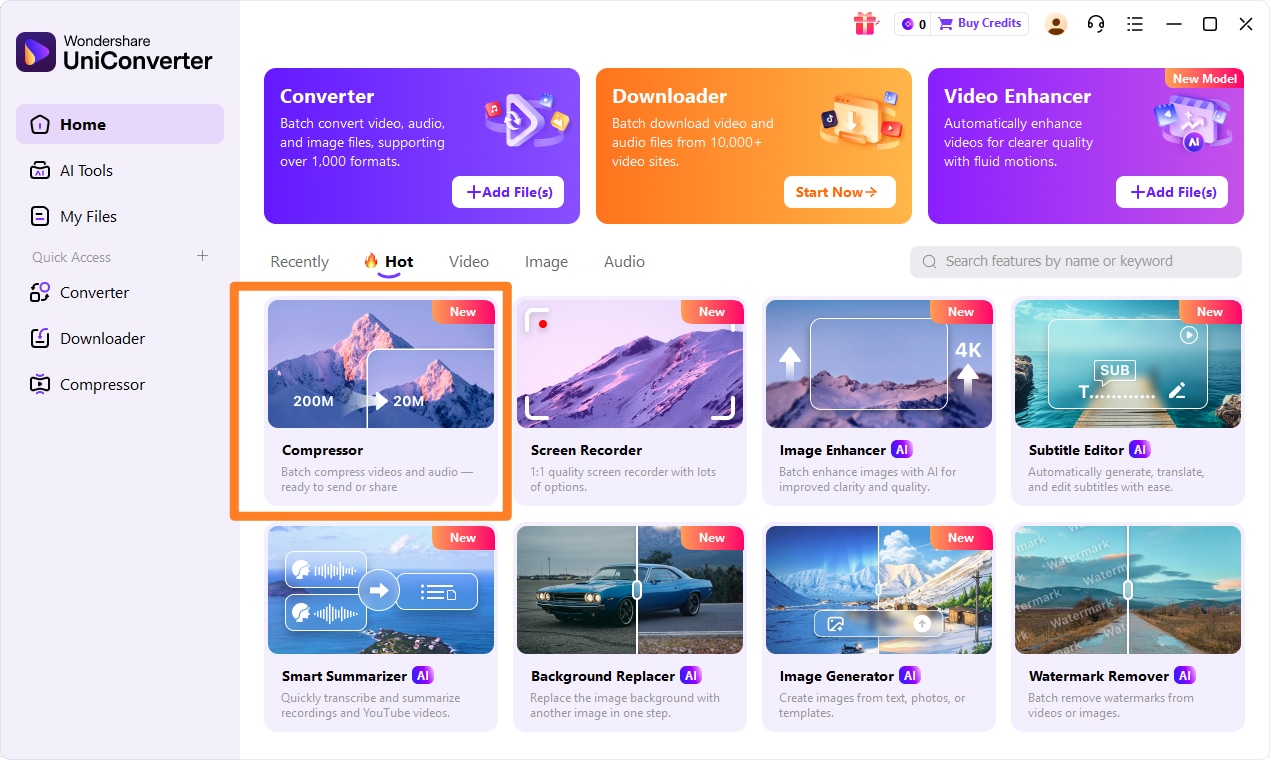
Step 1: Open UniConverter and Choose Compressor
First, launch UniConverter on your computer. On the left sidebar, you'll find various tools. Select the "Compressor" option to begin your audio or video compression task.
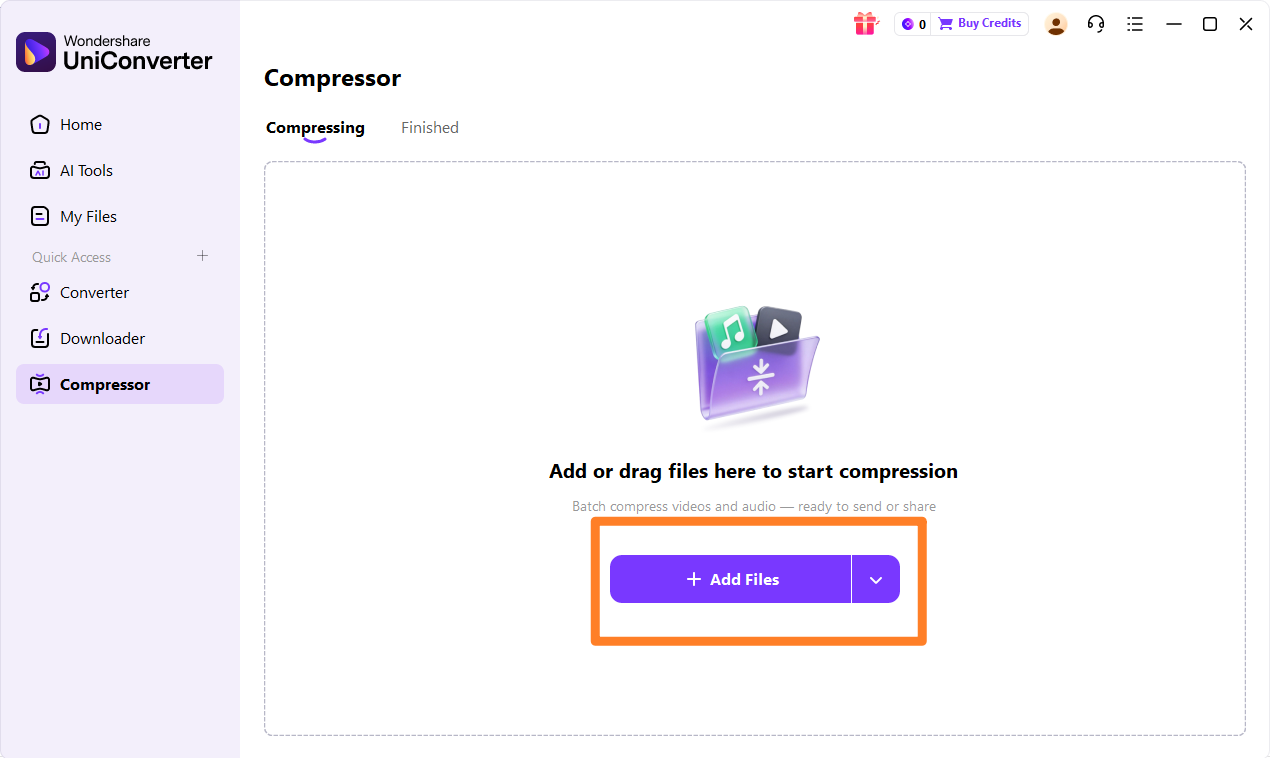
Step 2: Upload the Video, Audios or Images
Next, drag and drop your audio files (or video/image files) directly into the UniConverter interface. You can also click the "Add Files" button to browse and select your media from your computer.
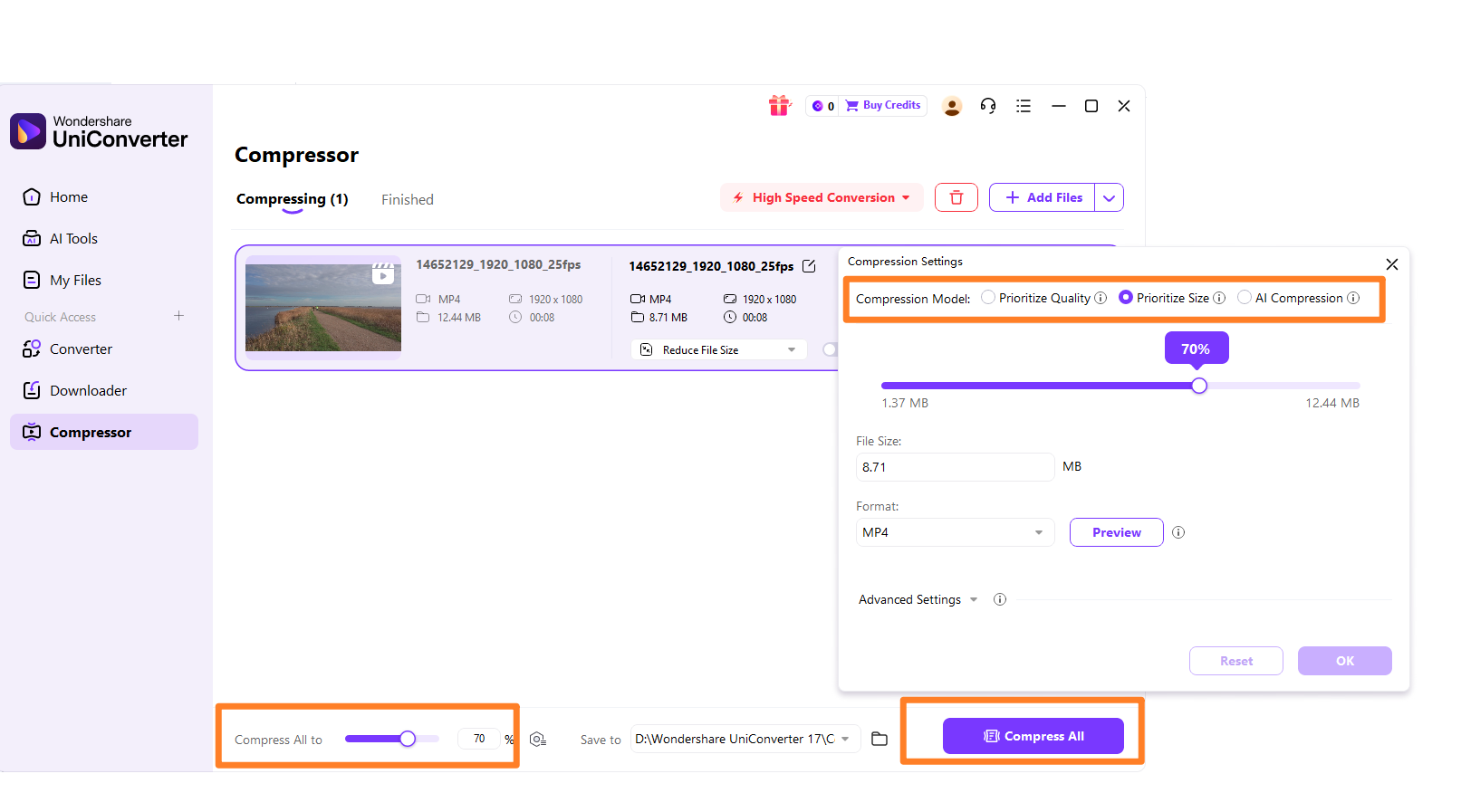
Step 3: Choose Required Parameters
Once your files are loaded, you can customize the compression settings. UniConverter allows you to adjust parameters like file size, format, resolution (for video), and bitrate to achieve your desired output quality and file size.
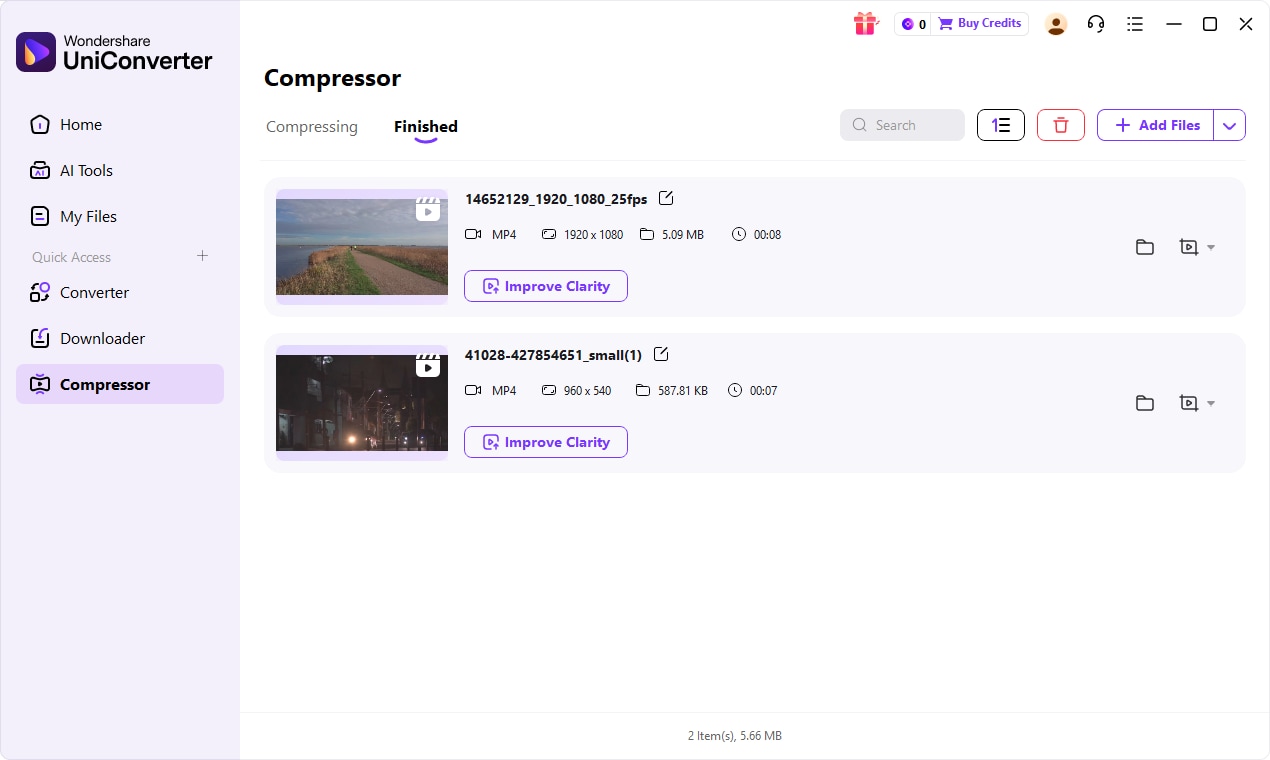
Step 4: Save the Compressed File
After setting your preferred parameters, click the "Compress" button. UniConverter will process your files quickly, often leveraging GPU acceleration. Once done, you can find your compressed files in the designated output folder.

Seeking a Kapwing Audio Compressor Alternative?
Part 7: Final Verdict and Recommendations
My Kapwing Audio Compressor review concludes that it's a highly accessible and convenient tool, particularly for specific user groups. Its web-based nature and integration with the Kapwing ecosystem make it incredibly easy to use for quick tasks. However, its limitations in advanced features and potential for slower processing on larger files mean it's not a one-size-fits-all solution.
For casual creators and social media enthusiasts who need to quickly optimize audio for short online content, Kapwing Audio Compressor is an excellent, free-to-start option. Its simplicity is its greatest strength, allowing you to focus on content creation rather than technical details.
For aspiring podcasters and YouTubers who are just starting out, Kapwing can serve as a decent entry-level tool for basic audio compression. However, as your projects grow in complexity and demand higher audio fidelity, you'll likely need to transition to more robust desktop software like Audacity or even UniConverter for better control and quality.
For professional audio engineers and producers, Kapwing Audio Compressor is simply not adequate. The lack of granular control over audio parameters, advanced editing capabilities, and offline functionality makes it unsuitable for critical audio work. Professionals should stick to industry-standard desktop applications such as Adobe Audition for their comprehensive feature sets and precision.
Part 8: FAQs
-
1. What is audio compression and why is it important?
Audio compression reduces the dynamic range of an audio signal, making it sound more consistent in volume. It's crucial for optimizing file size, ensuring consistent playback across devices, and improving overall listening experience.
-
2. Can Kapwing Audio Compressor handle large audio files?
While Kapwing can process large files, performance may vary depending on your internet speed and the complexity of the project. For very large files or batch processing, desktop alternatives like UniConverter might be more efficient and reliable.
-
3. Does Kapwing Audio Compressor degrade audio quality?
All compression involves some degree of data reduction. Kapwing aims to minimize quality loss, but for critical applications, it's always recommended to listen to the compressed output and compare it with the original. For truly critical projects, consider tools with more advanced quality control.
-
4. Are there any hidden costs with Kapwing Audio Compressor?
Kapwing offers a free tier with basic features. Advanced features, higher quality exports, increased storage, and removal of watermarks typically require a paid subscription. Always check their pricing page for the most current details.
-
5. What are the main advantages of using a desktop audio compressor like UniConverter over an online tool?
Desktop compressors generally offer more advanced controls, faster processing for large files (leveraging your computer's hardware), offline functionality, and often better privacy protection as your files don't need to be uploaded to a server. UniConverter, for instance, provides a comprehensive suite of features for diverse compression needs without relying on internet connectivity for processing.
